DRAG DROP
-
Your on-premises network uses an IP address space of 10.0.0.0/20.
You have an Azure subscription that contains the resources shown in the following table.
The on-premises network is connected to HubVnet by using a Site-to-Site (S2S) VPN.
You deploy an Azure firewall named AZFW1 to HubVNet.
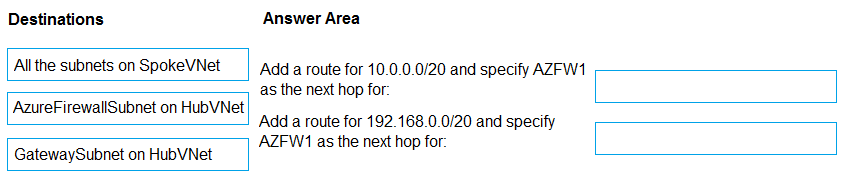
You need to ensure that AZFW/1 can inspect all the traffic between the on-premises network and SpokeVNet.
What should you do in RT1? To answer, drag the appropriate destination to the correct route. Each resource may be used once, more than once, or not at all. You may need to drag the split bar between panes or scroll to view content.
NOTE: Each correct selection is worth one point.
Show Answer
Correct Answer: 10.0.0.0/20 → GatewaySubnet on HubVNet
192.168.0.0/20 → All the subnets on SpokeVNet
Explanation: To force inspection in both directions, apply the route table to the VPN GatewaySubnet for on-premises prefixes so inbound VPN traffic is sent to Azure Firewall, and apply it to the Spoke subnets for the spoke prefix so return traffic also traverses the firewall.
Question 45
Note: This question is part of a series of questions that present the same scenario. Each question in the series contains a unique solution that might meet the stated goals. Some question sets might have more than one correct solution, while others might not have a correct solution.
After you answer a question in this section, you will NOT be able to return to it. As a result, these questions will not appear in the review screen.
You have an Azure application gateway that has Azure Web Application Firewall (WAF) enabled.
You configure the application gateway to direct traffic to the URL of the application gateway.
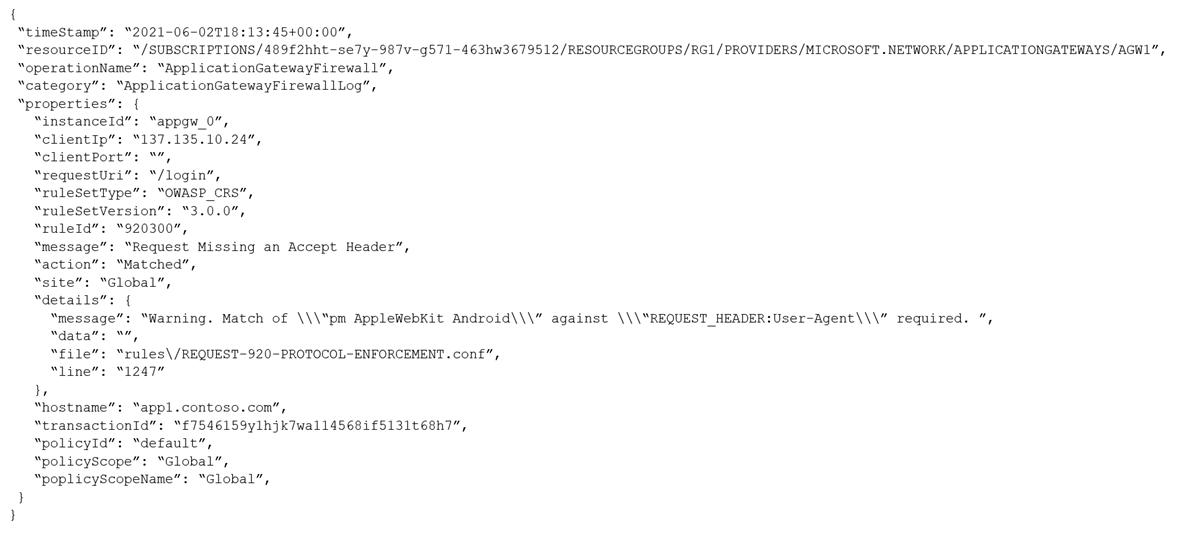
You attempt to access the URL and receive an HTTP 403 error. You view the diagnostics log and discover the following error.
You need to ensure that the URL is accessible through the application gateway from any IP address.
Solution: You add a rewrite rule for the host header.
Does this meet the goal?
A. Yes
B. No
Show Answer
Correct Answer: B
Explanation: No. The log shows WAF rule 920300 blocking the request because the Accept header is missing. Rewriting the host header does not resolve that; the request must include the required header or the WAF rule must be tuned.
Question 45
HOTSPOT -
You have an Azure subscription that contains a virtual network. The virtual network contains two subnets named Subnet1 and Subnet2. You have an instance of Azure Application Gateway v2 named AppGw1 that is connected to Subnet1.
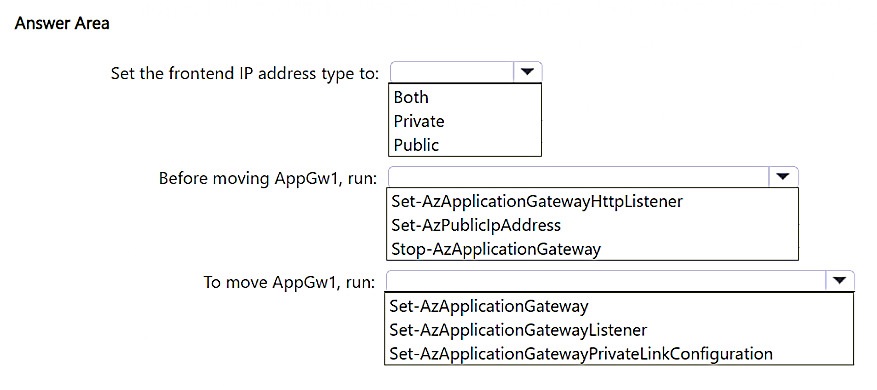
You need to move AppGw1 to Subnet2. The solution must minimize downtime.
What should you do? To answer, select the appropriate options in the answer area.
NOTE: Each correct selection is worth one point.
Show Answer
Correct Answer: Set the frontend IP address type to: Both
Before moving AppGw1, run: Stop-AzApplicationGateway
To move AppGw1, run: Set-AzApplicationGateway
Explanation: To change the subnet of an existing Application Gateway within the same virtual network, stop the gateway, update its IP configuration/subnet with Set-AzApplicationGateway, and start it again. Using both public and private frontends helps minimize downtime if both are required.
Question 46
DRAG DROP
-
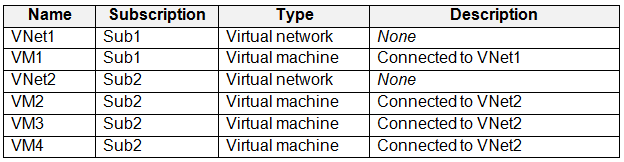
You have two Azure subscriptions named Sub1 and Sub2 that contain the resources shown in the following table.
VNet1 and VNet2 are NOT connected.
You plan to create an Azure Private Link service named Link1 that will be used to connect VNet1 and VNet2.
You need to ensure that Link1 meets the following requirements:
• Ensures that VM1 can connect only to a web app hosted on VM2
• Prevents VM1 from connecting to the other resources that are connected to VNet2
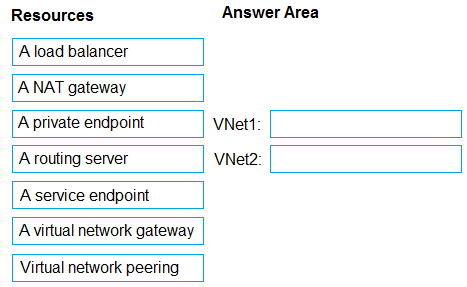
Which additional resources should you create for each virtual network? To answer, drag the appropriate resources to the correct virtual networks. Each resource may be used once, more than once, or not at all. You may need to drag the split bar between panes or scroll to view content.
NOTE: Each correct selection is worth one point.
Show Answer
Correct Answer: VNet1: A private endpoint
VNet2: A load balancer
Explanation: An Azure Private Link service is published behind a Standard Load Balancer in the provider virtual network. Consumers access it through a private endpoint in their own virtual network, which provides access only to the exposed service rather than the entire remote virtual network.
Question 46
Note: This question is part of a series of questions that present the same scenario. Each question in the series contains a unique solution that might meet the stated goals. Some question sets might have more than one correct solution, while others might not have a correct solution.
After you answer a question in this section, you will NOT be able to return to it. As a result, these questions will not appear in the review screen.
You have an Azure application gateway that has Azure Web Application Firewall (WAF) enabled.
You configure the application gateway to direct traffic to the URL of the application gateway.
You attempt to access the URL and receive an HTTP 403 error. You view the diagnostics log and discover the following error.
You need to ensure that the URL is accessible through the application gateway from any IP address.
Solution: You create a WAF policy exclusion for request headers that contain 137.135.10.24.
Does this meet the goal?
A. Yes
B. No
Show Answer
Correct Answer: B
Explanation: No. The log identifies the client IP as 137.135.10.24 and shows the request was blocked by a WAF rule for a missing Accept header. An exclusion for request headers containing that IP would not fix the missing-header rule, and it would not make the URL accessible from any IP address.
Question 47
HOTSPOT -
You have an Azure subscription that contains an Azure application gateway named AG1 and two Azure App Service apps named App1 and App2 that have the following configurations:
• Both apps are accessible by using HTTP and HTTPS.
• HTTP host headers are used to route requests to the appropriate apps.
• Both apps are hosted in a single App Service Environment in the West Europe Azure region.
You need to publish the apps by using AG1. The solution must ensure that AG1 provides both HTTP and HTTPS access.
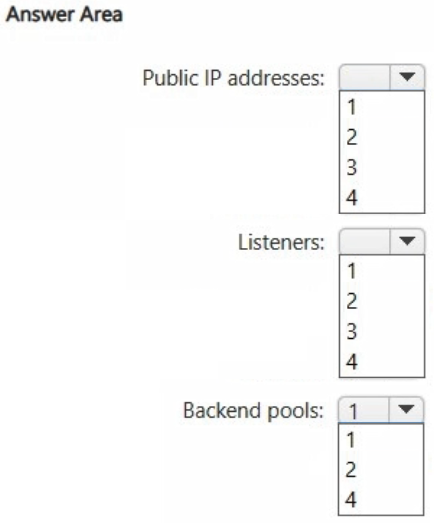
What is the minimum number of resources required for AG1? To answer, select the appropriate options in the answer area.
NOTE: Each correct selection is worth one point.
Show Answer
Correct Answer: Public IP addresses: 1
Listeners: 2
Backend pools: 2
Explanation: A single Application Gateway public IP can serve both apps. One HTTP and one HTTPS listener are sufficient when using host-name based routing. Each App Service app requires its own backend pool so routing sends traffic to the correct app.
Question 47
Your company has offices in London, Tokyo, and New York.
The company has a web app named App1 that has the Azure Traffic Manager profile shown in the following table.
In Asia, you plan to deploy an additional endpoint that will host an updated version of App1.
You need to route 10 percent of the traffic from the Tokyo office to the new endpoint during testing.
What should you configure in Traffic Manager?
A. two profiles and five endpoints
B. two profiles and four endpoints
C. three profiles and four endpoints
D. one profile and five endpoints
Show Answer
Correct Answer: A
Explanation: Use two nested Traffic Manager profiles: keep Geographic routing in the parent profile and make its Asia endpoint a nested endpoint to a child profile. Configure the child profile with Weighted routing between the existing and new Asia endpoints, assigning 90% and 10% of traffic respectively. Counting the parent’s three endpoints (including the nested endpoint) and the child’s two endpoints gives five endpoints total.
Question 48
HOTSPOT
-
You have an Azure subscription that contains six Azure App Service apps. The apps have an identical configuration and are deployed across multiple Azure regions.
You plan to deploy Azure Front Door to load balance traffic across the apps.
You need to ensure that the round robin load-balancing algorithm will send traffic only to a limited number App Service apps based on their proximity to a user. The solution must minimize administrative effort.
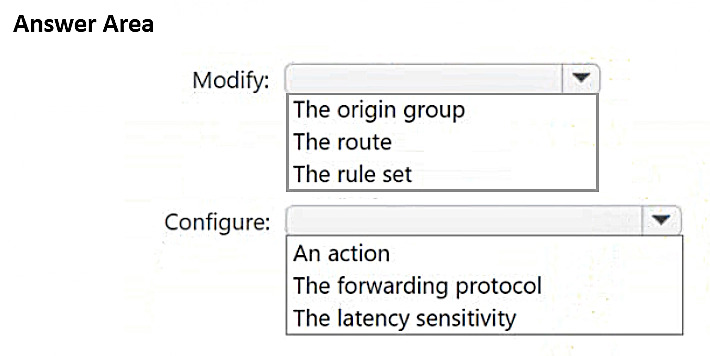
What should you modify, and what should you configure? To answer, select the appropriate options in the answer area.
NOTE: Each correct selection is worth one point.
Show Answer
Correct Answer: Modify: The origin group
Configure: The latency sensitivity
Explanation: Azure Front Door controls backend selection and load balancing in the origin group. The latency sensitivity setting limits eligible origins to those within a latency threshold of the closest origin, so round robin occurs only among nearby App Service apps, minimizing administration.
Question 48
You have the Azure resources shown in the following table.
You configure storage1 to provide access to the subnet in Vnet1 by using a service endpoint.
You need to ensure that you can use the service endpoint to connect to the read-only endpoint of storage1 in the paired Azure region.
What should you do first?
A. Fail over storage1 to the paired Azure region.
B. Configure the firewall settings for storage1.
C. Create a virtual network in the paired Azure region.
D. Create another service endpoint.
Show Answer
Correct Answer: B
Explanation: Configure storage1’s firewall to allow the Vnet1 subnet. The existing Azure Storage service endpoint can reach storage in the paired region, and the virtual-network rule also applies to the read-only geo-redundant replica. A second virtual network or service endpoint is not needed.
Sources:
https://learn.microsoft.com/en-us/azure/virtual-network/virtual-network-service-endpoints-overview
Question 49
You have an Azure subscription that is linked to an Azure Active Directory (Azure AD) tenant named contoso.onmicrosoft.com. The subscription contains the following resources:
✑ A virtual network named Vnet1
✑ An App Service plan named ASP1
✑ An Azure App Service named webapp1
An Azure private DNS zone named private.contoso.com
✑ Virtual machines on Vnet1 that cannot communicate outside the virtual network
You need to ensure that the virtual machines on Vnet1 can access webapp1 by using a URL of https://www.private.contoso.com.
Which two actions should you perform? Each correct answer presents part of the solution.
NOTE: Each correct selection is worth one point.
A. Create a CNAME record that maps www.private.contoso.com to webapp1.contoso.onmicrosoft.com.
B. Create a CNAME record that maps www.private.contoso.com to webapp1.private.contoso.com.
C. Create a service endpoint for webapp1.
D. Register an enterprise application in Azure AD for webapp1.
E. Create a private endpoint for webapp1.
F. Create a CNAME record that maps www.private.contoso.com to webapp1.privatelink.azurewebsites.net.
Show Answer
Correct Answer: E, F
Explanation: Create a private endpoint for webapp1 so Vnet1 virtual machines can reach the App Service privately. Then create a CNAME mapping www.private.contoso.com to webapp1.privatelink.azurewebsites.net so the requested name resolves through the private endpoint’s DNS path. A service endpoint does not provide private inbound access to the App Service.
$19
Get all 347 questions with detailed answers and explanations
Instant download HTML + PDF delivered the moment payment clears.
Secure Stripe checkout we never see or store your card details.
7-day refund if files are defective see our refund policy.