HOTSPOT
-
You have an Azure subscription that contains a virtual machine scale set named VMSS1 and a public standard Azure load balancer named LB1. VMSS1 contains eight virtual machines that have private IP addresses only. VMSS1 is configured as a backend pool of LB1. LB1 has two frontend IP addresses and one outbound rule that provides internet connectivity to VMSS1.
What is the maximum number of ports available to the virtual machines in VMSS1, and what should you change to increase the maximum number of SNAT ports available to VMSS1? To answer, select the appropriate options in the answer area.
NOTE: Each correct selection is worth one point.
Show Answer
Correct Answer: 128K
Frontend IP addresses for LB1
Explanation: Each Standard Load Balancer frontend IP provides about 64,000 SNAT ports. With two frontend IP addresses, the outbound rule has a maximum pool of 128K SNAT ports. To increase the available SNAT ports, add more frontend IP addresses to the load balancer.
Question 50
Note: This question is part of a series of questions that present the same scenario. Each question in the series contains a unique solution that might meet the stated goals. Some question sets might have more than one correct solution, while others might not have a correct solution.
After you answer a question in this section, you will NOT be able to return to it. As a result, these questions will not appear in the review screen.
You have an Azure application gateway that has Azure Web Application Firewall (WAF) enabled.
You configure the application gateway to direct traffic to the URL of the application gateway.
You attempt to access the URL and receive an HTTP 403 error. You view the diagnostics log and discover the following error.
You need to ensure that the URL is accessible through the application gateway from any IP address.
Solution: You configure a custom cookie and an exclusion rule.
Does this meet the goal?
A. Yes
B. No
Show Answer
Correct Answer: B
Explanation: No. The log shows WAF rule 920300 matched because the request is missing an Accept header. A custom cookie and an exclusion rule do not address this protocol-enforcement rule; you would need to ensure requests include the header or adjust the WAF rule configuration.
Question 51
You plan to publish a website that will use an FQDN of www.contoso.com. The website will be hosted by using the Azure App Service apps shown in the following table.
You plan to use Azure Traffic Manager to manage the routing of traffic for www.contoso.com between AS1 and AS2.
You create a Traffic Manager profile named TMprofile1. TMprofile1 uses the weighted traffic-routing method.
You need to ensure that Traffic Manager routes traffic for www.contoso.com.
Which DNS record should you create?
A. two A records that map www.contoso.com to 131.107.100.1 and 131.107.200.1
B. a CNAME record that maps www.contoso.com to TMprofile1.azurefd.net
C. a CNAME record that maps www.contoso.com to TMprofile1.trafficmanager.net
D. a TXT record that contains a string of as1.contoso.com and as2.contoso.com in the details
Show Answer
Correct Answer: C
Explanation: Create a CNAME record mapping www.contoso.com to TMprofile1.trafficmanager.net. Traffic Manager then applies its weighted routing policy to direct requests to the configured endpoints. trafficmanager.net is the Traffic Manager DNS domain; azurefd.net is for Azure Front Door.
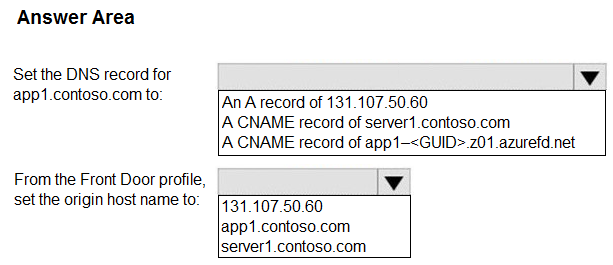
Question 51
HOTSPOT -
You have an on-premises web server that hosts a web app named App1 and has the following configurations:
• IP address: 131.107.50.60
• FQDN: server1.contoso.com
You have an Azure subscription.
You need to publish App1 by using Azure Front Door. The solution must meet the following requirements:
• Ensure that internet users can connect to App1 by using an FQDN of app1.contoso.com.
• Minimize the changes required to the configuration of Front Door if Server1 is migrated to Azure.
What should you include in the solution? To answer, select the appropriate options in the answer area.
NOTE: Each correct selection is worth one point.
Explanation: Point the custom domain to the Front Door endpoint using a CNAME. Configure the origin host name as the server FQDN so if the server is migrated, updating DNS/backend mapping is sufficient with minimal Front Door changes.
Question 52
SIMULATION
-
Username and password
-
Use the following login credentials as needed:
To enter your username, place your cursor in the Sign in box and click on the username below.
To enter your password, place your cursor in the Enter password box and click on the password below.
Azure Username:
Azure Password: xxxxxxxxxx
-
If the Azure portal does not load successfully in the browser, press CTRL-K to reload the portal in a new browser tab.
The following information is for technical support purposes only:
Lab Instance: 12345678
-
You have two servers that are each hosted by a separate service provider in New York and Germany. The server hosted in New York is accessible by using a host name of ny.contoso.com. The server hosted in Germany is accessible by using a host name of de.contoso.com.
You need to provide a single host name to access both servers. The solution must ensure that traffic originating from Germany is routed to de.contoso.com. All other traffic must be routed to ny.contoso.com.
To complete this task, sign in to the Azure portal.
Show Answer
Correct Answer: Create an Azure Traffic Manager profile using the Geographic routing method.
Add an external endpoint for de.contoso.com mapped to Germany.
Add an external endpoint for ny.contoso.com mapped to World (all other regions).
Use the Traffic Manager DNS name (or a CNAME from the required single hostname) for client access.
Explanation: Traffic Manager supports DNS-based geographic routing, allowing requests originating from Germany to resolve to the Germany server while all other requests resolve to the New York server. Application Gateway is regional and does not provide this global geographic DNS routing.
Question 52
You have an Azure subscription that contains the virtual networks shown in the following table.
You plan to deploy an Azure firewall named AF1 to RG1 in the West US Azure region.
To which virtual networks can you deploy AF1?
A. Vnet1 and Vnet4 only
B. Vnet1, Vnet2, Vnet3, and Vnet4
C. Vnet1 only
D. Vnet1 and Vnet2 only
E. Vnet1, Vnet2, and Vnet4 only
Show Answer
Correct Answer: C
Explanation: Azure Firewall and its virtual network must be in the same resource group and region. AF1 is deployed to RG1 in West US, so only Vnet1 meets both requirements.
Question 53
You have the Azure virtual networks shown in the following table.
You have the Azure resources shown in the following table.
You need to check latency between the resources by using connection monitors in Azure Network Watcher.
What is the minimum number of connection monitors that you must create?
A. 1
B. 2
C. 3
D. 4
E. 5
Show Answer
Correct Answer: B
Explanation: Create one connection monitor for each region that contains source virtual machines: East US for VM1 and VM3, and UK West for VM2. A monitor can include multiple sources and destinations, including resources in other regions, so two monitors are sufficient to check the required connectivity.
Question 53
DRAG DROP
-
You have an on-premises network.
You have an Azure subscription that contains a virtual network named VNet1. VNet1 contains an ExpressRoute gateway named Gateway1.
You need to implement an ExpressRoute solution from a third-party provider named Fabrikam, Inc. The solution must ensure that devices on the on-premises network can connect to the Azure resources on VNet1.
Which four actions should you perform in sequence? To answer, move the appropriate actions from the list of actions to the answer area and arrange them in the correct order.
Show Answer
Correct Answer: Create an ExpressRoute circuit.
Send the service key to Fabrikam.
Configure Azure private peering.
Connect Gateway1 to the ExpressRoute circuit.
Explanation: Create the circuit first, provide the service key to the connectivity provider so they can provision the connection, configure Azure private peering for VNet connectivity, and finally link the virtual network gateway to the ExpressRoute circuit.
Question 54
You have an Azure subscription that contains the public IPv4 addresses shown in the following table.
You plan to create a load balancer named LB1 that will have the following settings:
✑ Name: LB1
✑ Location: West US
✑ Type: Public
✑ SKU: Standard
Which public IPv4 addresses can be used by LB1?
A. IP1, IP3, IP4, and IP5 only
B. IP3 only
C. IP1 and IP3 only
D. IP2 only
E. IP1, IP2, IP3, IP4, and IP5
F. IP3 and IP5 only
Show Answer
Correct Answer: B
Explanation: LB1 is a regional Standard public load balancer in West US. Its public IP must use the Standard SKU and be in the same region. Only IP3 meets both requirements; IP5 is Standard but is in West US 2, and the other addresses use the Basic SKU.
Question 54
HOTSPOT
-
You have an Azure subscription that contains the resources shown in the following table.
You need to ensure that remote users can establish RDP connections to the virtual machines by using Bastion1.
How should you configure the rules for NSG1 for traffic from the internet to AzureBastionSubnet and for traffic from AzureBastionSubnet to Subnet1? To answer, select the appropriate options in the answer area.
NOTE: Each correct selection is worth one point.
Show Answer
Correct Answer: Traffic from the internet to AzureBastionSubnet: Enable TCP port 443 inbound.
Traffic from AzureBastionSubnet to Subnet1: Enable TCP port 3389 outbound.
Explanation: Azure Bastion is accessed by users over HTTPS (TCP 443) on its public IP. Bastion then initiates RDP connections to Windows VMs over TCP 3389 within the virtual network.
$19
Get all 347 questions with detailed answers and explanations
Instant download HTML + PDF delivered the moment payment clears.
Secure Stripe checkout we never see or store your card details.
7-day refund if files are defective see our refund policy.