DRAG DROP -
You have an on-premises network.
You have an Azure subscription that contains a virtual network named VNet1. VNet1 is connected to an Azure Virtual WAN hub named Hub1.
You need to enable connectivity between the on-premises network and VNet1 by using Hub1.
Which three actions should you perform in sequence? To answer, move the appropriate actions from the list of actions to the answer area and arrange them in the correct order.
Show Answer
Correct Answer: 1. Configure a Site-to-Site (S2S) VPN gateway.
2. Create a VPN site.
3. Connect the VPN site to Hub1.
Explanation: A Virtual WAN hub requires an S2S VPN gateway before a VPN site can connect. Then create the on-premises VPN site resource and finally associate it with the existing Hub1. VNet1 is already connected to Hub1, so no additional VNet or Hub actions are needed.
Question 55
You have an Azure virtual network named Vnet1 and an on-premises network. The on-premises network has policy-based VPN devices.
In Vnet1, you deploy a virtual network gateway named GW1 that uses a SKU of VpnGw1 and is route-based.
You have a Site-to-Site VPN connection for GW1 as shown in the following exhibit.
You need to ensure that the on-premises network can connect to the route-based GW1.
What should you do before you create the connection?
A. Set Connection Mode to ResponderOnly.
B. Set BGP to Enabled.
C. Set Use Azure Private IP Address to Enabled.
D. Set IPsec / IKE policy to Custom.
Show Answer
Correct Answer: D
Explanation: Set the IPsec/IKE policy to Custom so its parameters can be matched to the on-premises policy-based VPN devices. The exhibit already shows policy-based traffic selectors enabled. BGP and Azure private IP addressing are not required for this compatibility, and changing the connection mode does not address it.
Question 56
HOTSPOT
-
You have an Azure subscription that contains the resources shown in the following table.
You need to ensure that network traffic is routed over the Azure backbone network for the following scenarios:
• Traffic from SQLMIT to storage1
• Traffic from domain joined servers on VNet2 to storage
The solution must minimize costs.
What should you configure for each scenario? To answer, select the appropriate options in the answer area.
NOTE: Each correct selection is worth one point.
Show Answer
Correct Answer: Traffic from SQLMI1 to storage1: A service endpoint policy
Traffic from domain-joined servers on VNet2 to storage1: A private endpoint
Explanation: A service endpoint policy is the relevant low-cost configuration associated with Azure SQL Managed Instance access restrictions to Azure Storage over the Azure backbone. For domain-joined servers in VNet2, a private endpoint for the storage account provides private connectivity over the Azure backbone, and is the available appropriate option.
Question 56
Note: This question is part of a series of questions that present the same scenario. Each question in the series contains a unique solution that might meet the stated goals. Some question sets might have more than one correct solution, while others might not have a correct solution.
After you answer a question in this section, you will NOT be able to return to it. As a result, these questions will not appear in the review screen.
You have an Azure subscription that contains the following resources:
✑ A virtual network named Vnet1
A subnet named Subnet1 in Vnet1 -
✑ A virtual machine named VM1 that connects to Subnet1
✑ Three storage accounts named storage1, storage2, and storage3
You need to ensure that VM1 can access storage1. VM1 must be prevented from accessing any other storage accounts.
Solution: You create a network security group (NSG). You configure a service tag for Microsoft.Storage and link the tag to Subnet1.
Does this meet the goal?
A. Yes
B. No
Show Answer
Correct Answer: B
Explanation: No. The Microsoft.Storage service tag represents Azure Storage destinations broadly; it cannot distinguish storage1 from storage2 or storage3. An NSG rule using that tag would therefore not enforce access to only storage1.
Question 57
Your company has an on-premises network and three Azure subscriptions named Subscription1, Subscription2, and Subscription3.
The departments at the company use the Azure subscriptions as shown in the following table.
All the resources in the subscriptions are in either the West US Azure region or the West US 2 Azure region.
You plan to connect all the subscriptions to the on-premises network by using ExpressRoute.
What is the minimum number of ExpressRoute circuits required?
A. 1
B. 2
C. 3
D. 4
E. 5
Show Answer
Correct Answer: A
Explanation: One Standard ExpressRoute circuit can provide connectivity to Azure regions within the same geopolitical region, including both West US and West US 2. The circuit can be shared across subscriptions, so three subscriptions do not require three circuits.
Question 57
HOTSPOT
-
You have an Azure subscription that contains 1,000 virtual machines.
You collect network security group (NSG) flow logs.
You need to identify all the virtual machines that have interacted with non-Azure public IP addresses during the last 30 days.
How should you complete the query? To answer, select the appropriate options in the answer area.
NOTE: Each correct selection is worth one point.
Explanation: NSG Traffic Analytics data is stored in AzureNetworkAnalytics_CL. Filter FlowLog records from the last 30 days where FlowType_s equals "ExternalPublic" to identify VM interactions with non-Azure public IP addresses, then project and distinct the VM names.
Question 58
HOTSPOT
-
You have a firewall that is managed by using an Azure Firewall Premium policy named Policy1.
You need to configure Policy1 to block outbound traffic to the following locations:
• Malicious addresses identified by Microsoft.
• Social networking sites
The solution must minimize administrative effort.
What should you configure in Policy1 for each requirement? To answer, select the appropriate options in the answer area.
NOTE: Each correct selection is worth one point.
Show Answer
Correct Answer: Block traffic to malicious addresses: Threat intelligence
Block traffic to social networking sites: An application rule
Explanation: Threat intelligence automatically blocks traffic to Microsoft-identified malicious IPs/domains with minimal administration. Application rules support FQDNs and web categories (Premium), making them appropriate for blocking social networking sites.
Question 58
You have Azure App Service apps in the West US Azure region as shown in the following table.
You need to ensure that all the apps can access the resources in a virtual network named VNet1 without forwarding traffic through the internet.
How many integration subnets should you create?
A. 0
B. 1
C. 3
D. 4
E. 6
Show Answer
Correct Answer: C
Explanation: The exam’s expected configuration uses one integration subnet for each of the three App Service plans (ASP1, ASP2, and ASP3). App1 and App2 can share ASP1’s integration subnet; the number of app instances affects the IP addresses needed within a subnet, not the subnet count.
Sources:
https://learn.microsoft.com/en-us/azure/app-service/overview-vnet-integration
Question 59
You have a website that uses an FQDN of www.contoso.com. The DNS record for www. contoso.com resolves to an on-premises web server.
You plan to migrate the website to an Azure web app named Web1. The website on Web1 will be published by using an Azure Front Door instance named
ContosoFD1.
You build the website on Web1.
You plan to configure ContosoFD1 to publish the website for testing.
When you attempt to configure a custom domain for www.contoso.com on ContosoFD1, you receive the error message shown in the exhibit. (Click the Exhibit tab.)
You need to test the website and ContosoFD1 without affecting user access to the on-premises web server.
Which record should you create in the contoso.com DNS domain?
A. a CNAME record that maps afdverify.www.contoso.com to ContosoFD1.azurefd.net
B. a CNAME record that maps www.contoso.com to ContosoFD1.azurefd.net
C. a CNAME record that maps afdverify.www.contoso.com to afdverify.ContosoFD1.azurefd.net
D. a CNAME record that maps www.contoso.com to Web1.contoso.com
Show Answer
Correct Answer: C
Explanation: Create the temporary validation CNAME `afdverify.www.contoso.com` pointing to `afdverify.ContosoFD1.azurefd.net`. This lets Azure Front Door verify the custom domain without changing the existing `www.contoso.com` DNS record that directs users to the on-premises server.
Question 59
HOTSPOT
-
You have an Azure subscription that contains the resources shown in the following table.
You plan to deploy an app named App1 to meet the following requirements:
• External users must be able to access App1 from the internet.
• App1 will be load balanced across all the virtual machines.
• App1 will be hosted on VM1, VM2, VM3, and VM4.
• App1 must be available if an Azure region fails.
• Costs must be minimized.
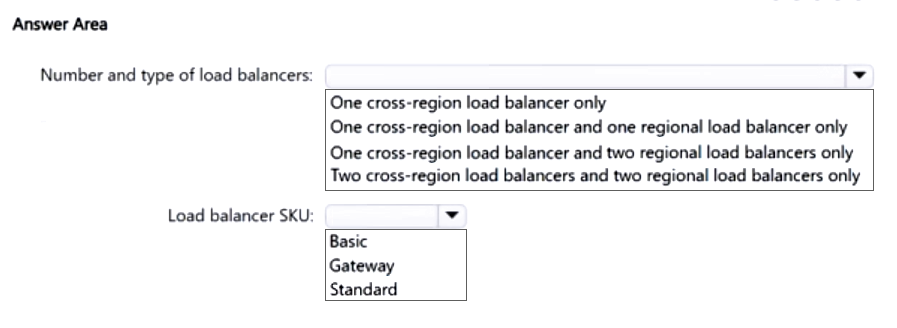
You need to implement a global load balancer solution for App1.
What should you configure? To answer, select the appropriate options in the answer area.
NOTE: Each correct answer is worth one point.
Show Answer
Correct Answer: Number and type of load balancers: One cross-region load balancer and two regional load balancers only
Load balancer SKU: Standard
Explanation: A cross-region Azure Load Balancer fronts regional Standard Load Balancers. Each region needs its own regional Standard Load Balancer to distribute traffic across the VMs in that region, while the cross-region load balancer provides global failover and internet entry point.
$19
Get all 347 questions with detailed answers and explanations
Instant download HTML + PDF delivered the moment payment clears.
Secure Stripe checkout we never see or store your card details.
7-day refund if files are defective see our refund policy.