HOTSPOT
-
You have an Azure subscription that contains a virtual network named VNet1.
You need to implement hybrid connectivity between an on-premises network and VNet1. The solution must meet the following requirements:
• All cross-premises network traffic must traverse an ExpressRoute circuit.
• All cross-premises network traffic must be encrypted by using a Site-to-Site (S2S) VPN.
What should you include in the solution? To answer, select the appropriate options in the answer area.
NOTE: Each correct selection is worth one point.
Show Answer
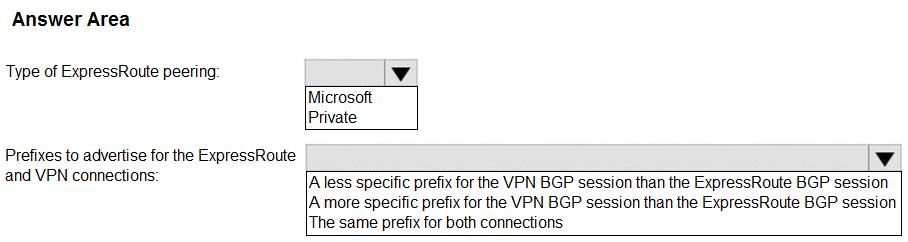
Correct Answer: Type of ExpressRoute peering: Private
Prefixes: A more specific prefix for the VPN BGP session than the ExpressRoute BGP session
Explanation: VPN over ExpressRoute private peering (ExpressRoute private peering) provides encrypted traffic while still traversing the ExpressRoute circuit. Advertising more specific routes over the VPN causes traffic to prefer the encrypted VPN path instead of the direct ExpressRoute path.
Question 40
You have an Azure subscription.
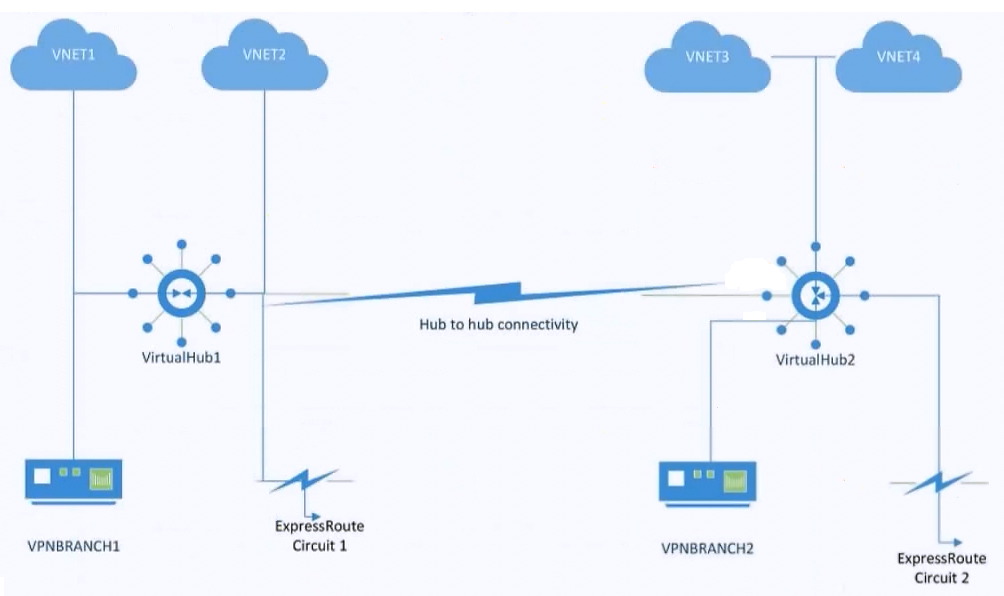
You plan to implement Azure Virtual WAN as shown in the following exhibit.
What is the minimum number of route tables that you should create?
A. 1
B. 2
C. 4
D. 6
Show Answer
Correct Answer: B
Explanation: There are two virtual hubs, and each has its own default route table. Connections in each hub can use that hub’s default table, so you need a minimum of two route tables—not one per connected VNet or circuit.
Question 40
HOTSPOT
-
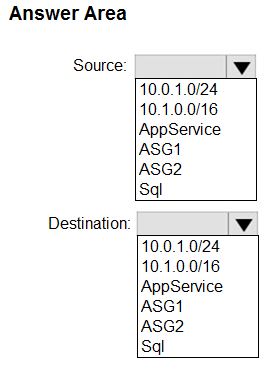
You have an Azure subscription. The subscription contains multiple Azure SQL Database resources and a virtual network named VNet1 that has five subnets. All the subnets are associated with a network security group (NSG) named NSG1. NSG1 blocks all outbound traffic, unless specifically allowed by a rule.
Each subnet contains 50 virtual machines. Multiple virtual machines host instances of SQL Server on Virtual Machines and will be configured to replicate with the Azure SQL Database resources.
You need to configure a new outbound rule in NSG1 to allow the SQL Server on Virtual Machines instances to connect to the Azure SQL Database resources. The solution must meet the following requirements:
• Minimize modifications to NSG1 when additional instances of SQL Server on Virtual Machines are deployed.
• Ensure that only SQL Server on Virtual Machines instances can connect to the Azure SQL Database resources.
How should you configure each setting for the new outbound rule? To answer, select the appropriate options in the answer area.
NOTE: Each correct selection is worth one point.
Show Answer
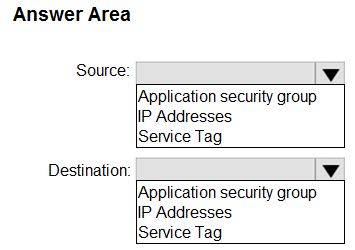
Correct Answer: Source: Application security group
Destination: Service Tag
Explanation: Use an Application Security Group for the source so new SQL Server VMs can be added to the ASG without changing NSG rules. Use the Azure SQL service tag (Sql) as the destination to allow traffic only to Azure SQL Database endpoints.
Question 41
Your company has an office in New York.
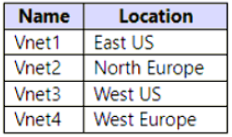
The company has an Azure subscription that contains the virtual networks shown in the following table.
You need to connect the virtual networks to the office by using ExpressRoute. The solution must meet the following requirements:
• The connection must have up to 1 Gbps of bandwidth.
• The office must have access to all the virtual networks.
• Costs must be minimized.
How many ExpressRoute circuits should be provisioned, and which ExpressRoute SKU should you enable?
A. one ExpressRoute Premium circuit
B. two ExpressRoute Premium circuits
C. four ExpressRoute Standard circuits
D. one ExpressRoute Standard circuit
Show Answer
Correct Answer: A
Explanation: Provision one ExpressRoute Premium circuit. Premium supports access to virtual networks across geopolitical regions, covering all four VNets in the US and Europe. A single circuit can provide up to 1 Gbps, so this meets the requirements with fewer circuits than using multiple circuits. A Standard circuit does not provide the required cross-geopolitical-region reach.
Question 41
HOTSPOT
-
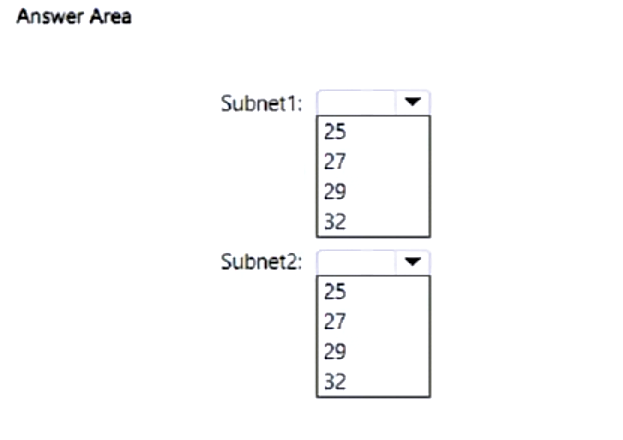
You have an Azure subscription that is linked to a Microsoft Entra tenant. The subscription contains a virtual network named VNet1, a storage account named storage1, an Azure App Service app named App1, and an Azure SQL database named DB1. VNet1 contains two subnets named Subnet1 and Subnet2. Subnet1 and Subnet2 each has a subnet mask of 255.255.255.224.
You plan to perform the following actions:
• On Subnet1, configure a service endpoint to connect to storage1 and a service endpoint to connect to the Microsoft Entra tenant.
• On Subnet2, configure a private endpoint to connect to App1 and a private endpoint to connect to DB1.
How many IP addresses will be available on each subnet once the planned actions are complete? To answer, select the appropriate options in the answer area.
NOTE: Each correct selection is worth one point.
Show Answer
Correct Answer: Subnet1: 27
Subnet2: 25
Explanation: A /27 subnet has 32 IP addresses, with 5 reserved by Azure, leaving 27 usable. Service endpoints do not consume subnet IP addresses. Each private endpoint consumes one IP address from the subnet, so two private endpoints reduce the available usable IPs from 27 to 25.
Question 42
HOTSPOT -
You have an Azure subscription that contains 200 virtual machines.
You need to use Azure Network Watcher to identify which virtual machines generate the most network traffic. The solution must minimize administrative effort.
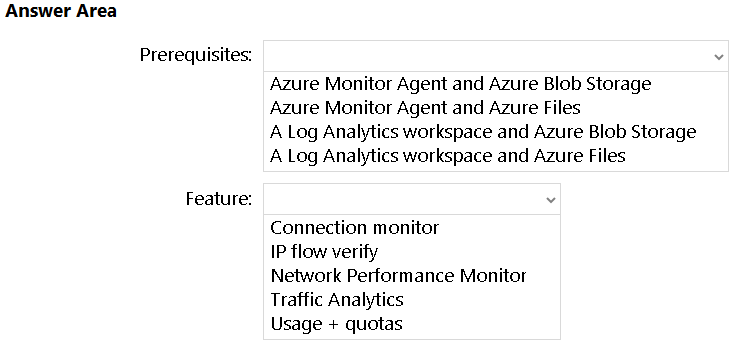
Which prerequisites should you deploy for Network Watcher, and which Network Watcher feature should you use to identify the virtual machines? To answer, select the appropriate options in the answer area.
NOTE: Each correct selection is worth one point.
Show Answer
Correct Answer: Prerequisites: A Log Analytics workspace and Azure Blob Storage
Feature: Traffic Analytics
Explanation: Traffic Analytics analyzes NSG flow logs stored in Azure Blob Storage and uses a Log Analytics workspace for analysis, allowing identification of VMs generating the most network traffic with minimal administrative effort.
Question 42
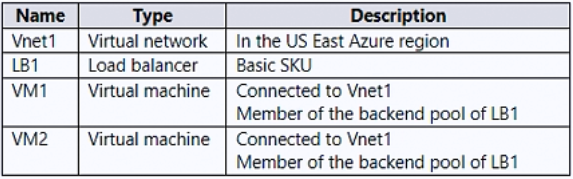
You have an Azure subscription that contains the resources shown in the following table.
You create a virtual network named Vnet2 in the West US region.
You plan to enable peering between Vnet1 and Vnet2.
You need to ensure that the virtual machines connected to Vnet2 can connect to VM1 and VM2 via LB1.
What should you do?
A. From the Peerings settings of Vnet2, set Traffic forwarded from remote virtual network to Allow.
B. Change the Floating IP configurations of LB1.
C. From the Peerings settings of Vnet1, set Traffic forwarded from remote virtual network to Allow.
D. Change the SKU of LB1.
Show Answer
Correct Answer: D
Explanation: Vnet1 is in East US and Vnet2 is in West US, so this uses global VNet peering. To reach an internal load balancer’s frontend across global peering, the load balancer must use the Standard SKU. Change LB1’s SKU; peering traffic-forwarding settings do not address this limitation.
Question 43
HOTSPOT
-
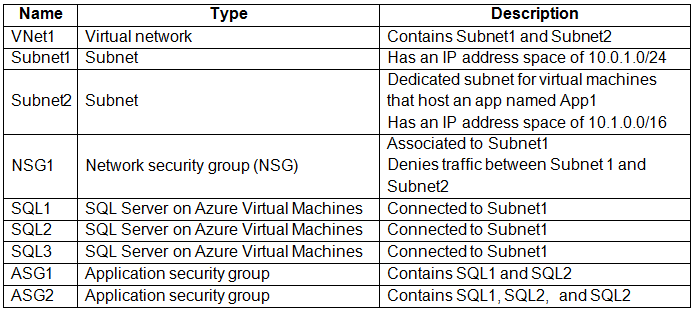
You have an Azure subscription that contains the resources shown in the following table:
Each quarter, you deploy five new virtual machines to host App1.
You need to add a rule to NSG1 to ensure that the virtual machines that host App1 can connect to SQL1 and SQL2. The solution must follow the principle of least privilege and minimize administrative effort.
How should you configure the source property and the destination property for the rule? To answer, select the appropriate options in the answer area.
NOTE: Each correct selection is worth one point.
Explanation: Use the Subnet2 address prefix as the source so all current and future App1 VMs are covered without updating the rule. Use the application security group that contains only SQL1 and SQL2 as the destination to follow least privilege.
Question 43
Your company has four branch offices and an Azure subscription. The subscription contains an Azure VPN gateway named GW1.
The branch offices are configured as shown in the following table.
The branch office routers provide internet connectivity and Site-to-Site VPN connections to GW1.
The users in Branch1 report that they can connect to internet resources, but cannot access Azure resources.
You need to ensure that the Branch1 users can connect to the Azure resources. The solution must meet the following requirements:
• Minimize downtime for all users.
• Minimize administrative effort.
What should you do first?
A. Recreate LNG1.
B. Reset RTR1.
C. Reset Connection1.
D. Reset GW1.
Show Answer
Correct Answer: C
Explanation: Reset Connection1 first. The problem is isolated to Branch1’s VPN connection, so resetting that connection is the least disruptive and simplest option. Resetting GW1 could interrupt VPN connectivity for all four branches; recreating LNG1 requires more administrative work.
Question 44
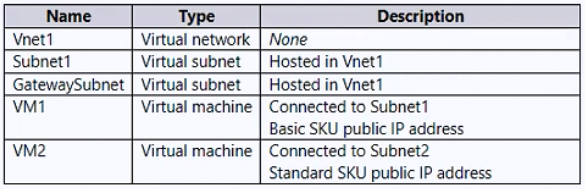
You have an Azure subscription that contains the resources shown in the following table.
You plan to deploy an Azure Virtual Network NAT gateway named Gateway1. The solution must meet the following requirements:
• VM1 will access the internet by using its public IP address.
• VM2 will access the internet by using its public IP address.
• Administrative effort must be minimized.
You need to ensure that you can deploy Gateway1 to Vnet1.
What is the minimum number of subnets required on Vnet1?
A. 2
B. 3
C. 4
D. 5
Show Answer
Correct Answer: C
Explanation: Four subnets are required: Subnet1 for VM1, Subnet2 for VM2, the existing GatewaySubnet, and one additional subnet to associate with Gateway1. Associating a NAT gateway with either VM subnet would make NAT take precedence over the VMs’ instance-level public IPs; Subnet1 also uses a Basic SKU public IP, which is incompatible with NAT Gateway. The NAT gateway does not need a dedicated deployment subnet, but it must be associated with a subnet to be operational.
$19
Get all 347 questions with detailed answers and explanations
Instant download HTML + PDF delivered the moment payment clears.
Secure Stripe checkout we never see or store your card details.
7-day refund if files are defective see our refund policy.