HOTSPOT
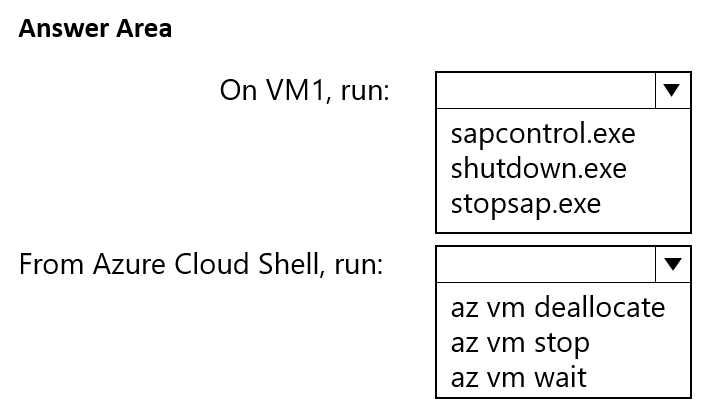
You have an Azure virtual machine named VM1 that hosts an SAP application server.
You need to implement snoozing for VM1. The solution must meet the following requirements:
• Minimize compute costs for VM1.
• Gracefully terminate the SAP application.
What should you do? To answer, select the appropriate options in the answer area.
NOTE: Each correct selection is worth one point.
Show Answer
Correct Answer: On VM1: stopsap.exe
From Azure Cloud Shell: az vm deallocate
Explanation: stopsap.exe gracefully stops the SAP application. Deallocating the VM stops compute charges while it is snoozed.
Question 77
HOTSPOT
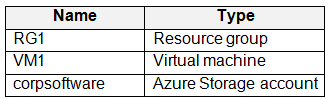
You have an Azure subscription that contains the resources shown in the following table.
You plan to deploy an SAP production landscape.
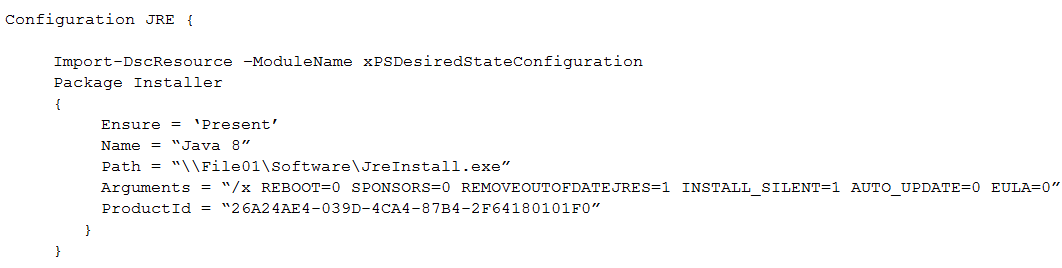
You create the following PowerShell Desired State Configuration (DSC) and publish the DSC configuration to corpsoftware.
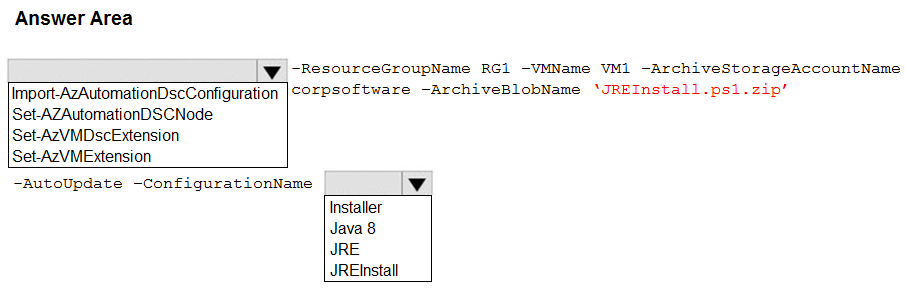
You need to deploy the DSC configuration to VM1.
How should you complete the command? To answer, select the appropriate options in the answer area.
NOTE: Each correct selection is worth one point.
Show Answer
Correct Answer: Set-AzVMDscExtension
JRE
Explanation: Set-AzVMDscExtension applies the published DSC archive to VM1. The configuration name is JRE; Installer is the name of the Package resource within it.
Question 78
HOTSPOT
You are deploying an SAP production landscape in Azure.
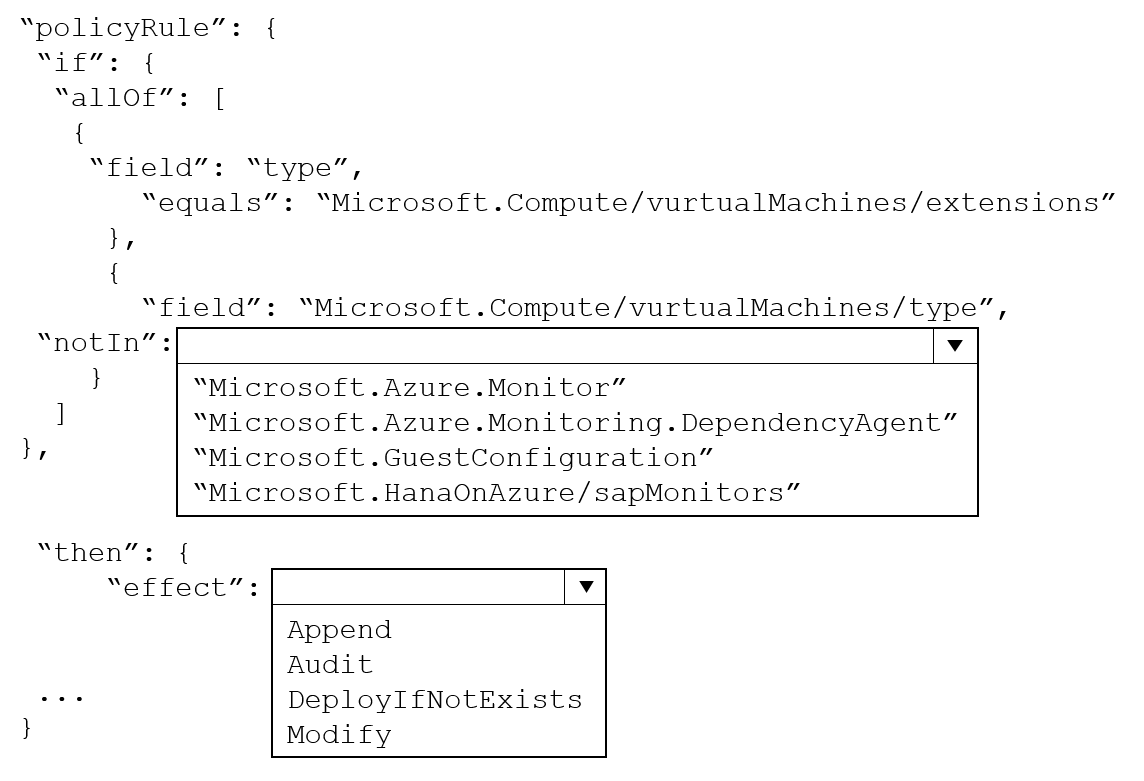
You need to create an Azure policy that meets the following requirements:
• Limits which applications can be installed on virtual machines
• Ensures that when a virtual machine is deployed, the virtual machine has the latest version of the extension to be installed
How should you complete the policy? To answer, select the appropriate options in the answer area.
NOTE: Each correct selection is worth one point.
Explanation: Guest Configuration supports policies that restrict software installed on VMs. DeployIfNotExists installs the required extension when it is missing during deployment.
Question 79
HOTSPOT
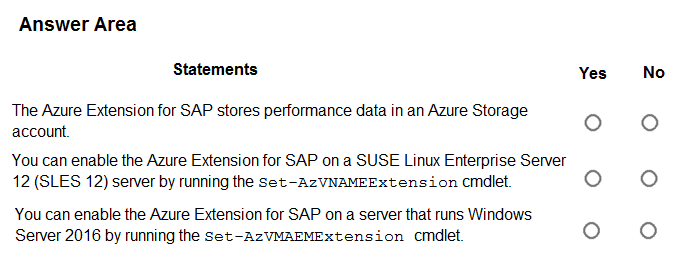
For each of the following statements, select Yes if the statement is true. Otherwise, select No.
NOTE: Each correct selection is worth one point.
Show Answer
Correct Answer: 1. Yes
2. No
3. Yes
Explanation: The extension stores performance data in an Azure Storage account. The cmdlet in the second statement is misspelled; `Set-AzVMAEMExtension` is the valid cmdlet and can be used for the Windows Server scenario.
Question 80
HOTSPOT
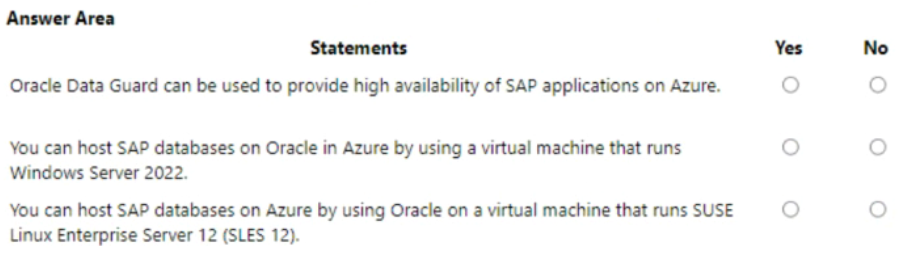
For each of the following statements, select Yes if the statement is true. Otherwise, select No.
NOTE: Each correct selection is worth one point.
Show Answer
Correct Answer: 1. Yes
2. Yes
3. No
Explanation: Oracle Data Guard can provide high availability for the Oracle database used by an SAP application on Azure. SAP on Oracle is supported on eligible Azure VMs running Windows Server 2022, but not on SLES 12.
Question 81
You have an SAP on Azure deployment that has been running for 180 days.
You need to validate that the virtual machines are sized to maximize the use of allocated resources. The solution must minimize administrative effort.
What should you use?
A. Azure Advisor
B. SAP Quick Sizer
C. Azure Monitor for SAP solutions
D. VM insights
Show Answer
Correct Answer: A
Explanation: Azure Advisor analyzes virtual machine utilization over time and provides right-sizing recommendations to help optimize resource use with minimal administrative effort. SAP Quick Sizer is for estimating requirements before deployment, while the monitoring options focus on telemetry and diagnostics.
Question 82
HOTSPOT
You have an on-premises SAP HANA deployment that uses HANA system replication in synchronous mode.
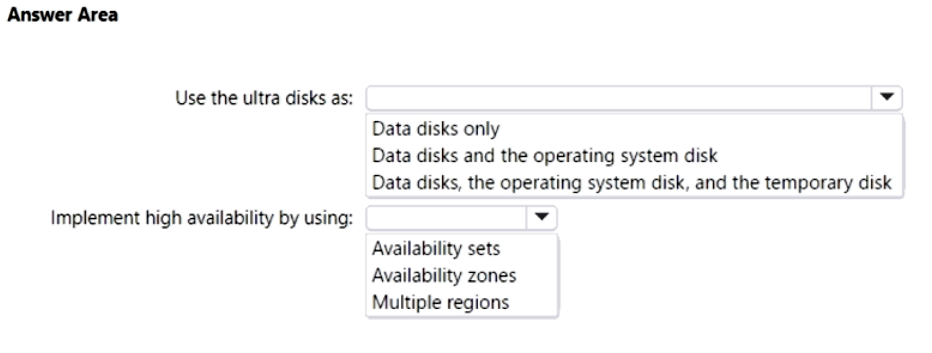
You plan to migrate the on-premises deployment to Azure and use ultra disks as part of the HANA deployment on Azure.
You need to configure storage resources and high availability for the HANA deployment on Azure.
What should you do? To answer, select the appropriate options in the answer area.
NOTE: Each correct selection is worth one point.
Show Answer
Correct Answer: Use the ultra disks as: Data disks only
Implement high availability by using: Availability zones
Explanation: Ultra disks cannot be used as operating system disks and do not support availability sets. Availability zones provide high availability for this deployment.
Question 83
Note: This question is part of a series of questions that present the same scenario. Each question in the series contains a unique solution that might meet the stated goals. Some question sets might have more than one correct solution, while others might not have a correct solution.
After you answer a question in this section, you will NOT be able to return to it. As a result, these questions will not appear in the review screen.
You have an SAP production landscape on-premises and an SAP development landscape on Azure.
You deploy a network virtual appliance to act as a firewall between the Azure subnets and the on-premises network.
You need to ensure that all traffic is routed through the network virtual appliance.
Solution: You configure a user-defined route table.
Does this meet the goal?
A. Yes
B. No
Show Answer
Correct Answer: A
Explanation: Yes. A user-defined route can direct traffic destined for the on-premises network to the network virtual appliance as its next hop, ensuring that traffic passes through the firewall.
Question 84
HOTSPOT
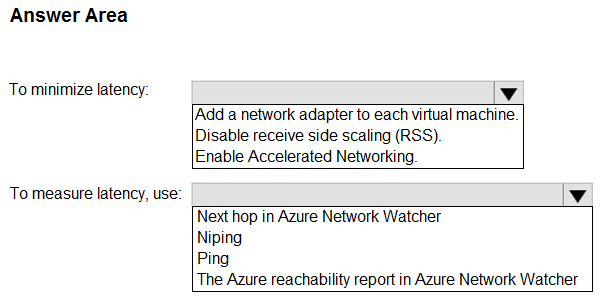
You are planning an SAP NetWeaver deployment on Azure. The database tier will consist of two Azure virtual machines that have Microsoft SQL Server 2017 installed. Each virtual machine will be deployed to a separate availability zone.
You need to perform the following:
• Minimize network latency between the virtual machines.
• Measure network latency between the virtual machines.
What should you do? To answer, select the appropriate options in the answer area.
NOTE: Each correct selection is worth one point.
Show Answer
Correct Answer: To minimize latency: Enable Accelerated Networking.
To measure latency: Use Niping.
Explanation: Accelerated Networking reduces VM network latency. SAP’s Niping tool measures latency between the two VMs.
Question 85
HOTSPOT
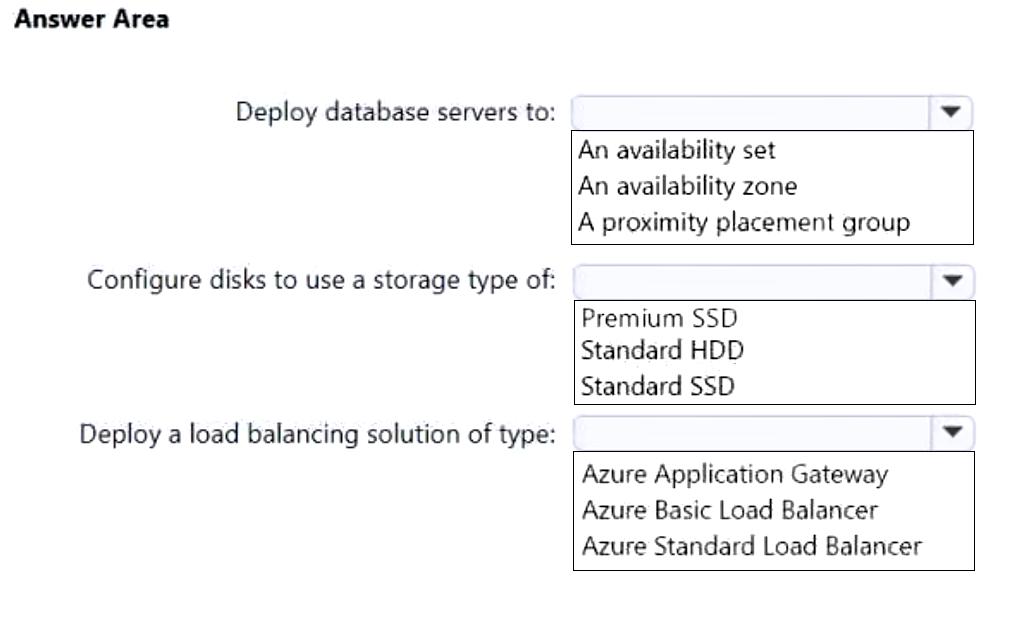
You plan to deploy an SAP NetWeaver landscape that will use SQL Server on Azure virtual machines.
The database tier must meet the following requirements:
• Maintain database availability in the event of a single Azure datacenter failure.
• Maximize IOPS.
How should you configure the database tier? To answer, select the appropriate options in the answer area.
NOTE: Each correct selection is worth one point.
Show Answer
Correct Answer: Deploy database servers to: Availability zones
Configure disks to use: Premium SSD
Deploy a load balancing solution of type: Azure Standard Load Balancer
Explanation: Placing database servers in separate availability zones protects against a single datacenter failure. Premium SSD provides the highest IOPS of the listed storage types, and Standard Load Balancer supports zone-based deployments.
$19
Get all 261 questions with detailed answers and explanations
Instant download HTML + PDF delivered the moment payment clears.
Secure Stripe checkout we never see or store your card details.
7-day refund if files are defective see our refund policy.