HOTSPOT
You have an on-premises SAP HANA deployment.
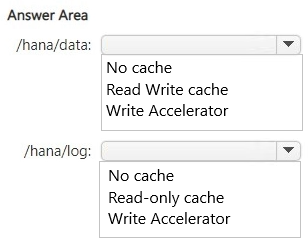
You plan to migrate the deployment to Azure virtual machines. The migrated deployment will use Azure Premium Storage V1 SSD for the volume that will host /hana/data and Azure ultra disks for the volume that will host /hana/logs.
You need to recommend the cache configuration for each volume.
What should you recommend for each volume? To answer, select the appropriate options in the answer area.
NOTE: Each correct selection is worth one point.
Show Answer
Correct Answer: /hana/data: Read-only cache
/hana/log: No cache
Explanation: Read-only caching is recommended for SAP HANA data on Premium SSD v1. Azure ultra disks do not support host caching, so the log volume must use no cache.
Question 56
You are planning an SAP on Azure deployment.
You need to recommend a storage access solution that meets the following requirements:
• Provides a common file share that will be accessed by virtual machines that run either Red Hat Enterprise Linux (RHEL) or Windows Server 2022.
• Ensures that each virtual machine uses its native sharing protocol to access the common file share.
Which type of storage should you include in the recommendation?
A. Azure NetApp Files in NFSv4.1 mode
B. Azure NetApp Files in dual protocol mode
C. a premium storage account file share
D. a standard storage account file share
Show Answer
Correct Answer: B
Explanation: Azure NetApp Files in dual protocol mode provides access to the same data through both NFS and SMB. RHEL VMs can use NFS, while Windows Server VMs can use SMB—their native file-sharing protocols.
Question 57
You plan to implement a deployment of SAP NetWeaver on Azure. The deployment will be hosted on virtual machines that run SUSE Linux Enterprise Server (SLES).
You need to identify which virtual machine size to use to meet the following requirements:
• The size must be based on the SAPS rating of the deployment.
• The virtual machines must be certified to run the deployment.
What should you use?
A. a designated SAP note
B. Product Availability Matrix (PAM)
C. SAP Cloud Appliance Library (CAL)
Show Answer
Correct Answer: A
Explanation: Use the designated SAP Note for SAP on Azure. It lists certified Azure virtual machine sizes and their SAPS ratings, allowing you to select a VM that meets both requirements. PAM provides product compatibility information, while CAL is for deploying preconfigured SAP solutions.
Question 58
HOTSPOT
You are deploying SAP HANA to Azure virtual machines.
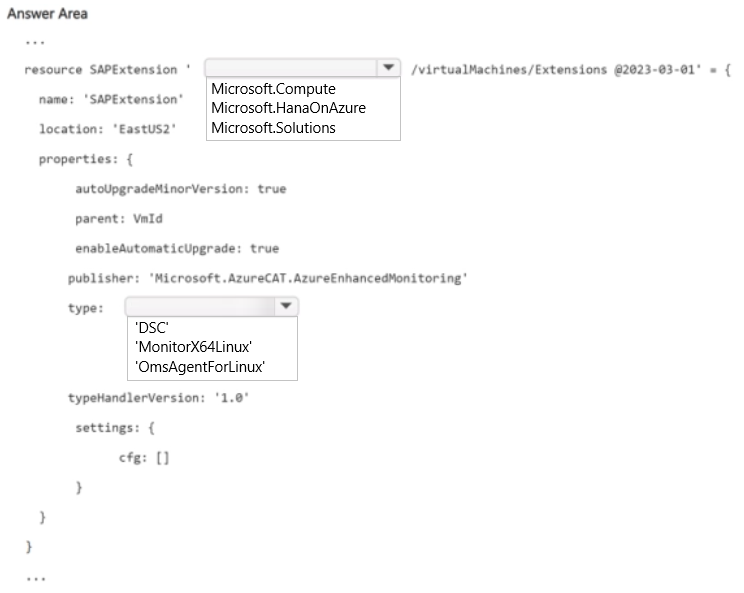
You need to include the new version of the Azure VM extension for SAP solutions in the deployment.
You have a Bicep resource definition template.
How should you complete the template? To answer, select the appropriate options in the answer area.
NOTE: Each correct selection is worth one point.
Explanation: The SAP monitoring extension is a Microsoft.Compute virtual machine extension. With publisher Microsoft.AzureCAT.AzureEnhancedMonitoring, its Linux extension type is MonitorX64Linux.
Question 59
You have an Azure subscription. The subscription contains a virtual machine named VM1 that runs SUSE Linux Enterprise Server (SLES) and was created by using an Azure Marketplace image.
You plan to deploy four virtual machines based on VM1 that will have the SAP Web Dispatcher role.
You need to create a generalized image of VM1.
What should you do first?
A. Install the Custom Script Extension.
B. Run sysprep.
C. Install the Azure Linux VM agent.
D. Run waagent.
Show Answer
Correct Answer: D
Explanation: SLES is a Linux VM, so use the Azure Linux Agent (`waagent`) to deprovision the VM before capturing it as a generalized image. Sysprep is for Windows; a Marketplace SLES image normally already includes the agent.
Question 60
HOTSPOT
You plan to deploy an Azure virtual machine that will host an SAP HANA database.
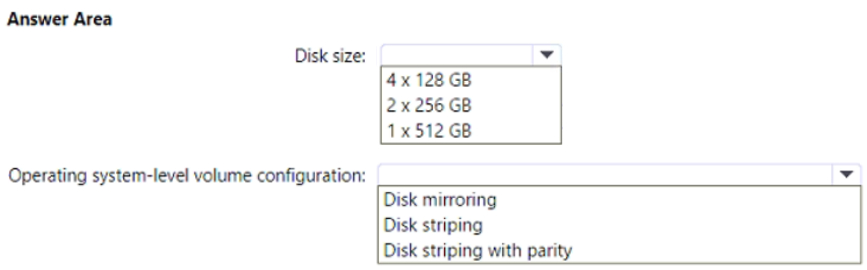
You need to provide a 512-GB volume for the database. The volume must meet the following requirements:
• Provide storage resiliency.
• Provide maximum throughput.
• Maximize disk space usage without affecting storage resiliency.
What should you configure? To answer, select the appropriate options in the answer area.
NOTE: Each correct selection is worth one point.
Show Answer
Correct Answer: Disk size: 4 × 128 GB
Operating system-level volume configuration: Disk striping
Explanation: Striping across four disks provides the highest aggregate throughput and uses the full 512 GB. Azure storage provides the underlying resiliency, so OS-level mirroring or parity would reduce usable capacity unnecessarily.
Question 61
HOTSPOT
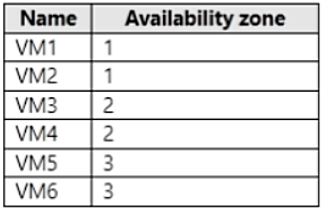
You have an Azure subscription that contains the virtual machines shown in the following table.
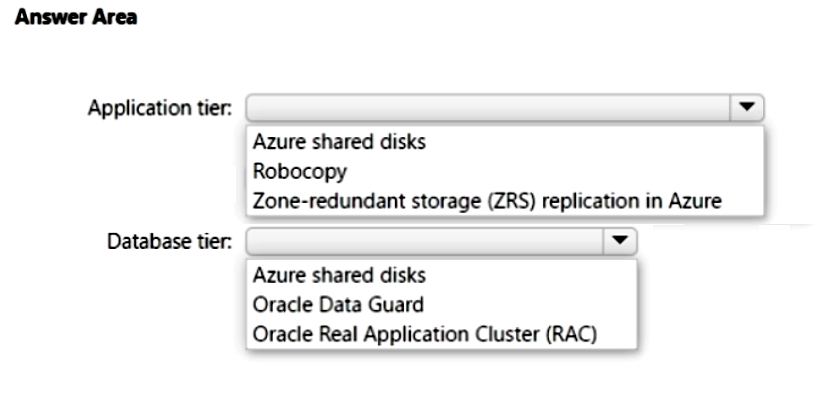
You need to deploy a highly available, three-tier SAP NetWeaver landscape that will use an Oracle database.
What should you use to ensure redundancy for the application tier and the database tier? To answer, select the appropriate options in the answer area.
NOTE: Each correct selection is worth one point.
Explanation: Azure shared disks provide shared storage for clustered SAP application services. Oracle Data Guard maintains a standby database for failover across availability zones.
Question 62
HOTSPOT
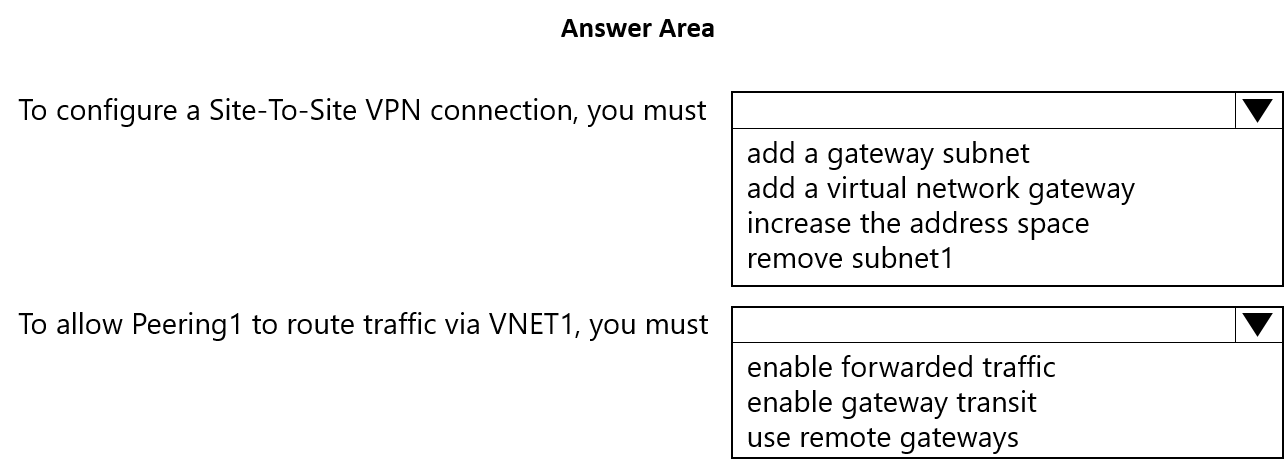
You have an on-premises SAP landscape and an Azure subscription that contains a virtual network named VNET1. VNET1 has the following settings.
You plan to migrate the landscape to Azure.
You need to configure VNET1 to support the SAP landscape.
Use the drop-down menus to select the answer choice that completes each statement based on the information presented in the settings.
NOTE: Each correct selection is worth one point.
Explanation: A Site-to-Site VPN gateway requires a dedicated GatewaySubnet. Enabling gateway transit lets the peered network use VNET1’s gateway.
Question 63
You have an Azure subscription that contains an Azure Monitor for SAP solutions resource and a virtual machine named VM1. VM1 runs SUSE Enterprise Linux (SLES) and hosts an SAP NetWeaver application server.
You need to monitor the CPU, memory, and network usage of VM1 by using the Azure Monitor for SAP solutions resource.
What should you do first?
A. On VM1, install the Prometheus node exporter.
B. From the Azure portal, add the Azure Monitor for SAP solutions NetWeaver provider.
C. From the Azure portal, add the Azure Monitor for SAP solutions OS (Linux) provider.
D. On VM1, install the Telegraf agent.
Show Answer
Correct Answer: A
Explanation: Install the Prometheus node exporter on VM1 first so the OS (Linux) provider can collect its CPU, memory, and network metrics. Then add the OS (Linux) provider to the Azure Monitor for SAP solutions resource.
Question 64
You have an Azure virtual machine named VM1 that runs SUSE Linux Enterprise Server (SLES).
You need to deploy Azure Monitor for SAP Solutions to VM1. The solution must support gathering CPU and memory metrics.
What should you install on VM1?
A. the SAPControl web service
B. Node Exporter
C. Performance co-pilot
D. the Log Analytics agent
Show Answer
Correct Answer: B
Explanation: Node Exporter exposes Linux host metrics, including CPU and memory usage, for Azure Monitor for SAP solutions to collect.
$19
Get all 261 questions with detailed answers and explanations
Instant download HTML + PDF delivered the moment payment clears.
Secure Stripe checkout we never see or store your card details.
7-day refund if files are defective see our refund policy.