You have an Azure subscription named Sub1 that contains a Microsoft Sentinel workspace named Workspace1.
You have an SAP RISE managed workload that is integrated with Sub1.
You plan to deploy the Microsoft Sentinel solution for SAP applications arid use automated attack disruption in Microsoft Defender XDR.
You need to implement the Microsoft Sentinel solution for SAP applications in Workspace1 by using the Azure portal.
What should you use?
A. Content hub
B. Automation
C. Data connectors
D. Analytics
Show Answer
Correct Answer: A
Explanation: Use **Content hub** to find and install the Microsoft Sentinel solution for SAP applications in Workspace1. The solution is deployed from the Content hub; data connectors and analytics are configured as part of the subsequent setup.
Question 25
HOTSPOT
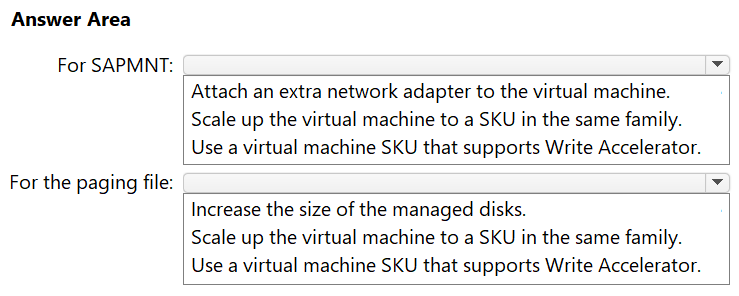
You plan to deploy an SAP workload to an Azure virtual machine that has the following types of storage:
• An SAPMNT file share hosted in Azure premium files
• Application files stored on Azure Premium managed disks
During testing, you use the E20ds v4 virtual machine SKU.
You discover that the bandwidth of the connection to the SAPMNT share is too low, and the disk space available for the paging file is insufficient.
You need to increase the available bandwidth and disk space. The solution must minimize costs.
What should you do? To answer, select the appropriate options in the answer area.
NOTE: Each correct selection is worth one point.
Show Answer
Correct Answer: For SAPMNT: Scale up the virtual machine to a SKU in the same family.
For the paging file: Scale up the virtual machine to a SKU in the same family.
Explanation: A larger VM SKU provides more network bandwidth for the Azure Files share and more local temporary disk space for the paging file. An extra network adapter does not raise the VM’s bandwidth limit.
Question 26
HOTSPOT
You are designing the backup solution for an SAP database.
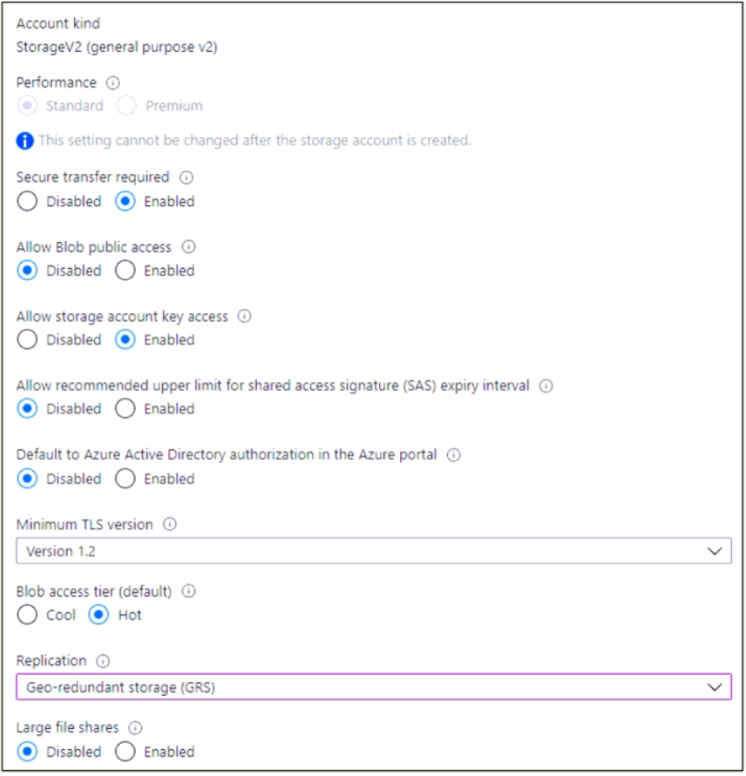
You have an Azure Storage account that is configured as shown in the following exhibit.
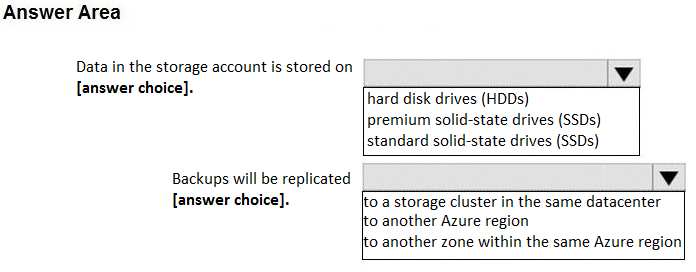
Use the drop-down menus to select the answer choice that completes each statement based on the information presented in the graphic.
NOTE: Each correct selection is worth one point.
Show Answer
Correct Answer: Data is stored on hard disk drives (HDDs).
Backups will be replicated to another Azure region.
Explanation: Standard storage uses HDDs. Geo-redundant storage (GRS) replicates data to a secondary Azure region.
Question 27
You have an Azure subscription that contains virtual machines and an Azure Policy named Policy1.
Policy1 is configured to automatically install Azure VM extension for SAP solutions to newly deployed virtual machines.
You need to modify Policy1 to ensure that the policy also applies to the existing virtual machines.
What should you create first?
A. a managed identity
B. a service principal
C. an Azure logic app
D. an Azure Automation runbook
Show Answer
Correct Answer: A
Explanation: A managed identity is required for the Azure Policy assignment to deploy the VM extension. After configuring it with the necessary permissions, create a remediation task to apply the policy to existing VMs.
Sources:
https://learn.microsoft.com/en-us/azure/azure-monitor/vm/vminsights-enable-policy
Question 28
You have an SAP production landscape in Azure.
You plan to migrate the landscape to an SAP RISE managed workload.
Which task will be the sole responsibility of the SAP vendor after the migration?
A. configuring security monitoring in Microsoft Sentinel
B. implementing single sign-on (SSO)
C. sizing the Azure resources that host the landscape
D. configuring virtual network peering
Show Answer
Correct Answer: C
Explanation: With SAP RISE, SAP is responsible for sizing and provisioning the Azure infrastructure within the managed workload. Sentinel monitoring, SSO, and connectivity such as virtual network peering generally require customer involvement or configuration.
Question 29
You have an on-premises datacenter.
You have an Azure subscription that contains a virtual network named VNet1.
VNet1 uses forced tunneling to force all outbound traffic to the internet via the datacenter.
You deploy an SAP landscape to VNet1. The landscape uses virtual machines that run Red Hat Enterprise Linux (RHEL) and uses the pay-as-you-go rates.
You discover that the virtual machines fail to receive operating system updates.
You need to ensure that the virtual machines receive operating system updates.
What should you do?
A. Add user-defined routes (UDRs) to the route table.
B. Deploy an Azure firewall.
C. Configure an Azure DNS Private Resolver.
D. Deploy Azure Update Manager.
Show Answer
Correct Answer: A
Explanation: RHEL pay-as-you-go VMs receive updates from the Red Hat Update Infrastructure (RHUI). With forced tunneling, their RHUI traffic is routed through the datacenter and may not reach the service. Add user-defined routes for the RHUI destination IP ranges with the next hop set to Internet, so update traffic bypasses forced tunneling.
Question 30
You have an Azure subscription.
You plan to deploy an Azure virtual machine that runs SUSE Linux Enterprise Server (SLES) 15 SP5 for SAP Applications. The virtual machine will host an SAP workload.
You need to ensure that the virtual machine will use the UEFI-based boot architecture.
What should you select from the Azure portal during the deployment?
A. Extensions
B. Host group
C. Image
D. VM architecture
Show Answer
Correct Answer: C
Explanation: Select an Image that supports Generation 2. Azure Generation 2 virtual machines use UEFI boot; the image selection determines the supported VM generation.
Question 31
You have an SAP landscape on Azure that contains a virtual machine named VM1. VM1 hosts the central services application.
You need to encrypt VM1. The solution must meet the following requirements:
• All disks must be encrypted.
• The impact on the CPU of VM1 must be minimized.
• The manual rotation of encryption keys must be supported.
Which type of encryption should you use?
A. Encryption at rest with platform-managed keys
B. Encryption at rest with customer-managed keys
C. Azure Disk Encryption
D. Encryption at host
Show Answer
Correct Answer: B
Explanation: Use encryption at rest with customer-managed keys. Encryption is handled by Azure’s storage infrastructure, minimizing CPU impact on VM1, and you can manually rotate the customer-managed keys. Azure Disk Encryption runs in the guest and can consume VM CPU; platform-managed keys do not provide customer-controlled manual rotation.
Question 32
You have an Azure subscription that contains a Windows-based SAP deployment.
You plan to register the SAP deployment with Azure Center for SAP solutions.
You need to verify that SAP system-level prerequisites are met.
Which command should you run?
A. saposcol
B. sapacext
C. saphostexec
D. hostexecstart
Show Answer
Correct Answer: C
Explanation: Run `saphostexec` to verify the SAP Host Agent status on Windows. For example, use `C:\Program Files\SAP\hostctrl\exe\saphostexec -status`.
Question 33
You have two Azure subscriptions.
You plan to deploy virtual machines to both subscriptions. The virtual machines will host SAP workloads. As part of the deployment the virtual machines will be deployed to an availability zone named Availability Zone 1 in each subscription.
You need to ensure that the virtual machines will reside in the same physical datacenter.
What should you do first?
A. Use the Check Zone Peers REST API.
B. Deploy the virtual machines to the same availability set.
C. Deploy the virtual machines to the same proximity group.
D. Use the List By Location REST API.
Show Answer
Correct Answer: A
Explanation: Use the Check Zone Peers REST API first to verify that Availability Zone 1 in the two subscriptions maps to the same physical zone. Zone numbering can differ between subscriptions, so matching zone names alone does not guarantee the VMs will be in the same datacenter.
$19
Get all 261 questions with detailed answers and explanations
Instant download HTML + PDF delivered the moment payment clears.
Secure Stripe checkout we never see or store your card details.
7-day refund if files are defective see our refund policy.