You plan to deploy an SAP landscape in Azure that will contain an SAP HANA database.
You need to identify the amount and size of virtual machines required for the deployment. The solution must minimize administrative effort.
What should you use?
A. HANA Cockpit
B. SAP Quick Sizer
C. Azure Advisor
D. Azure Center for SAP solutions
Show Answer
Correct Answer: B
Explanation: SAP Quick Sizer estimates the infrastructure requirements for an SAP workload, including the compute capacity needed to determine VM quantities and sizes. HANA Cockpit is for HANA administration, Azure Advisor provides recommendations for existing resources, and Azure Center for SAP solutions focuses on deploying and managing SAP systems.
Question 52
You have an Azure subscription. The subscription contains two virtual machines that run Red Hat Enterprise Linux (RHEL) and are configured as a cluster that hosts an SAP workload.
You deploy Azure Monitor for SAP solutions.
You need to configure the high-availability cluster provider.
Which package should you install on each cluster node?
A. Node_Exporter
B. ha_cluster_exporter
C. saposcol
D. Performance co-pilot
Show Answer
Correct Answer: B
Explanation: Install `ha_cluster_exporter` on each cluster node. Azure Monitor for SAP solutions uses it to collect high-availability cluster metrics.
Question 53
HOTSPOT
You have a deployment of SAP NetWeaver on Azure.
You plan to register the deployment in Azure Center for SAP solutions.
You need to perform the following actions:
• Register the resource provider required by Azure Center for SAP solutions.
• Create the identity that will be used to discover SAP system resources.
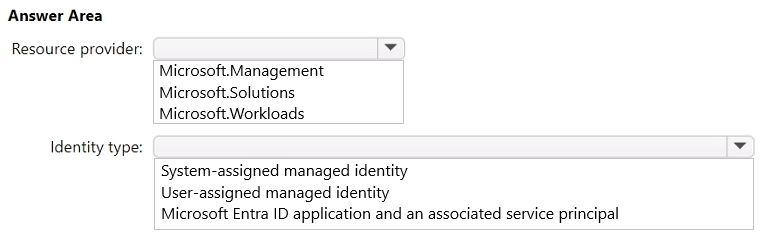
Which resource provider should you register, and which type of identity should you create? To answer, select the appropriate options in the answer area.
NOTE: Each correct selection is worth one point.
Explanation: Azure Center for SAP solutions uses the Microsoft.Workloads resource provider. A user-assigned managed identity is used to discover the existing SAP system’s Azure resources during registration.
Question 54
You have an Azure subscription named Sub1 that contains an Azure logic app named App1.
You have an SAP RISE managed workload that is integrated with Sub1.
You need to ensure that App1 can access data stored in SAP by using REST API calls.
What should you deploy?
A. an on-premises data gateway
B. an application gateway
C. an integration runtime
D. an Azure Data Share instance
Show Answer
Correct Answer: A
Explanation: Deploy an on-premises data gateway to provide Logic Apps with a secure connection to the SAP RISE environment. An application gateway handles inbound application traffic, an integration runtime is used for data integration services, and Azure Data Share is for sharing datasets.
Question 55
HOTSPOT
You have an on-premises SAP HANA deployment.
You plan to migrate the deployment to Azure virtual machines. The migrated deployment will use Azure Premium Storage V1 SSD for the volume that will host /hana/data and Azure ultra disks for the volume that will host /hana/logs.
You need to recommend the cache configuration for each volume.
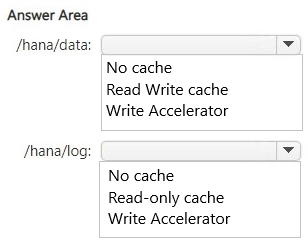
What should you recommend for each volume? To answer, select the appropriate options in the answer area.
NOTE: Each correct selection is worth one point.
Show Answer
Correct Answer: /hana/data: Read-only cache
/hana/log: No cache
Explanation: Read-only caching is recommended for SAP HANA data on Premium SSD v1. Azure ultra disks do not support host caching, so the log volume must use no cache.
Question 56
You are planning an SAP on Azure deployment.
You need to recommend a storage access solution that meets the following requirements:
• Provides a common file share that will be accessed by virtual machines that run either Red Hat Enterprise Linux (RHEL) or Windows Server 2022.
• Ensures that each virtual machine uses its native sharing protocol to access the common file share.
Which type of storage should you include in the recommendation?
A. Azure NetApp Files in NFSv4.1 mode
B. Azure NetApp Files in dual protocol mode
C. a premium storage account file share
D. a standard storage account file share
Show Answer
Correct Answer: B
Explanation: Azure NetApp Files in dual protocol mode provides access to the same data through both NFS and SMB. RHEL VMs can use NFS, while Windows Server VMs can use SMB—their native file-sharing protocols.
Question 57
You plan to implement a deployment of SAP NetWeaver on Azure. The deployment will be hosted on virtual machines that run SUSE Linux Enterprise Server (SLES).
You need to identify which virtual machine size to use to meet the following requirements:
• The size must be based on the SAPS rating of the deployment.
• The virtual machines must be certified to run the deployment.
What should you use?
A. a designated SAP note
B. Product Availability Matrix (PAM)
C. SAP Cloud Appliance Library (CAL)
Show Answer
Correct Answer: A
Explanation: Use the designated SAP Note for SAP on Azure. It lists certified Azure virtual machine sizes and their SAPS ratings, allowing you to select a VM that meets both requirements. PAM provides product compatibility information, while CAL is for deploying preconfigured SAP solutions.
Question 58
HOTSPOT
You are deploying SAP HANA to Azure virtual machines.
You need to include the new version of the Azure VM extension for SAP solutions in the deployment.
You have a Bicep resource definition template.
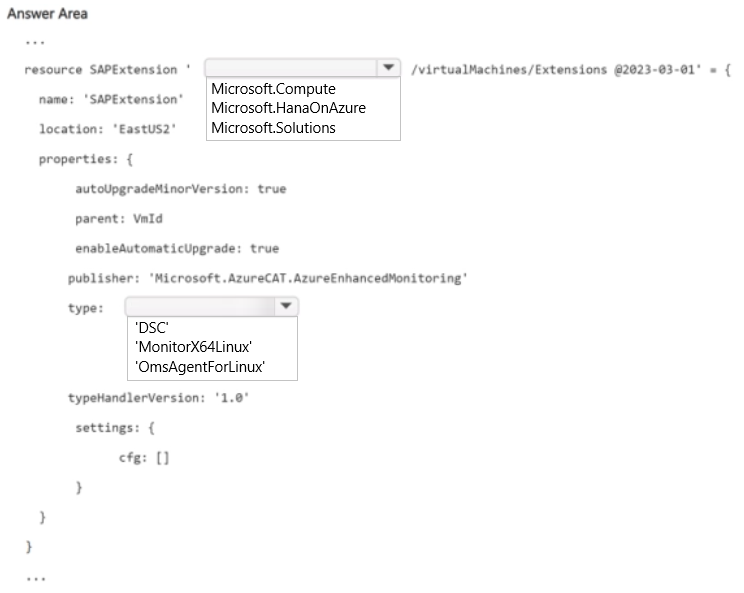
How should you complete the template? To answer, select the appropriate options in the answer area.
NOTE: Each correct selection is worth one point.
Explanation: The SAP monitoring extension is a Microsoft.Compute virtual machine extension. With publisher Microsoft.AzureCAT.AzureEnhancedMonitoring, its Linux extension type is MonitorX64Linux.
Question 59
You have an Azure subscription. The subscription contains a virtual machine named VM1 that runs SUSE Linux Enterprise Server (SLES) and was created by using an Azure Marketplace image.
You plan to deploy four virtual machines based on VM1 that will have the SAP Web Dispatcher role.
You need to create a generalized image of VM1.
What should you do first?
A. Install the Custom Script Extension.
B. Run sysprep.
C. Install the Azure Linux VM agent.
D. Run waagent.
Show Answer
Correct Answer: D
Explanation: SLES is a Linux VM, so use the Azure Linux Agent (`waagent`) to deprovision the VM before capturing it as a generalized image. Sysprep is for Windows; a Marketplace SLES image normally already includes the agent.
Question 60
HOTSPOT
You plan to deploy an Azure virtual machine that will host an SAP HANA database.
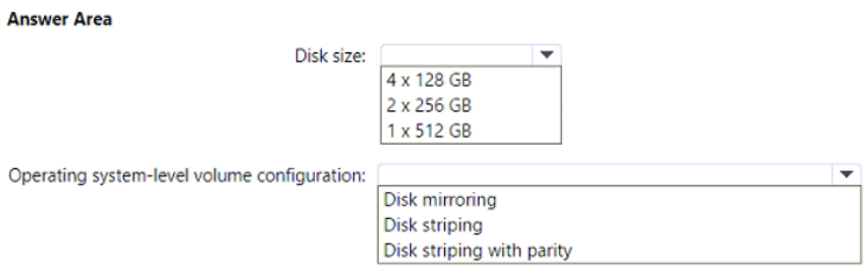
You need to provide a 512-GB volume for the database. The volume must meet the following requirements:
• Provide storage resiliency.
• Provide maximum throughput.
• Maximize disk space usage without affecting storage resiliency.
What should you configure? To answer, select the appropriate options in the answer area.
NOTE: Each correct selection is worth one point.
Show Answer
Correct Answer: Disk size: 4 × 128 GB
Operating system-level volume configuration: Disk striping
Explanation: Striping across four disks provides the highest aggregate throughput and uses the full 512 GB. Azure storage provides the underlying resiliency, so OS-level mirroring or parity would reduce usable capacity unnecessarily.
$19
Get all 299 questions with detailed answers and explanations
Instant download HTML + PDF delivered the moment payment clears.
Secure Stripe checkout we never see or store your card details.
7-day refund if files are defective see our refund policy.