You have an on-premises SAP NetWeaver deployment. The deployment has a DB2 data store that contains a 5-TB SAP database.
You plan to migrate the deployment to SQL Server on an Azure virtual machine.
You need to optimize the performance of transaction log write operations during the migration. The solution must NOT affect the I/O quota of the virtual machine.
What should you do?
A. Place the transaction logs on the temporary disk.
B. Place the transaction logs on a striped volume of Premium SSD disks.
C. Place the transaction logs on an Ultra disk.
D. Enable the write cache for the disk that hosts the transaction logs.
Show Answer
Correct Answer: C
Explanation: Place the transaction logs on an Ultra disk. Ultra disks provide configurable, high-performance storage for write-intensive workloads, and their I/O is not charged against the virtual machine’s I/O quota.
Question 122
DRAG DROP
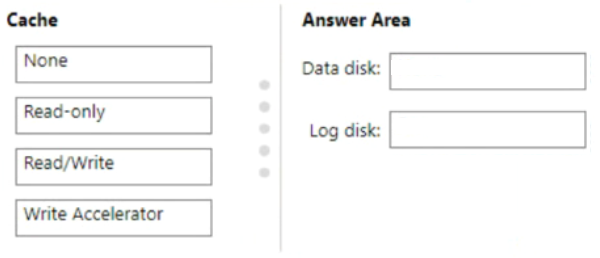
You have an Azure subscription that contains a D-series virtual machine named SQL1.
You plan to deploy an SAP landscape on Azure that will have Microsoft SQL Server installed.
You install a SQL server on SQL1 and place databases and logs on separate disks.
You need to configure caching for the disks.
Which type of cache should you configure for each disk? To answer, drag the appropriate cache types to the correct disks. Each cache type may be used once, more than once, or not at all. You may need to drag the split bar between panes or scroll to view content.
NOTE: Each correct selection is worth one point.
Show Answer
Correct Answer: Data disk: Read-only
Log disk: None
Explanation: Read-only caching benefits SQL Server data reads. Disable caching on the transaction log disk to preserve write consistency.
Question 123
DRAG DROP
You have an Azure subscription that is linked to an Azure AD tenant. The subscription contains a virtual machine named VM1.
You install SAP Landscape Management (LaMa) on VM1.
You need to ensure that you can use SAP LaMa to manage the deployment of SAP workloads to Azure virtual machines. The solution must minimize administrative effort.
Which three actions should you perform in sequence? To answer, move the appropriate actions from the list of actions to the answer area and arrange them in the correct order.
Show Answer
Correct Answer: 1. From the Azure portal, enable a system-assigned managed identity for VM1.
2. From the Azure portal, assign the Contributor role to the managed identity for the subscription.
3. From SAP Landscape Management, create an SAP LaMa connector.
Explanation: A system-assigned identity avoids managing separate credentials. Grant it access to Azure resources before configuring the SAP LaMa connector to use it.
Question 124
HOTSPOT
You have an on-premises SAP landscape.
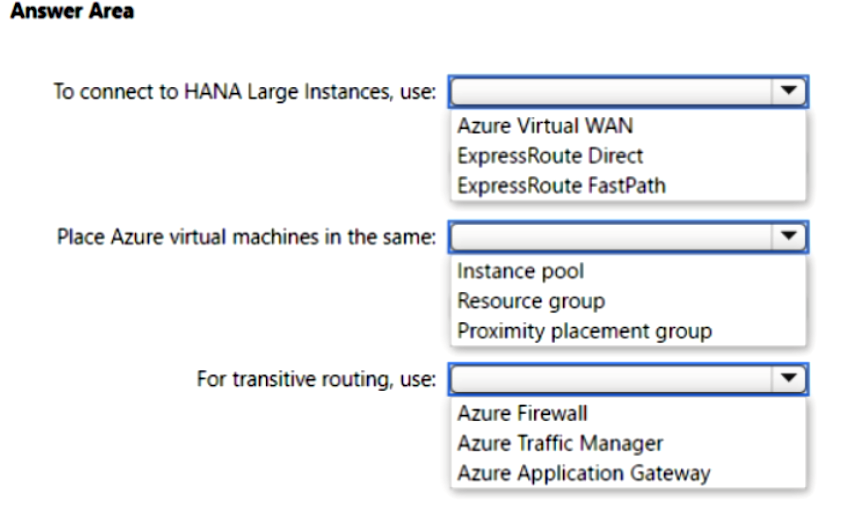
You plan to deploy SAP HANA on Azure (Large Instances) to the landscape.
You need to recommend a networking solution that meets the following requirements:
• Ensures low latency between HANA Large Instances and SAP applications
• Supports using SAP Solution Manager on-premises
How should you recommend configuring the network? To answer, select the appropriate options in the answer area.
NOTE: Each correct selection is worth one point.
Show Answer
Correct Answer: To connect to HANA Large Instances: ExpressRoute FastPath
Place Azure virtual machines in the same: Proximity placement group
For transitive routing: Azure Firewall
Explanation: FastPath reduces latency between Azure VMs and HANA Large Instances. A proximity placement group keeps the SAP application VMs close together, while Azure Firewall enables transitive routing for on-premises connectivity.
Question 125
You have an SAP landscape on Azure that contains the virtual machines shown in the following table.
You need to ensure that the Application Server role is available if a single Azure datacenter fails.
What should you include in the solution?
A. Azure Virtual WAN
B. Azure Basic Load Balancer
C. Azure Application Gateway v2
D. Azure AD Application Proxy
Show Answer
Correct Answer: C
Explanation: Azure Application Gateway v2 supports zone redundancy, allowing it to distribute traffic across availability zones so the SAP Application Server role can remain available if a single Azure datacenter fails. Azure Basic Load Balancer does not provide this zone-redundant capability.
Question 126
DRAG DROP
You have an on-premises network and an Azure subscription.
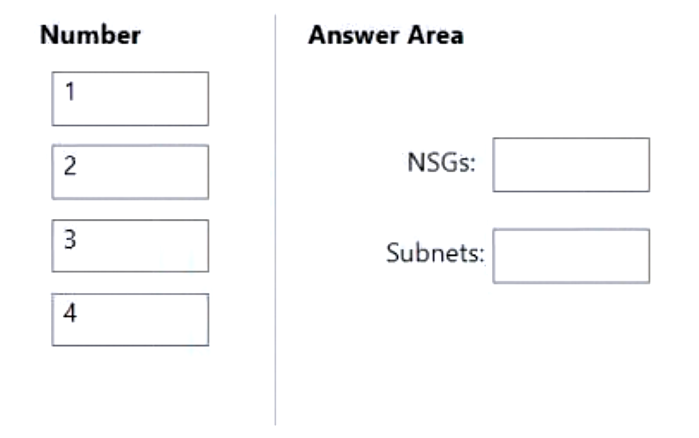
You plan to deploy a standard three-tier SAP architecture to a new Azure virtual network.
You need to configure network isolation for the virtual network. The solution must meet the following requirements:
• Allow client access from the on-premises network to the presentation servers.
• Only allow the application servers to communicate with the database servers.
• Only allow the presentation servers to access the application servers.
• Block all other inbound traffic.
What is the minimum number of network security groups (NSGs) and subnets required? To answer, drag the appropriate number to the correct targets. Each number may be used once, more than once, or not at all. You may need to drag the split bar between panes or scroll to view content.
NOTE: Each correct selection is worth one point.
Show Answer
Correct Answer: NSGs: 1
Subnets: 3
Explanation: Use one subnet for each SAP tier. A single NSG can be associated with all three subnets; its rules can allow the specified source-to-destination traffic and deny other inbound traffic.
Question 127
You have an Azure subscription that contains an SAP HANA on Azure (Large Instances) deployment.
The deployment is forecasted to require an additional 256 GB of storage.
What is the minimum amount of additional storage you can allocate?
A. 256 GB
B. 512 GB
C. 1 TB
D. 2 TB
Show Answer
Correct Answer: C
Explanation: Additional storage for SAP HANA on Azure (Large Instances) is allocated in 1-TB units. Therefore, the minimum allocation to cover a forecasted need of 256 GB is 1 TB.
Question 128
HOTSPOT
You plan to deploy an SAP production landscape on Azure.
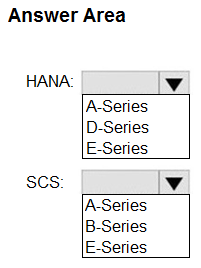
You need to identify which virtual machine series to use for the SAP HANA role and the SAP Central Services (SCS) role. The solution must meet the following requirements:
• Provide 384 GB of memory for the HANA role.
• Support ultra disks for the HANA role.
• Meet SAP certification.
• Minimize costs.
Which virtual machine series should you identify for each role? To answer, select the appropriate options in the answer area.
NOTE: Each correct selection is worth one point.
Show Answer
Correct Answer: HANA: E-Series
SCS: E-Series
Explanation: E-Series offers an SAP-certified option with 384 GB of memory and Ultra Disk support for HANA. For SCS, E-Series is the lowest-cost choice among the listed SAP-certified options.
Question 129
HOTSPOT
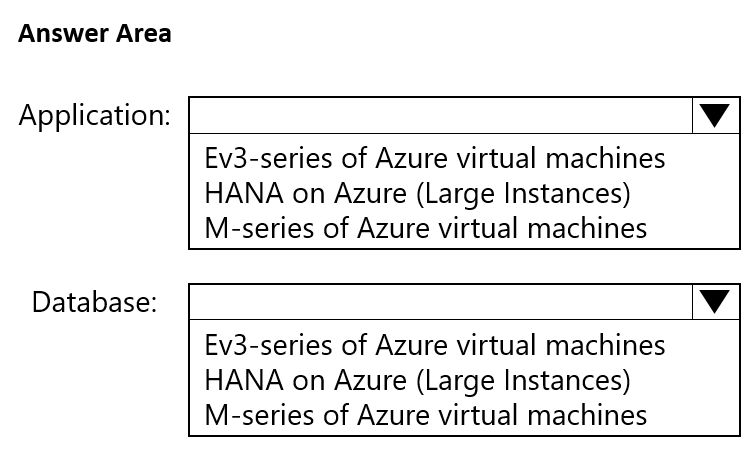
You have an on-premises deployment of SAP Business Suite on HANA that includes a CPU-intensive application tier and a 20-TB database tier.
You plan to migrate to SAP HANA on Azure.
You need to recommend a compute option to host the application and database tiers. The solution must minimize cost.
What should you recommend for each tier? To answer, select the appropriate options in the answer area.
NOTE: Each correct selection is worth one point.
Show Answer
Correct Answer: Application: Ev3-series Azure virtual machines
Database: HANA on Azure (Large Instances)
Explanation: Ev3 VMs are the lower-cost fit among the listed options for the application tier. A 20-TB HANA database requires the capacity of HANA Large Instances.
Question 130
DRAG DROP
You have a bill of materials (BOM) that describes SAP deployments.
You plan to automate the implementation of an SAP S4/HANA deployment to Azure by using the SAP deployment automation framework on Azure.
You need to generate the SAP application templates for the planned implementation and update the BOM.
In which order should you perform the actions? To answer, move all actions from the list of actions to the answer area and arrange them in the correct order.
Show Answer
Correct Answer: 1. Generate an ABAP Central Services (ASCS) parameter file.
2. Generate and combine the parameter files of the application servers.
3. Install the SAP HANA and SAP Central Services (SCS) instances.
4. Load the database content.
5. Add the templates to the BOM.
Explanation: Generate the application parameter files first. The HANA and SCS instances must be installed and running before the database content is loaded; then add the completed templates to the BOM.
$19
Get all 299 questions with detailed answers and explanations
Instant download HTML + PDF delivered the moment payment clears.
Secure Stripe checkout we never see or store your card details.
7-day refund if files are defective see our refund policy.