This is the free Microsoft MB-310 practice question bank —
180 of 357 total questions, each with a full explanation, free to
read with no signup required. Updated 2026-10-13.
Every answer is verified against official Microsoft documentation —
see our methodology.
Question 1
A company plans to implement financial management with Dynamics 365 Finance.
The company must be able to view cost changes for manufactured items without affecting the current active costs.
You need to configure the costing versions.
Which type of costing version should you configure?
A. Indirect cost allocation
B. Planned costs
C. Standard costs
D. Actual cost tracking
Show Answer
Correct Answer: B
Explanation: A planned-cost costing version is used to simulate and analyze cost changes for manufactured items without affecting the currently active costs. It allows cost calculations and comparisons before any activation, whereas standard cost versions are for active standard costs, actual cost tracking records actual costs, and indirect cost allocation is unrelated to costing version simulation.
Question 1
Case study -
This is a case study. Case studies are not timed separately. You can use as much exam time as you would like to complete each case. However, there may be additional case studies and sections on this exam. You must manage your time to ensure that you are able to complete all questions included on this exam in the time provided.
To answer the questions included in a case study, you will need to reference information that is provided in the case study. Case studies might contain exhibits and other resources that provide more information about the scenario that is described in the case study. Each question is independent of the other questions in this case study.
At the end of this case study, a review screen will appear. This screen allows you to review your answers and to make changes before you move to the next section of the exam. After you begin a new section, you cannot return to this section.
To start the case study -
To display the first question in this case study, click the Next button. Use the buttons in the left pane to explore the content of the case study before you answer the questions. Clicking these buttons displays information such as business requirements, existing environment, and problem statements. If the case study has an All Information tab, note that the information displayed is identical to the information displayed on the subsequent tabs. When you are ready to answer a question, click the Question button to return to the question.
Background -
Tailspin Toys is a toy manufacturing company that sells to distributors and customers through a business-to-consumer website. Tailspin Toys has been using custom-developed software for their accounting and supply chain management needs.
Tailspin Toys has toy factories in Mexico and Canada, with a head office based out of the United States. Tailspin Toys is currently operating with various financial departments including accounts payable, accounts receivable, fixed assets, and general accounting. The company has multiple legal entities to support their manufacturing units and selling organization.
Tailspin Toys wants to maintain consistent growth as a company and is now implementing Dynamics 365 Finance for all business processes.
Current environment -
Vendors -
• Tailspin Toys works with local and foreign vendors.
• The procurement process is designed for manufacturing raw materials, finished products, and packing materials for toys.
• The company monitors vendor balances by local and foreign vendors, both appearing in different general ledger accounts.
• For vendor payments, the accounts payable manager generates payment proposals every Wednesday, to have approvals and check printing done by Thursday in order to mail the checks by Friday of each week.
• Vendors can take part in the incentive program that offers travel vouchers and other gifts based on quantity and quality of supplies at the end of the year.
• Incentive program data is being monitored outside of the system and qualifying vendors are then provided to the financial department for expenses.
• The finance department accrues a small percentage of every vendor invoice during the year for this purpose, booking accounts payable liability account offsetting to the incentive expenses account.
• The finance department accrual then allows management to easily make decisions regarding types of gifts and vouchers to provide to the top-performing vendors.
Reporting -
• Management gets periodic reports from the finance department for all the legal entities. These reports provide all required finance data and are comprised of balance sheets, income statements, and cash flow statements.
Budget planning -
• The finance department oversees all budget planning.
• The finance department estimates the baseline for all budgets and distributes them to the respective departments.
• Each department estimates and forecasts their budget and sends it back to the finance department where the budget is updated accordingly.
Expenses -
Utility bills for the toy factories are currently getting expensed to the following departments as per the listed breakdown.
Asset leasing -
Tailspin Toys has leased assets in the form of factory buildings and warehouses. The company maintains asset books for the monthly leasing payments and pays compound interest on them. Tailspin Toys maintains future forecasts of their payment projections and budget requirements for leasing payments.
Requirements -
Consolidation -
• Automatic foreign currency consolidation at the corporate level is required by Tailspin Toys’ leadership.
• Consolidated results are needed in multiple reporting currencies.
Expenses -
• Utility bills must be allocated to allow each department to expense the correct amount.
Reports -
• Leadership requires financial reports to come to their inbox automatically as one at the end of every month.
Vendors -
• The system must show accounts payable liability by type of vendor similar to how it works in the current system.
• The chief financial officer (CFO) wants to configure the system to follow their business policies of paying vendors every Friday and as per credit issued by vendors and agreed method of payments.
• The accounts payable administrator must automate the vendor invoice process for imported invoices to bypass the review stage when no discrepancy is determined.
Budgets -
• A new organizational hierarchy is required for budget planning purposes.
• Leadership wants financial budgets enforced by alerting users upon reaching 90% of the total budget.
Asset leasing -
• The CFO must automatically process payments and journal entries for the leased properties.
• Management must view payment forecasts based on leased assets.
Issues -
Accounts payable issues -
• Vendor liability information for local and foreign vendors is not separated in the system.
• The accounts payable manager observed that a percentage of each invoice paid to vendors is not being posted for the yearly incentives program.
• The accounts payable clerk had to manually invoice a vendor receipt during user acceptance testing.
• The accounts payable manager must automate the current process of vendor payment proposals.
Other issues -
• The differences resulting from consolidating subsidiaries with foreign currencies are not considered.
• User A confirmed they did not receive an alert before running out of their budget.
• Expense reports for the manufacturing and sales departments do not contain utility bill expenses.
• The accounting manager reported that there is no batch journal created for the monthly lease expenses.
You need to report on forecasted lease payments.
Which asset leasing report should you use?
A. Five-years undiscounted payment forecast
B. GAAP cash flows
C. Asset movement
D. Lease balances forecast
Show Answer
Correct Answer: A
Explanation: Use the Five-years undiscounted payment forecast report. It shows projected lease payment amounts over the next five years. Lease balances forecast focuses on projected lease accounting balances rather than the payment forecast itself.
Question 1
HOTSPOT
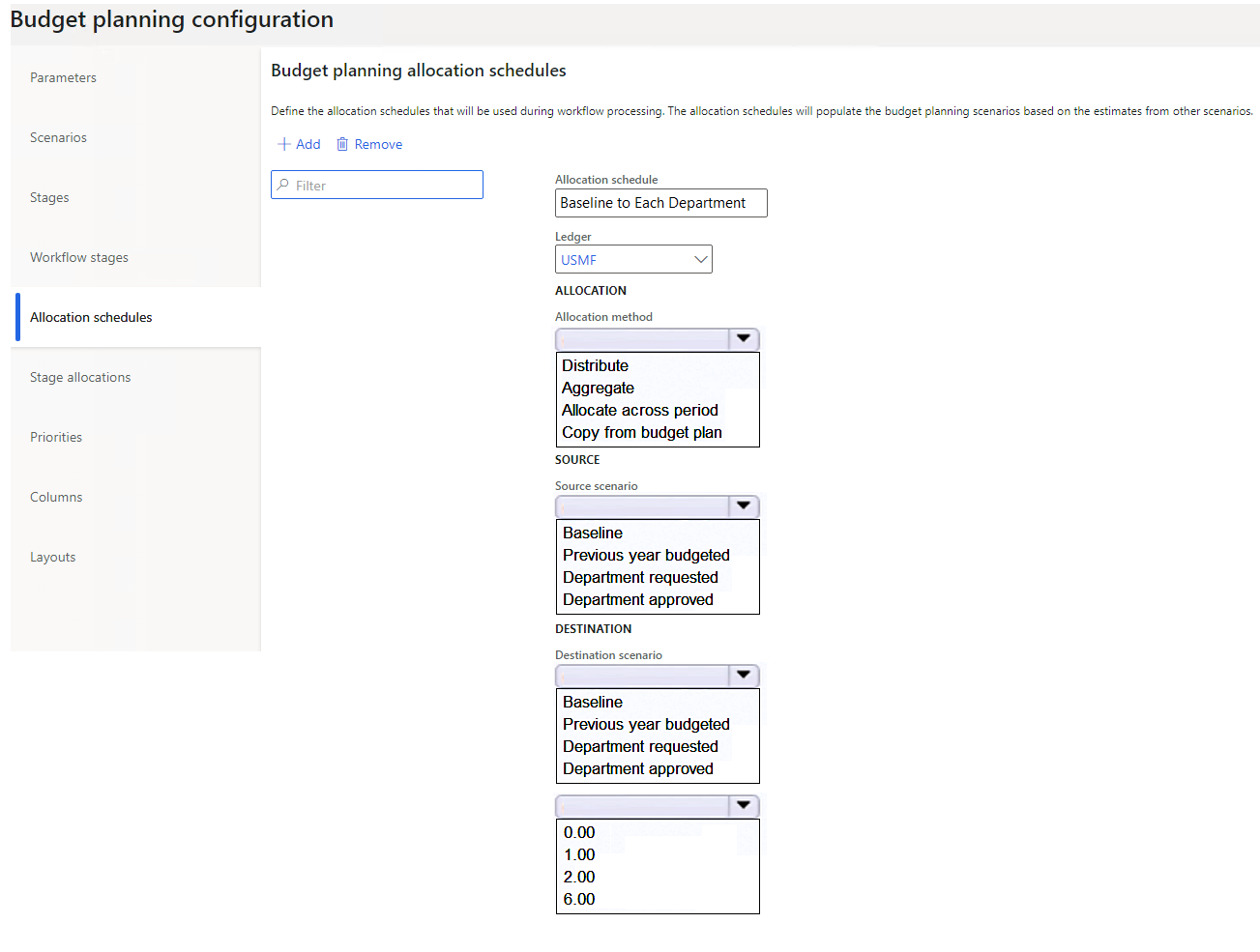
A company implements Dynamics 365 Finance. The company has six departments for budget planning purposes.
The company is budget planning and requires the following scenarios:
• A previous year budgeted scenario will be generated by the finance department.
• The baseline scenario will be generated based on the previous year budget scenarios with some increase.
• A baseline scenario will be sent to each department to review.
• Department requested scenarios will be keyed in by a department manager based on their review of the baseline scenario.
• Department requested scenarios will be aggregated back to the finance department, so finance can see the total budget requested.
• Finance will approve the final budget in Department approved scenario.
You need to configure allocation schedules to populate a baseline column for each department in the review process.
How should you configure budget planning? To answer, select the appropriate options in the answer area.
NOTE: Each correct selection is worth one point.
Explanation: Distribute copies the finance baseline to each department’s budget plan. Using Baseline as both source and destination populates each department’s baseline column; a factor of 1.00 preserves the amounts.
Question 2
Case study -
This is a case study. Case studies are not timed separately. You can use as much exam time as you would like to complete each case. However, there may be additional case studies and sections on this exam. You must manage your time to ensure that you are able to complete all questions included on this exam in the time provided.
To answer the questions included in a case study, you will need to reference information that is provided in the case study. Case studies might contain exhibits and other resources that provide more information about the scenario that is described in the case study. Each question is independent of the other questions in this case study.
At the end of this case study, a review screen will appear. This screen allows you to review your answers and to make changes before you move to the next section of the exam. After you begin a new section, you cannot return to this section.
To start the case study -
To display the first question in this case study, click the Next button. Use the buttons in the left pane to explore the content of the case study before you answer the questions. Clicking these buttons displays information such as business requirements, existing environment, and problem statements. If the case study has an All Information tab, note that the information displayed is identical to the information displayed on the subsequent tabs. When you are ready to answer a question, click the Question button to return to the question.
Background -
Tailspin Toys is a toy manufacturing company that sells to distributors and customers through a business-to-consumer website. Tailspin Toys has been using custom-developed software for their accounting and supply chain management needs.
Tailspin Toys has toy factories in Mexico and Canada, with a head office based out of the United States. Tailspin Toys is currently operating with various financial departments including accounts payable, accounts receivable, fixed assets, and general accounting. The company has multiple legal entities to support their manufacturing units and selling organization.
Tailspin Toys wants to maintain consistent growth as a company and is now implementing Dynamics 365 Finance for all business processes.
Current environment -
Vendors -
• Tailspin Toys works with local and foreign vendors.
• The procurement process is designed for manufacturing raw materials, finished products, and packing materials for toys.
• The company monitors vendor balances by local and foreign vendors, both appearing in different general ledger accounts.
• For vendor payments, the accounts payable manager generates payment proposals every Wednesday, to have approvals and check printing done by Thursday in order to mail the checks by Friday of each week.
• Vendors can take part in the incentive program that offers travel vouchers and other gifts based on quantity and quality of supplies at the end of the year.
• Incentive program data is being monitored outside of the system and qualifying vendors are then provided to the financial department for expenses.
• The finance department accrues a small percentage of every vendor invoice during the year for this purpose, booking accounts payable liability account offsetting to the incentive expenses account.
• The finance department accrual then allows management to easily make decisions regarding types of gifts and vouchers to provide to the top-performing vendors.
Reporting -
• Management gets periodic reports from the finance department for all the legal entities. These reports provide all required finance data and are comprised of balance sheets, income statements, and cash flow statements.
Budget planning -
• The finance department oversees all budget planning.
• The finance department estimates the baseline for all budgets and distributes them to the respective departments.
• Each department estimates and forecasts their budget and sends it back to the finance department where the budget is updated accordingly.
Expenses -
Utility bills for the toy factories are currently getting expensed to the following departments as per the listed breakdown.
Asset leasing -
Tailspin Toys has leased assets in the form of factory buildings and warehouses. The company maintains asset books for the monthly leasing payments and pays compound interest on them. Tailspin Toys maintains future forecasts of their payment projections and budget requirements for leasing payments.
Requirements -
Consolidation -
• Automatic foreign currency consolidation at the corporate level is required by Tailspin Toys’ leadership.
• Consolidated results are needed in multiple reporting currencies.
Expenses -
• Utility bills must be allocated to allow each department to expense the correct amount.
Reports -
• Leadership requires financial reports to come to their inbox automatically as one at the end of every month.
Vendors -
• The system must show accounts payable liability by type of vendor similar to how it works in the current system.
• The chief financial officer (CFO) wants to configure the system to follow their business policies of paying vendors every Friday and as per credit issued by vendors and agreed method of payments.
• The accounts payable administrator must automate the vendor invoice process for imported invoices to bypass the review stage when no discrepancy is determined.
Budgets -
• A new organizational hierarchy is required for budget planning purposes.
• Leadership wants financial budgets enforced by alerting users upon reaching 90% of the total budget.
Asset leasing -
• The CFO must automatically process payments and journal entries for the leased properties.
• Management must view payment forecasts based on leased assets.
Issues -
Accounts payable issues -
• Vendor liability information for local and foreign vendors is not separated in the system.
• The accounts payable manager observed that a percentage of each invoice paid to vendors is not being posted for the yearly incentives program.
• The accounts payable clerk had to manually invoice a vendor receipt during user acceptance testing.
• The accounts payable manager must automate the current process of vendor payment proposals.
Other issues -
• The differences resulting from consolidating subsidiaries with foreign currencies are not considered.
• User A confirmed they did not receive an alert before running out of their budget.
• Expense reports for the manufacturing and sales departments do not contain utility bill expenses.
• The accounting manager reported that there is no batch journal created for the monthly lease expenses.
You need to enforce financial budgets for management and resolve User A's issue.
What should you do?
A. Apply security rules to budget plans.
B. Configure budget control threshold.
C. Create a schema for formulating budget.
D. Create a new organizational hierarchy.
Show Answer
Correct Answer: B
Explanation: Configure the budget control threshold to 90%. This enforces budget monitoring and triggers an alert when spending reaches the specified percentage, addressing User A’s issue.
Question 2
HOTSPOT
-
A company uses Dynamics 365 Finance for its ledger settlement process. The company uses multiple currencies for business.
The company requires an automatic, efficient way to process gains and losses to settle accounts, including when the accounting currency amounts differ from the initial recording.
You need to configure the system to post foreign currency realized gains and losses for ledger settlements.
What should you do? To answer, select the appropriate options in the answer area.
NOTE: Each correct selection is worth one point.
Show Answer
Correct Answer: Set up gains and losses for ledger settlements: Configure posting profiles for gains and losses.
Account for the realized gain or loss on the foreign currency payable: Enable posting of realized gains or losses.
Explanation: Dynamics 365 Finance posts realized foreign currency gains/losses during settlement when realized gain/loss posting is enabled and the related gain/loss posting accounts are configured.
Question 3
DRAG DROP
-
A company uses Dynamics 365 Finance to manage fixed assets.
The company requires partial retirement of a fixed asset by using the split fixed asset functionality.
You need to process the fixed asset split.
Which three actions should you perform in sequence? To answer, move the appropriate actions from the list of actions to the answer area and arrange them in the correct order.
Show Answer
Correct Answer: 1. Create a new fixed asset.
2. Split the fixed asset by specifying the new asset number, book, split percentage, transaction date, and journal name.
3. Post the generated journal transaction.
Explanation: In Dynamics 365 Finance, the target asset must exist before performing the split. The split process generates a journal that must then be posted. Deleting the original acquisition record is not part of the split process.
Question 3
Case study -
This is a case study. Case studies are not timed separately. You can use as much exam time as you would like to complete each case. However, there may be additional case studies and sections on this exam. You must manage your time to ensure that you are able to complete all questions included on this exam in the time provided.
To answer the questions included in a case study, you will need to reference information that is provided in the case study. Case studies might contain exhibits and other resources that provide more information about the scenario that is described in the case study. Each question is independent of the other questions in this case study.
At the end of this case study, a review screen will appear. This screen allows you to review your answers and to make changes before you move to the next section of the exam. After you begin a new section, you cannot return to this section.
To start the case study -
To display the first question in this case study, click the Next button. Use the buttons in the left pane to explore the content of the case study before you answer the questions. Clicking these buttons displays information such as business requirements, existing environment, and problem statements. If the case study has an All Information tab, note that the information displayed is identical to the information displayed on the subsequent tabs. When you are ready to answer a question, click the Question button to return to the question.
Background -
Tailspin Toys is a toy manufacturing company that sells to distributors and customers through a business-to-consumer website. Tailspin Toys has been using custom-developed software for their accounting and supply chain management needs.
Tailspin Toys has toy factories in Mexico and Canada, with a head office based out of the United States. Tailspin Toys is currently operating with various financial departments including accounts payable, accounts receivable, fixed assets, and general accounting. The company has multiple legal entities to support their manufacturing units and selling organization.
Tailspin Toys wants to maintain consistent growth as a company and is now implementing Dynamics 365 Finance for all business processes.
Current environment -
Vendors -
• Tailspin Toys works with local and foreign vendors.
• The procurement process is designed for manufacturing raw materials, finished products, and packing materials for toys.
• The company monitors vendor balances by local and foreign vendors, both appearing in different general ledger accounts.
• For vendor payments, the accounts payable manager generates payment proposals every Wednesday, to have approvals and check printing done by Thursday in order to mail the checks by Friday of each week.
• Vendors can take part in the incentive program that offers travel vouchers and other gifts based on quantity and quality of supplies at the end of the year.
• Incentive program data is being monitored outside of the system and qualifying vendors are then provided to the financial department for expenses.
• The finance department accrues a small percentage of every vendor invoice during the year for this purpose, booking accounts payable liability account offsetting to the incentive expenses account.
• The finance department accrual then allows management to easily make decisions regarding types of gifts and vouchers to provide to the top-performing vendors.
Reporting -
• Management gets periodic reports from the finance department for all the legal entities. These reports provide all required finance data and are comprised of balance sheets, income statements, and cash flow statements.
Budget planning -
• The finance department oversees all budget planning.
• The finance department estimates the baseline for all budgets and distributes them to the respective departments.
• Each department estimates and forecasts their budget and sends it back to the finance department where the budget is updated accordingly.
Expenses -
Utility bills for the toy factories are currently getting expensed to the following departments as per the listed breakdown.
Asset leasing -
Tailspin Toys has leased assets in the form of factory buildings and warehouses. The company maintains asset books for the monthly leasing payments and pays compound interest on them. Tailspin Toys maintains future forecasts of their payment projections and budget requirements for leasing payments.
Requirements -
Consolidation -
• Automatic foreign currency consolidation at the corporate level is required by Tailspin Toys’ leadership.
• Consolidated results are needed in multiple reporting currencies.
Expenses -
• Utility bills must be allocated to allow each department to expense the correct amount.
Reports -
• Leadership requires financial reports to come to their inbox automatically as one at the end of every month.
Vendors -
• The system must show accounts payable liability by type of vendor similar to how it works in the current system.
• The chief financial officer (CFO) wants to configure the system to follow their business policies of paying vendors every Friday and as per credit issued by vendors and agreed method of payments.
• The accounts payable administrator must automate the vendor invoice process for imported invoices to bypass the review stage when no discrepancy is determined.
Budgets -
• A new organizational hierarchy is required for budget planning purposes.
• Leadership wants financial budgets enforced by alerting users upon reaching 90% of the total budget.
Asset leasing -
• The CFO must automatically process payments and journal entries for the leased properties.
• Management must view payment forecasts based on leased assets.
Issues -
Accounts payable issues -
• Vendor liability information for local and foreign vendors is not separated in the system.
• The accounts payable manager observed that a percentage of each invoice paid to vendors is not being posted for the yearly incentives program.
• The accounts payable clerk had to manually invoice a vendor receipt during user acceptance testing.
• The accounts payable manager must automate the current process of vendor payment proposals.
Other issues -
• The differences resulting from consolidating subsidiaries with foreign currencies are not considered.
• User A confirmed they did not receive an alert before running out of their budget.
• Expense reports for the manufacturing and sales departments do not contain utility bill expenses.
• The accounting manager reported that there is no batch journal created for the monthly lease expenses.
You need to address the requirement for allocating the utility bills.
Which allocation method should you use?
A. Equally
B. Fixed percentage
C. Basis
D. Fixed weight
Show Answer
Correct Answer: B
Explanation: The utility bills have a specified percentage for each department (60% manufacturing, 5% administration, 10% sales, and 25% marketing). Use a fixed-percentage allocation to apply that breakdown.
Question 4
A company is using Dynamics 365 Finance.
The company sets up items to be deferred by default by sales category for sales orders by completing the following steps:
1. Select items to defer by default.
2. Set up the deferred items for sales order type transactions.
3. Set up category relations for all deferred items.
Transaction lines where the items are entered are not being deferred.
You need to update the configuration to ensure that the transaction lines are deferred as required.
What should you do?
A. Set up deferred items for Purchasing transaction types.
B. Select the default accounts and templates.
C. Select the Account relation for all items.
D. Set up item relations for all deferred items.
Show Answer
Correct Answer: B
Explanation: In Dynamics 365 Finance, after configuring items to be deferred by default and defining category relations, you must also configure the default deferral accounts and templates. Microsoft Learn states that if the default accounts and templates are not selected on the Deferral defaults page, transaction lines where those items are entered are not deferred.
Sources:
https://learn.microsoft.com/en-us/dynamics365/finance/accounts-receivable/sb-deferrals
https://www.secexams.com/exams/Microsoft/mb-310/view/39
Question 4
Case study -
This is a case study. Case studies are not timed separately. You can use as much exam time as you would like to complete each case. However, there may be additional case studies and sections on this exam. You must manage your time to ensure that you are able to complete all questions included on this exam in the time provided.
To answer the questions included in a case study, you will need to reference information that is provided in the case study. Case studies might contain exhibits and other resources that provide more information about the scenario that is described in the case study. Each question is independent of the other questions in this case study.
At the end of this case study, a review screen will appear. This screen allows you to review your answers and to make changes before you move to the next section of the exam. After you begin a new section, you cannot return to this section.
To start the case study -
To display the first question in this case study, click the Next button. Use the buttons in the left pane to explore the content of the case study before you answer the questions. Clicking these buttons displays information such as business requirements, existing environment, and problem statements. If the case study has an All Information tab, note that the information displayed is identical to the information displayed on the subsequent tabs. When you are ready to answer a question, click the Question button to return to the question.
Background -
First Up Consultants is a global engineering and consulting organization based in Atlanta. The organization assists customers with various implementation projects. The organization provides both consulting services and custom software development.
First Up Consultants was recently acquired by a Canadian engineering firm that uses Dynamics 365 Finance. The firm requires First Up Consultants to transition to the solution by 2022.
First Up Consultants employs consultants that travel globally, which requires extensive expense management capabilities. First Up Consultants offers software as a service (SaaS) products to customers by using monthly and quarterly subscriptions.
Current environment. Travel and expense
The company is currently in Phase 2 of their Dynamics 365 Finance implementation.
• Consultants submit all travel receipts by using inter-office mail to the team admin for processing, but First Up Consultants wants to modernize this experience.
• Expense reports are manually approved and signed by the employee’s manager.
Current environment. Finance -
• First Up Consultants operates on a 4-5-4 calendar.
• Accounting for revenue has been difficult with the SaaS offerings. This has led to implementing Dynamics 365 Finance Revenue recognition.
• Revenue recognition has been live for 3 months.
• Adatum Corporation pays quarterly for use of the First Up Consultants web design application, starting from the day of use.
• Fourth Coffee pays monthly for use of the First Up Consultants photograph editing application with a contract starting August 1 and payment starting September 1.
• Adventure Works Cycles pays per use of the First Up Consultant video platform.
• A blocking rule is set up to prevent a sales order from processing if a customer exceeds a credit limit.
• Customer credit is set up at the account level for VanArsdel, Ltd.
• Tailspin Toys is owned by Wingtip Toys. The companies have a credit limit of $60.000 and $100,000, respectively.
Current environment. Revenue allocation
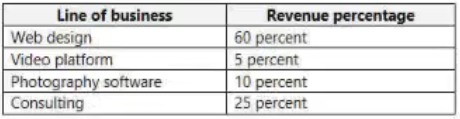
The company reports the following revenue allocation percentages:
Current environment. Tax -
VAT tax recovery is required for eligible international business trip expenses. Bank reconciliation is manual and performed by using monthly mailed account statements.
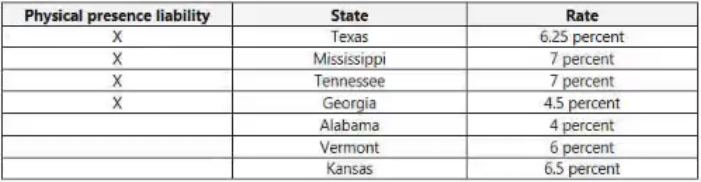
The company collects sales taxes from the following states:
Requirements -
Travel and expense -
• First Up Consultants requires that employees start using corporate cards for all travel expenses.
• All expenses over $50 require a receipt.
• Beer cannot be expensed.
• Employees may use the corporate card for personal expenses during work travel, but expenses must be categorized correctly.
• Client entertainment expenses totaling more than $250 must be audited.
• Employees require a mobile expense experience.
• Expense report entries must be validated when a transaction line is entered.
• Employees require the ability to capture receipts by using a mobile device.
• First Up Consultants requires the ability to reimburse employees in their paychecks for expenses incurred on personal cards.
Financials -
• A virtual thirteenth month is required for year-end transactions.
• Each day, a validation file must go to First Up Consultants bank detailing all vendor checks paid.
• Except fees, all matched transactions must clear automatically during bank reconciliation.
• The accounts payable team must verify expense reports prior to posting.
• Only payables are allowed to be posted to a prior period up to seven days into the new period.
Issues -
• User1 installed the Expense Management Service add-in and implemented the auto-match and create expense from receipt features, but the receipt images do not match the corporate card transactions.
• Employee1 submits an expense report for a business trip to Europe, but the report is not visible on the expense tax recovery page.
• Employees provided feedback that the system lets them know of an expense report policy violation only after the entire expense report is submitted.
• Members of the finance department observe sales orders that posted into a closed period.
• The finance team observed that for sales order invoice 1234, the price incorrectly posts to a revenue account when it should be deferring.
• Employee2 purchased supplies for a holiday party and needs to be reimbursed.
• A customer orders software licenses for the offices in Tennessee and Alabama.
• Expense reports for unapproved items are posting.
• VanArsdel, Ltd. exceeded its credit limit but the sales order was processed.
• Tailspin Toys purchases $70,000 in custom software development.
You need to address the posting of sales orders to a closed period.
What should you do?
A. Permanently close the period for all modules.
B. Use a ledger calendar to update period status.
C. Permanently close the fiscal year.
D. Use a ledger calendar to update module access.
E. Divide the period.
Show Answer
Correct Answer: D
Explanation: Update module access in the ledger calendar to prevent sales orders from posting to the prior period while keeping it open for Accounts payable during the permitted seven-day window. Changing the period status would also block the required payables postings.
Question 5
HOTSPOT
-
A utility company uses Dynamics 365 Finance for its recurring contract billing.
The company bills its customers quarterly for water and sewer services based on water meter readings. Pricing depends on usage. The cost is $10 per 1,000 gallons if the usage is under 10,000 gallons and $15 per 1,000 gallons if the usage exceeds 10,000 gallons.
You need to configure the billing schedule group.
How should you complete the setup? To answer, select the appropriate options in the answer area.
NOTE: Each correct selection is worth one point.
Explanation: Billing is based on meter readings, so the item type is Usage. The pricing states one rate applies when usage is under the threshold and a different rate applies when usage exceeds the threshold, which matches flat-tier pricing where the applicable tier rate is applied based on the total usage level.
$19
Get all 357 questions with detailed answers and explanations
Instant download HTML + PDF delivered the moment payment clears.
Secure Stripe checkout we never see or store your card details.
7-day refund if files are defective see our refund policy.