You have a 1-TB Azure Repos repository named repo1.
You need to clone repo1. The solution must meet the following requirements:
• You must be able to search the commit history of the /src directory
• The amount of time it takes to clone the repository must be minimized
Which command should you run?
A. git clone –-depth-1 [email protected] :v3/org/Project1/repo1
B. git clone –-filter=blob:none [email protected] :v3/org/Project1/repo1
C. git clone [email protected] :v3/org/Project1/repo1
D. git clone –-filter=true:0 [email protected] :v3/org/Project1/repo1
Show Answer
Correct Answer: B
Explanation: Use a partial clone with `--filter=blob:none` to download the commit history and tree objects while omitting blob (file content) objects until they are needed. This preserves the full commit history, allowing history searches (including for the `/src` directory), while minimizing initial clone time and data transfer. `--depth=1` removes most history, a full clone downloads everything, and `--filter=true:0` is not a valid Git partial clone filter syntax.
Question 118
You manage a project by using Azure Boards. You manage the project code by using GitHub.
You have three work items that have IDs of 456, 457, and 458.
You need to create a pull request that will be linked to all the work items. The solution must set the state of work item 456 to done.
What should you add to the commit message?
A. Done #456, #457, #458
B. #AB456, #AB457, #AB458
C. #456, #457, #458 Completed #456
D. #AB456, #AB457, #AB458 Completed #AB456
Show Answer
Correct Answer: D
Explanation: GitHub links to Azure Boards work items using the AB#<ID> syntax. To link all three work items, include AB#456, AB#457, and AB#458. Among the provided options, only D both uses the Azure Boards notation and includes a workflow keyword intended to complete work item 456. Although current Microsoft documentation commonly uses keywords such as 'Fixes AB#456' rather than 'Completed', D is the only answer that matches the exam's expected pattern.
Question 119
You manage code by using GitHub.
You plan to ensure that all GitHub Actions are validated by a security team.
You create a branch protection rule requiring that code changes be reviewed by code owners.
You need to create the CODEOWNERS file.
Where should you create the file?
A. .github/actions/
B. .github/
C. .git/
D. .github/workflows/
Show Answer
Correct Answer: B
Explanation: The CODEOWNERS file is supported when placed in the repository root, the docs/ directory, or the .github/ directory. Among the provided options, only .github/ is a valid location. Branch protection with required code owner reviews will use this file to determine code owners.
Question 120
Your company uses Azure DevOps and Microsoft Azure Active Directory (Azure AD), part of Microsoft Entra.
Only users who have accounts in Azure AD can access the Azure DevOps environment.
You need to ensure that only devices that are connected to the on-premises network can access the Azure DevOps environment.
What should you do?
A. Assign the Stakeholder access level to all users.
B. In Azure DevOps, configure Security in Project Settings.
C. In Azure AD, configure conditional access.
D. In Azure AD, configure risky sign-ins.
Show Answer
Correct Answer: C
Explanation: Azure AD (Microsoft Entra ID) Conditional Access is used to enforce access policies based on conditions such as device state, network location, or named locations. To ensure Azure DevOps is only accessible from devices connected to the on-premises network, configure a Conditional Access policy that restricts access based on trusted network locations or compliant/hybrid-joined device conditions. The other options do not enforce network-based access restrictions.
Question 123
You are automating the testing process for your company.
You need to automate UI testing of a web application.
Which framework should you use?
A. JaCoco
B. Playwright
C. Xamarin.UITest
D. Microsoft.CodeAnalysis
Show Answer
Correct Answer: B
Explanation: Playwright is a modern end-to-end test automation framework for automating UI testing of web applications across Chromium, Firefox, and WebKit. JaCoco is a Java code coverage tool, Xamarin.UITest targets mobile app UI testing, and Microsoft.CodeAnalysis (Roslyn) is for code analysis and compilation, not UI automation.
Question 125
You have an Azure web app that is deployed by using Azure Pipelines.
You need to ensure that when a new version of the app is deployed to production, you can roll back to the previous version. The solution must meet the following requirements:
• Minimize downtime during the deployment.
• Minimize the time it takes for the rollback.
What should you use?
A. a single web app and two deployment slots
B. a single web app and two deployment pipelines
C. two web apps and an Azure Standard Load Balancer
D. two web apps and an Azure Traffic Manager instance
Show Answer
Correct Answer: A
Explanation: Use a single Azure App Service with two deployment slots (typically production and staging). Deploy the new version to the staging slot, validate it, then perform a slot swap to production. Slot swaps provide near-zero downtime and allow very fast rollback by swapping back if issues are detected.
Question 127
You use GitHub to host container packages that use Semantic Versioning (SemVer).
You have an app named App1. The current version of App1 is 11.2.0.
You change the code of App1 to fix a bug that was introduced in version 10.5.1.
Which version number should you assign to the release?
A. 10.5.1-PATCH
B. 11.2.1
C. 10.5.2
D. 10.6.0
Show Answer
Correct Answer: B
Explanation: Under Semantic Versioning, a backwards-compatible bug fix increments the PATCH component of the current release line. The question states the current version is 11.2.0, so the next release that fixes the bug is 11.2.1. Although the bug was introduced in 10.5.1, the question does not state that you are maintaining a separate 10.5.x maintenance branch; if you were, 10.5.2 could be appropriate for that branch, but that is not what is described.
Question 128
DRAG DROP
-
You have an Azure Repos repository named repo1.
You delete a branch named features/feature11.
You need to recover the deleted branch.
Which three commands should you run in sequence? To answer, move the appropriate commands from the list of commands to the answer area and arrange them in the correct order.
Explanation: Find the commit SHA of the deleted branch, check out that commit in detached HEAD state, then recreate the branch pointing to the current commit.
Question 129
HOTSPOT
-
You have an Azure subscription.
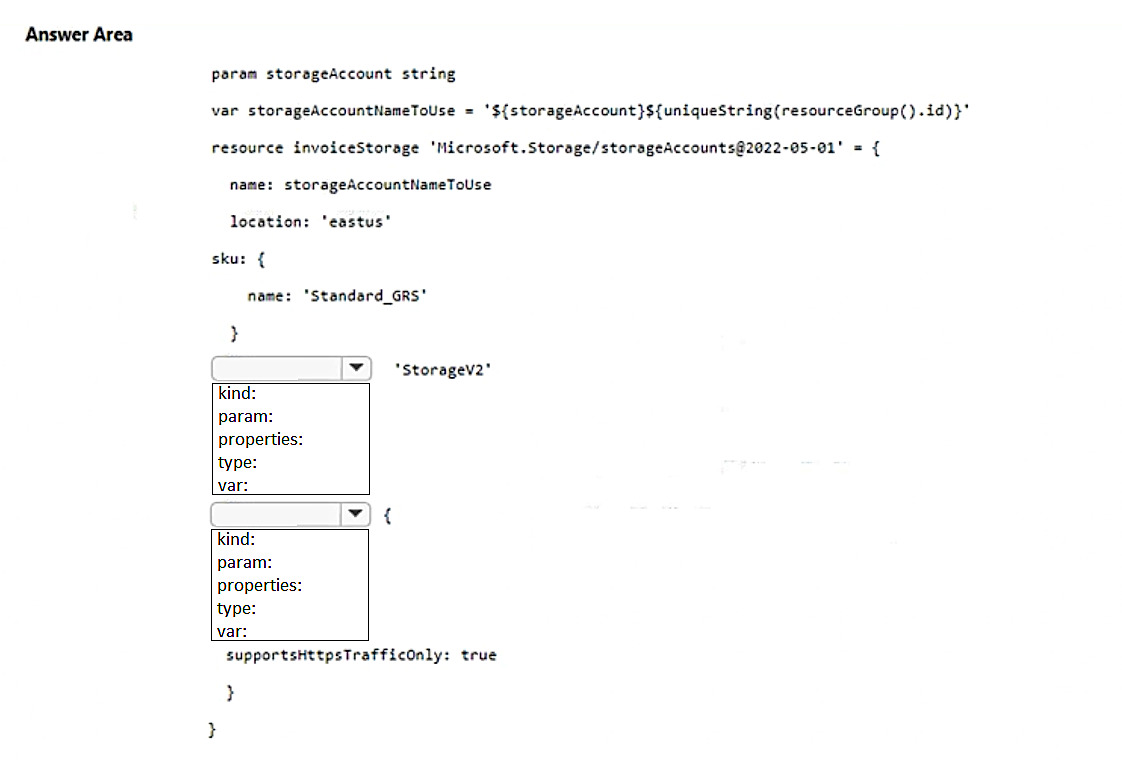
You need to create a storage account by using a Bicep file.
How should you complete the file? To answer, select the appropriate options in the answer area.
NOTE: Each correct selection is worth one point.
Show Answer
Correct Answer: kind:
properties:
Explanation: For a Microsoft.Storage/storageAccounts resource, the account type is specified with the 'kind' property (e.g. 'StorageV2'), and configuration such as supportsHttpsTrafficOnly belongs under the 'properties' object.
Question 131
You use Azure Repos to manage source code and Azure Pipelines to implement continuous integration and continuous deployment (CI/CD).
You need to ensure that all comments on pull requests are resolved before the pull requests are included in a build. The solution must minimize administrative effort.
What should you include in the solution?
A. a custom action
B. a post-deployment gate
C. a branch policy
D. a pre-deployment gate
Show Answer
Correct Answer: C
Explanation: Use an Azure Repos branch policy with the 'Check for comment resolution' setting. This enforces that all pull request comments are resolved before the PR can be completed and included in the target branch, minimizing administrative effort because it is a built-in policy. Pre-deployment and post-deployment gates apply to release/deployment workflows, and a custom action is unnecessary.
$19
Get all 541 questions with detailed answers and explanations
Instant download HTML + PDF delivered the moment payment clears.
Secure Stripe checkout we never see or store your card details.
7-day refund if files are defective see our refund policy.