You have an Azure Resource Manager (ARM) template that contains the following expression.
[if(parameters('isComplete'), '1a', '2a')]
You need to migrate the template to Bicep.
Which expression should you run?
A. iif(isComplete, '1a', '2a')
B. if(isComplete, '1a', '2a')
C. if('isComplete') '1a' else '2a'
D. isComplete ? '1a' '2a'
Show Answer
Correct Answer: D
Explanation: In ARM templates, if(condition, trueValue, falseValue) is migrated in Bicep to the ternary conditional operator: condition ? trueValue : falseValue. Therefore the equivalent is `isComplete ? '1a' : '2a'`. Among the options, D is clearly intended, but the colon appears to be missing due to a typo/OCR error. Bicep does not use an `if()` or `iif()` expression for this kind of value selection.
Question 46
You are developing an open source solution that uses a GitHub repository.
You create a new public project in Azure DevOps.
You plan to use Azure Pipelines for continuous build. The solution will use the GitHub Checks API.
Which authentication type should you use?
A. OpenID
B. GitHub App
C. a personal access token (PAT)
D. SAML
Show Answer
Correct Answer: B
Explanation: Use a GitHub App. Azure Pipelines requires GitHub App authentication to integrate with the GitHub Checks API; a personal access token is not the appropriate authentication type.
Question 47
You administer an Azure DevOps project that includes package feeds.
You need to ensure that developers can unlist and deprecate packages. The solution must use the principle of least privilege.
Which access level should you grant to the developers?
A. Collaborator
B. Contributor
C. Owner
Show Answer
Correct Answer: B
Explanation: Grant the developers the Contributor access level. Contributors can publish, unlist, and deprecate packages. Collaborators have more limited permissions, while Owners can also manage feed settings and permissions, which exceeds the least-privilege requirement.
Question 47
HOTSPOT
-
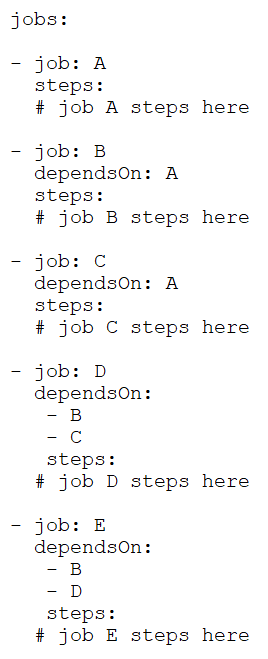
You have an Azure Pipelines pipeline that has the following definition.
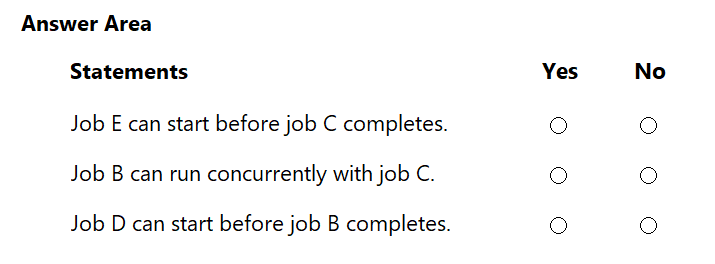
For each of the following statements, select Yes if the statement is true. Otherwise, select No.
NOTE: Each correct selection is worth one point.
Show Answer
Correct Answer: 1. No
2. Yes
3. No
Explanation: B and C both depend only on A, so they can run in parallel after A completes. D depends on both B and C, so it cannot start until both finish. E depends on B and D; since D already requires C, E also cannot start before C completes.
Question 48
Note: This question is part of a series of questions that present the same scenario. Each question in the series contains a unique solution that might meet the stated goals. Some question sets might have more than one correct solution, while others might not have a correct solution.
After you answer a question in this section, you will NOT be able to return to it. As a result, these questions will not appear in the review screen.
You plan to update the Azure DevOps strategy of your company.
You need to identify the following issues as they occur during the company's development process:
✑ Licensing violations
✑ Prohibited libraries
Solution: You implement automated security testing.
Does this meet the goal?
A. Yes
B. No
Show Answer
Correct Answer: A
Explanation: Yes. Automated security testing can include software-composition analysis that scans dependencies for prohibited libraries and license-compliance violations, for example through a tool integrated into the build pipeline.
Question 49
DRAG DROP -
Your company has two virtual machines that run Linux in a third-party public cloud.
You plan to use the company's Azure Automation State Configuration implementation to manage the two virtual machines and detect configuration drift.
You need to onboard the Linux virtual machines.
You install PowerShell Desired State Configuration (DSC) on the virtual machines, and then run register.py.
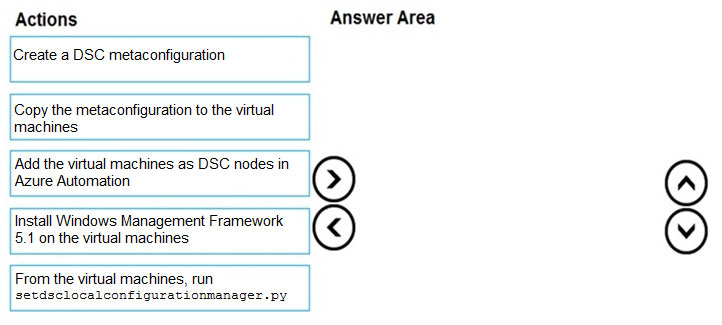
Which three actions should you perform next in sequence? To answer, move the actions from the list of actions to the answer area and arrange them in the correct order.
Select and Place:
Show Answer
Correct Answer: 1. Create a DSC metaconfiguration.
2. Copy the metaconfiguration to the virtual machines.
3. From the virtual machines, run setdsclocalconfigurationmanager.py.
Explanation: The script applies the metaconfiguration to each Linux VM’s Local Configuration Manager, enabling it to connect to Azure Automation State Configuration.
Question 50
You have an Azure DevOps project that contains a release pipeline and a Git repository.
When a new code revision is committed to the repository, a build and release is triggered.
You need to ensure that release information for the pipeline is added automatically to the work items associated to the Git commit.
What should you do?
A. Modify the Integrations options for the pipeline.
B. Modify the post-deployment conditions for the last stage of the pipeline.
C. Add an agentless job to the pipeline.
D. Modify the service hooks for the project.
Show Answer
Correct Answer: A
Explanation: Modify the release pipeline’s Integrations options to report deployment status to work items. This automatically adds release deployment information to work items linked to changes associated with the Git commit.
Question 51
HOTSPOT -
You company uses Azure DevOps to deploy infrastructures to Azure.
Pipelines are developed by using YAML.
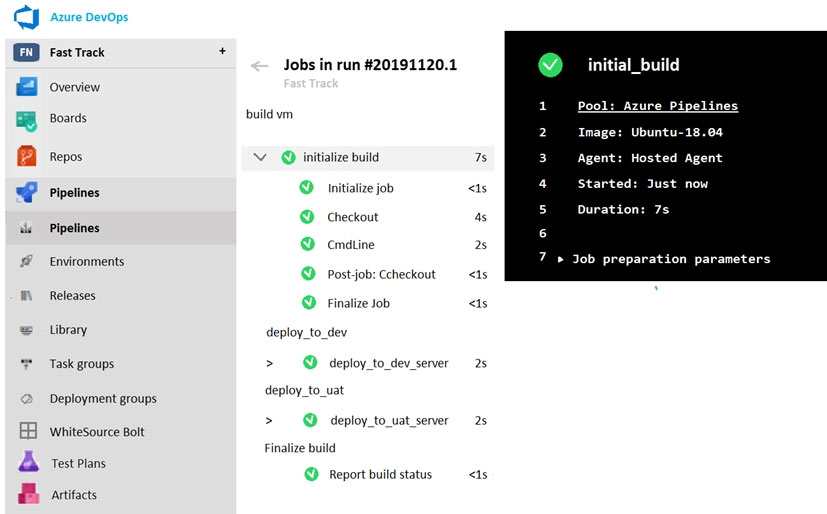
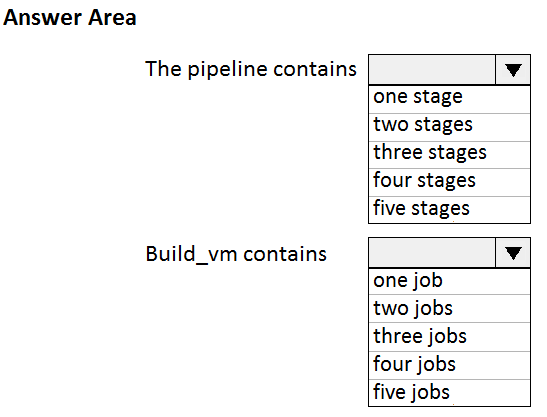
You execute a pipeline and receive the results in the web portal for Azure Pipelines as shown in the following exhibit.
Use the drop-down menus to select the answer choice that completes each statement based on the information presented in the graphic.
NOTE: Each correct selection is worth one point.
Hot Area:
Explanation: The run lists four stage headings: build vm, deploy_to_dev, deploy_to_uat, and Finalize build. Only initial_build is listed under build vm.
Question 52
DRAG DROP -
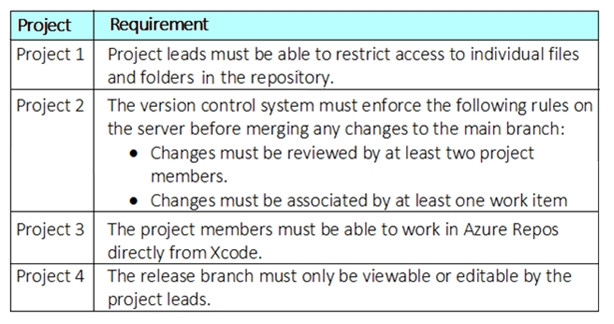
Your company has four projects. The version control requirements for each project are shown in the following table.
You plan to use Azure Repos for all the projects.
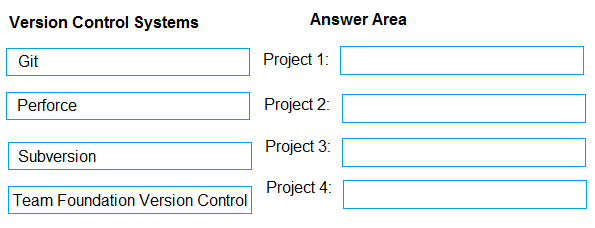
Which version control system should you use for each project? To answer, drag the appropriate version control systems to the correct projects. Each version control system may be used once, more than once, or not at all. You may need to drag the split bar between panes or scroll to view content.
NOTE: Each correct selection is worth one point.
Select and Place:
Show Answer
Correct Answer: Project 1: Team Foundation Version Control
Project 2: Git
Project 3: Git
Project 4: Team Foundation Version Control
Explanation: TFVC supports file- and folder-level access controls, including for a release branch. Git supports the required pull-request branch policies and direct use from Xcode.
Question 53
You have an Azure DevOps organization named Contoso and an Azure subscription. The subscription contains an Azure virtual machine scale set named VMSS1 and an Azure Standard Load Balancer named LB1. LB1 distributes incoming requests across VMSS1 instances.
You use Azure DevOps to build a web app named App1 and deploy App1 to VMSS1. App1 is accessible via HTTPS only and configured to require mutual authentication by using a client certificate.
You need to recommend a solution for implementing a health check of App1. The solution must meet the following requirements:
✑ Identify whether individual instances of VMSS1 are eligible for an upgrade operation.
✑ Minimize administrative effort.
What should you include in the recommendation?
A. an Azure Load Balancer health probe
B. Azure Monitor autoscale
C. the Custom Script Extension
D. the Application Health extension
Show Answer
Correct Answer: D
Explanation: Use the Application Health extension. It reports each VM scale set instance’s application health to Azure, which can use that status to determine whether the instance is eligible for an upgrade. It also avoids relying on an external HTTPS Load Balancer probe, which does not support mutual authentication with a client certificate.
$19
Get all 541 questions with detailed answers and explanations
Instant download HTML + PDF delivered the moment payment clears.
Secure Stripe checkout we never see or store your card details.
7-day refund if files are defective see our refund policy.