DRAG DROP
-
You have a project in Azure DevOps.
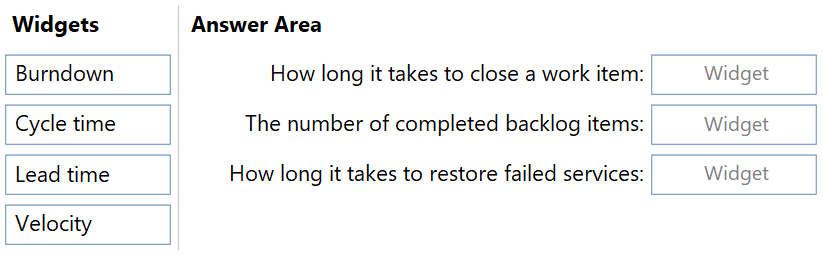
You need to configure a dashboard that will provide information on the following metrics.
• How long it takes to close a work item
• The number of completed backlog items
• How long it takes to restore failed services
Which type of widget should you use for each metric? To answer, drag the appropriate widget types to the correct metrics. Each widget type may be used once, more than once, or not at all. You may need to drag the split bar between panes or scroll to view content.
NOTE: Each correct selection is worth one point.
Show Answer
Correct Answer: How long it takes to close a work item: Cycle time
The number of completed backlog items: Velocity
How long it takes to restore failed services: Lead time
Explanation: Cycle time measures work item completion duration, Velocity shows completed backlog items per iteration, and Lead time measures elapsed time from request/issue creation to completion or resolution.
Question 65
You add the virtual machines as managed nodes in Azure Automation State Configuration.
You need to configure the managed computers in Pool7.
What should you do next?
A. Modify the RefreshMode property of the Local Configuration Manager (LCM).
B. Run the Register-AzureRmAutomationDscNode Azure Powershell cmdlet.
C. Modify the ConfigurationMode property of the Local Configuration Manager (LCM).
D. Install PowerShell Core.
Show Answer
Correct Answer: C
Explanation: The virtual machines are already added as managed nodes, so they do not need to be registered again. Modify the LCM’s ConfigurationMode to control how it applies and enforces the assigned configuration—for example, ApplyAndAutoCorrect to remediate drift automatically.
Question 65
You have an Azure subscription that contains an Azure Kubernetes Service (AKS) instance named AKS1.
You collect and analyze metrics for AKS1 by using the Azure Monitor managed service for Prometheus.
You need to analyze the performance of AKS1.
Which query language should you use?
A. PL/SQL
B. PromQL
C. SparkQL
D. KQL
Show Answer
Correct Answer: B
Explanation: Azure Monitor managed service for Prometheus stores and queries Prometheus metrics using PromQL. KQL is used for Log Analytics and Azure Data Explorer, not for querying Prometheus metrics. PL/SQL is Oracle's procedural language, and SparkQL is for Apache Spark.
Question 66
You have a project in Azure DevOps. You have an Azure Resource Group deployment project in Microsoft Visual Studio that is checked in to the Azure DevOps project.
You need to create a release pipeline that will deploy resources by using Azure Resource Manager templates. The solution must minimize administrative effort.
Which task type should you include in the solution?
A. Azure Cloud Service Deployment
B. Azure RM Web App Deployment
C. Azure PowerShell
D. Azure App Service Manage
Show Answer
Correct Answer: C
Explanation: Use the Azure PowerShell task to run the deployment script generated by the Visual Studio Azure Resource Group project. It deploys the ARM template and its parameters; the other options are for cloud services or App Service deployments rather than general Azure resources.
Question 66
You have an Azure App Service app named App1.
You need to identify when App1 was offline. The solution must minimize administrative effort.
Which troubleshooting category in App Service diagnostics should you use?
A. Navigator
B. Configuration and Management
C. Diagnostic Tools
D. Availability and Performance
Show Answer
Correct Answer: D
Explanation: Use the Availability and Performance troubleshooting category in App Service Diagnostics. It includes availability analysis, application downtime detection, HTTP errors, latency, and performance insights, making it the appropriate place to identify when an App Service was offline with minimal administrative effort.
Question 67
HOTSPOT -
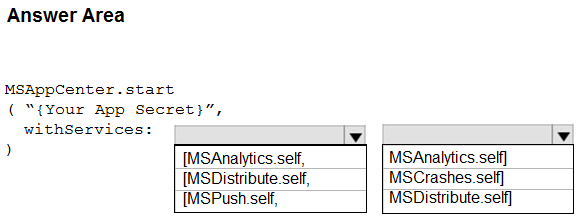
How should you complete the code to initialize App Center in the mobile application? To answer, select the appropriate options in the answer area.
NOTE: Each correct selection is worth one point.
Hot Area:
Show Answer
Correct Answer: First blank: [MSAnalytics.self,
Second blank: MSCrashes.self]
Explanation: Analytics collects device properties, while Crashes reports application crashes. Together they meet both reporting requirements.
Question 67
You manage source control by using GitHub.
You have a file named Data.txt that contains sensitive data. A user pushes Data.txt to a repository.
You need to purge the file from the repository.
Which two commands can you use? Each correct answer presents a complete solution.
NOTE: Each correct solution is worth one point.
A. git checkout git reset -hard -pathspec data.txt
Explanation: To purge a sensitive file from a Git repository, you must rewrite the repository history and then force-push the rewritten history. BFG Repo-Cleaner (`bfg --delete-files`) is a standard tool for removing sensitive files from all commits, followed by a force push. `git filter-repo --invert-paths --path data.txt` likewise rewrites history to remove the file from every commit, and `git push origin --force --all` publishes the rewritten history. Commands like `git rm` only remove the file from the latest commit and do not purge it from history; `git revert`, `git checkout`, and `git clean` do not remove sensitive data from repository history.
Sources:
https://learn.microsoft.com/en-us/training/modules/manage-git-repositories
Question 68
HOTSPOT
-
You have a management group that contains four Azure subscriptions. Each subscription contains four resource groups.
You develop a new web app named App1.
You plan to deploy an instance of App1 to each resource group.
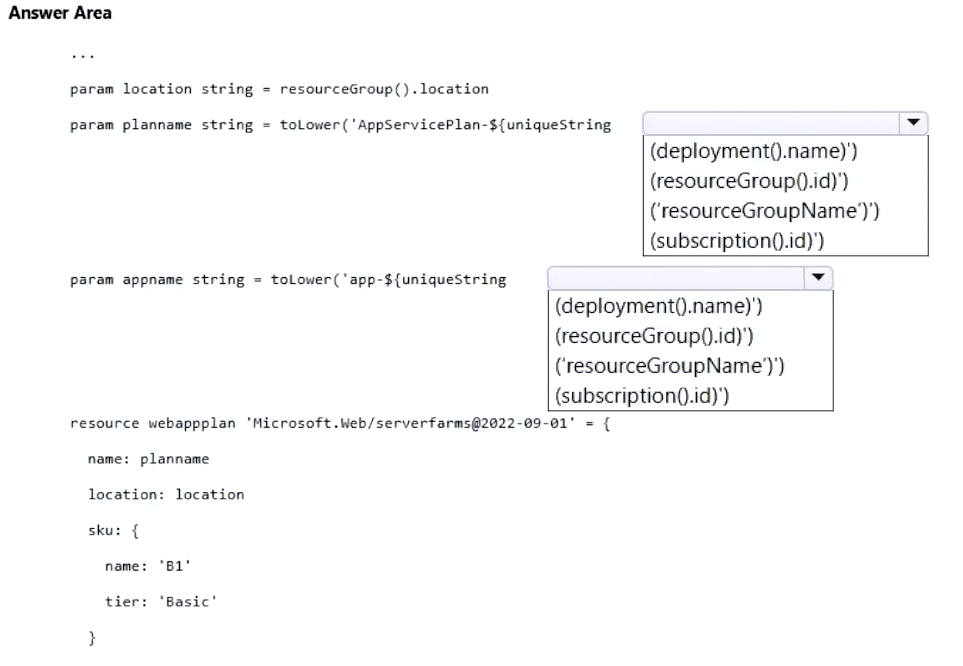
You need to create a Bicep template that will be used to deploy App1. The solution must meet the following requirements:
• The name of each App1 instance must be consistent for each subscription and resource group.
• The name of each App Service plan used to host App1 must be consistent.
How should you complete the template? To answer, select the appropriate options in the answer area.
NOTE: Each correct selection is worth one point.
Show Answer
Correct Answer: Plan name: subscription().id
App name: resourceGroup().id
Explanation: Use uniqueString(subscription().id) to keep the App Service plan name consistent across all resource groups within a subscription. Use uniqueString(resourceGroup().id) to generate a stable, unique app name per resource group, giving consistent names for repeated deployments while differing between resource groups.
Question 68
Your company has a project in Azure DevOps.
You need to ensure that when there are multiple builds pending deployment, only the most recent build is deployed.
What should you use?
A. deployment conditions
B. deployment queue settings
C. release gates
D. pull request triggers
Show Answer
Correct Answer: B
Explanation: Use deployment queue settings and choose the option to deploy the latest build and cancel the other queued deployments.
Question 69
You have a branch policy in a project in Azure DevOps. The policy requires that code always builds successfully.
You need to ensure that a specific user can always merge changes to the master branch, even if the code fails to compile. The solution must use the principle of least privilege.
What should you do?
A. Add the user to the Build Administrators group.
B. Add the user to the Project Administrators group.
C. From the Security settings of the repository, modify the access control for the user.
D. From the Security settings of the branch, modify the access control for the user.
Show Answer
Correct Answer: D
Explanation: Modify the user’s permissions in the master branch’s Security settings and allow the permission to bypass branch policies when completing pull requests. This grants the exception only to that user and branch, which is more narrowly scoped than repository- or project-wide access.
$19
Get all 541 questions with detailed answers and explanations
Instant download HTML + PDF delivered the moment payment clears.
Secure Stripe checkout we never see or store your card details.
7-day refund if files are defective see our refund policy.