You need to recommend a solution to generate a monthly report of all the new Azure Resource Manager (ARM) resource deployments in your Azure subscription.
What should you include in the recommendation?
A. Azure Arc
B. Azure Monitor metrics
C. Azure Advisor
D. Azure Log Analytics
Show Answer
Correct Answer: D
Explanation: Azure Log Analytics can collect and query Azure Activity Logs, including ARM resource deployment events. By querying deployment-related records over a monthly time range, you can generate a report of new Azure Resource Manager resource deployments. Azure Monitor metrics do not track deployment events, Azure Advisor provides recommendations rather than deployment reporting, and Azure Arc is for managing hybrid resources.
Question 73
You have an Azure subscription that contains 1,000 resources.
You need to generate compliance reports for the subscription. The solution must ensure that the resources can be grouped by department.
What should you use to organize the resources?
A. application groups and quotas
B. Azure Policy and tags
C. administrative units and Azure Lighthouse
D. resource groups and role assignments
Show Answer
Correct Answer: B
Explanation: Azure Policy can enforce governance requirements such as requiring specific tags, while tags (for example, a 'Department' tag) allow resources to be grouped, filtered, and reported by department. This combination supports compliance reporting across a large subscription. The other options do not provide resource classification for compliance reporting by department.
Question 73
Note: This question is part of a series of questions that present the same scenario. Each question in the series contains a unique solution that might meet the stated goals. Some question sets might have more than one correct solution, while others might not have a correct solution.
After you answer a question in this section, you will NOT be able to return to it. As a result, these questions will not appear in the review screen.
Your company deploys several virtual machines on-premises and to Azure. ExpressRoute is deployed and configured for on-premises to Azure connectivity.
Several virtual machines exhibit network connectivity issues.
You need to analyze the network traffic to identify whether packets are being allowed or denied to the virtual machines.
Solution: Use Azure Traffic Analytics in Azure Network Watcher to analyze the network traffic.
Does this meet the goal?
A. Yes
B. No
Show Answer
Correct Answer: B
Explanation: No. Traffic Analytics summarizes network-flow patterns from flow logs. To check whether a specific packet to or from a VM is allowed or denied—and identify the blocking security rule—use Network Watcher IP flow verify.
Question 74
You need to recommend a solution to generate a monthly report of all the new Azure Resource Manager (ARM) resource deployments in your Azure subscription.
What should you include in the recommendation?
A. Azure Monitor action groups
B. Azure Arc
C. Azure Monitor metrics
D. Azure Activity Log
Show Answer
Correct Answer: D
Explanation: Azure Activity Log records subscription-level events, including Azure Resource Manager create, update, and delete operations. It can be queried and exported to generate monthly reports of new ARM resource deployments. Azure Monitor metrics capture performance data, action groups are for notifications, and Azure Arc is for managing hybrid resources.
Question 76
DRAG DROP
-
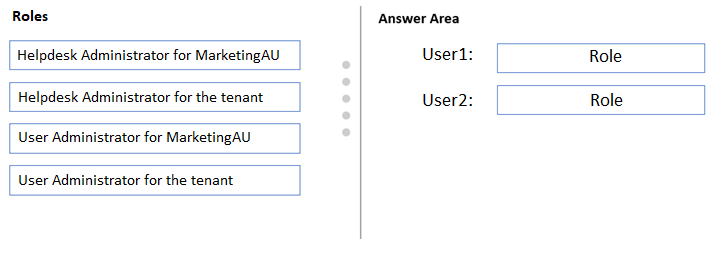
You have an Azure AD tenant that contains an administrative unit named MarketingAU. MarketingAU contains 100 users.
You create two users named User1 and User2.
You need to ensure that the users can perform the following actions in MarketingAU:
• User1 must be able to create user accounts.
• User2 must be able to reset user passwords.
Which role should you assign to each user? To answer, drag the appropriate roles to the correct users. Each role may be used once, more than once, or not at all. You may need to drag the split bar between panes or scroll to view content.
NOTE: Each correct selection is worth one point.
Show Answer
Correct Answer: User1: User Administrator for MarketingAU
User2: Helpdesk Administrator for MarketingAU
Explanation: Use administrative unit–scoped roles to follow least privilege. User Administrator scoped to the administrative unit can manage users (including creating user accounts relevant to that scope). Helpdesk Administrator scoped to the administrative unit can reset passwords for users in that administrative unit.
Question 77
HOTSPOT
-
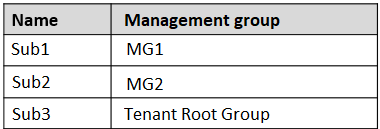
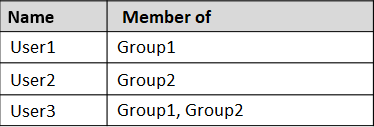
You have an Azure AD tenant that contains a management group named MG1.
You have the Azure subscriptions shown in the following table.
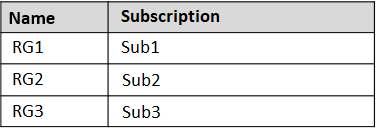
The subscriptions contain the resource groups shown in the following table.
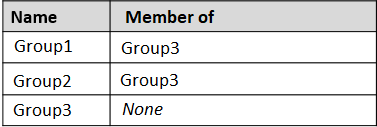
The subscription contains the Azure AD security groups shown in the following table.
The subscription contains the user accounts shown in the following table.
You perform the following actions:
Assign User3 the Contributor role for Sub1.
Assign Group1 the Virtual Machine Contributor role for MG1.
Assign Group3 the Contributor role for the Tenant Root Group.
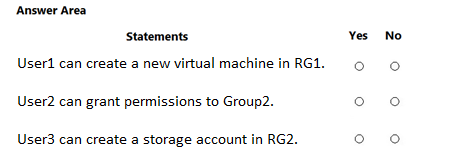
For each of the following statements, select Yes if the statement is true. Otherwise, select No.
NOTE: Each correct selection is worth one point.
Show Answer
Correct Answer: Yes
No
Yes
Explanation: VM Contributor at MG1 applies to Sub1/RG1, so User1 can create VMs there. Contributor cannot grant RBAC permissions, so User2 cannot grant permissions. Contributor at the Tenant Root Group propagates to descendant scopes, and nested group membership grants the role to User3, allowing creation of a storage account in RG2.
Question 79
You need to design a highly available Azure SQL database that meets the following requirements:
• Failover between replicas of the database must occur without any data loss.
• The database must remain available in the event of a zone outage.
• Costs must be minimized.
Which deployment option should you use?
A. Azure SQL Database Hyperscale
B. Azure SQL Database Premium
C. Azure SQL Database Basic
D. Azure SQL Database Serverless
Show Answer
Correct Answer: B
Explanation: Premium (DTU model) maps to the Business Critical architecture, which provides multiple synchronous replicas with automatic failover and can be configured for zone redundancy to survive an availability zone outage without data loss. Basic and Serverless do not meet these high-availability requirements, and Hyperscale prioritizes scalability rather than this combination of synchronous zero-data-loss failover and minimized cost among the listed HA-capable options.
Question 80
You need to design a highly available Azure SQL database that meets the following requirements:
• Failover between replicas of the database must occur without any data loss.
• The database must remain available in the event of a zone outage.
• Costs must be minimized.
Which deployment option should you use?
A. Azure SQL Database Standard
B. Azure SQL Managed Instance General Purpose
C. Azure SQL Database Serverless
D. Azure SQL Database Premium
Show Answer
Correct Answer: D
Explanation: The requirements imply synchronous replication with zero data loss on failover and zone resilience. Azure SQL Database Premium uses the Business Critical architecture with multiple synchronous replicas and supports zone-redundant high availability. Standard and General Purpose do not provide the same zero-data-loss local failover architecture, and Serverless is a compute tier rather than an HA architecture and does not by itself satisfy these requirements.
Question 82
HOTSPOT
-
You have an app that generates 50,000 events daily.
You plan to stream the events to an Azure event hub and use Event Hubs Capture to implement cold path processing of the events. The output of Event Hubs Capture will be consumed by a reporting system.
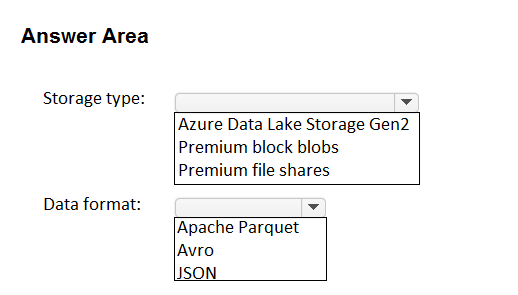
You need to identify which type of Azure storage must be provisioned to support Event Hubs Capture, and which inbound data format the reporting system must support.
What should you identify? To answer, select the appropriate options in the answer area.
NOTE: Each correct selection is worth one point.
Show Answer
Correct Answer: Storage type: Azure Data Lake Storage Gen2
Data format: Avro
Explanation: Event Hubs Capture supports capturing to Azure Blob Storage or Azure Data Lake Storage Gen2 (not premium storage). From the given options, Azure Data Lake Storage Gen2 is correct. Event Hubs Capture stores captured events in Avro format by default.
Question 83
You are developing a sales application that will contain several Azure cloud services and handle different components of a transaction. Different cloud services will process customer orders, billing, payment, inventory, and shipping.
You need to recommend a solution to enable the cloud services to asynchronously communicate transaction information by using XML messages.
What should you include in the recommendation?
A. Azure Notification Hubs
B. Azure Queue Storage
C. Azure Blob Storage
D. Azure Application Gateway
Show Answer
Correct Answer: B
Explanation: Azure Queue Storage is designed for asynchronous communication between application components by storing messages for later processing. It is suitable for decoupling services such as orders, billing, payment, inventory, and shipping, and queue messages can contain XML payloads. Notification Hubs are for push notifications, Blob Storage is for object storage, and Application Gateway is a web traffic load balancer.
$19
Get all 315 questions with detailed answers and explanations
Instant download HTML + PDF delivered the moment payment clears.
Secure Stripe checkout we never see or store your card details.
7-day refund if files are defective see our refund policy.