This is the free Microsoft AZ-305 practice question bank —
140 of 272 total questions, each with a full explanation, free to
read with no signup required. Updated 2026-10-13.
Every answer is verified against official Microsoft documentation —
see our methodology.
Question 1
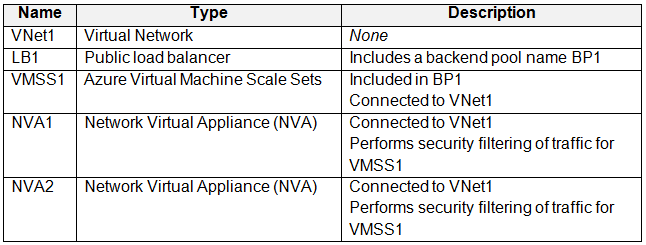
You have an Azure subscription that contains the resources shown in the following table.
You need to recommend a load balancing solution that will distribute incoming traffic for VMSS1 across NVA1 and NVA2. The solution must minimize administrative effort.
What should you include in the recommendation?
A. Gateway Load Balancer
B. Azure Front Door
C. Azure Application Gateway
D. Azure Traffic Manager
Show Answer
Correct Answer: A
Explanation: Use Azure Gateway Load Balancer. It is designed to transparently distribute traffic through network virtual appliances such as NVA1 and NVA2. It can be chained to the existing load balancer, minimizing the routing and configuration work needed to inspect traffic destined for VMSS1.
Question 1
You have an on-premises network and an Azure subscription. The on-premises network has several branch offices.
A branch office in Toronto contains a virtual machine named VM1 that is configured as a file server. Users access the shared files on VM1 from all the offices.
You need to recommend a solution to ensure that the users can access the shared files as quickly as possible if the Toronto branch office is inaccessible.
What should you include in the recommendation?
A. a Recovery Services vault and Windows Server Backup
B. Azure blob containers and Azure File Sync
C. a Recovery Services vault and Azure Backup
D. an Azure file share and Azure File Sync
Show Answer
Correct Answer: D
Explanation: Azure File Sync synchronizes the on-premises Windows file server with an Azure file share. If the Toronto branch office or VM1 becomes unavailable, users can access the data directly from the Azure file share, providing the fastest continuity of access. Backup solutions (Recovery Services vault, Azure Backup, Windows Server Backup) are intended for recovery, not immediate file access.
Question 1
HOTSPOT -
Your on-premises datacenter contains a server named Server1 that runs Microsoft SQL Server 2022. Server1 contains a 30-TB database named DB1 that stores customer data. Server1 runs a custom application named App1 that verifies the compliance of records in DB1. App1 must run on the same server as DB1.
You have an Azure subscription.
You need to migrate DB1 to Azure. The solution must minimize administrative effort.
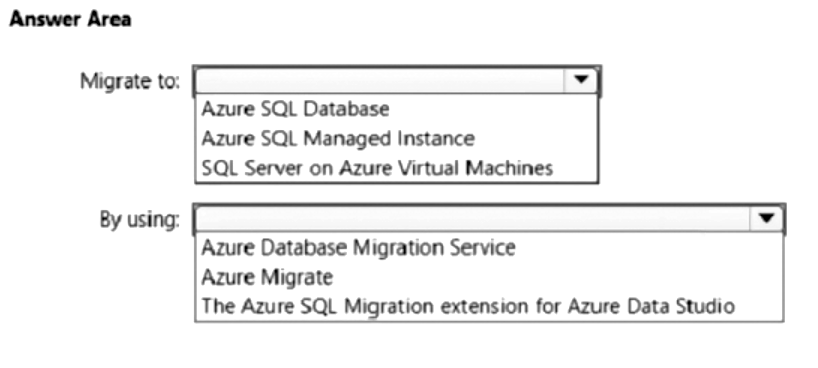
To which service should you migrate DB1, and what should you use to perform the migration? To answer, select the appropriate options in the answer area.
NOTE: Each correct selection is worth one point.
Show Answer
Correct Answer: Migrate to: SQL Server on Azure Virtual Machines
By using: Azure Migrate
Explanation: An Azure VM can host both DB1 and App1 on the same server. Azure Migrate supports lifting and shifting the server together, minimizing migration effort.
Question 1
You need to recommend a solution to generate a monthly report of all the new Azure Resource Manager (ARM) resource deployments in your Azure subscription.
What should you include in the recommendation?
A. Azure Log Analytics
B. Azure Arc
C. Azure Analysis Services
D. Azure Monitor action groups
Show Answer
Correct Answer: A
Explanation: Azure Log Analytics can collect and query Azure Activity Logs, including Azure Resource Manager deployment events, making it suitable for generating monthly reports of new ARM resource deployments. Azure Arc manages hybrid resources, Azure Analysis Services is for semantic models, and Azure Monitor action groups are for alert notifications rather than reporting.
Question 2
You are developing a sales application that will contain several Azure cloud services and handle different components of a transaction. Different cloud services will process customer orders, billing, payment, inventory, and shipping.
You need to recommend a solution to enable the cloud services to asynchronously communicate transaction information by using XML messages.
What should you include in the recommendation?
A. Azure Service Fabric
B. Azure Notification Hubs
C. Azure Service Bus
D. Azure Traffic Manager
Show Answer
Correct Answer: C
Explanation: Azure Service Bus provides reliable asynchronous messaging between distributed cloud services using queues and topics, and supports message-based integration, including XML payloads. It is designed for decoupling services such as orders, billing, payment, inventory, and shipping. Service Fabric is an application platform, Notification Hubs is for push notifications, and Traffic Manager is for DNS-based traffic routing.
Question 2
You have the resources shown in the following table.
CDB1 hosts a container that stores continuously updated operational data.
You are designing a solution that will use AS1 to analyze the operational data daily.
You need to recommend a solution to analyze the data without affecting the performance of the operational data store.
What should you include in the recommendation?
A. Azure Data Factory with Azure Cosmos DB and Azure Synapse Analytics connectors
B. Azure Synapse Analytics with PolyBase data loading
C. Azure Synapse Link for Azure Cosmos DB
D. Azure Cosmos DB change feed
Show Answer
Correct Answer: C
Explanation: Azure Synapse Link for Azure Cosmos DB lets Azure Synapse Analytics analyze Cosmos DB operational data through an analytical store, isolating analytical queries from the transactional workload and avoiding a separate ETL pipeline.
Question 3
You have 12 Azure subscriptions and three projects. Each project uses resources across multiple subscriptions.
You need to use Microsoft Cost Management to monitor costs on a per project basis. The solution must minimize administrative effort.
Which two components should you include in the solution? Each correct answer presents part of the solution.
NOTE: Each correct selection is worth one point.
A. budgets
B. resource tags
C. custom role-based access control (RBAC) roles
D. management groups
E. Azure boards
Show Answer
Correct Answer: B, D
Explanation: Resource tags identify which project each resource belongs to, even when projects share subscriptions. A management group provides a single Cost Management scope across the subscriptions, avoiding separate monitoring setups for each one. Budgets are useful for spending alerts but aren’t required to analyze costs by project.
Sources:
https://learn.microsoft.com/en-us/azure/cost-management-billing/costs/overview-cost-management
https://learn.microsoft.com/en-us/azure/cloud-adoption-framework/ready/azure-best-practices/track-costs
Question 3
You need to recommend a solution to generate a monthly report of all the new Azure Resource Manager (ARM) resource deployments in your Azure subscription.
What should you include in the recommendation?
A. Application Insights
B. Azure Analysis Services
C. Azure Advisor
D. Azure Log Analytics
Show Answer
Correct Answer: D
Explanation: Azure Log Analytics can collect and query Azure Activity Logs, including Azure Resource Manager deployment events. You can create queries and scheduled monthly reports of newly deployed ARM resources. Application Insights monitors application telemetry, Azure Analysis Services is an analytics platform, and Azure Advisor provides optimization recommendations rather than deployment reporting.
Question 3
Your company has the divisions shown in the following table.
Sub1 contains an Azure App Service web app named App1. App1 uses Azure AD for single-tenant user authentication. Users from contoso.com can authenticate to App1.
You need to recommend a solution to enable users in the fabrikam.com tenant to authenticate to App1.
What should you recommend?
A. Configure Azure AD Identity Protection.
B. Configure assignments for the fabrikam.com users by using Azure AD Privileged Identity Management (PIM).
C. Configure Supported account types in the application registration and update the sign-in endpoint.
D. Configure a Conditional Access policy.
Show Answer
Correct Answer: C
Explanation: App1 is registered for single-tenant authentication, so only users in contoso.com can sign in. Change the application registration’s supported account types to allow accounts from any organizational directory (multitenant), and update the sign-in endpoint to use the appropriate multitenant endpoint.
Question 4
Your company has the divisions shown in the following table.
Sub1 contains an Azure App Service web app named App1. App1 uses Azure AD for single-tenant user authentication. Users from contoso.com can authenticate to App1.
You need to recommend a solution to enable users in the fabrikam.com tenant to authenticate to App1.
What should you recommend?
A. Use Azure AD entitlement management to govern external users.
B. Enable Azure AD pass-through authentication and update the sign-in endpoint.
C. Configure a Conditional Access policy.
D. Configure assignments for the fabrikam.com users by using Azure AD Privileged Identity Management (PIM).
Show Answer
Correct Answer: A
Explanation: Use Azure AD entitlement management to onboard and govern fabrikam.com users as external users in the contoso.com tenant, then grant them access to App1. Pass-through authentication, Conditional Access, and PIM do not enable users from another tenant to authenticate to the app.
$19
Get all 272 questions with detailed answers and explanations
Instant download HTML + PDF delivered the moment payment clears.
Secure Stripe checkout we never see or store your card details.
7-day refund if files are defective see our refund policy.