You need to design a highly available Azure SQL database that meets the following requirements:
• Failover between replicas of the database must occur without any data loss.
• The database must remain available in the event of a zone outage.
• Costs must be minimized.
Which deployment option should you use?
A. Azure SQL Database Basic
B. Azure SQL Database Business Critical
C. Azure SQL Database Standard
D. Azure SQL Managed Instance General Purpose
Show Answer
Correct Answer: B
Explanation: Business Critical uses Always On availability groups with synchronous replicas, enabling failover without data loss and supports zone-redundant deployments for availability during an availability zone outage. Basic and Standard do not meet the zero-data-loss/high-availability requirement. Managed Instance General Purpose historically did not provide the required combination for exam scenarios; Business Critical is the expected deployment despite higher cost because it is the least expensive option that satisfies all requirements.
Question 90
You are developing a sales application that will contain several Azure cloud services and handle different components of a transaction. Different cloud services will process customer orders, billing, payment, inventory, and shipping.
You need to recommend a solution to enable the cloud services to asynchronously communicate transaction information by using XML messages.
What should you include in the recommendation?
A. Azure Notification Hubs
B. Azure Application Gateway
C. Azure Queue Storage
D. Azure Traffic Manager
Show Answer
Correct Answer: C
Explanation: Azure Queue Storage enables asynchronous communication between application components by storing messages (including XML payloads) in queues for reliable processing. Notification Hubs are for push notifications, Application Gateway is a web traffic load balancer, and Traffic Manager provides DNS-based traffic routing.
Question 91
You are developing a sales application that will contain several Azure cloud services and handle different components of a transaction. Different cloud services will process customer orders, billing, payment, inventory, and shipping.
You need to recommend a solution to enable the cloud services to asynchronously communicate transaction information by using XML messages.
What should you include in the recommendation?
A. Azure Notification Hubs
B. Azure Application Gateway
C. Azure Service Bus
D. Azure Traffic Manager
Show Answer
Correct Answer: C
Explanation: Azure Service Bus is designed for reliable asynchronous messaging between distributed applications and services. It supports queues and topics for decoupled communication and can carry XML messages between components such as orders, billing, payments, inventory, and shipping. Notification Hubs are for push notifications, Application Gateway is a web traffic load balancer, and Traffic Manager performs DNS-based traffic routing.
Question 94
You plan to migrate on-premises MySQL databases to Azure Database for MySQL Flexible Server.
You need to recommend a solution for the Azure Database for MySQL Flexible Server configuration. The solution must meet the following requirements:
• The databases must be accessible if a datacenter fails.
• Costs must be minimized.
Which compute tier should you recommend?
A. Burstable
B. General Purpose
C. Memory Optimized
Show Answer
Correct Answer: B
Explanation: To remain accessible if a datacenter (availability zone) fails, the server must support high availability/zone-redundant deployment. The Burstable tier has historically not supported the high availability feature required for this scenario, while General Purpose does and is less expensive than Memory Optimized. Therefore, General Purpose is the lowest-cost tier that satisfies the availability requirement.
Question 95
You are designing an application that will aggregate content for users.
You need to recommend a database solution for the application. The solution must meet the following requirements:
• Support SQL commands.
• Support multi-master writes.
• Guarantee low latency read operations.
What should you include in the recommendation?
A. Azure Cosmos DB for NoSQL
B. Azure SQL Database that uses active geo-replication
C. Azure SQL Database Hyperscale
D. Azure Cosmos DB for PostgreSQL
Show Answer
Correct Answer: A
Explanation: Azure Cosmos DB for NoSQL supports SQL-style queries via its SQL API, offers multi-region multi-master (multi-write) capability, and is designed to provide single-digit millisecond, low-latency reads globally. Azure SQL Database active geo-replication and Hyperscale do not support multi-master writes, and Azure Cosmos DB for PostgreSQL does not provide the same multi-master write capability.
Question 96
You need to recommend a solution to generate a monthly report of all the new Azure Resource Manager (ARM) resource deployments in your Azure subscription.
What should you include in the recommendation?
A. Azure Activity Log
B. Azure Arc
C. Azure Analysis Services
D. Azure Monitor metrics
Show Answer
Correct Answer: A
Explanation: Azure Activity Log records subscription-level control plane events, including Azure Resource Manager resource creation, deletion, and updates. It can be queried or exported to generate monthly reports of new resource deployments. Azure Arc manages hybrid resources, Azure Analysis Services is an analytics service, and Azure Monitor metrics capture numeric performance metrics rather than deployment events.
Question 97
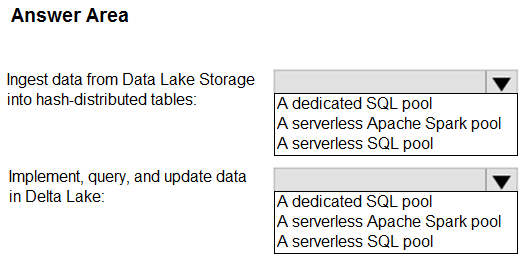
HOTSPOT -
You are designing a data analytics solution that will use Azure Synapse and Azure Data Lake Storage Gen2.
You need to recommend Azure Synapse pools to meet the following requirements:
• Ingest data from Data Lake Storage into hash-distributed tables.
• Implement query, and update data in Delta Lake.
What should you recommend for each requirement? To answer, select the appropriate options in the answer area.
NOTE: Each correct selection is worth one point.
Show Answer
Correct Answer: Ingest data into hash-distributed tables: A dedicated SQL pool
Implement, query, and update data in Delta Lake: A serverless Apache Spark pool
Explanation: Hash-distributed tables are a feature of dedicated SQL pools. Delta Lake updates require Apache Spark; serverless SQL pool can query Delta Lake but does not support updating Delta Lake files.
Question 98
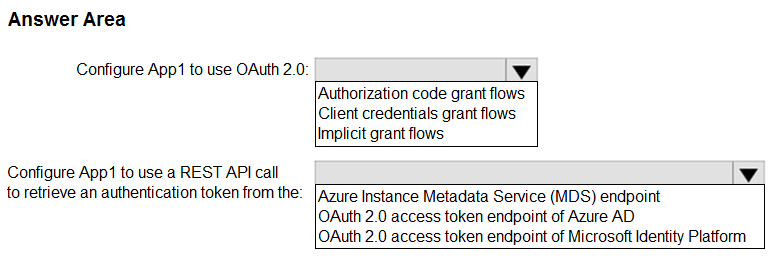
HOTSPOT -
You have an Azure subscription that contains an Azure key vault named KV1 and a virtual machine named VM1. VM1 runs Windows Server 2022: Azure Edition.
You plan to deploy an ASP.Net Core-based application named App1 to VM1.
You need to configure App1 to use a system-assigned managed identity to retrieve secrets from KV1. The solution must minimize development effort.
What should you do? To answer, select the appropriate options in the answer area.
NOTE: Each correct selection is worth one point.
Show Answer
Correct Answer: Client credentials grant flows
Azure Instance Metadata Service (IMDS) endpoint
Explanation: A system-assigned managed identity is a service identity, so it aligns with the OAuth 2.0 client credentials flow. On an Azure VM, applications obtain access tokens for the managed identity by calling the Azure Instance Metadata Service (IMDS) endpoint, which returns a token for accessing Azure Key Vault without managing credentials.
Question 101
You are developing an app that will use Azure Functions to process Azure Event Hubs events. Request processing is estimated to take between five and 20 minutes.
You need to recommend a hosting solution that meets the following requirements:
• Supports estimates of request processing runtimes
• Supports event-driven autoscaling for the app
Which hosting plan should you recommend?
A. Dedicated
B. Consumption
C. App Service
D. Premium
Show Answer
Correct Answer: D
Explanation: The Premium plan supports event-driven autoscaling for Event Hubs triggers and allows function execution durations that accommodate 5–20 minute processing (with configurable long/unlimited timeouts), unlike the Consumption plan which has execution time limits. Dedicated/App Service plans can support long-running executions but do not provide event-driven autoscaling.
Question 102
You are designing an app that will include two components. The components will communicate by sending messages via a queue.
You need to recommend a solution to process the messages by using a First in, First out (FIFO) pattern.
What should you include in the recommendation?
A. storage queues with a custom metadata setting
B. Azure Service Bus queues with partitioning enabled
C. Azure Service Bus queues with sessions enabled
D. storage queues with a stored access policy
Show Answer
Correct Answer: C
Explanation: Azure Service Bus queues support FIFO processing by using message sessions. Sessions preserve the ordered sequence of related messages and ensure they are processed in arrival order by a single receiver for that session. Azure Storage queues do not provide guaranteed FIFO, and Service Bus partitioning improves scalability rather than enforcing global FIFO.
$19
Get all 272 questions with detailed answers and explanations
Instant download HTML + PDF delivered the moment payment clears.
Secure Stripe checkout we never see or store your card details.
7-day refund if files are defective see our refund policy.