HOTSPOT -
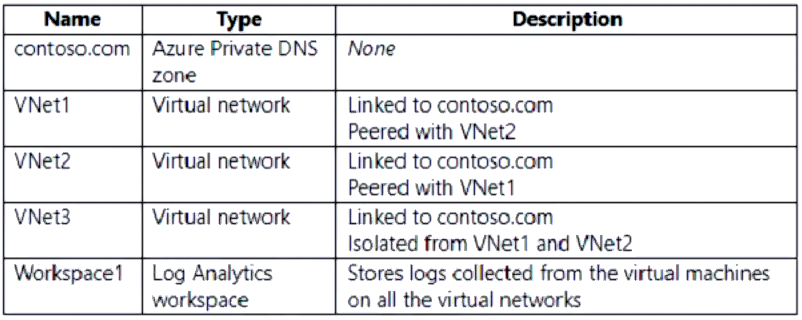
You have an Azure subscription that contains the resources shown in the following table.
VNet1, VNet2, and VNet3 each has multiple virtual machines connected. The virtual machines use the Azure DNS service for name resolution.
You need to recommend an Azure Monitor log routing solution that meets the following requirements:
• Ensures that the logs collected from the virtual machines and sent to Workspace1 are routed over the Microsoft backbone network
• Minimizes administrative effort
What should you include in the recommendation? To answer, select the appropriate options in the answer area.
Show Answer
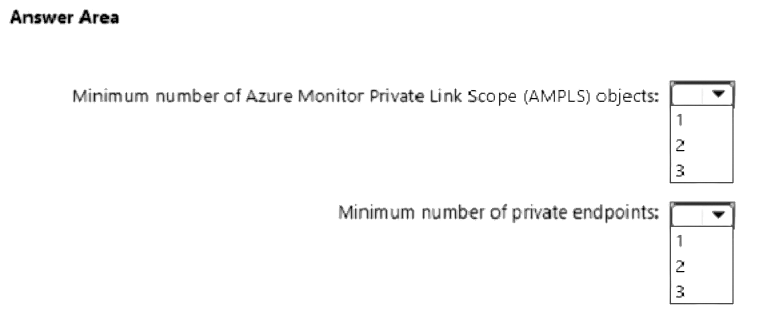
Correct Answer: 1
2
Explanation: Use a single Azure Monitor Private Link Scope (AMPLS) for the single Log Analytics workspace to minimize administration. One private endpoint can serve the peered VNet1/VNet2, while isolated VNet3 requires its own private endpoint because it cannot reach the first over peering.
Question 11
Your company has the divisions shown in the following table.
Sub1 contains an Azure App Service web app named App1. App1 uses Azure AD for single-tenant user authentication. Users from contoso.com can authenticate to App1.
You need to recommend a solution to enable users in the fabrikam.com tenant to authenticate to App1.
What should you recommend?
A. Configure Azure AD join.
B. Use Azure AD entitlement management to govern external users.
C. Enable Azure AD pass-through authentication and update the sign-in endpoint.
D. Configure assignments for the fabrikam.com users by using Azure AD Privileged Identity Management (PIM).
Show Answer
Correct Answer: B
Explanation: Use Azure AD entitlement management to provide and govern access for users from fabrikam.com as external users. They can authenticate with their fabrikam.com credentials, while App1 remains configured for single-tenant authentication in contoso.com.
Question 12
HOTSPOT
-
You have an Azure subscription.
You need to deploy a relational database. The solution must meet the following requirements:
• Support multiple read-only replicas.
• Automatically load balance read-only requests across all the read-only replicas.
• Minimize administrative effort
What should you use? To answer, select the appropriate options in the answer area.
NOTE: Each correct selection is worth one point.
Show Answer
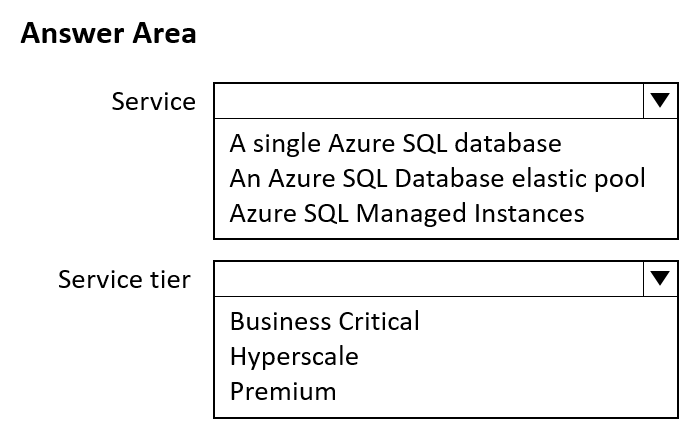
Correct Answer: Service: A single Azure SQL database
Service tier: Hyperscale
Explanation: Hyperscale supports multiple accessible read-only replicas and automatically load balances read-only connections across them. A single Azure SQL Database is the simplest managed deployment, minimizing administrative effort.
Question 12
You have an on-premises line-of-business (LOB) application that uses a Microsoft SQL Server instance as the backend.
You plan to migrate the on-premises SQL Server instance to Azure virtual machines.
You need to recommend a highly available SQL Server deployment that meets the following requirements:
✑ Minimizes costs
Minimizes failover time if a single server fails
What should you include in the recommendation?
A. an Always On availability group that has premium storage disks and a virtual network name (VNN)
B. an Always On Failover Cluster Instance that has a virtual network name (VNN) and a standard file share
C. an Always On availability group that has premium storage disks and a distributed network name (DNN)
D. an Always On Failover Cluster Instance that has a virtual network name (VNN) and a premium file share
Show Answer
Correct Answer: C
Explanation: An Always On availability group avoids the shared-storage requirement of an FCI, helping control infrastructure costs. Using a DNN rather than a VNN avoids the Azure load-balancer path and can reduce client reconnection time during failover. The premium disks support SQL Server workload performance; the standard-file-share FCI option is cheaper on storage but does not best meet the fast-failover requirement.
Question 13
You need to design a highly available Azure SQL database that meets the following requirements:
✑ Failover between replicas of the database must occur without any data loss.
✑ The database must remain available in the event of a zone outage.
✑ Costs must be minimized.
Which deployment option should you use?
A. Azure SQL Managed Instance Business Critical
B. Azure SQL Database Premium
C. Azure SQL Database Basic
D. Azure SQL Managed Instance General Purpose
Show Answer
Correct Answer: B
Explanation: Azure SQL Database Premium supports synchronous replica failover without data loss and can be configured for zone-redundant availability, so it can withstand a zone outage. Basic lacks zone-redundant availability, while the Managed Instance options are not the lowest-cost fit for these requirements.
Question 13
You are designing a solution that calculates 3D geometry from height-map data.
You need to recommend a solution that meets the following requirements:
✑ Performs calculations in Azure.
✑ Ensures that each node can communicate data to every other node.
✑ Maximizes the number of nodes to calculate multiple scenes as fast as possible.
Minimizes the amount of effort to implement the solution.
Which two actions should you include in the recommendation? Each correct answer presents part of the solution.
NOTE: Each correct selection is worth one point.
A. Enable parallel file systems on Azure.
B. Create a render farm that uses virtual machines.
C. Create a render farm that uses virtual machine scale sets.
D. Create a render farm that uses Azure Batch.
E. Enable parallel task execution on compute nodes.
Show Answer
Correct Answer: D, E
Explanation: Azure Batch is designed to manage compute pools and schedule parallel rendering workloads, reducing implementation effort. Enabling parallel task execution lets each compute node run multiple scene-calculation tasks concurrently, helping maximize throughput.
Question 14
You have an Azure subscription that contains an Azure Cosmos DB for NoSQL account named account1 and an Azure Synapse Analytics workspace named Workspace1. The account1 account contains a container named Contained that has the analytical store enabled.
You need to recommend a solution that will process the data stored in Contained in near-real-time (NRT) and output the results to a data warehouse in Workspace1 by using a runtime engine in the workspace. The solution must minimize data movement.
Which pool in Workspace1 should you use?
A. Apache Spark
B. serverless SQL
C. dedicated SQL
D. Data Explorer
Show Answer
Correct Answer: A
Explanation: Apache Spark pools in Azure Synapse integrate with Azure Cosmos DB analytical store via Synapse Link, allowing direct processing of analytical store data with minimal data movement. Spark is the appropriate runtime engine for near-real-time data processing and can write transformed results into a Synapse data warehouse (dedicated SQL pool). Serverless SQL is primarily for interactive querying, dedicated SQL is the target warehouse rather than the processing engine, and Data Explorer is optimized for telemetry/log analytics rather than this Synapse Link processing pattern.
Question 14
You have 100 servers that run Windows Server 2012 R2 and host Microsoft SQL Server 2014 instances. The instances host databases that have the following characteristics:
✑ Stored procedures are implemented by using CLR.
✑ The largest database is currently 3 TB. None of the databases will ever exceed 4 TB.
You plan to move all the data from SQL Server to Azure.
You need to recommend a service to host the databases. The solution must meet the following requirements:
✑ Whenever possible, minimize management overhead for the migrated databases.
✑ Ensure that users can authenticate by using Azure Active Directory (Azure AD) credentials.
✑ Minimize the number of database changes required to facilitate the migration.
What should you include in the recommendation?
A. Azure SQL Database elastic pools
B. Azure SQL Managed Instance
C. Azure SQL Database single databases
D. SQL Server 2016 on Azure virtual machines
Show Answer
Correct Answer: B
Explanation: Azure SQL Managed Instance is a fully managed service that supports CLR and Azure AD authentication, while offering high compatibility with SQL Server to minimize migration changes. Azure SQL Database options do not support CLR, and SQL Server on Azure VMs would require more management.
Question 14
You are designing a microservices architecture that will support a web application.
The solution must meet the following requirements:
✑ Deploy the solution on-premises and to Azure.
Support low-latency and hyper-scale operations.
✑ Allow independent upgrades to each microservice.
✑ Set policies for performing automatic repairs to the microservices.
You need to recommend a technology.
What should you recommend?
A. Azure Container Instance
B. Azure Logic App
C. Azure Service Fabric
D. Azure virtual machine scale set
Show Answer
Correct Answer: C
Explanation: Azure Service Fabric supports deploying microservices both on-premises and in Azure. It is designed for scalable, low-latency services and provides independent service upgrades, health monitoring, and configurable policies for automatic repair.
Question 15
HOTSPOT
-
You have an Azure subscription.
You are designing a solution for containerized apps. The solution must meet the following requirements:
• Automatically scale the apps by creating additional instances.
• Minimize administrative effort to maintain nodes and clusters.
• Ensure that containerized apps are highly available across multiple availability zones.
• Provide a central location for the lifecycle management and storage of container images.
What should you include in the solution? To answer, select the appropriate options in the answer area.
NOTE: Each correct selection is worth one point.
Show Answer
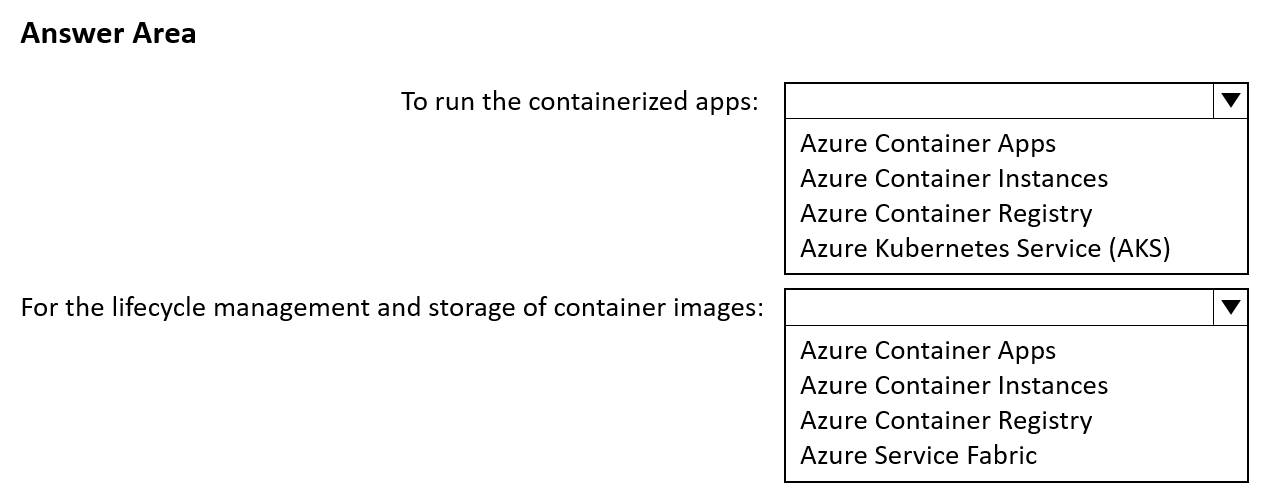
Correct Answer: To run the containerized apps: Azure Container Apps
For the lifecycle management and storage of container images: Azure Container Registry
Explanation: Azure Container Apps provides managed container hosting with autoscaling and reduced operational overhead while supporting high availability. Azure Container Registry is the Azure service for storing and managing container images.
$19
Get all 272 questions with detailed answers and explanations
Instant download HTML + PDF delivered the moment payment clears.
Secure Stripe checkout we never see or store your card details.
7-day refund if files are defective see our refund policy.