You have a multi-tier app named App1 and an Azure SQL database named SQL1. The backend service of App1 writes data to SQL1. Users use the App1 client to read the data from SQL1.
During periods of high utilization, the users experience delays retrieving the data.
You need to minimize how long it takes for data requests.
What should you include in the solution?
A. Azure Cache for Redis
B. Azure Content Delivery Network (CDN)
C. Azure Data Factory
D. Azure Synapse Analytics
Show Answer
Correct Answer: A
Explanation: Azure Cache for Redis is the appropriate solution because it caches frequently accessed data in memory, reducing read latency and offloading read requests from the Azure SQL database during periods of high utilization. Azure CDN is for static content delivery, Azure Data Factory is for data integration/orchestration, and Azure Synapse Analytics is for analytics and data warehousing rather than accelerating transactional application reads.
Question 104
You have an on-premises storage solution.
You need to migrate the solution to Azure. The solution must support Hadoop Distributed File System (HDFS).
What should you use?
A. Azure Data Lake Storage Gen2
B. Azure NetApp Files
C. Azure Data Share
D. Azure Table storage
Show Answer
Correct Answer: A
Explanation: Azure Data Lake Storage Gen2 is the Azure storage service designed for big data analytics and provides Hadoop-compatible access via the HDFS interface (ABFS driver). It supports hierarchical namespaces and is the appropriate choice for workloads requiring HDFS compatibility. Azure NetApp Files provides NFS/SMB file shares, Azure Data Share is for data sharing, and Table storage is a NoSQL key-value store.
Question 106
HOTSPOT
-
You have an Azure subscription named Sub1 that is linked to an Azure AD tenant named contoso.com.
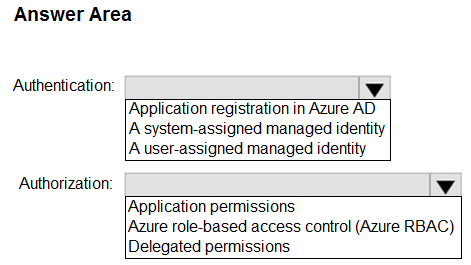
You plan to implement two ASP.NET Core apps named App1 and App2 that will be deployed to 100 virtual machines in Sub1. Users will sign in to App1 and App2 by using their contoso.com credentials.
App1 requires read permissions to access the calendar of the signed-in user. App2 requires write permissions to access the calendar of the signed-in user.
You need to recommend an authentication and authorization solution for the apps. The solution must meet the following requirements:
• Use the principle of least privilege.
• Minimize administrative effort.
What should you include in the recommendation? To answer, select the appropriate options in the answer area.
NOTE: Each correct selection is worth one point.
Show Answer
Correct Answer: Authentication: Application registration in Azure AD
Authorization: Delegated permissions
Explanation: Users sign in with Azure AD and the apps access Microsoft Graph on behalf of the signed-in user. Separate app registrations allow each app to request only the delegated calendar permissions it needs (read for App1, write for App2), satisfying least privilege. Managed identities are for Azure resource authentication, not user sign-in to web apps.
Question 107
HOTSPOT -
You are building an Azure web app that will store the Personally Identifiable Information (PII) of employees.
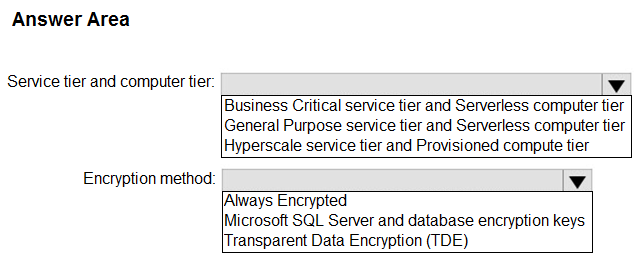
You need to recommend an Azure SQL. Database solution for the web app. The solution must meet the following requirements:
• Maintain availability in the event of a single datacenter outage.
• Support the encryption of specific columns that contain PII.
• Automatically scale up during payroll operations.
• Minimize costs.
What should you include in the recommendations? To answer, select the appropriate options in the answer area.
NOTE: Each correct selection is worth one point.
Show Answer
Correct Answer: General Purpose service tier and Serverless compute tier
Always Encrypted
Explanation: Serverless automatically scales compute and helps minimize cost. General Purpose supports zone-redundant deployment for datacenter resilience. Always Encrypted provides column-level encryption for sensitive PII, unlike TDE which encrypts the database at rest.
Question 108
HOTSPOT
-
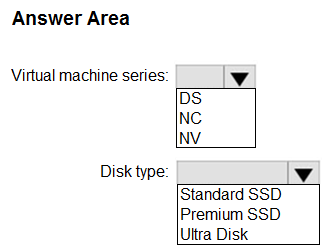
You need to deploy an instance of SQL Server on Azure Virtual Machines. The solution must meet the following requirements:
• Support 15,000 disk IOPS.
• Support SR-IOV.
• Minimize costs.
What should you include in the solution? To answer, select the appropriate options in the answer area.
NOTE: Each correct selection is worth one point.
Show Answer
Correct Answer: Virtual machine series: DS
Disk type: Premium SSD
Explanation: DS-series VMs support SR-IOV and are appropriate for SQL Server workloads. To meet 15,000 IOPS while minimizing cost, Premium SSD is sufficient; Ultra Disk would provide higher performance but at higher cost.
Question 109
You have an Azure AD tenant named contoso.com that has a security group named Group1. Group1 is configured for assigned memberships. Group1 has 50 members, including 20 guest users.
You need to recommend a solution for evaluating the membership of Group1. The solution must meet the following requirements:
• The evaluation must be repeated automatically every three months.
• Every member must be able to report whether they need to be in Group1.
• Users who report that they do not need to be in Group1 must be removed from Group1 automatically.
• Users who do not report whether they need to be in Group1 must be removed from Group1 automatically.
What should you include in the recommendation?
A. Implement Azure AD Identity Protection.
B. Change the Membership type of Group1 to Dynamic User.
C. Create an access review.
D. Implement Azure AD Privileged Identity Management (PIM).
Show Answer
Correct Answer: C
Explanation: Access Reviews in Microsoft Entra ID Governance are designed to periodically review group membership, can be scheduled to recur every three months, allow members to self-attest whether they still need access, and can automatically remove users who deny needing access or fail to respond at the end of the review.
Question 110
HOTSPOT
-
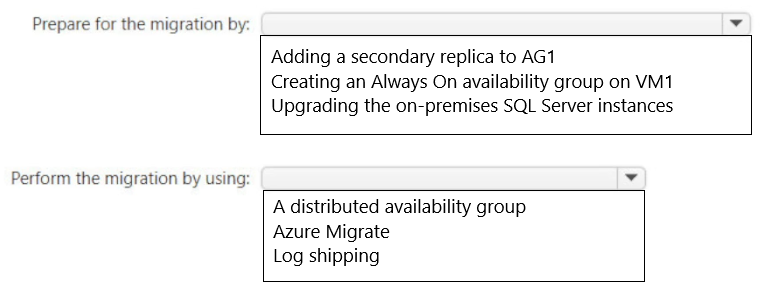
You have two on-premises Microsoft SQL Server 2017 instances that host an Always On availability group named AG1. AG1 contains a single database named DB1.
You have an Azure subscription that contains a virtual machine named VM1. VM1 runs Linux and contains a SQL Server 2019 instance.
You need to migrate DB1 to VM1. The solution must minimize downtime on DB1.
What should you do? To answer, select the appropriate options in the answer area.
NOTE: Each correct selection is worth one point.
Show Answer
Correct Answer: Prepare: Adding a secondary replica to AG1
Migrate: A distributed availability group
Explanation: To minimize downtime, first extend the existing availability group by adding VM1 as a secondary replica (cross-platform support exists). Then use a distributed availability group for near-zero-downtime migration and controlled failover to the new environment.
Question 111
HOTSPOT
-
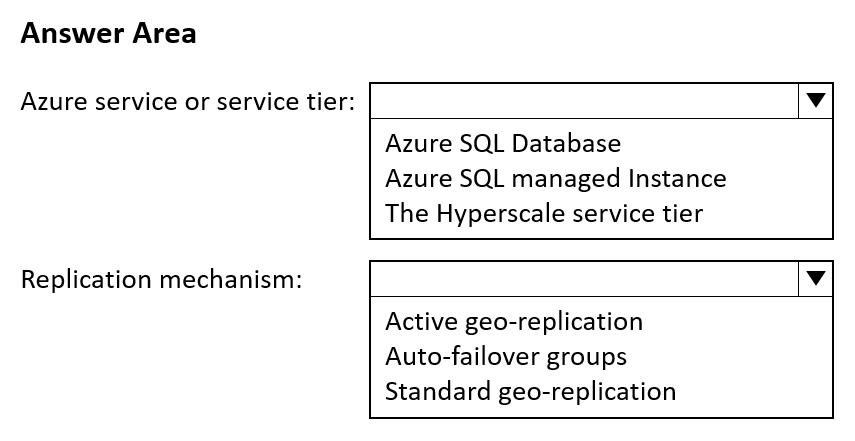
You have an on-premises Microsoft SQL Server database named SQL1.
You plan to migrate SQL1 to Azure.
You need to recommend a hosting solution for SQL1. The solution must meet the following requirements:
• Support the deployment of multiple secondary, read-only replicas.
• Support automatic replication between primary and secondary replicas.
• Support failover between primary and secondary replicas within a 15-minute recovery time objective (RTO).
What should you include in the solution? To answer, select the appropriate options in the answer area.
NOTE: Each correct selection is worth one point.
Show Answer
Correct Answer: Azure SQL Database
Active geo-replication
Explanation: Active geo-replication for Azure SQL Database supports multiple readable secondary replicas with automatic asynchronous replication and manual failover well within a 15-minute RTO. SQL Managed Instance does not support active geo-replication, and standard geo-replication supports only one secondary.
Question 113
You are designing a point of sale (POS) solution that will be deployed across multiple locations and will use an Azure Databricks workspace in the Standard tier. The solution will include multiple apps deployed to the on-premises network of each location.
You need to configure the authentication method that will be used by the app to access the workspace. The solution must minimize the administrative effort associated with staff turnover and credential management.
What should you configure?
A. a managed identity
B. a service principal
C. a personal access token
Show Answer
Correct Answer: B
Explanation: Because the applications are deployed on-premises, they cannot use Azure managed identities, which are only available to Azure-hosted resources. A service principal provides a non-user identity for applications to authenticate to Azure Databricks, minimizing administrative effort related to employee turnover. A personal access token is tied to users or requires credential management and is less suitable for enterprise application authentication.
Question 114
You need to design a highly available Azure SQL database that meets the following requirements:
• Failover between replicas of the database must occur without any data loss.
• The database must remain available in the event of a zone outage.
• Costs must be minimized.
Which deployment option should you use?
A. Azure SQL Database Business Critical
B. Azure SQL Managed Instance Business Critical
C. Azure SQL Database Standard
D. Azure SQL Managed Instance General Purpose
Show Answer
Correct Answer: A
Explanation: Azure SQL Database Business Critical supports synchronous replicas with automatic failover, providing zero data loss (RPO=0). It also supports zone-redundant high availability to remain available during an Availability Zone outage. Azure SQL Database Standard (DTU) does not support zone redundancy, Managed Instance General Purpose does not meet the zero-data-loss HA requirement, and Managed Instance Business Critical is generally more expensive than Azure SQL Database Business Critical for this requirement.
$19
Get all 272 questions with detailed answers and explanations
Instant download HTML + PDF delivered the moment payment clears.
Secure Stripe checkout we never see or store your card details.
7-day refund if files are defective see our refund policy.