You are developing a sales application that will contain several Azure cloud services and handle different components of a transaction. Different cloud services will process customer orders, billing, payment, inventory, and shipping.
You need to recommend a solution to enable the cloud services to asynchronously communicate transaction information by using XML messages.
What should you include in the recommendation?
A. Azure Service Bus
B. Azure Blob Storage
C. Azure Notification Hubs
D. Azure Application Gateway
Show Answer
Correct Answer: A
Explanation: Azure Service Bus is designed for reliable asynchronous messaging between distributed applications and services. It supports message queues and topics/subscriptions, making it appropriate for decoupling cloud services that exchange transaction information, including XML payloads. Azure Blob Storage is for object storage, Notification Hubs are for push notifications, and Application Gateway is a web traffic load balancer.
Question 53
You are developing a sales application that will contain several Azure cloud services and handle different components of a transaction. Different cloud services will process customer orders, billing, payment, inventory, and shipping.
You need to recommend a solution to enable the cloud services to asynchronously communicate transaction information by using XML messages.
What should you include in the recommendation?
A. Azure Service Fabric
B. Azure Traffic Manager
C. Azure Queue Storage
D. Azure Notification Hubs
Show Answer
Correct Answer: C
Explanation: Azure Queue Storage is designed for asynchronous communication between application components by decoupling producers and consumers through queues. It can carry XML payloads as message content. Azure Service Fabric is an application platform, Traffic Manager is a DNS-based load balancer, and Notification Hubs is for mobile push notifications.
Question 54
You need to design a highly available Azure SQL database that meets the following requirements:
• Failover between replicas of the database must occur without any data loss.
• The database must remain available in the event of a zone outage.
• Costs must be minimized.
Which deployment option should you use?
A. Azure SQL Database Business Critical
B. Azure SQL Database Hyperscale
C. Azure SQL Managed Instance Business Critical
D. Azure SQL Database Standard
Show Answer
Correct Answer: A
Explanation: Azure SQL Database Business Critical uses Always On availability groups with multiple synchronous replicas, enabling automatic failover without data loss. It also supports zone-redundant configuration to remain available during an Availability Zone outage. Compared with Azure SQL Managed Instance Business Critical, Azure SQL Database Business Critical is typically the lower-cost option when managed instance features are not required. Hyperscale is optimized for scale rather than zero-data-loss HA, and Standard does not meet the synchronous high-availability requirement.
Question 55
You need to recommend a solution to generate a monthly report of all the new Azure Resource Manager (ARM) resource deployments in your Azure subscription.
What should you include in the recommendation?
A. Application Insights
B. Azure Arc
C. Azure Log Analytics
D. Azure Monitor metrics
Show Answer
Correct Answer: C
Explanation: Azure Log Analytics can collect and query Azure Activity Logs, including Azure Resource Manager deployment events. You can create queries and scheduled monthly reports of new ARM resource deployments across a subscription. Application Insights is for application telemetry, Azure Arc manages hybrid resources, and Azure Monitor metrics stores numeric performance metrics rather than detailed deployment event history.
Question 56
HOTSPOT
-
Case Study
-
This is a case study. Case studies are not timed separately. You can use as much exam time as you would like to complete each case. However, there may be additional case studies and sections on this exam. You must manage your time to ensure that you are able to complete all questions included on this exam in the time provided.
To answer the questions included in a case study, you will need to reference information that is provided in the case study. Case studies might contain exhibits and other resources that provide more information about the scenario that is described in the case study. Each question is independent of the other questions in this case study.
At the end of this case study, a review screen will appear. This screen allows you to review your answers and to make changes before you move to the next section of the exam. After you begin a new section, you cannot return to this section.
To start the case study
-
To display the first question in this case study, click the Next button. Use the buttons in the left pane to explore the content of the case study before you answer the questions. Clicking these buttons displays information such as business requirements, existing environment, and problem statements. If the case study has an All Information tab, note that the information displayed is identical to the information displayed on the subsequent tabs. When you are ready to answer a question, click the Question button to return to the question.
Overview
-
Fabrikam, Inc. is an engineering company that has offices throughout Europe. The company has a main office in London and three branch offices in Amsterdam, Berlin, and Rome.
Existing Environment: Active Directory Environment
The network contains two Active Directory forests named corp.fabrikam.com and rd.fabrikam.com. There are no trust relationships between the forests.
Corp.fabrikam.com is a production forest that contains identities used for internal user and computer authentication.
Rd.fabrikam.com is used by the research and development (R&D) department only. The R&D department is restricted to using on-premises resources only.
Existing Environment: Network Infrastructure
Each office contains at least one domain controller from the corp.fabrikam.com domain. The main office contains all the domain controllers for the rd.fabrikam.com forest.
All the offices have a high-speed connection to the internet.
An existing application named WebApp1 is hosted in the data center of the London office. WebApp1 is used by customers to place and track orders. WebApp1 has a web tier that uses Microsoft Internet Information Services (IIS) and a database tier that runs Microsoft SQL Server 2016. The web tier and the database tier are deployed to virtual machines that run on Hyper-V.
The IT department currently uses a separate Hyper-V environment to test updates to WebApp1.
Fabrikam purchases all Microsoft licenses through a Microsoft Enterprise Agreement that includes Software Assurance.
Existing Environment: Problem Statements
The use of WebApp1 is unpredictable. At peak times, users often report delays. At other times, many resources for WebApp1 are underutilized.
Requirements: Planned Changes
-
Fabrikam plans to move most of its production workloads to Azure during the next few years, including virtual machines that rely on Active Directory for authentication.
As one of its first projects, the company plans to establish a hybrid identity model, facilitating an upcoming Microsoft 365 deployment.
All R&D operations will remain on-premises.
Fabrikam plans to migrate the production and test instances of WebApp1 to Azure.
Requirements: Technical Requirements
Fabrikam identifies the following technical requirements:
• Website content must be easily updated from a single point.
• User input must be minimized when provisioning new web app instances.
• Whenever possible, existing on-premises licenses must be used to reduce cost.
• Users must always authenticate by using their corp.fabrikam.com UPN identity.
• Any new deployments to Azure must be redundant in case an Azure region fails.
• Whenever possible, solutions must be deployed to Azure by using the Standard pricing tier of Azure App Service.
• An email distribution group named IT Support must be notified of any issues relating to the directory synchronization services.
• In the event that a link fails between Azure and the on-premises network, ensure that the virtual machines hosted in Azure can authenticate to Active Directory.
• Directory synchronization between Azure Active Directory (Azure AD) and corp.fabrikam.com must not be affected by a link failure between Azure and the on-premises network.
Requirements: Database Requirements
Fabrikam identifies the following database requirements:
• Database metrics for the production instance of WebApp1 must be available for analysis so that database administrators can optimize the performance settings.
• To avoid disrupting customer access, database downtime must be minimized when databases are migrated.
• Database backups must be retained for a minimum of seven years to meet compliance requirements.
Requirements: Security Requirements
Fabrikam identifies the following security requirements:
• Company information including policies, templates, and data must be inaccessible to anyone outside the company.
• Users on the on-premises network must be able to authenticate to corp.fabrikam.com if an internet link fails.
• Administrators must be able authenticate to the Azure portal by using their corp.fabrikam.com credentials.
• All administrative access to the Azure portal must be secured by using multi-factor authentication (MFA).
• The testing of WebApp1 updates must not be visible to anyone outside the company.
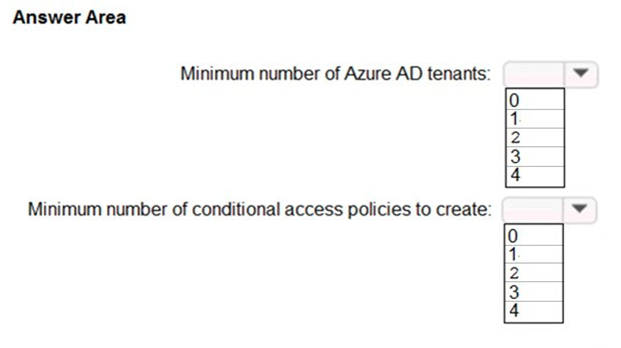
To meet the authentication requirements of Fabrikam, what should you include in the solution? To answer, select the appropriate options in the answer area.
NOTE: Each correct selection is worth one point.
Show Answer
Correct Answer: Minimum number of Azure AD tenants: 1
Minimum number of conditional access policies to create: 1
Explanation: A single Microsoft Entra ID (Azure AD) tenant can synchronize identities from the production forest for the planned hybrid identity deployment. The R&D forest remains on-premises. The only authentication requirement that explicitly requires Conditional Access is enforcing MFA for Azure portal administrators. Keeping the test WebApp inaccessible is primarily a networking/application access design requirement, not necessarily a Conditional Access requirement.
Question 57
You have an on-premises Microsoft SQL server named SQL1 that hosts 50 databases.
You plan to migrate SQL1 to Azure SQL Managed Instance.
You need to perform an offline migration of SQL1. The solution must minimize administrative effort.
What should you include in the solution?
A. Azure Migrate
B. Azure Database Migration Service
C. SQL Server Migration Assistant (SSMA)
D. Data Migration Assistant (DMA)
Show Answer
Correct Answer: B
Explanation: Azure Database Migration Service is the appropriate service for performing offline migrations from on-premises SQL Server to Azure SQL Managed Instance, especially when migrating many databases and minimizing administrative effort. Azure Migrate is for broader infrastructure assessment and migration, SSMA is intended for migrations from non-SQL Server database platforms, and DMA is primarily an assessment/upgrade compatibility tool rather than the migration service for SQL Managed Instance offline migrations.
Question 59
HOTSPOT
-
You are developing a multi-tier app named App1 that will be hosted on Azure virtual machines. The peak utilization periods for App1 will be from 8 AM to 9 AM and 4 PM to 5 PM on weekdays.
You need to deploy the infrastructure for App1. The solution must meet the following requirements:
• Support virtual machines deployed to four availability zones across two Azure regions.
• Minimize costs by accumulating CPU credits during periods of low utilization.
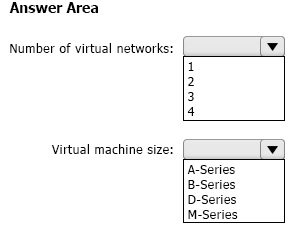
What is the minimum number of virtual networks you should deploy, and which virtual machine size should you use? To answer, select the appropriate options in the answer area.
Show Answer
Correct Answer: Number of virtual networks: 2
Virtual machine size: B-Series
Explanation: A virtual network spans all availability zones within a region, so one VNet per region is sufficient. Across two Azure regions, the minimum is two VNets. B-Series VMs are burstable and accumulate CPU credits during low utilization, making them the cost-effective choice for predictable peak periods.
Question 60
DRAG DROP -
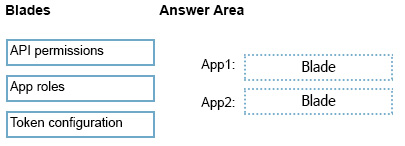
You have two app registrations named App1 and App2 in Azure AD. App1 supports role-based access control (RBAC) and includes a role named Writer.
You need to ensure that when App2 authenticates to access App1, the tokens issued by Azure AD include the Writer role claim.
Which blade should you use to modify each app registration? To answer, drag the appropriate blades to the correct app registrations. Each blade may be used once, more than once, or not at all. You may need to drag the split bar between panes or scroll to view content.
NOTE: Each correct selection is worth one point.
Show Answer
Correct Answer: App1: App roles
App2: API permissions
Explanation: Define the application role on the resource app (App1) using App roles. Then configure the client app (App2) to request access to App1 via API permissions. When the app role is assigned to App2's service principal, Azure AD includes the role in access tokens for App1.
Question 61
HOTSPOT
-
You are designing an app that will be hosted on Azure virtual machines that run Ubuntu. The app will use a third-party email service to send email messages to users. The third-party email service requires that the app authenticate by using an API key.
You need to recommend an Azure Key Vault solution for storing and accessing the API key. The solution must minimize administrative effort.
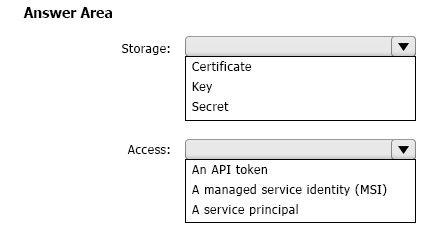
What should you recommend using to store and access the key? To answer, select the appropriate options in the answer area.
NOTE: Each correct selection is worth one point.
Show Answer
Correct Answer: Storage: Secret
Access: A managed service identity (MSI)
Explanation: API keys should be stored as Key Vault secrets. For an application running on Azure VMs, a managed identity provides passwordless authentication to Azure Key Vault and minimizes administrative effort by avoiding credential management.
Question 63
You need to design a highly available Azure SQL database that meets the following requirements:
• Failover between replicas of the database must occur without any data loss.
• The database must remain available in the event of a zone outage.
• Costs must be minimized.
Which deployment option should you use?
A. Azure SQL Managed Instance General Purpose
B. Azure SQL Database Hyperscale
C. Azure SQL Database Premium
D. Azure SQL Managed Instance Business Critical
Show Answer
Correct Answer: C
Explanation: Azure SQL Database Premium (Business Critical service tier for single databases) supports zone-redundant deployments and uses Always On technology with synchronous replicas, providing automatic failover with RPO=0 (no data loss). Compared with Managed Instance Business Critical, it is typically the lower-cost option while still meeting the stated availability requirements. General Purpose does not provide the same synchronous local replica architecture, and Hyperscale is intended for scale rather than minimizing cost for this requirement.
$19
Get all 272 questions with detailed answers and explanations
Instant download HTML + PDF delivered the moment payment clears.
Secure Stripe checkout we never see or store your card details.
7-day refund if files are defective see our refund policy.