You have an Azure subscription. The subscription contains a tiered app named App1 that is distributed across multiple containers hosted in Azure Container Instances.
You need to deploy an Azure Monitor monitoring solution for App. The solution must meet the following requirements:
• Support using synthetic transaction monitoring to monitor traffic between the App1 components.
• Minimize development effort.
What should you include in the solution?
A. Network insights
B. Application Insights
C. Container insights
D. Log Analytics Workspace insights
Show Answer
Correct Answer: B
Explanation: Application Insights is the Azure Monitor feature that provides application performance monitoring and supports synthetic transaction/availability monitoring with minimal application changes. Container Insights focuses on container infrastructure, Network Insights on networking, and Log Analytics Workspace is the data platform rather than the synthetic monitoring capability.
Question 37
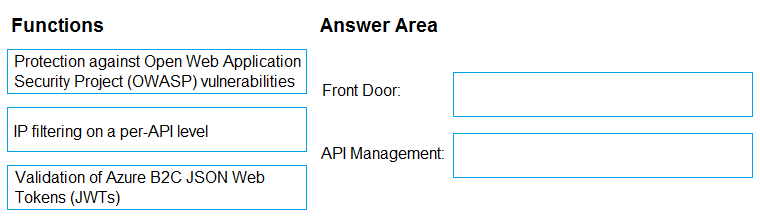
DRAG DROP -
You plan to deploy an infrastructure solution that will contain the following configurations:
• External users will access the infrastructure by using Azure Front Door.
• External user access to the backend APIs hosted in Azure Kubernetes Service (AKS) will be controlled by using Azure API Management.
• External users will be authenticated by an Azure AD B2C tenant that uses OpenID Connect-based federation with a third-party identity provider.
Which function does each service provide? To answer, drag the appropriate functions to the correct services. Each function may be used once, more than once, or not at all. You may need to drag the split bar between panes or scroll to view content.
NOTE: Each correct selection is worth one point.
Show Answer
Correct Answer: Front Door → Protection against Open Web Application Security Project (OWASP) vulnerabilities
API Management → Validation of Azure B2C JSON Web Tokens (JWTs)
Explanation: Azure Front Door with Web Application Firewall (WAF) protects against OWASP web vulnerabilities. Azure API Management can validate Azure AD B2C-issued JWTs using the validate-jwt policy. Although APIM also supports IP filtering, the per-API IP filtering function is not required by the described solution.
Question 40
HOTSPOT
-
You have an Azure subscription that contains the resources shown in the following table:
Log files from App1 are registered to App1Logs. An average of 120 GB of log data is ingested per day.
You configure an Azure Monitor alert that will be triggered if the App1 logs contain error messages.
You need to minimize the Log Analytics costs associated with App1. The solution must meet the following requirements:
• Ensure that all the log files from App1 are ingested to App1Logs.
• Minimize the impact on the Azure Monitor alert.
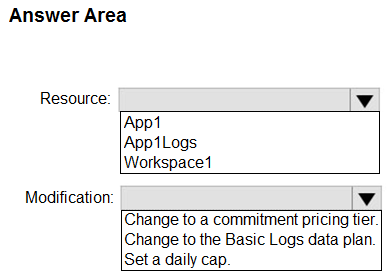
Which resource should you modify, and which modification should you perform? To answer, select the appropriate options in the answer area.
NOTE: Each correct selection is worth one point.
Show Answer
Correct Answer: Resource: Workspace1
Modification: Change to a commitment pricing tier
Explanation: The workspace is currently pay-as-you-go and ingests about 120 GB/day. A commitment pricing tier reduces ingestion cost at this sustained volume while continuing to ingest all logs. Switching the table to Basic Logs would negatively affect alert capabilities, and a daily cap could stop ingestion, violating the requirement.
Question 42
You have an Azure subscription that contains 10 web apps. The apps are integrated with Azure AD and are accessed by users on different project teams.
The users frequently move between projects.
You need to recommend an access management solution for the web apps. The solution must meet the following requirements:
• The users must only have access to the app of the project to which they are assigned currently.
• Project managers must verify which users have access to their project’s app and remove users that are no longer assigned to their project.
• Once every 30 days, the project managers must be prompted automatically to verify which users are assigned to their projects.
What should you include in the recommendation?
A. Azure AD Identity Protection
B. Microsoft Defender for Identity
C. Microsoft Entra Permissions Management
D. Azure AD Identity Governance
Show Answer
Correct Answer: D
Explanation: Azure AD Identity Governance (now Microsoft Entra ID Governance) includes access reviews, entitlement management, and lifecycle governance. Access Reviews can automatically prompt project managers every 30 days to review and certify user access, allowing removal of users who are no longer assigned. The other options focus on identity risk detection, threat detection, or cloud permission management rather than recurring application access governance.
Question 43
HOTSPOT
-
You have an Azure subscription. The subscription contains an Azure SQL managed instance that stores employee details, including social security numbers and phone numbers.
You need to configure the managed instance to meet the following requirements:
• The helpdesk team must see only the last four digits of an employee’s phone number.
• Cloud administrators must be prevented from seeing the employee’s social security numbers.
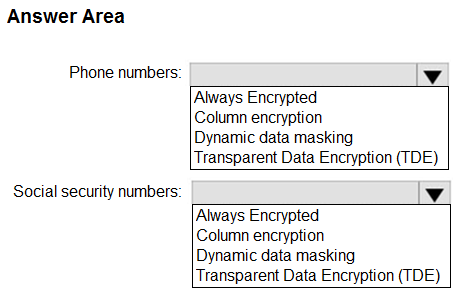
What should you enable for each column in the managed instance? To answer, select the appropriate options in the answer area.
NOTE: Each correct selection is worth one point.
Show Answer
Correct Answer: Phone numbers: Dynamic data masking
Social security numbers: Always Encrypted
Explanation: Dynamic data masking can reveal only the last four digits of a phone number to specific users. Always Encrypted protects sensitive column data so even cloud/database administrators cannot view plaintext without the client-side encryption keys.
Question 46
You plan to use an Azure Storage account to store data assets.
You need to recommend a solution that meets the following requirements:
• Supports immutable storage
• Disables anonymous access to the storage account
• Supports access control list (ACL)-based Azure AD permissions
What should you include in the recommendation?
A. Azure Files
B. Azure Data Lake Storage
C. Azure NetApp Files
D. Azure Blob Storage
Show Answer
Correct Answer: B
Explanation: Azure Data Lake Storage Gen2 (implemented on Azure Blob Storage with a hierarchical namespace) meets all three requirements: it supports immutable storage (WORM policies), allows anonymous access to be disabled at the storage account, and uniquely provides POSIX-style ACLs integrated with Azure AD for fine-grained file and directory permissions. Azure Blob Storage alone supports RBAC and immutability, but the ACL-based Azure AD permission requirement points to Azure Data Lake Storage Gen2.
Question 48
You are developing a sales application that will contain several Azure cloud services and handle different components of a transaction. Different cloud services will process customer orders, billing, payment, inventory, and shipping.
You need to recommend a solution to enable the cloud services to asynchronously communicate transaction information by using XML messages.
What should you include in the recommendation?
A. Azure Application Gateway
B. Azure Data Lake
C. Azure Queue Storage
D. Azure Blob Storage
Show Answer
Correct Answer: C
Explanation: Azure Queue Storage enables asynchronous communication between distributed application components by storing messages in queues. It is suitable for decoupling cloud services such as order processing, billing, inventory, and shipping. Application Gateway is for web traffic load balancing, Data Lake is for analytics storage, and Blob Storage is for object storage rather than message-based communication.
Question 49
You are developing a sales application that will contain several Azure cloud services and handle different components of a transaction. Different cloud services will process customer orders, billing, payment, inventory, and shipping.
You need to recommend a solution to enable the cloud services to asynchronously communicate transaction information by using XML messages.
What should you include in the recommendation?
A. Azure Service Bus
B. Azure Data Lake
C. Azure Traffic Manager
D. Azure Notification Hubs
Show Answer
Correct Answer: A
Explanation: Azure Service Bus provides reliable asynchronous messaging between distributed cloud services using queues and topics/subscriptions. It is designed to decouple components such as order processing, billing, payment, inventory, and shipping, and can carry XML messages. Azure Data Lake is for analytics storage, Traffic Manager is for DNS-based traffic routing, and Notification Hubs is for push notifications.
Question 50
You are developing a sales application that will contain several Azure cloud services and handle different components of a transaction. Different cloud services will process customer orders, billing, payment, inventory, and shipping.
You need to recommend a solution to enable the cloud services to asynchronously communicate transaction information by using XML messages.
What should you include in the recommendation?
A. Azure Service Bus
B. Azure Data Lake
C. Azure Application Gateway
D. Azure Notification Hubs
Show Answer
Correct Answer: A
Explanation: Azure Service Bus is designed for asynchronous messaging between distributed applications and services. It supports reliable message queues and topics, allowing different cloud services such as orders, billing, payments, inventory, and shipping to exchange XML (or JSON/plain text) messages independently. Azure Data Lake is for analytics storage, Application Gateway is a web traffic load balancer, and Notification Hubs is for push notifications to client devices.
Question 51
You need to recommend a solution to generate a monthly report of all the new Azure Resource Manager (ARM) resource deployments in your Azure subscription.
What should you include in the recommendation?
A. Application Insights
B. Azure Analysis Services
C. Azure Advisor
D. Azure Activity Log
Show Answer
Correct Answer: D
Explanation: Azure Activity Log records subscription-level events, including Azure Resource Manager (ARM) resource creation, update, and deletion operations. It is the appropriate source for generating monthly reports of new ARM resource deployments. Application Insights monitors application telemetry, Azure Analysis Services is an analytics platform, and Azure Advisor provides optimization recommendations rather than deployment event logs.
$19
Get all 272 questions with detailed answers and explanations
Instant download HTML + PDF delivered the moment payment clears.
Secure Stripe checkout we never see or store your card details.
7-day refund if files are defective see our refund policy.