You have 12 on-premises data sources that contain customer information and consist of Microsoft SQL Server, MySQL, and Oracle databases.
You have an Azure subscription.
You plan to create an Azure Data Lake Storage account that will consolidate the customer information for analysis and reporting.
You need to recommend a solution to automatically copy new information from the data sources to the Data Lake Storage account by using extract, transform and load (ETL). The solution must minimize administrative effort.
What should you include in the recommendation?
A. Azure Data Factory
B. Azure Data Explorer
C. Azure Data Share
D. Azure Data Studio
Show Answer
Correct Answer: A
Explanation: Azure Data Factory is the managed Azure service designed for building and orchestrating ETL/ELT pipelines. It supports hybrid data integration with built-in connectors for on-premises SQL Server, MySQL, and Oracle databases, and can automatically copy new data into Azure Data Lake Storage with minimal administrative effort.
Question 20
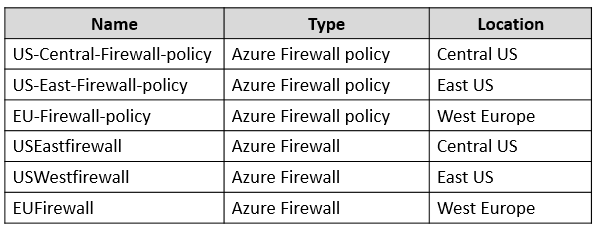
You have the Azure resources shown in the following table.
You need to deploy a new Azure Firewall policy that will contain mandatory rules for all Azure Firewall deployments. The new policy will be configured as a parent policy for the existing policies.
What is the minimum number of additional Azure Firewall policies you should create?
A. 0
B. 1
C. 2
D. 3
Show Answer
Correct Answer: D
Explanation: Azure Firewall parent and child policies must be in the same region. The existing policies are in three regions, so you need one parent policy in each region: three additional policies.
Question 20
HOTSPOT
-
You have an Azure App Service web app named Webapp1 that connects to an Azure SQL database named DB1. Webapp1 and DB1 are deployed to the East US Azure region.
You need to ensure that all the traffic between Webapp1 and DB1 is sent via a private connection.
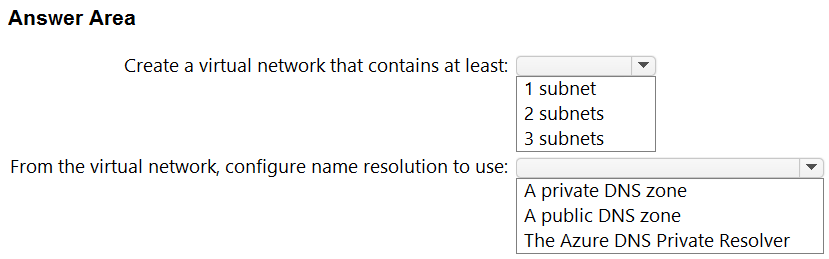
What should you do? To answer, select the appropriate options in the answer area.
NOTE: Each correct selection is worth one point.
Show Answer
Correct Answer: 2 subnets
A private DNS zone
Explanation: App Service VNet Integration requires a delegated subnet, while the Azure SQL Private Endpoint cannot be placed in that delegated subnet, so at least two subnets are needed. A Private DNS zone ensures the SQL database name resolves to the private endpoint IP, keeping traffic on the private network.
Question 21
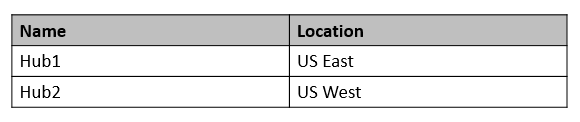
You have an Azure subscription that contains a Basic Azure virtual WAN named VirtualWAN1 and the virtual hubs shown in the following table.
You have an ExpressRoute circuit in the US East Azure region.
You need to create an ExpressRoute association to VirtualWAN1.
What should you do first?
A. Upgrade VirtualWAN1 to Standard.
B. Create a gateway on Hub1.
C. Enable the ExpressRoute premium add-on.
D. Create a hub virtual network in US East.
Show Answer
Correct Answer: A
Explanation: ExpressRoute connectivity requires Azure Virtual WAN Standard. VirtualWAN1 is Basic, so upgrade it to Standard first; you can then configure the ExpressRoute association.
Question 21
HOTSPOT
-
Your on-premises network contains an Active Directory Domain Services (AD DS) domain. The domain contains a server named Server1. Server1 contains an app named App1 that uses AD DS authentication. Remote users access App1 by using a VPN connection to the on-premises network.
You have an Azure AD tenant that syncs with the AD DS domain by using Azure AD Connect.
You need to ensure that the remote users can access App1 without using a VPN. The solution must meet the following requirements:
• Ensure that the users authenticate by using Azure Multi-Factor Authentication (MFA).
• Minimize administrative effort.
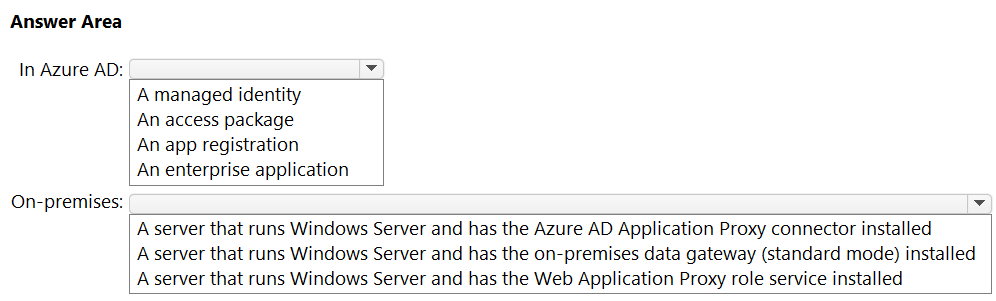
What should you include in the solution? To answer, select the appropriate options in the answer area.
NOTE: Each correct selection is worth one point.
Show Answer
Correct Answer: In Azure AD: An enterprise application
On-premises: A server that runs Windows Server and has the Azure AD Application Proxy connector installed
Explanation: Publish the on-premises AD-authenticated app with Microsoft Entra Application Proxy. This creates/configures an enterprise application for Azure AD pre-authentication, enabling Conditional Access and Azure MFA, while the Application Proxy connector provides secure access without a VPN and minimizes administrative effort.
Question 22
HOTSPOT
-
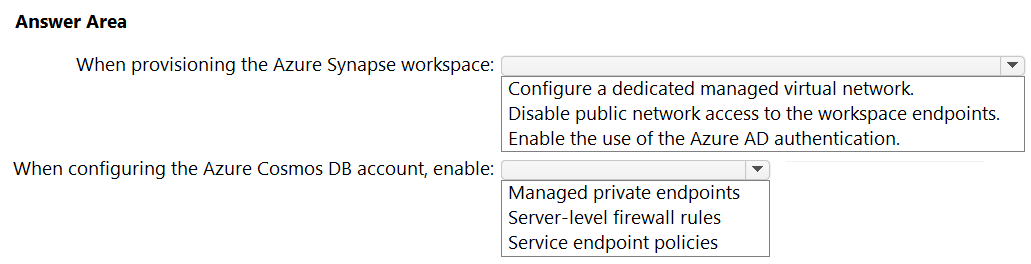
You need to recommend a solution to integrate Azure Cosmos DB and Azure Synapse. The solution must meet the following requirements:
• Traffic from an Azure Synapse workspace to the Azure Cosmos DB account must be sent via the Microsoft backbone network.
• Traffic from the Azure Synapse workspace to the Azure Cosmos DB account must NOT be routed over the internet.
• Implementation effort must be minimized.
What should you include in the recommendation? To answer, select the appropriate options in the answer area.
NOTE: Each correct selection is worth one point.
Explanation: A Synapse managed virtual network is required to use managed private endpoints. Managed private endpoints (Azure Private Link) provide private connectivity from Synapse to Azure Cosmos DB over the Microsoft backbone, avoiding internet routing with minimal implementation effort.
Question 22
Note: This question is part of a series of questions that present the same scenario. Each question in the series contains a unique solution that might meet the stated goals. Some question sets might have more than one correct solution, while others might not have a correct solution.
After you answer a question in this section, you will NOT be able to return to it. As a result, these questions will not appear in the review screen.
You need to deploy resources to host a stateless web app in an Azure subscription. The solution must meet the following requirements:
✑ Provide access to the full .NET framework.
Provide redundancy if an Azure region fails.
✑ Grant administrators access to the operating system to install custom application dependencies.
Solution: You deploy two Azure virtual machines to two Azure regions, and you create an Azure Traffic Manager profile.
Does this meet the goal?
A. Yes
B. No
Show Answer
Correct Answer: A
Explanation: Yes. Azure virtual machines support the full .NET Framework and give administrators operating-system access to install dependencies. Deploying them in separate regions provides regional redundancy, and Traffic Manager can route users to a healthy regional endpoint if one region fails.
Question 23
You have an Azure subscription that contains an Azure Kubernetes Service (AKS) instance named AKS1. AKS1 hosts microservice-based APIs that are configured to listen on non-default HTTP ports.
You plan to deploy a Standard tier Azure API Management instance named APIM1 that will make the APIs available to external users.
You need to ensure that the AKS1 APIs are accessible to APIM1. The solution must meet the following requirements:
• Implement MTLS authentication between APIM1 and AKS1.
• Minimize development effort.
• Minimize costs.
What should you do?
A. Implement an external load balancer on AKS1.
B. Redeploy APIM1 to the virtual network that contains AKS1.
C. Implement an ExternalName service on AKS1.
D. Deploy an ingress controller to AKS1.
Show Answer
Correct Answer: D
Explanation: Deploying an ingress controller (such as NGINX Ingress or AGIC) provides a standard entry point for AKS services, supports mutual TLS termination/authentication with Azure API Management, and avoids modifying each microservice. This minimizes development effort and is more cost-effective than exposing services individually or redeploying API Management into a virtual network solely for connectivity. An external load balancer does not by itself provide the required mTLS integration, and an ExternalName service is only for DNS aliasing within Kubernetes.
Question 23
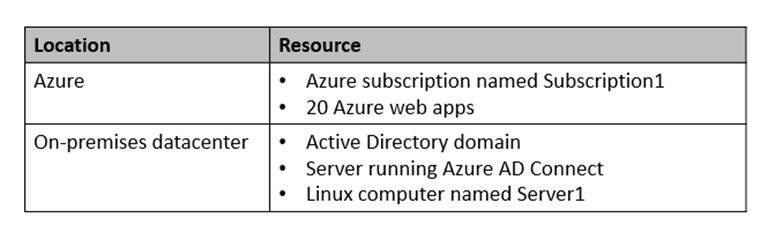
Your company has the infrastructure shown in the following table.
The on-premises Active Directory domain syncs with Azure Active Directory (Azure AD).
Server1 runs an application named App1 that uses LDAP queries to verify user identities in the on-premises Active Directory domain.
You plan to migrate Server1 to a virtual machine in Subscription1.
A company security policy states that the virtual machines and services deployed to Subscription1 must be prevented from accessing the on-premises network.
You need to recommend a solution to ensure that App1 continues to function after the migration. The solution must meet the security policy.
What should you include in the recommendation?
A. Azure AD Application Proxy
B. the Active Directory Domain Services role on a virtual machine
C. an Azure VPN gateway
D. Azure AD Domain Services (Azure AD DS)
Show Answer
Correct Answer: D
Explanation: Azure AD Domain Services provides managed LDAP authentication in Azure and can use identities synchronized from the on-premises AD domain through Azure AD. App1 can query the managed domain without connecting to the on-premises network. Azure AD Application Proxy is for publishing applications, while a VPN gateway would provide the prohibited on-premises connectivity.
Question 25
HOTSPOT
-
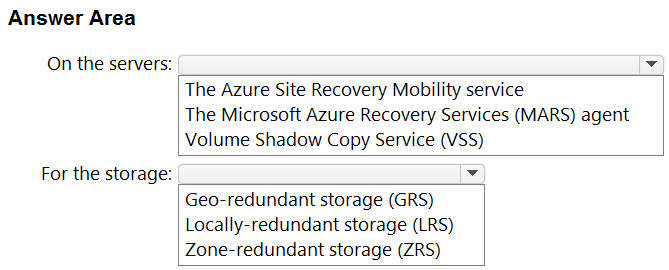
You have 10 on-premises servers that run Windows Server.
You need to perform daily backups of the servers to a Recovery Services vault. The solution must meet the following requirements:
• Back up all the files and folders on the servers.
• Maintain three copies of the backups in Azure.
• Minimize costs.
What should you configure? To answer, select the appropriate options in the answer area.
NOTE: Each correct selection is worth one point.
Show Answer
Correct Answer: On the servers: The Microsoft Azure Recovery Services (MARS) agent
For the storage: Locally-redundant storage (LRS)
Explanation: MARS is the Azure Backup agent used to back up Windows Server files and folders to a Recovery Services vault. LRS maintains three copies of the data within a single Azure region and is the lowest-cost option that satisfies the three-copy requirement.
$19
Get all 272 questions with detailed answers and explanations
Instant download HTML + PDF delivered the moment payment clears.
Secure Stripe checkout we never see or store your card details.
7-day refund if files are defective see our refund policy.