You have an Azure subscription named Subscription1. Subscription1 contains a virtual machine named VM1.
You have a computer named Computer1 that runs Windows 10. Computer1 is connected to the Internet.
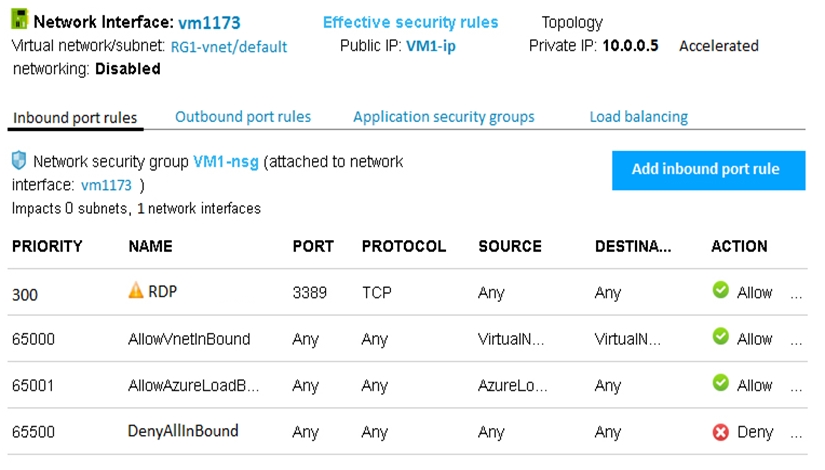
You add a network interface named vm1173 to VM1 as shown in the exhibit. (Click the Exhibit tab.)
From Computer1, you attempt to connect to VM1 by using Remote Desktop, but the connection fails.
You need to establish a Remote Desktop connection to VM1.
What should you do first?
A. Change the priority of the RDP rule
B. Attach a network interface
C. Delete the DenyAllInBound rule
D. Start VM1
Show Answer
Correct Answer: D
Explanation: Start VM1. The network interface is already attached, and the inbound security rules allow TCP port 3389 at priority 300, ahead of the default DenyAllInBound rule. A stopped VM cannot accept Remote Desktop connections.
Question 93
You have an Azure subscription that contains a resource group named RG1 and a virtual network named VNet1.
You plan to create an Azure container instance named container1.
You need to be able to configure DNS name label scope reuse for container1.
What should you configure for container1?
A. the private networking type
B. the public networking type
C. a new subnet on VNet1
D. a confidential SKU
Show Answer
Correct Answer: B
Explanation: DNS name label scope reuse applies to the public DNS name assigned to an Azure Container Instance. The DNS name label scope reuse setting is available only when the container instance uses the public networking type, because private networking does not expose a public DNS label. A new subnet or confidential SKU are unrelated to this feature.
Question 93
Note: This question is part of a series of questions that present the same scenario. Each question in the series contains a unique solution that might meet the stated goals. Some question sets might have more than one correct solution, while others might not have a correct solution.
After you answer a question in this section, you will NOT be able to return to it. As a result, these questions will not appear in the review screen.
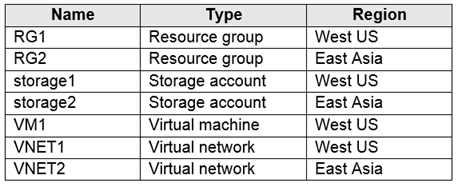
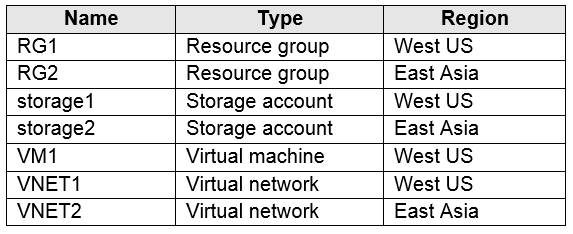
You have an Azure subscription that contains the resources shown in the following table.
VM1 connects to VNET1.
You need to connect VM1 to VNET2.
Solution: You create a new network interface, and then you add the network interface to VM1.
Does this meet the goal?
A. Yes
B. No
Show Answer
Correct Answer: B
Explanation: No. Adding a network interface does not move VM1 from VNET1 to VNET2. Also, VM1 is in West US while VNET2 is in East Asia, so a NIC in VNET2 cannot be attached to VM1. You would need to redeploy or migrate the VM to the appropriate region and network.
Question 94
HOTSPOT
-
You have an Azure AD tenant.
You need to create a Microsoft 365 group that contains only members of a marketing department in France.
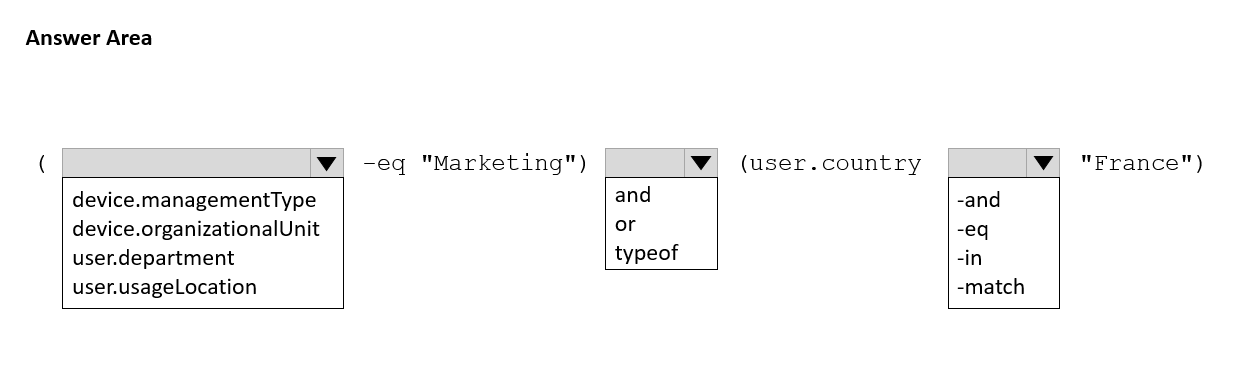
How should you complete the dynamic membership rule? To answer, select the appropriate options in the answer area.
NOTE: Each correct answer is worth one point.
Show Answer
Correct Answer: user.department
and
-eq
Explanation: Use the user department attribute to match Marketing, combine both conditions with AND, and compare the country attribute for exact equality to France.
Question 94
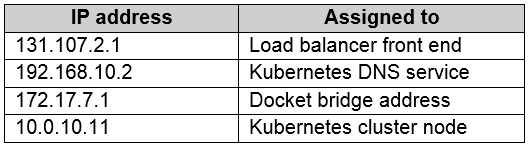
You deploy an Azure Kubernetes Service (AKS) cluster named Cluster1 that uses the IP addresses shown in the following table.
You need to provide internet users with access to the applications that run in Cluster1.
Which IP address should you include in the DNS record for Cluster1?
A. 131.107.2.1
B. 10.0.10.11
C. 172.17.7.1
D. 192.168.10.2
Show Answer
Correct Answer: A
Explanation: Use 131.107.2.1, the load balancer front-end IP. It is the public-facing address internet users can reach and should be listed in the DNS record. The other addresses are for internal Kubernetes or container networking.
Question 95
You have an Azure subscription named Subscription1 that contains virtual network named VNet1. VNet1 is in a resource group named RG1.
User named User1 has the following roles for Subscription1:
• Reader
• Security Admin
• Security Reader
You need to ensure that User1 can assign the Reader role for VNet1 to other users.
What should you do?
A. Remove User1 from the Security Reader and Reader roles for Subscription1. Assign User1 the Contributor role for Subscription1.
B. Remove User1 from the Security Reader role for Subscription1. Assign User1 the Contributor role for RG1.
C. Assign User1 the Network Contributor role for VNet1.
D. Assign User1 the User Access Administrator role for VNet1.
Show Answer
Correct Answer: D
Explanation: To assign Azure RBAC roles, a principal needs the Microsoft.Authorization/roleAssignments/write permission, which is included in the Owner and User Access Administrator built-in roles. Contributor and Network Contributor can manage resources but cannot grant access. Assigning User Access Administrator at the VNet1 scope allows User1 to assign the Reader role for that virtual network.
Question 95
You have an Azure subscription named Subscription1. Subscription1 contains the resource groups in the following table.
RG1 has a web app named WebApp1. WebApp1 is located in West Europe.
You move WebApp1 to RG2.
What is the effect of the move?
A. The App Service plan for WebApp1 remains in West Europe. Policy2 applies to WebApp1.
B. The App Service plan for WebApp1 moves to North Europe. Policy2 applies to WebApp1.
C. The App Service plan for WebApp1 remains in West Europe. Policy1 applies to WebApp1.
D. The App Service plan for WebApp1 moves to North Europe. Policy1 applies to WebApp1.
Show Answer
Correct Answer: A
Explanation: Moving WebApp1 to RG2 changes its resource-group association, not its Azure region. Its App Service plan remains in West Europe, and the policy assigned to the destination resource group—Policy2—applies to the app.
Question 96
You have an Azure subscription named Subscription1 that contains virtual network named VNet1. VNet1 is in a resource group named RG1.
A user named User1 has the following roles for Subscription1:
• Reader
• Security Admin
• Security Reader
You need to ensure that User1 can assign the Reader role for VNet1 to other users.
What should you do?
A. Assign User1 the Contributor role for VNet1.
B. Assign User1 the Network Contributor role for VNet1.
C. Assign User1 the User Access Administrator role for VNet1.
D. Remove User1 from the Security Reader and Reader roles for Subscription1. Assign User1 the Contributor role for Subscription1.
Show Answer
Correct Answer: C
Explanation: To assign Azure RBAC roles (such as the Reader role) to other users for a specific resource, the user needs permission to manage access. The User Access Administrator role grants permission to manage role assignments on the scoped resource. Contributor and Network Contributor can manage resources but cannot grant access or assign RBAC roles. The existing Reader, Security Admin, and Security Reader roles do not provide role assignment permissions.
Question 96
Note: This question is part of a series of questions that present the same scenario. Each question in the series contains a unique solution that might meet the stated goals. Some question sets might have more than one correct solution, while others might not have a correct solution.
After you answer a question in this section, you will NOT be able to return to it. As a result, these questions will not appear in the review screen.
You have an Azure subscription that contains the resources shown in the following table.
VM1 connects to VNET1.
You need to connect VM1 to VNET2.
Solution: You move VM1 to RG2, and then you add a new network interface to VM1.
Does this meet the goal?
A. Yes
B. No
Show Answer
Correct Answer: B
Explanation: No. Moving VM1 to RG2 changes its resource group, not its region or virtual network. VM1 remains in West US, while VNET2 is in East Asia, so a new NIC connected to VNET2 cannot be attached to it. VM1 must be redeployed or migrated to the appropriate region and network.
Question 97
Note: This question is part of a series of questions that present the same scenario. Each question in the series contains a unique solution that might meet the stated goals. Some question sets might have more than one correct solution, while others might not have a correct solution.
After you answer a question in this section, you will NOT be able to return to it. As a result, these questions will not appear in the review screen.
You have an Azure subscription that contains the resources shown in the following table.
VM1 connects to VNET1.
You need to connect VM1 to VNET2.
Solution: You delete VM1. You recreate VM1, and then you create a new network interface for VM1 and connect it to VNET2.
Does this meet the goal?
A. Yes
B. No
Show Answer
Correct Answer: A
Explanation: Yes. A VM’s network interface must be in the same region as the VM and VNet. Recreating VM1 in East Asia with a new NIC connected to VNET2 allows it to connect; the VM’s disks or image must also be available in that region.
$19
Get all 558 questions with detailed answers and explanations
Instant download HTML + PDF delivered the moment payment clears.
Secure Stripe checkout we never see or store your card details.
7-day refund if files are defective see our refund policy.