A construction equipment rental company is implementing Dynamics 365 Supply Chain Management. Equipment can be rented out more than once throughout its useful life.
The company requires the equipment to be configured as assets. The controller must be able to report on the cost of each asset and the group of assets at a single construction site.
You need to configure the financial dimensions.
Where should you configure the financial dimension?
A. Work orders
B. Functional location
C. Condition assessment
D. Asset
E. Work order pools
Show Answer
Correct Answer: B
Explanation: Configure the financial dimension on the functional location representing the construction site. Assets assigned to that location can inherit its dimensions, enabling cost reporting for individual assets and for the site’s group of assets.
Question 20
A company is configuring Dynamics 365 Supply Chain Management for its transportation management requirements.
When the company ships a container through a specific route, specific equipment with minimum and maximum weights must be used.
You need to configure the equipment and limits.
What should you configure?
A. route guide
B. route plans
C. constraints
D. hub types
E. hubs
Show Answer
Correct Answer: C
Explanation: Configure constraints to specify the equipment requirements and the minimum and maximum weight limits that apply to the shipment route.
Question 21
You are the planner for a distribution company.
You observe an increase in planned orders for item C0001. You must track the source for these planned orders and break them out based on their demand. You are not concerned with safety stock maximums for this item.
You need to ensure that the master planning batch job will create a unique planned purchase order for every new demand requirement for C0001.
Which coverage code should you use?
A. Manual
B. Period
C. Min/Max
D. Requirement
Show Answer
Correct Answer: D
Explanation: Requirement coverage creates a separate planned order for each demand requirement, allowing you to trace the source of planned orders individually. Manual does not automatically create plans per demand, Period groups demand within a time bucket, and Min/Max replenishes to inventory targets rather than creating one planned order per requirement. The note about not being concerned with safety stock maximums also rules out Min/Max.
Question 21
DRAG DROP
A company uses Dynamics 365 Supply Chain Management.
A planner observes that an item has last-minute orders placed. These orders drive new demand that is dependent upon POs arriving on schedule.
The planner determines the vendor is inconsistent with turnaround time.
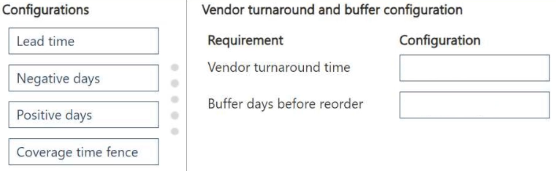
You need to configure the system to adjust for the vendor turnaround and add a buffer of two days prior to reordering product.
What should you configure for each requirement? To answer, move the appropriate configurations to the correct requirements. You may use each configuration once, more than once, or not at all. You may need to move the split bar between panes or scroll to view content.
NOTE: Each correct selection is worth one point.
Show Answer
Correct Answer: Vendor turnaround time: Lead time
Buffer days before reorder: Negative days
Explanation: Lead time accounts for the vendor’s turnaround. Negative days sets how long planning can wait for a delayed receipt before recommending a new order; set it to two days.
Question 22
A company receives a large quantity of inventory into the warehouse.
The inventory has a short shelf life and must be sent out to the stores as soon as possible.
You need to use Buyer's push to transfer the inventory out to the stores.
Which two actions should you perform? Each correct answer presents part of the solution.
NOTE: Each correct selection is worth one point.
A. Create a sales order.
B. Create transfer orders.
C. Select Product and ship open sales orders.
D. Select Product and distribution method.
Show Answer
Correct Answer: B, D
Explanation: Buyer's push distributes newly received inventory to stores by selecting the product and distribution method, then generating transfer orders to move stock from the warehouse to stores. It does not require creating sales orders or shipping open sales orders.
Question 22
HOTSPOT
This is a case study. Case studies are not timed separately. You can use as much exam time as you would like to complete each case. However, there may be additional case studies and sections on this exam. You must manage your time to ensure that you are able to complete all questions included on this exam in the time provided.
To answer the questions included in a case study, you will need to reference information that is provided in the case study. Case studies might contain exhibits and other resources that provide more information about the scenario that is described in the case study. Each question is independent of the other questions in this case study.
At the end of this case study, a review screen will appear. This screen allows you to review your answers and to make changes before you move to the next section of the exam. After you begin a new section, you cannot return to this section.
To start the case study
To display the first question in this case study, click the Next button. Use the buttons in the left pane to explore the content of the case study before you answer the questions. Clicking these buttons displays information such as business requirements, existing environment, and problem statements. If the case study has an All Information tab, note that the information displayed is identical to the information displayed on the subsequent tabs. When you are ready to answer a question, click the Question button to return to the question.
Background
Coho Vineyard & Winery is a parent company that has two subsidiaries: Coho Vineyard and Coho Winery. Coho Vineyard is based in Medford, Oregon. The vineyard grows the grapes and then produces and bottles the wine. Coho Winery, based in Grants Pass, Oregon, distributes packaged wine to businesses and consumers. The winery sells imported cheese and olive oil in addition to the wines.
Current environment. Technology landscape
• Coho Vineyard & Winery requires financial reporting from both Coho Vineyard and Coho Winery. The parent company consolidates financials in a third-party tool.
• Coho Winery currently manages inventory and financials on spreadsheets separately from the parent company.
Current environment. Inventory and warehousing
• The entire warehouse is temperature controlled. A refrigerated section of the warehouse is used for items that require colder storage.
• The items do not have fixed locations in the warehouse.
• Coho uses smart numbering for cheese items today. The items start with F for France and U for United States such as the following:
• F11234 = French cheese
• U14567 = US cheese
• Currently, wine does not use smart numbering.
• Inventory is valued at First In, First-Out (FIFO).
• Olive oil has a 12-month shelf life.
• WineA is expensive and not regularly stocked in the warehouse.
• WineB must be in the refrigerated section of the warehouse.
• WineC is non-refrigerated wine and is the majority of inventory in the warehouse.
Current environment. Vendors and procurement
• Cheese is purchased from vendors in two countries: France and United States.
• Non-cheese items can be purchased from vendors in other countries or regions.
• Olive oil is bought and sold in full cases of six each.
• When Coho Vineyard produces more wine than expected in a season, rebate programs are offered to any company whose monthly purchases exceed $5,000.
Requirements. General
• The Coho Vineyard & Winery parent company, as well as Coho Vineyard, will not be considered in the implementation of Dynamics 365 Finance and Dynamics 365 Supply Chain Management for Coho Winery. They plan to implement them as separate legal entities in the next five years.
Requirements. Inventory and warehousing
• Items must be renumbered in the new system.
• Separate item numbers must be used for each imported item for use in simplified reporting by source country or region.
• Advanced Warehouse Management capabilities must be enabled in the new system.
• Each bottle of wine has a single item number.
• The vintage of each bottle will change annually and may affect the cost of the bottle. This cost must be tracked by year.
• Some bottles of wine require refrigeration. The system must automatically define where items must be stored in the warehouse.
• Wine must be grouped in a hierarchy such as the following:
• Red
• Cabernet
• Merlot
• White
• Chardonnay
• Pinot
• Inventory value must be stored at each month end.
• Each month, the olive oil on-hand inventory is evaluated. Anything with less than six months left on the shelf life is sold to a discount retail store. If less than 90 days remains for the shelf life, then the olive oil is donated or destroyed.
• At least 20 cases of olive oil and no more than 50 cases are on hand and not reserved for upcoming customer orders.
• WineB must be refrigerated.
Requirements. Vendors and procurement
• The cheese smart numbering system will not be used in the future. Instead, the system must use standard configurations to ensure the correct cheese items are used for the correct country or region when ordering.
• Olive oil must be managed in full cases only, although the inventory cost must be calculated as cages.
• Should any bottle of olive oil be broken within a case, the cases will be sold at a discounted price.
• Vendor rebates must be calculated and submitted for a claim.
• Rebate programs are passed on to the retailers selling Coho Winery wines. The rebates must be claimed from Coho Vineyard.
• Purchase orders (POs) must be maintained online with tracked changes between the vendors and the buyers.
• The controller decides WineA must not be held in financial inventory on the Coho Winery books. The winery makes an agreement with the vendor that WineA will be owned by the vendor until a later date.
• Vendor1 sends bulk shipments. Coho Winery does not always have enough warehouse staff to receive inventory. The company requires Vendor1 to send advanced shipping notices (ASNs).
• The operations coordinator must schedule inbound loads. The company requires automation of inbound load creation where possible.
Issues
• The warehouse is at maximum capacity. Empty bin locations are not always available.
• The warehouse manager wants to establish fast moving locations for WineB on the floor and refill locations from higher rack storage.
• Coho Winery recently conducted an internal audit risk assessment. The risk assessment found that inventory value reports were stored in spreadsheets. The spreadsheets can easily be edited and lack controls.
• After olive oil is counted, multiple cases are destroyed due to shelf life. The inventory planner must determine if a new PO should be placed for olive oil.
• The vendor rebates claims are often rejected because the claims were miscalculated by not including discounts.
• The purchasing manager receives multiple complaints regarding POs:
• Issue 1: PO changes are not accepted and confirmed, resulting in out-of-stock issues.
• Issue 2: Vendors do not have control on responses to POs. Instead, the vendors rely on emails.
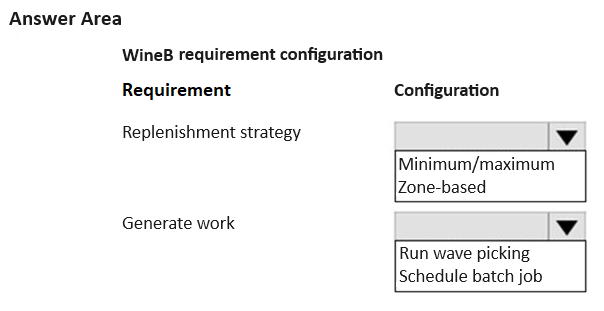
You need to configure the WineB requirements.
What should you configure for each requirement? To answer, select the appropriate options in the answer area.
NOTE: Each correct selection is worth one point.
Explanation: Zone-based replenishment refills WineB’s floor picking area from higher racks without requiring fixed item locations. A scheduled batch job generates the replenishment work.
Question 23
DRAG DROP
Case study
This is a case study. Case studies are not timed separately. You can use as much exam time as you would like to complete each case. However, there may be additional case studies and sections on this exam. You must manage your time to ensure that you are able to complete all questions included on this exam in the time provided.
To answer the questions included in a case study, you will need to reference information that is provided in the case study. Case studies might contain exhibits and other resources that provide more information about the scenario that is described in the case study. Each question is independent of the other questions in this case study.
At the end of this case study, a review screen will appear. This screen allows you to review your answers and to make changes before you move to the next section of the exam. After you begin a new section, you cannot return to this section.
To start the case study
To display the first question in this case study, click the Next button. Use the buttons in the left pane to explore the content of the case study before you answer the questions. Clicking these buttons displays information such as business requirements, existing environment, and problem statements. If the case study has an All Information tab, note that the information displayed is identical to the information displayed on the subsequent tabs. When you are ready to answer a question, click the Question button to return to the question.
Background
Munson’s Pickles and Preserves Farm is a distribution company that supplies pickles, preserves, pickling supplies, and accessory products to local farmers’ markets as well as grocers. Munson’s Pickles and Preserves Farm does not produce or provide canning services for any items.
Current Environment
Munson's Pickles and Preserves Farm has an accounting system that is disconnected from the warehousing system. This has caused issues with controlling and valuing inventory. With these core drivers, Munson's Pickles and Preserves Farm decides to implement Dynamics 365 Finance and Dynamics 365 Supply Chain Management.
Warehousing
• Munson’s Pickles and Preserves Farm has a single warehouse that serves as the distribution center for all products.
• The warehouse has bulk locations as well as racking, but location names and numbers do not exist.
• Bulk locations are for storage of extra inventory that will not fit into the picking locations.
• The warehouse is temperature-controlled, with locations grouped into two zones: refrigerated and non-perishable.
• Inventory adjustments are made regularly due to lack of inventory controls.
Inventory Data
• Item numbers are inconsistent and were set up as “smart-numbering,” such as 1-23-PKL and 44-24-PICK.
• Cucumbers are not grown by Munson's Pickles and Preserves Farm and may be sourced from local farmers.
• Pickles come in bottle sizes of 8 oz, 16 oz, 32 oz. The bottles are packed in cases.
• Pickles may be spear, chip, or whole shapes within the bottles. This does not impact the cost of the pickles when they are the same flavor.
• Pickle flavors are sweet, spicy, and dill. The flavors vary in price.
• Preserves come in multiple flavors, such as mango, strawberry, and grape. These are seasonal items only. Due to the varying flavors and quantities, the preserves are owned by the vendor until they are sold. The mango preserves require refrigeration. The other preserves do not require refrigeration.
• Many items are sold as accessories or supplies for pickling.
• Some items within inventory have an expiration date, such as vinegar.
• Fast-moving items are identified by inventory turns per quarter. Sweet and spicy pickles are the most popular.
Purchasing and Sales
• Munson’s Pickles and Preserves Farm has an online store that can be found at munsonspicklesandpreservesfarm.com.
• The online store is limited to a subset of products that are accessories only, such as bottles and jars.
• A new product line of kosher pickles is going to be distributed by Munson’s Pickles and Preserves Farm.
• VendorA is the largest vendor that Munson’s Pickles and Preserves Farm buys products from. Munson’s Pickles and Preserves Farm’s second largest vendor is VendorB.
Requirements
Warehousing
• The warehouse manager requires fast-moving items to be easily accessible to the order pickers in AisleA, with no more than one item per bin location in AisleA. Both sweet and spicy pickles have more inventory than will fit in AisleA, resulting in bulk location storage.
o Spicy pickles must have no less than half of a pallet in AisleA at any time.
o Sweet pickles must have enough inventory in AisleA prior to creating waves for warehouse work.
• Strawberry preserves are selling slowly this season. They are put away in higher bin locations because they are not considered fast-moving items
Inventory & Data
• Item numbers must be set up to create a streamlined numbering system. Munson’s Pickles and Preserves Farm requires that the old item number be stored in Dynamics 365 for cross reference purposes. Munson’s Pickles and Preserves Farm has settled on 0000001 as the item format for pickles instead of 1-23-PKL. PKL will be stored as an attribute.
• Item numbers for pickles must be consolidated where possible into a single item number, regardless of bottle size.
• Cucumbers must be sold at actual cost because they are a special order.
• Kosher pickles must be set up in the item master. The kosher pickles are the same size jars and flavors as the other pickles, except that they have a kosher designation and will be slightly more expensive.
• Vinegar and other perishable items must have date tracking for the manufacturer's batch number and expiration date of the product.
• A batch of mango preserves had to be thrown away because the warehouse workers put away the product into the non-perishable zone.
Purchasing & Sales
• Cucumbers must be sourced from local vendors for special orders only.
• Munson’s Pickles and Preserves Farm recently signed an exclusivity agreement with VendorA, and buyers must now only purchase from VendorA.
• VendorA recently purchased a competitor company, VendorB. VendorA wants to ensure that all agreements with VendorA also apply to VendorB while they work on merging the two companies into one.
• VendorC sells preserves to Munson’s Pickles and Preserves Farm and requires the following:
o Shipment requirement: VendorC owns the product after shipment to Munson’s Pickles and Preserves Farm until the time of sale.
o On-hand requirement: VendorC has access to view on-hand preserve inventory at Munson’s Pickles and Preserves Farm warehouse.
Issues
• CustomerD reports that the vinegar they ordered had a week left before it expired when they received it. This did not give CustomerD enough time to use the vinegar before they had to dispose of it. CustomerD now requires that all vinegar has more than 30 days left before the expiration date.
• A customer calls and states that they ordered kosher pickles and received regular pickles. Inventory Control Clerk 2 reports that kosher and non-kosher pickles of the same variety are in the same warehouse location, contributing to the picking errors.
• A salesperson reports that the margin is incorrect on a customer’s special order because the cucumber cost was for the most recent receipt of cucumbers, not the cucumbers received for the specific customer order.
• An internal audit revealed that large quantities of pickles were missing and written off as damaged on multiple occasions cover the past year. No documentation or explanation of the write offs exist. There is no documentation of disposal, and no approval from management to substantiate that the pickles were not stolen.
• Jars of pickles are received as eaches. Case counts of pickle jars vary by size:
o 8 oz jars are 12 per case
o 16 oz jars are 6 per case
o The varied counts in each case create overhead in the warehouse.
• The receiving clerk in the warehouse wants to ensure that broken bottles of vinegar are moved to a damage location named LocationA. Expired vinegar should be moved to a return-to-vendor location named LocationB. All other vinegar should be put away and sold according to normal location directives.
• Operator1 is picking a pallet of strawberry preserves from a location to the shipping dock. While picking up the pallet, Operator1 drops the pallet. Operator1 must make sure that the strawberry preserves are not available for shipment until the damage is evaluated.
• Operator2 tries to print wave labels that contain item 0000001. The labels start to print and then jam. At the same time, the printer battery needs to be recharged and the labels need to be reprinted.
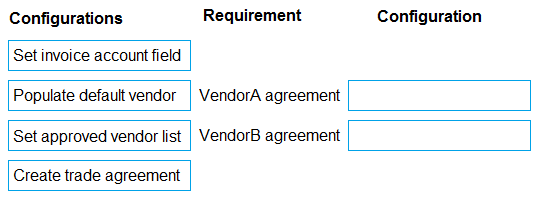
You need to configure the kosher pickle requirements for VendorA.
What should you configure? To answer, move the appropriate configurations to the correct requirements. You may use each configuration once, more than once, or not at all. You may need to drag the split bar between panes or scroll to view content.
NOTE: Each correct selection is worth one point.
Show Answer
Correct Answer: VendorA agreement: Set approved vendor list
VendorB agreement: Set invoice account field
Explanation: Approve only VendorA to enforce the exclusive purchasing agreement. Set VendorB’s invoice account to VendorA so VendorA’s purchasing agreements also apply to VendorB.
Question 24
DRAG DROP
Case study
This is a case study. Case studies are not timed separately. You can use as much exam time as you would like to complete each case. However, there may be additional case studies and sections on this exam. You must manage your time to ensure that you are able to complete all questions included on this exam in the time provided.
To answer the questions included in a case study, you will need to reference information that is provided in the case study. Case studies might contain exhibits and other resources that provide more information about the scenario that is described in the case study. Each question is independent of the other questions in this case study.
At the end of this case study, a review screen will appear. This screen allows you to review your answers and to make changes before you move to the next section of the exam. After you begin a new section, you cannot return to this section.
To start the case study
To display the first question in this case study, click the Next button. Use the buttons in the left pane to explore the content of the case study before you answer the questions. Clicking these buttons displays information such as business requirements, existing environment, and problem statements. If the case study has an All Information tab, note that the information displayed is identical to the information displayed on the subsequent tabs. When you are ready to answer a question, click the Question button to return to the question.
Background
Munson’s Pickles and Preserves Farm is a distribution company that supplies pickles, preserves, pickling supplies, and accessory products to local farmers’ markets as well as grocers. Munson’s Pickles and Preserves Farm does not produce or provide canning services for any items.
Current Environment
Munson's Pickles and Preserves Farm has an accounting system that is disconnected from the warehousing system. This has caused issues with controlling and valuing inventory. With these core drivers, Munson's Pickles and Preserves Farm decides to implement Dynamics 365 Finance and Dynamics 365 Supply Chain Management.
Warehousing
• Munson’s Pickles and Preserves Farm has a single warehouse that serves as the distribution center for all products.
• The warehouse has bulk locations as well as racking, but location names and numbers do not exist.
• Bulk locations are for storage of extra inventory that will not fit into the picking locations.
• The warehouse is temperature-controlled, with locations grouped into two zones: refrigerated and non-perishable.
• Inventory adjustments are made regularly due to lack of inventory controls.
Inventory Data
• Item numbers are inconsistent and were set up as “smart-numbering,” such as 1-23-PKL and 44-24-PICK.
• Cucumbers are not grown by Munson's Pickles and Preserves Farm and may be sourced from local farmers.
• Pickles come in bottle sizes of 8 oz, 16 oz, 32 oz. The bottles are packed in cases.
• Pickles may be spear, chip, or whole shapes within the bottles. This does not impact the cost of the pickles when they are the same flavor.
• Pickle flavors are sweet, spicy, and dill. The flavors vary in price.
• Preserves come in multiple flavors, such as mango, strawberry, and grape. These are seasonal items only. Due to the varying flavors and quantities, the preserves are owned by the vendor until they are sold. The mango preserves require refrigeration. The other preserves do not require refrigeration.
• Many items are sold as accessories or supplies for pickling.
• Some items within inventory have an expiration date, such as vinegar.
• Fast-moving items are identified by inventory turns per quarter. Sweet and spicy pickles are the most popular.
Purchasing and Sales
• Munson’s Pickles and Preserves Farm has an online store that can be found at munsonspicklesandpreservesfarm.com.
• The online store is limited to a subset of products that are accessories only, such as bottles and jars.
• A new product line of kosher pickles is going to be distributed by Munson’s Pickles and Preserves Farm.
• VendorA is the largest vendor that Munson’s Pickles and Preserves Farm buys products from. Munson’s Pickles and Preserves Farm’s second largest vendor is VendorB.
Requirements
Warehousing
• The warehouse manager requires fast-moving items to be easily accessible to the order pickers in AisleA, with no more than one item per bin location in AisleA. Both sweet and spicy pickles have more inventory than will fit in AisleA, resulting in bulk location storage.
o Spicy pickles must have no less than half of a pallet in AisleA at any time.
o Sweet pickles must have enough inventory in AisleA prior to creating waves for warehouse work.
• Strawberry preserves are selling slowly this season. They are put away in higher bin locations because they are not considered fast-moving items
Inventory & Data
• Item numbers must be set up to create a streamlined numbering system. Munson’s Pickles and Preserves Farm requires that the old item number be stored in Dynamics 365 for cross reference purposes. Munson’s Pickles and Preserves Farm has settled on 0000001 as the item format for pickles instead of 1-23-PKL. PKL will be stored as an attribute.
• Item numbers for pickles must be consolidated where possible into a single item number, regardless of bottle size.
• Cucumbers must be sold at actual cost because they are a special order.
• Kosher pickles must be set up in the item master. The kosher pickles are the same size jars and flavors as the other pickles, except that they have a kosher designation and will be slightly more expensive.
• Vinegar and other perishable items must have date tracking for the manufacturer's batch number and expiration date of the product.
• A batch of mango preserves had to be thrown away because the warehouse workers put away the product into the non-perishable zone.
Purchasing & Sales
• Cucumbers must be sourced from local vendors for special orders only.
• Munson’s Pickles and Preserves Farm recently signed an exclusivity agreement with VendorA, and buyers must now only purchase from VendorA.
• VendorA recently purchased a competitor company, VendorB. VendorA wants to ensure that all agreements with VendorA also apply to VendorB while they work on merging the two companies into one.
• VendorC sells preserves to Munson’s Pickles and Preserves Farm and requires the following:
o Shipment requirement: VendorC owns the product after shipment to Munson’s Pickles and Preserves Farm until the time of sale.
o On-hand requirement: VendorC has access to view on-hand preserve inventory at Munson’s Pickles and Preserves Farm warehouse.
Issues
• CustomerD reports that the vinegar they ordered had a week left before it expired when they received it. This did not give CustomerD enough time to use the vinegar before they had to dispose of it. CustomerD now requires that all vinegar has more than 30 days left before the expiration date.
• A customer calls and states that they ordered kosher pickles and received regular pickles. Inventory Control Clerk 2 reports that kosher and non-kosher pickles of the same variety are in the same warehouse location, contributing to the picking errors.
• A salesperson reports that the margin is incorrect on a customer’s special order because the cucumber cost was for the most recent receipt of cucumbers, not the cucumbers received for the specific customer order.
• An internal audit revealed that large quantities of pickles were missing and written off as damaged on multiple occasions cover the past year. No documentation or explanation of the write offs exist. There is no documentation of disposal, and no approval from management to substantiate that the pickles were not stolen.
• Jars of pickles are received as eaches. Case counts of pickle jars vary by size:
o 8 oz jars are 12 per case
o 16 oz jars are 6 per case
o The varied counts in each case create overhead in the warehouse.
• The receiving clerk in the warehouse wants to ensure that broken bottles of vinegar are moved to a damage location named LocationA. Expired vinegar should be moved to a return-to-vendor location named LocationB. All other vinegar should be put away and sold according to normal location directives.
• Operator1 is picking a pallet of strawberry preserves from a location to the shipping dock. While picking up the pallet, Operator1 drops the pallet. Operator1 must make sure that the strawberry preserves are not available for shipment until the damage is evaluated.
• Operator2 tries to print wave labels that contain item 0000001. The labels start to print and then jam. At the same time, the printer battery needs to be recharged and the labels need to be reprinted.
You need to configure the location directives for vinegar.
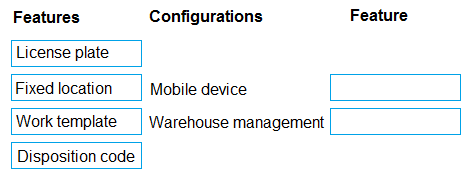
Which features should you choose for the given configurations? To answer, move the appropriate features to the correct configurations. You may use each feature once, more than once, or not at all. You may need to drag the split bar between panes or scroll to view content.
NOTE: Each correct selection is worth one point.
Show Answer
Correct Answer: Mobile device → Disposition code
Warehouse management → Work template
Explanation: The receiving clerk uses disposition codes to identify broken or expired vinegar. Warehouse work templates create the put-away work, and location directives route it to the appropriate location.
Question 25
Note: This question is part of a series of questions that present the same scenario. Each question in the series contains a unique solution that might meet the stated goals. Some question sets might have more than one correct solution, while others might not have a correct solution.
After you answer a question in this section, you will NOT be able to return to it. As a result, these questions will not appear in the review screen.
A company plans to configure Dynamics 365 Supply Chain Management to perform preventative maintenance for several machines on its shop floor.
The company has the following requirements:
• Create work orders automatically.
• Inspect assets daily starting June 1 of this year.
• Perform five calibration and safety checks on a set of assets each day to maintain safety compliance.
You need to configure the appropriate solution.
Solution: Create a work order, assign a work order maintenance job for each asset, configure the work order for the requirements, and schedule the work order.
Does the solution meet the goal?
A. Yes
B. No
Show Answer
Correct Answer: B
Explanation: No. A work order is used to execute a maintenance job; creating and scheduling one does not establish automatic recurring work orders. Configure a maintenance plan or maintenance round with the required daily recurrence, start date, assets, and calibration and safety checks so work orders are generated automatically.
Question 26
Note: This question is part of a series of questions that present the same scenario. Each question in the series contains a unique solution that might meet the stated goals. Some question sets might have more than one correct solution, while others might not have a correct solution.
After you answer a question in this section, you will NOT be able to return to it. As a result, these questions will not appear in the review screen.
A manufacturing company has implemented Dynamics 365 Supply Chain Management. The company relies on machinery and equipment for its operations. It has a diverse range of assets, including manufacturing equipment, vehicles, and tools.
The company wants to optimize its asset maintenance processes to minimize downtime and improve overall productivity. The company wants to implement both preventive and reactive maintenance strategies on the following scenarios:
• Changing the tires and oil on the maintenance vehicle fleet.
• Replacing a faulty component on a box maker.
You need to determine the functionality to use for each maintenance requirement.
Solution: Create maintenance plan for the vehicle fleet and a maintenance round for the box maker.
Does the solution meet the goal?
A. Yes
B. No
Show Answer
Correct Answer: B
Explanation: A maintenance plan is appropriate for preventive, scheduled maintenance such as changing tires and oil on a vehicle fleet. Replacing a faulty component on a box maker is reactive (corrective) maintenance triggered by a failure, not a recurring maintenance activity. A maintenance round is used to group and execute planned maintenance work on multiple assets/routes, not to handle unplanned corrective repairs.
$19
Get all 443 questions with detailed answers and explanations
Instant download HTML + PDF delivered the moment payment clears.
Secure Stripe checkout we never see or store your card details.
7-day refund if files are defective see our refund policy.