HOTSPOT
-
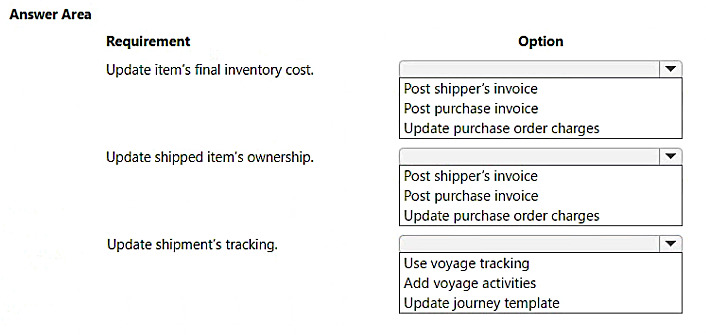
A company uses Dynamics 365 Supply Chain Management to manage procurement operations.
The company plans to source some product lines from offshore vendors. The company wants to use the landed cost module feature for the shipment tracking and item costing.
You need to configure the procurement requirements.
What should you do? To answer, select the appropriate options in the answer area.
NOTE: Each correct selection is worth one point.
Show Answer
Correct Answer: Update item's final inventory cost: Post shipper's invoice
Update shipped item's ownership: Post purchase invoice
Update shipment's tracking: Use voyage tracking
Explanation: In Landed Cost, the final inventory cost is finalized when actual shipping costs are posted via the shipper's invoice. Ownership is updated through purchase invoice processing. Shipment tracking is managed using voyage tracking.
Question 128
You are the logistics manager at a distribution company.
Your primary carrier service provides rates for transportation between New York City and Colorado. These rates are a flat rate depending on the city or general area of pickup as follows:
• New York City = $500
• Colorado = $450
You need to set up Transportation Management to calculate the rate from New York City to Colorado.
What should you do?
A. Use a Point-to-Point engine based on weight and miles. Assign rates from New York City as the starting location and Colorado as the ending location and break the rates out based on the weight of the package.
B. Using the Point-to-Point engine with an empty break master, assign rates based on starting and ending locations.
C. Create a Shipping carrier and service. Create carrier accessorial charges to represent the rates for each location.
D. Set up A Transit Time Engine to track days from New York City to Colorado. Set up rates in the Rate Master tied to day breaks.
Show Answer
Correct Answer: B
Explanation: Among the provided options, the Point-to-Point rating engine with an empty break master is the correct configuration for a flat origin-to-destination rate that does not vary by weight, distance, or transit time. Option A incorrectly introduces weight and miles, C misuses accessorial charges, and D is about transit time rather than freight rating. Although Dynamics 365 commonly uses Zone Masters for geographic rating, that correct approach is not offered in the answer choices, making B the best available answer.
Question 129
Case study -
This is a case study. Case studies are not timed separately. You can use as much exam time as you would like to complete each case. However, there may be additional case studies and sections on this exam. You must manage your time to ensure that you are able to complete all questions included on this exam in the time provided.
To answer the questions included in a case study, you will need to reference information that is provided in the case study. Case studies might contain exhibits and other resources that provide more information about the scenario that is described in the case study. Each question is independent of the other questions in this case study.
At the end of this case study, a review screen will appear. This screen allows you to review your answers and to make changes before you move to the next section of the exam. After you begin a new section, you cannot return to this section.
To start the case study -
To display the first question in this case study, click the Next button. Use the buttons in the left pane to explore the content of the case study before you answer the questions. Clicking these buttons displays information such as business requirements, existing environment, and problem statements. If the case study has an All Information tab, note that the information displayed is identical to the information displayed on the subsequent tabs. When you are ready to answer a question, click the Question button to return to the question.
Background -
School of Fine Art is a distribution company that sells school supply items to primary and secondary schools. These include items such as pens, pencils, paper, notebooks, chalk, desks, acrylic paints, blackboards, dry erase markers, and whiteboard paint. Due to increased demand for colored pencils, lead times are longer for these pencils. School of Fine Art plans to expand sales into this market.
School of Fine Art plans to implement Dynamics 365 Supply Chain Management to manage the business.
Current environment. Company structure
School of Fine Art consists of two legal entities.
Primary company -
• Located in Dublin, Ireland.
• Has a single named warehouse.
• Is the primary distribution center for both companies.
Second company -
• Is located in Glasgow, Scotland.
• Includes the following warehouses: Glasgow1, Glasgow2.
○ Glasgow1 is used primarily to supply items regionally.
○ Glasgow2 serves as local storage for vendor-owned inventory and bulk storage for School of Fine Art's inventory.
Current environment. General processes
School of Fine Art uses a combination of spreadsheets and paper forms to manage the business.
• All sales, purchases, and inventory are tracked in spreadsheets that are password protected by managers.
• Managers frequently share spreadsheet passwords so that other users can make edits on their behalf. Inventory quantities and values are unreliable.
• The spreadsheets are often incorrectly updated, have entry errors, and broken formulas for calculations.
• Purchase order receipts, picking lists, packing slips, and invoices are all handwritten on pre-printed, three-part forms.
• Late summer is the company's busiest time. During this time, workers are typically on the warehouse floor or making rush deliveries to schools to meet last-minute needs.
Current environment. Inventory and warehousing
• School of Fine Art values inventory by using FIFO costing methods.
• Inventory in the warehouses cannot be distinguished as available inventory or inventory that is sold to a customer and waiting to be picked. This creates inventory inflation during cycle counts and later shortages because warehouse workers count items that are already promised to customers and waiting to be shipped.
• Glasgow2 space is fully allocated to vendors.
• Due to space constraints, school orders for photocopiers are shipped from the vendor to the school.
• Crayons are stored as separate item numbers depending on whether they are in a box or a case. This creates issues when counting inventory to determine the total number of crayons in stock.
• Lack of inventory controls has led to shortages on sales orders, creating backorders and unhappy schools.
• Inventory is ordered quarterly due to the seasonality of the business.
• Items can change annually based on popular sizes, colors, and styles for each new school season. The creation of the different configurations is a manual process, which creates so much overhead that temporary workers are brought in to do the data entry.
Current environment. Purchasing -
• Reordering is manually managed by the buyers looking at the seasonal spikes for the start of the school year, slowing around the end-of-year holidays until the following school year.
• Pens are readily available products that are rarely discounted for sale.
• Photocopiers are only available for sale on the Glasgow region.
• Photocopy paper and construction paper are ordered by the pallet into Dublin1 and must be broken down into smaller sizes. The pallets are typically broken down and then split between what stays in Dublin1 and what is shipped to Glasgow1.
• Chalk and blackboards are slower sellers, so many vendors do not carry these items. School of Fine Art purchases these products from a single vendor. There are no alternative vendors available.
• School of Fine Art agrees to purchase a new line of smartboards from a vendor. The agreed-upon smartboard purchase prices will have a cost price per 55-inch, 75-inch, or 85-inch smartboard.
• The company purchases pencils for the following warehouses:
○ Glasgow1:
• standard pencils from Vendor A
• colored pencils from Vendor B
○ Dublin1:
• standard pencils from Vendor A
• colored pencils from Vendor A
• As whiteboard paint grows in popularity, so does the demand. This causes supply shortages. Whiteboard paint is ordered six months in advance.
Current environment. Customer sales
• The company contractually agrees to prices for some items with schools prior to the start of each school year.
• Schools may order bulk cases of products and choose to distribute further breakdowns, such as a case of crayons, which are then distributed to classrooms by the box.
• Pens do not require contracts with schools because they are low margin and do not have supply chain shortages.
• Painting supplies such as acrylic paint, canvases, and easels do not require a special contract and are sold at regular list price to all schools.
• Schools that offer painting classes are part of a program that provides special pricing on the painting supplies.
• Chalk and blackboards are ordered less frequently than they were in past years. Schools are choosing to use whiteboard paint, which is a lower cost than ordering and installing the whiteboards.
Requirements. Customers and sales
• The system must have the ability to limit product purchase amounts by a single school to prevent stock shortages for other schools.
• Schools are obligated to purchase the agreed amount for specific items per the school year.
• Customer service must be able to easily enter items for sales orders and identify stock shortages.
• Sales of whiteboard paint must be limited so that one school does not buy all the inventory and force backorders for other schools.
• Schools must agree to the amount of whiteboard paint they will purchase for the whole school year.
Requirements. Inventory costing -
• Inventory must have associated costs except for the vendor storage in Glasgow2.
• The vendor storage must still contain quantities but not include cost in inventory valuations.
• At the end of each month, the costing manager must be able to identify how many items will not be fully settled.
• Annual configuration changes to items must be automatically created where possible.
• The company must be able to track costs for colored pencils and standard pencils separately.
Requirements. Inventory -
• Warehouse workers must be able to use their mobile phones and the mobile app to take calls and create transactions in the warehouse.
• The desks must use a single item number and barcode regardless of year manufactured and the vendor.
• Water-based paints from the vendor must be received in pails.
• Acrylic paint must be managed by batches and expiration dates.
• Pencils must be categorized as colored pencils or standard pencils. The individual colors of each colored pencil (such as red, green, and blue) will not be tracked.
• The creation of unique smartboard items must be kept to a minimum.
Issues -
• WarehouseWorker1 works in Glasgow2. The worker receives a request to ship pallets of paper from the warehouse to Glasgow1 and Dublin1. WarehouseWorker1 must create the shipments in the system to transfer the pallets of paper from Glasgow1 to Dublin1.
• The number of backorders for desks has increased. Customer service representatives struggle to select a desk item number that has inventory on hand. The desks are the same item, but the manufacturer vendor and year differ.
• A school calls customer service to report that its photocopier is broken. The school needs expedited shipment of a replacement.
• A school that is part of the special paint program reports that a sale price on canvas last month was a better price than its paint program price. The school requests a price adjustment.
• A school reports that different shipments of acrylic paints are slightly different in color.
• The sales team decides to have a flash sale on pens for one month only. The person entering the Sales order line should be able to communicate the information to the customer on the Sales order line.
• Schools are reporting that chalk and blackboards are broken upon receipt. A worker in Dublin1 opens some cases of these products in the warehouse and finds that they are also broken. You must implement processes to enforce inventory inspection for a percentage of each purchase order line received. You must block all inventory for a purchase order line if the inspection fails.
You need to provide the information for the costing manager.
What should you do first?
A. Check cost prices.
B. Check for open quantities.
C. Close and adjust cancellation.
D. View close settlements.
Show Answer
Correct Answer: B
Explanation: Before month-end inventory close, the first step to determine which inventory transactions will not be fully settled is to review open quantities. Open quantities indicate receipts/issues that remain unsettled and help identify transactions that will not be fully matched during inventory close. Close settlements are reviewed after running close, while checking cost prices or cancellation is not the initial step for this requirement.
Question 130
Note: This question is part of a series of questions that present the same scenario. Each question in the series contains a unique solution that might meet the stated goals. Some question sets might have more than one correct solution, while others might not have a correct solution.
After you answer a question in this section, you will NOT be able to return to it. As a result, these questions will not appear in the review screen.
A company plans to simplify interactions between purchasing department employees and vendors.
You need to ensure that employees are redirected to a vendor's online store to select items for inclusion on purchase requisitions.
Solution: Create an external catalog.
Does the solution meet the goal?
A. Yes
B. No
Show Answer
Correct Answer: A
Explanation: An external catalog (punch-out catalog) allows employees to be redirected from Dynamics 365 to a vendor's online store, where they select items. The selected items are then returned to Dynamics 365 and included on the purchase requisition, which matches the stated goal.
Question 131
A company has multiple legal entities. The company is implementing Dynamics 365 Supply Chain Management.
Purchase orders are generated from multiple legal entities. To reduce shipping costs, the purchase orders must be consolidated into multiple shipping containers of the same type and placed onto a single vessel for inbound receipt into the country/region.
You need to configure the path of the shipping containers.
What should you configure?
A. Journey
B. Voyage
C. Route
D. Route segment
Show Answer
Correct Answer: A
Explanation: In Landed Cost, the path that shipping containers follow is defined by a Journey (or journey template), which specifies the transport legs, ports, and route between origin and destination. A Voyage is the operational shipment on a vessel that contains shipping containers, but it uses the configured journey to define the container path. Therefore, to configure the path of the shipping containers, configure the Journey.
Sources:
https://learn.microsoft.com/en-us/dynamics365/supply-chain/landed-cost/manage-shipping-containers
Question 132
DRAG DROP
-
Case study
-
This is a case study. Case studies are not timed separately. You can use as much exam time as you would like to complete each case. However, there may be additional case studies and sections on this exam. You must manage your time to ensure that you are able to complete all questions included on this exam in the time provided.
To answer the questions included in a case study, you will need to reference information that is provided in the case study. Case studies might contain exhibits and other resources that provide more information about the scenario that is described in the case study. Each question is independent of the other questions in this case study.
At the end of this case study, a review screen will appear. This screen allows you to review your answers and to make changes before you move to the next section of the exam. After you begin a new section, you cannot return to this section.
To start the case study
-
To display the first question in this case study, click the Next button. Use the buttons in the left pane to explore the content of the case study before you answer the questions. Clicking these buttons displays information such as business requirements, existing environment, and problem statements. If the case study has an All Information tab, note that the information displayed is identical to the information displayed on the subsequent tabs. When you are ready to answer a question, click the Question button to return to the question.
Background
-
Trey Research is a multinational manufacturer of health and dietary supplements based in Seattle, Washington. The company is experiencing a rapid expansion not only in its supplements but as a lifestyle brand that also sells apparel. The supplements and apparel businesses operate independently but manufacture and operate in the same legal entity.
Current environment
-
Current environment. Technology
Trey Research is migrating from an outdated, on-premises version of Dynamics AX to Dynamics 365 Supply Chain Management. The company wants to retain a lot of its current data structures and processes but adopt new efficiencies when the benefit is obvious. The company uses a third-party e-commerce site that is custom developed by an internal developer.
Current environment. Items
-
Product numbering
-
All items are numbered by using a smart numbering format: [Product SKU+Size+Color+Style]. For reporting, items are queried for sales and inventory reports by using the first six digits of the item number or until the first dash is encountered.
• A t-shirt could be 01001-S-Red for item 1001 in a size small with the color red.
• A single energy drink could be 02001-12oz or 02001-20oz for the different sizes that product 02001 is sold in.
Product attributes
-
• All clothing shares the same set of product attributes.
• Supplements may share the same Product SKU but can have different attributes for the different size, color, or style variations of the product.
• Product attributes that are unnecessary for an item should be excluded from the item.
Pricing
-
• All items always have a default price. This price will not expire.
• An item will have four different prices created for it every month, one for each customer tier, as detailed later in this section. The pricing expires at the end of the month. If no special pricing is created, the default item price will be used.
• The monthly sales price in which the additional price breaks are determined is based on the estimated cost of the manufactured items.
• Customers are categorized into four pricing tiers (A, B, C, and D) based on sales volume over the past 12 months.
• Customers can negotiate special pricing for items in 30-day, 60-day, and 90-day increments. Quantity restrictions may be placed, depending on the item discount and promotion.
• Promotional pricing is not used today. Pricing is restricted to monthly prices and customer-specific contract pricing.
Cost
-
Items use a FIFO costing model today in their current Dynamics AX 2009 environment; however, using the FIFO costing method has created problems.
Current environment. Warehouse and inventory
• Warehouse requirements are simplistic. There is only one site. The site has two warehouses.
• Trey Research needs to make sure that any energy drinks and nutritional supplements are manufactured and packaged with the highest standards. Trey Research automatically inspects products when all products are reported as finished. All products are inspected again when the items are picked.
• Energy drinks require independent tests to check for dents in packaging, carbonation levels, and fill level.
• Nutritional supplements require separate tests for packaging, expiration date, product seal, and product labeling.
• Government compliancy and consistency testing are handled outside of the Enterprise Resource Planning (ERP) system.
• Resalable products are placed on one of two racks in the warehouse.
Requirements
-
Requirements. Technology
-
• Trey Research will integrate all pricing and discount capabilities to its e-commerce website.
Requirements. Items
-
• Reporting on products should be streamlined as much as possible.
• The item numbering does not have to equate to the actual item number.
• The future costing methods adopted must be commonly accepted for manufacturers.
• Inventory costing should be done after a full inventory valuation is complete. It should take into consideration the direct materials, direct labor, and overhead that goes into an item.
• Any costing method used needs the ability to track cost records about an item, cost categories, and calculation formulas for indirect costs.
• The profitability for nutritional supplements manufacturing processes needs to be expressed in terms of the cost categories for routing operations and the calculation formulas for manufacturing overheads.
• If a vendor can no longer deliver the raw materials for the energy drinks due to supply chain issues, the costs for using an alternative vendor to source the raw materials should be used to determine the impact on profits.
• Apparel items will not be upgraded to the new costing method until after the go-live date due to resourcing and implementation limitations from the apparel team.
Requirements. Pricing
-
• Trey Research plans to do promotional pricing. Certain products will receive special pricing during the hours of extreme sporting events that Trey Research sponsors. Before or after the event, normal pricing will resume.
Requirements. White labeling
-
• Trey Research wants to start white labeling its products under the brands of major nutritional retail store brands. These products would only be sold to specific customers.
• Trey Research will provide and maintain a 'Compare to' price for customers to use to compare the white-labeled products. This Compare to price will also be the default item price for the customer if the customer accidentally lets a contract price expire.
• The configuration of these restrictions must be applied automatically when creating new products for those customers.
Requirements. Warehouse and inventory
• If products in the warehouse must be blocked from transactions for a specific reason, such as a health and safety review, warehouse users should be able to block the products quickly from the ERP system.
• All product quality tests should be processed in a uniform and consistent manner.
• Creation of any quality processes for products inbound to the warehouse, from the production line, or outbound from the warehouse to consumers should be automatically created to facilitate execution.
• Testing requirements:
◦ Requirement 1: 100 percent of all nutritional supplements and 50 percent of all energy drinks must be tested when production orders are completed. After a product is in testing, 100 percent of all tests must be completed.
◦ Requirement 2: 75 percent of all nutritional supplements and energy drinks should be tested against their required tests during an outbound process.
◦ Damaged products must be placed in one of four bins (based on product type) during the inspection process.
◦ You must define quarantine zones to optimize product visibility throughout the testing process.
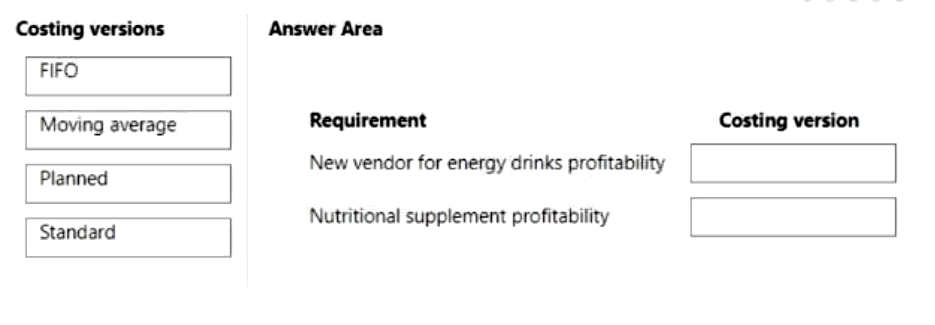
You need to determine the costing versions for the requirements.
Which costing versions should you use? To answer, drag the appropriate costing versions to the correct requirements. Each costing version may be used once, more than once, or not at all. You may need to drag the split bar between panes or scroll to view content.
NOTE: Each correct selection is worth one point.
Show Answer
Correct Answer: New vendor for energy drinks profitability — Planned
Nutritional supplement profitability — Standard
Explanation: Use a Planned costing version to simulate alternative vendor costs and analyze profit impact. Use a Standard costing version for manufacturing profitability based on cost categories, routing operations, and indirect cost calculation formulas.
Question 133
Case study -
This is a case study. Case studies are not timed separately. You can use as much exam time as you would like to complete each case. However, there may be additional case studies and sections on this exam. You must manage your time to ensure that you are able to complete all questions included on this exam in the time provided.
To answer the questions included in a case study, you will need to reference information that is provided in the case study. Case studies might contain exhibits and other resources that provide more information about the scenario that is described in the case study. Each question is independent of the other questions in this case study.
At the end of this case study, a review screen will appear. This screen allows you to review your answers and to make changes before you move to the next section of the exam. After you begin a new section, you cannot return to this section.
To start the case study -
To display the first question in this case study, click the Next button. Use the buttons in the left pane to explore the content of the case study before you answer the questions. Clicking these buttons displays information such as business requirements, existing environment, and problem statements. If the case study has an All Information tab, note that the information displayed is identical to the information displayed on the subsequent tabs. When you are ready to answer a question, click the Question button to return to the question.
Background -
Trey Research is a multinational manufacturer of health and dietary supplements based in Seattle, Washington. The company is experiencing a rapid expansion not only in its supplements but as a lifestyle brand that also sells apparel. The supplements and apparel businesses operate independently but manufacture and operate in the same legal entity.
Current environment -
Current environment. Technology -
Trey Research is migrating from an outdated, on-premises version of Dynamics AX to Dynamics 365 Supply Chain Management. The company wants to retain a lot of its current data structures and processes but adopt new efficiencies when the benefit is obvious. The company uses a third-party e-commerce site that is custom developed by an internal developer.
Current environment. Items -
Product numbering -
All items are numbered by using a smart numbering format: [Product SKU+Size+Color+Style]. For reporting, items are queried for sales and inventory reports by using the first six digits of the item number or until the first dash is encountered.
• A t-shirt could be 01001-S-Red for item 1001 in a size small with the color red.
• A single energy drink could be 02001-12oz or 02001-20oz for the different sizes that product 02001 is sold in.
Product attributes -
• All clothing shares the same set of product attributes.
• Supplements may share the same Product SKU but can have different attributes for the different size, color, or style variations of the product.
• Product attributes that are unnecessary for an item should be excluded from the item.
Pricing -
• All items always have a default price. This price will not expire.
• An item will have four different prices created for it every month, one for each customer tier, as detailed later in this section. The pricing expires at the end of the month. If no special pricing is created, the default item price will be used.
• The monthly sales price in which the additional price breaks are determined is based on the estimated cost of the manufactured items.
• Customers are categorized into four pricing tiers (A, B, C, and D) based on sales volume over the past 12 months.
• Customers can negotiate special pricing for items in 30-day, 60-day, and 90-day increments. Quantity restrictions may be placed, depending on the item discount and promotion.
• Promotional pricing is not used today. Pricing is restricted to monthly prices and customer-specific contract pricing.
Cost -
Items use a FIFO costing model today in their current Dynamics AX 2009 environment; however, using the FIFO costing method has created problems.
Current environment. Warehouse and inventory
• Warehouse requirements are simplistic. There is only one site. The site has two warehouses.
• Trey Research needs to make sure that any energy drinks and nutritional supplements are manufactured and packaged with the highest standards. Trey Research automatically inspects products when all products are reported as finished. All products are inspected again when the items are picked.
• Energy drinks require independent tests to check for dents in packaging, carbonation levels, and fill level.
• Nutritional supplements require separate tests for packaging, expiration date, product seal, and product labeling.
• Government compliancy and consistency testing are handled outside of the Enterprise Resource Planning (ERP) system.
• Resalable products are placed on one of two racks in the warehouse.
Requirements -
Requirements. Technology -
• Trey Research will integrate all pricing and discount capabilities to its e-commerce website.
Requirements. Items -
• Reporting on products should be streamlined as much as possible.
• The item numbering does not have to equate to the actual item number.
• The future costing methods adopted must be commonly accepted for manufacturers.
• Inventory costing should be done after a full inventory valuation is complete. It should take into consideration the direct materials, direct labor, and overhead that goes into an item.
• Any costing method used needs the ability to track cost records about an item, cost categories, and calculation formulas for indirect costs.
• The profitability for nutritional supplements manufacturing processes needs to be expressed in terms of the cost categories for routing operations and the calculation formulas for manufacturing overheads.
• If a vendor can no longer deliver the raw materials for the energy drinks due to supply chain issues, the costs for using an alternative vendor to source the raw materials should be used to determine the impact on profits.
• Apparel items will not be upgraded to the new costing method until after the go-live date due to resourcing and implementation limitations from the apparel team.
Requirements. Pricing -
• Trey Research plans to do promotional pricing. Certain products will receive special pricing during the hours of extreme sporting events that Trey Research sponsors. Before or after the event, normal pricing will resume.
Requirements. White labeling -
• Trey Research wants to start white labeling its products under the brands of major nutritional retail store brands. These products would only be sold to specific customers.
• Trey Research will provide and maintain a 'Compare to' price for customers to use to compare the white-labeled products. This Compare to price will also be the default item price for the customer if the customer accidentally lets a contract price expire.
• The configuration of these restrictions must be applied automatically when creating new products for those customers.
Requirements. Warehouse and inventory
• If products in the warehouse must be blocked from transactions for a specific reason, such as a health and safety review, warehouse users should be able to block the products quickly from the ERP system.
• All product quality tests should be processed in a uniform and consistent manner.
• Creation of any quality processes for products inbound to the warehouse, from the production line, or outbound from the warehouse to consumers should be automatically created to facilitate execution.
• Testing requirements:
◦ Requirement 1: 100 percent of all nutritional supplements and 50 percent of all energy drinks must be tested when production orders are completed. After a product is in testing, 100 percent of all tests must be completed.
◦ Requirement 2: 75 percent of all nutritional supplements and energy drinks should be tested against their required tests during an outbound process.
◦ Damaged products must be placed in one of four bins (based on product type) during the inspection process.
◦ You must define quarantine zones to optimize product visibility throughout the testing process.
You need to configure the system to automatically enforce inbound and outbound product requirements to and from the warehouse.
Which feature should you use?
A. quality associations
B. quality orders
C. quarantine zones
D. quality tests
E. nonconformances
Show Answer
Correct Answer: A
Explanation: Use quality associations to automatically create and enforce quality orders at specific process events such as production order completion (inbound from production) and outbound picking/shipment. Quality associations define when quality orders are generated, enabling sampling rules (e.g., 100% or 50% inspection) and consistent execution. Quality orders are the resulting records, while quarantine zones, quality tests, and nonconformances support the process but do not trigger it automatically.
Question 135
DRAG DROP
-
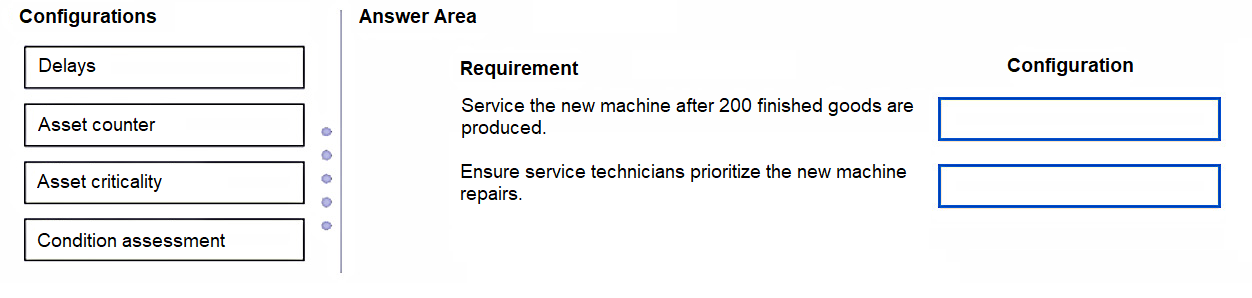
A company uses Dynamics 365 Supply Chain Management. The company purchased a high-tech machine that cuts production time in half compared to existing machines.
The new machine must be serviced after 200 finished goods are produced. Downtime for the new machine will impact production and must be planned in advance so the production lead times are adjusted. The service technicians must always prioritize the new machine repairs over any other repairs.
You need to configure the new machine to prioritize servicing over other repairs.
What should you configure for each requirement? To answer, drag the appropriate configurations to the correct requirements. Each configuration may be used once, more than once, or not at all. You may need to drag the split bar between panes or scroll to view content.
NOTE: Each correct selection is worth one point.
Show Answer
Correct Answer: Service the new machine after 200 finished goods are produced. → Asset counter
Ensure service technicians prioritize the new machine repairs. → Asset criticality
Explanation: Use an asset counter to trigger maintenance based on production count (200 finished goods). Use asset criticality to assign higher maintenance priority so work orders for this machine are prioritized.
Question 136
You need to configure the system to support the pottery line.
What should you do first?
A. Set up a new product with product configuration.
B. Create a new product with tracking dimensions.
C. Create a new product master with pre-defined product variants.
D. Create a new product with storage dimensions.
Show Answer
Correct Answer: C
Explanation: When introducing a product line that requires multiple variations, the first step is to create a product master. Product masters support predefined product variants (such as size, color, style, or other dimensions), which can then be generated and managed consistently. Tracking and storage dimensions are configured afterward as needed, while product configuration is for configurable products rather than the initial setup of a variant-based product line.
Question 137
HOTSPOT -
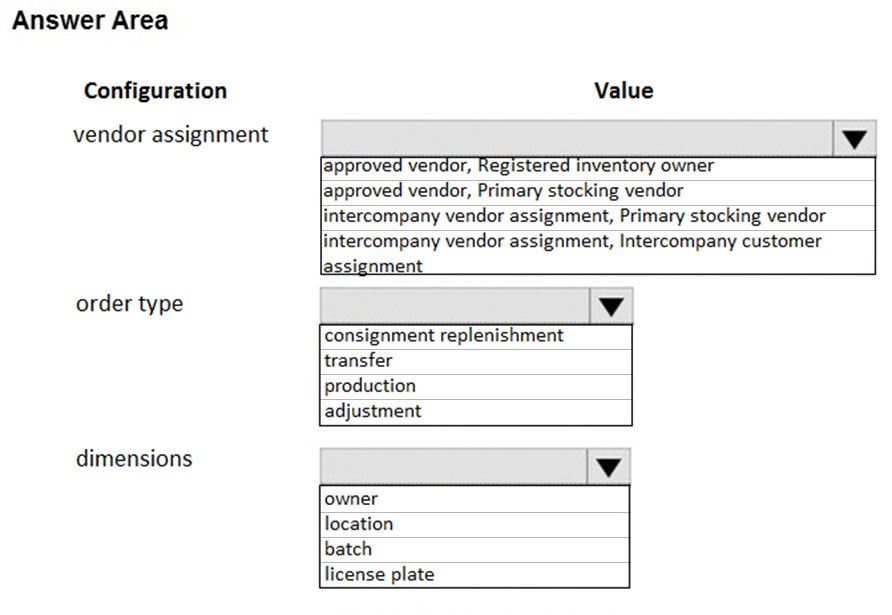
A company must set up replenishment of inventory using vendor-owned consignment inventory.
You need to create the replenishment order.
How should you complete the replenishment order? To answer, select the appropriate options in the answer area.
NOTE: Each correct selection is worth one point.
Hot Area:
Explanation: For vendor-owned consignment inventory replenishment in Dynamics 365, the vendor must be the registered inventory owner, the replenishment order type is consignment replenishment, and the owner inventory dimension is required.
$19
Get all 443 questions with detailed answers and explanations
Instant download HTML + PDF delivered the moment payment clears.
Secure Stripe checkout we never see or store your card details.
7-day refund if files are defective see our refund policy.