This is the free Microsoft DP-600 practice question bank —
110 of 205 total questions, each with a full explanation, free to
read with no signup required. Updated 2026-10-13.
Every answer is verified against official Microsoft documentation —
see our methodology.
Question 1
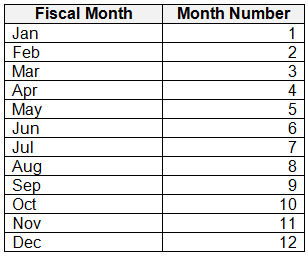
You have a Microsoft Power BI semantic model that contains a table named Date. Date contains the following data.
You need to ensure that the visuals that use the Date table appear in chronological order. The solutions must minimize administrative effort.
What should you do?
A. Sort the Month Number column by Column.
B. Sort the visuals by using the Sort ascending option on Fiscal Month.
C. Sort the Fiscal Month column by Column.
D. Sort the Date table by Column.
Show Answer
Correct Answer: C
Explanation: Sort the Fiscal Month column by the Month Number column. This makes month names display in calendar order in visuals that use Fiscal Month, without manually sorting each visual.
Question 1
You have a Fabric workspace named Workspace1 that contains the following items:
• A warehouse named Warehouse1
• A semantic model named Model1
• An interactive report named Report1
You need to allow a user named User1 to access a single table in Warehouse1. The solution must follow the principle of least privilege.
What should you do first?
A. Assign the Viewer role to User1 for Workspace1.
B. Share Warehouse1 with User1.
C. Assign object-level permissions to User1 for Warehouse1.
D. Assign the db_datareader role to User1 for Warehouse1.
Show Answer
Correct Answer: B
Explanation: To grant access to a single table in a Fabric warehouse, the user must first be granted access to the warehouse itself. Sharing the warehouse gives the user the basic permission needed to connect. After that, object-level permissions (such as GRANT SELECT on a specific table) can be assigned to restrict access to only the required table, satisfying least privilege. Workspace Viewer grants broader access than necessary, db_datareader grants access to all tables, and object-level permissions alone are not sufficient before the user has access to the warehouse.
Question 1
HOTSPOT
You have a Fabric workspace that contains a large warehouse.
You plan to create a lakehouse named Lakehouse1 for a sales dataset. Lakehouse1 will contain the following tables:
• Sales: Contains sales transactions
• Stores: Contains a unique list of store names and locations
• Loyalty: Contains a list of customers and their preferred stores
• Customers: Contains a unique list of customer names and addresses
• Products: Contains a unique list of available products and their descriptions
You need to configure a star schema for Lakehouse1.
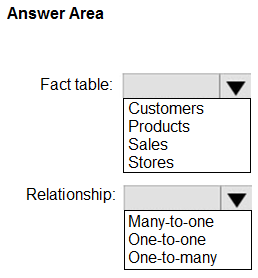
Which table should you define as the fact table, and which type of relationship should you configure from the Sales table to the Customers table? To answer, select the appropriate options in the answer area.
NOTE: Each correct selection is worth one point.
Explanation: Sales contains the transactions. Each customer can have multiple sales, while each sale relates to one customer.
Question 2
You have a Fabric workspace named Workspace1 that contains an eventstream named Eventstream1.
Eventstream1 reads data from an Azure event hub named Eventhub1.
Eventhub1 contains the following columns.
You need to add a continuous percentile calculation to the Payload column. The solution must minimize development effort.
What should you do?
A. Add a KQL queryset to Workspace1.
B. Add a Group by transformation to Eventstream1.
C. Add a Manage fields transformation to Eventstream1.
D. Add an Aggregate transformation to Eventstream1.
Show Answer
Correct Answer: D
Explanation: Add an Aggregate transformation to Eventstream1. It supports calculating a continuous percentile as part of the stream, requiring less development than writing a query. Group by and Manage fields do not perform percentile calculations.
Question 2
You have a Fabric tenant that contains a semantic model named Model1. Model1 contains a fact table named FactSales. FactSales has a relationship to a dimension table named DimDate on a column named OrderDate.
To FactSales, you add a second relationship between FactSales and DimDate based on a column named ShippedDate.
You need to filter by using ShippedDate in a new report. The solution must NOT affect the function of existing reports.
Which two actions should you perform? Each correct answer presents part of the solution.
NOTE: Each correct answer is worth one point.
A. Enable the ShippedDate relationship.
B. Use a RELATEDTABLE DAX function.
C. Use a CROSSFILTER DAX function.
D. Use a USERELATIONSHIP DAX function.
E. Disable the ShippedDate relationship between the tables.
Show Answer
Correct Answer: D, E
Explanation: To avoid changing existing report behavior, the new ShippedDate relationship should remain inactive (disabled). Existing reports continue using the active OrderDate relationship. For new calculations that must filter by ShippedDate, create measures that use the USERELATIONSHIP DAX function to temporarily activate the inactive relationship during evaluation. RELATEDTABLE and CROSSFILTER do not address this requirement, and enabling the ShippedDate relationship would alter the model's active relationship behavior.
Question 2
You have a Fabric tenant.
You need to create a semantic model that delivers fast report rendering, minimizes query latency, and maximizes flexibility for DAX calculations.
Which storage mode should you select?
A. Import
B. Direct Lake
C. Composite Mode
D. DirectQuery
Show Answer
Correct Answer: A
Explanation: Import mode generally provides the fastest report rendering and lowest query latency because data is held in the in-memory engine. It also offers the broadest flexibility for DAX calculations and modeling features.
Question 3
HOTSPOT -
You have a Microsoft Power BI report and a semantic model that uses Direct Lake mode.
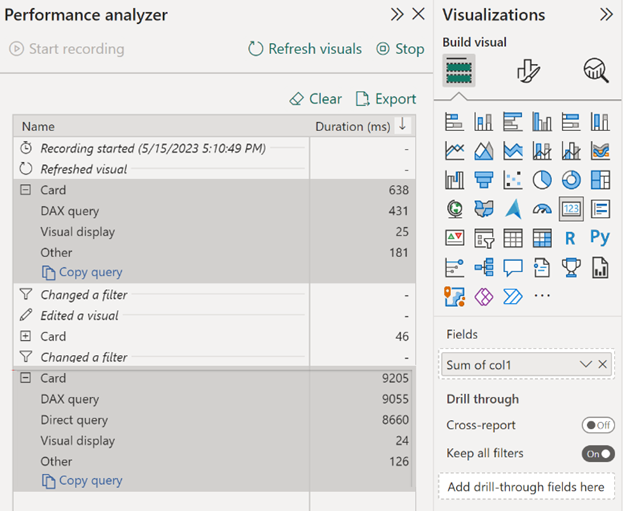
From Power BI Desktop, you open Performance analyzer as shown in the following exhibit.
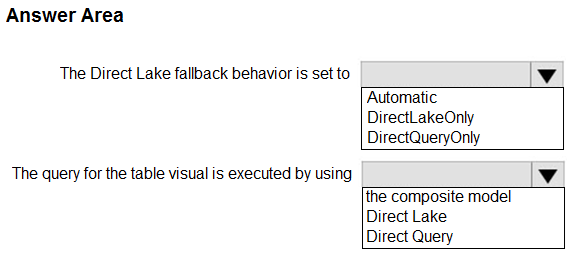
Use the drop-down menus to select the answer choice that completes each statement based on the information presented in the graphic.
NOTE: Each correct selection is worth one point.
Show Answer
Correct Answer: Fallback behavior: Automatic
Table visual query: Direct Lake
Explanation: One visual shows a Direct query step, so fallback is enabled. The visual based on the table has no Direct query step, indicating that it uses Direct Lake.
Question 3
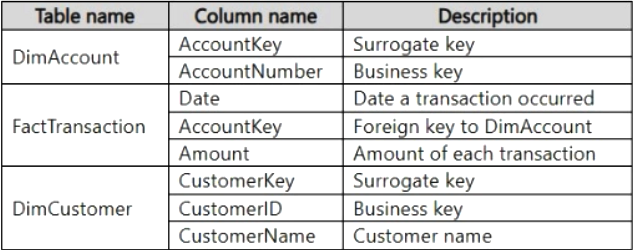
You have a semantic model named Model1 that contains data that relates to customers and their bank account balances.
Model1 has the following tables and columns.
A customer can have one or more accounts. Each account can be associated to multiple customers.
You need to ensure that users can query Model1 to identify the total transaction amounts by customer.
What should you add to Model1?
A. a many-to-many relationship between FactTransaction and Dim Customer
B. a bridge table with relationships to DimCustomer and DimAccount
C. a bridge table with relationships to FactTransaction and DimCustomer
D. the CustomerKey column in FactTransaction and a relationship to DimCustomer
Show Answer
Correct Answer: B
Explanation: Add a bridge table that maps customers to accounts, with relationships to DimCustomer and DimAccount. Transactions are related to accounts, so this lets users analyze transaction amounts by each customer associated with an account. If an account has multiple customers, its transactions will be counted for each associated customer unless an allocation rule is applied.
Question 4
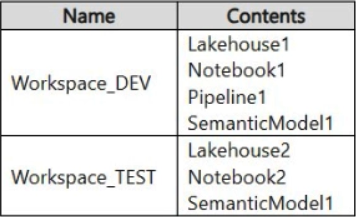
You have a Fabric tenant that contains the workspaces shown in the following table.
You have a deployment pipeline named Pipeline1 that deploys items from Workspace_DEV to Workspace_TEST. In Pipeline1, all items that have matching names are paired.
You deploy the contents of Workspace_DEV to Workspace_TEST by using Pipeline1.
What will the contents of Workspace_TEST be once the deployment is complete?
A. Lakehouse2 - Notebook2 - SemanticModel1 -
B. Lakehouse1 - Notebook1 - Pipeline1 - SemanticModel1 -
D. Lakehouse2 - Notebook2 - Pipeline1 - SemanticModel1
Show Answer
Correct Answer: C
Explanation: Deployment adds the DEV items to Workspace_TEST. The matching SemanticModel1 is paired and updated, while the unpaired Lakehouse2 and Notebook2 in TEST are not deleted. Workspace_TEST will therefore contain Lakehouse1, Lakehouse2, Notebook1, Notebook2, Pipeline1, and SemanticModel1.
Question 4
You have a Fabric tenant that contains a lakehouse named Lakehouse1. Lakehouse1 contains an unpartitioned table named Table1.
You plan to copy data to Table1 and partition the table based on a date column in the source data.
You create a Copy activity to copy the data to Table1.
You need to specify the partition column in the Destination settings of the Copy activity.
What should you do first?
A. From the Destination tab, set Mode to Append.
B. From the Destination tab, select the partition column.
C. From the Source tab, select Enable partition discovery.
D. From the Destination tabs, set Mode to Overwrite.
Show Answer
Correct Answer: D
Explanation: Set the destination Table action to Overwrite first. This makes the partitioning option available so you can then enable partitioning and select the date column. Be aware that overwrite replaces the existing table data.
$19
Get all 205 questions with detailed answers and explanations
Instant download HTML + PDF delivered the moment payment clears.
Secure Stripe checkout we never see or store your card details.
7-day refund if files are defective see our refund policy.