You have a Fabric tenant that contains a semantic model.
You need to modify object-level security (OLS) for the model.
What should you use?
A. the Fabric service
B. Microsoft Power BI Desktop
C. ALM Toolkit
D. Tabular Editor
Show Answer
Correct Answer: D
Explanation: Object-level security (OLS) for Power BI/Fabric semantic models is not created or modified natively in Power BI Desktop. OLS is defined in model roles using an external tool, with Tabular Editor being the supported tool for authoring and modifying OLS metadata. The Fabric service can consume OLS but not author it, and ALM Toolkit is intended for deployment and comparison rather than editing OLS definitions.
Question 36
You have a Fabric tenant named Tenant1 that contains a lakehouse named Lakehouse1.
You need to add data to Lakehouse1 from a CSV file in an Azure Storage account outside of Fabric. The solution must minimize development effort.
What should you use to add the data?
A. copy job
B. shortcut
C. pipeline
D. Dataflow Gen2
Show Answer
Correct Answer: A
Explanation: A copy job is the lowest-effort way to ingest (physically add) data from an external Azure Storage CSV into a Fabric lakehouse. A shortcut only creates a reference to external data and does not copy it into the lakehouse. Pipelines and Dataflow Gen2 can also ingest data but require more configuration and development effort.
Question 37
DRAG DROP
-
You have a Fabric workspace named Workspace1.
You have three groups named Group1, Group2, and Group3.
You need to assign a workspace role to each group. The solution must follow the principle of least privilege and meet the following requirements:
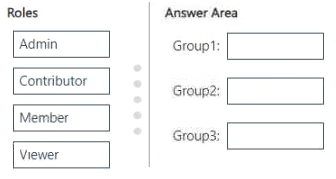
• Group1 must be able to write data to Workspace1, but be unable to add members to Workspace1.
• Group2 must be able to configure and maintain the settings of Workspace1.
• Group3 must be able to write data and add members to Workspace1, but be unable to delete Workspace1.
Which workspace role should you assign to each group? To answer, drag the appropriate roles to the correct groups. Each role may be used once, more than once, or not at all. You may need to drag the split bar between panes or scroll to view content.
NOTE: Each correct selection is worth one point.
Show Answer
Correct Answer: Group1: Contributor
Group2: Admin
Group3: Member
Explanation: Contributor can create and modify content but cannot manage workspace access. Admin can configure and maintain workspace settings. Member can create/modify content and add members, but cannot delete the workspace.
Question 38
You have a Fabric workspace named Workspace1 that is assigned to a newly created Fabric capacity named Capacity1.
You create a semantic model named Model1 and deploy Model1 to Workspace1.
You need to publish changes to Model1 directly from Tabular Editor.
What should you do?
A. For Workspace1, enable Git integration.
B. For Model1, enable external sharing.
C. For Workspace1, create a managed private endpoint.
D. For Capacity1, set XMLA Endpoint to Read Write.
Show Answer
Correct Answer: D
Explanation: Publishing metadata changes directly from Tabular Editor to a semantic model requires a read-write XMLA endpoint. Fabric/Power BI semantic models hosted on a capacity must have the XMLA Endpoint set to Read Write to allow metadata operations such as deploying model changes. Git integration, external sharing, and managed private endpoints are not required for this scenario.
Question 39
You have a Fabric workspace named Workspace1.
Workspace1 contains multiple semantic models, including a model named Model1. Model1 is updated by using an XMLA endpoint.
You need to increase the speed of the write operations of the XMLA endpoint.
What should you do?
A. Delete any unused semantic models from Workspace1.
B. Select Large semantic model storage format for Workspace1.
C. Configure Model 1 to use the Direct Lake storage format.
D. Delete any unused columns from Model1.
Show Answer
Correct Answer: B
Explanation: Enabling the Large semantic model storage format optimizes the semantic model for XMLA write operations by using storage optimizations that improve processing and write performance. Deleting unused models or columns may reduce resource usage or model size but does not specifically accelerate XMLA endpoint writes, and Direct Lake is a storage mode aimed at query access rather than improving XMLA write performance.
Question 40
HOTSPOT
-
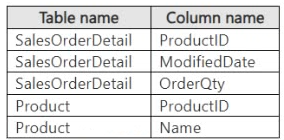
You have a Fabric workspace that contains a warehouse named DW1. DW1 contains the following tables and columns.
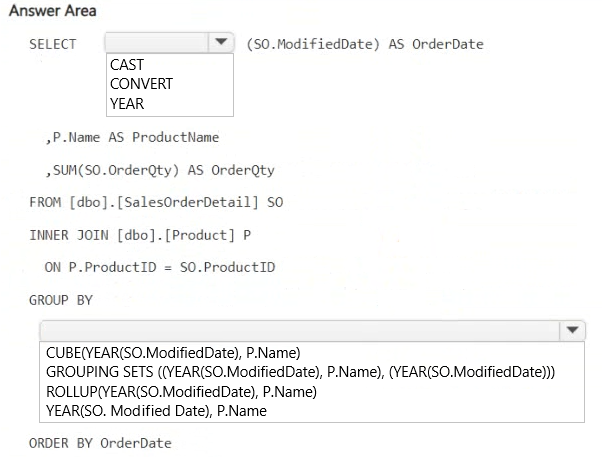
You need to summarize order quantities by year and product. The solution must include the yearly sum of order quantities for all the products in each row.
How should you complete the T-SQL statement? To answer, select the appropriate options in the answer area.
NOTE: Each correct selection is worth one point.
Show Answer
Correct Answer: YEAR
GROUPING SETS ((YEAR(SO.ModifiedDate), P.Name), (YEAR(SO.ModifiedDate)))
Explanation: Use YEAR() to extract the year. GROUPING SETS returns both year+product totals and yearly totals across all products, without the extra grand total row that ROLLUP would produce.
Question 41
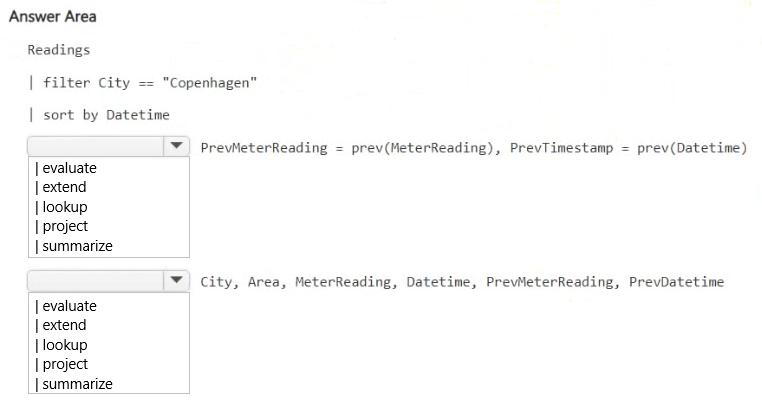
HOTSPOT
-
You have a KQL database that contains a table named Readings.
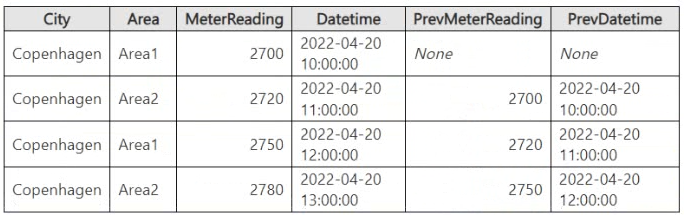
You need to query Readings and return the results shown in the following table.
How should you complete the query? To answer, select the appropriate options in the answer area.
NOTE: Each correct selection is worth one point.
Show Answer
Correct Answer: extend
project
Explanation: Use extend to create calculated columns with prev(), then use project to return only the required columns in the output.
Question 42
You have a Fabric tenant.
You are creating a Fabric Data Factory pipeline.
You have a stored procedure that returns the number of active customers and their average sales for the current month.
You need to add an activity that will execute the stored procedure in a warehouse. The returned values must be available to the downstream activities of the pipeline.
Which type of activity should you add?
A. Append variable
B. Script
C. Stored procedure
D. Get metadata
Show Answer
Correct Answer: B
Explanation: Use a Script activity. The requirement is not just to execute a stored procedure, but to make the returned values available to downstream pipeline activities. In Fabric Data Factory, the Stored procedure activity is intended to execute the procedure but does not expose returned result sets/output in the way required for downstream consumption. A Script activity can execute the stored procedure (for example, via EXEC) and expose the result set for later activities.
Question 43
HOTSPOT
-
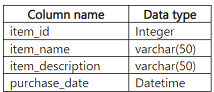
You have a Fabric warehouse that contains a table named Table1. Table1 contains the following data.
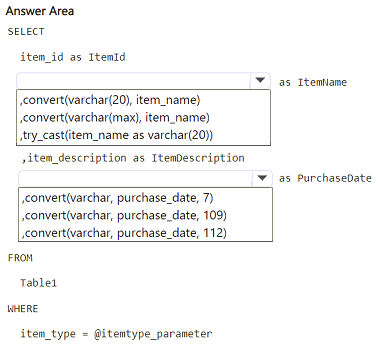
You need to create a T-SQL statement that meets the following requirements:
• Outputs the item name of each item and returns a null value if the item name is longer than 20 characters
• Outputs the PurchaseDate value in the format of МММ dd, yy
How should you complete the statement? To answer, select the appropriate options in the answer area.
NOTE: Each correct selection is worth one point.
Show Answer
Correct Answer: TRY_CAST(item_name AS varchar(20))
CONVERT(varchar, purchase_date, 7)
Explanation: TRY_CAST to varchar(20) returns NULL when the source string exceeds the target length. CONVERT style 7 formats the date as 'Mon dd, yy' (MMM dd, yy).
Question 44
You have a Fabric tenant that contains a workspace named Workspace1 and a user named User1. Workspace1 contains a warehouse named DW1.
You share DW1 with User1 and assign User1 the default permissions for DW1.
What can User1 do?
A. Build reports by using the default dataset.
B. Read data from the tables in DW1.
C. Connect to DW1 via the Azure SQL Analytics endpoint.
D. Read the underlying Parquet files from OneLake.
Show Answer
Correct Answer: C
Explanation: By default, sharing a Fabric Warehouse grants the recipient the Read (CONNECT) permission on the SQL analytics endpoint. This allows the user to connect to the warehouse endpoint but does not grant SELECT on tables, Build permission on the default semantic model, or access to OneLake Parquet files. Reading tables requires additional T-SQL GRANT permissions, and OneLake file access is separate.
$19
Get all 205 questions with detailed answers and explanations
Instant download HTML + PDF delivered the moment payment clears.
Secure Stripe checkout we never see or store your card details.
7-day refund if files are defective see our refund policy.