You have a Fabric tenant that contains a Microsoft Power BI report named Report1. Report1 includes a Python visual.
Data displayed by the visual is grouped automatically and duplicate rows are NOT displayed.
You need all rows to appear in the visual.
What should you do?
A. Reference the columns in the Python code by index.
B. Modify the Sort Column By property for all columns.
C. Add a unique field to each row.
D. Modify the Summarize By property for all columns.
Show Answer
Correct Answer: C
Explanation: Add a unique field (such as an index or row ID) to every row and include it in the Python visual’s data. Power BI groups identical rows; the unique value makes each row distinct, so duplicates are retained. Referencing columns by index in the Python code does not prevent grouping.
Question 8
Note: This question is part of a series of questions that present the same scenario. Each question in the series contains a unique solution that might meet the stated goals. Some question sets might have more than one correct solution, while others might not have a correct solution.
After you answer a question in this section, you will NOT be able to return to it. As a result, these questions will not appear in the review screen.
You have a Fabric tenant that contains a semantic model named Model1.
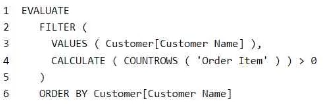
You discover that the following query performs slowly against Model1.
You need to reduce the execution time of the query.
Solution: You replace line 4 by using the following code:
ISEMPTY ( RELATEDTABLE ( 'Order Item' ) )
Does this meet the goal?
A. Yes
B. No
Show Answer
Correct Answer: B
Explanation: No. The original condition selects customers with at least one related Order Item row. ISEMPTY(RELATEDTABLE('Order Item')) is true when there are no related rows, so it reverses the condition. NOT ISEMPTY would preserve the original logic.
Question 8
DRAG DROP
-
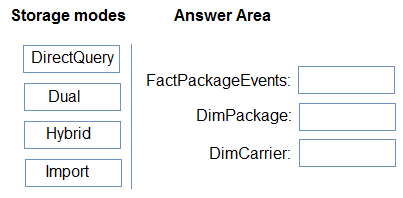
You have Fabric tenant that contains a semantic model named Model1. Model1 contains the following tables.
You are designing a Microsoft Power BI report named Report1 that will deliver near-real-time (NRT) shipping data. Report1 will contain data about many shipped packages.
You need to ensure that each table is in the appropriate storage mode to support Report1. The solution must support near-real-time data delivery while maintaining high query performance.
Which storage mode should you select for each table? To answer, drag the appropriate storage modes to the correct tables. Each mode may be used once, more than once, or not at all. You may need to drag the split bar between panes or scroll to view content.
NOTE: Each correct selection is worth one point.
Explanation: Use Hybrid for the large fact table to combine imported historical data with DirectQuery for the latest near-real-time data. Set related dimension tables to Dual so they can behave as Import for high-performance queries and as DirectQuery when joining to the DirectQuery portion of the hybrid fact table.
Question 9
Note: This question is part of a series of questions that present the same scenario. Each question in the series contains a unique solution that might meet the stated goals. Some question sets might have more than one correct solution, while others might not have a correct solution.
After you answer a question in this section, you will NOT be able to return to it. As a result, these questions will not appear in the review screen.
You have a Fabric tenant that contains a semantic model named Model1.
You discover that the following query performs slowly against Model1.
You need to reduce the execution time of the query.
Solution: You replace line 4 by using the following code:
CALCULATE ( COUNTROWS ( 'Order Item' ) ) >= 0
Does this meet the goal?
A. Yes
B. No
Show Answer
Correct Answer: B
Explanation: No. `COUNTROWS` is never negative, so changing `> 0` to `>= 0` makes the condition true for every customer, including those with no orders. It changes the query’s results and does not provide the required performance improvement.
Question 9
You are the administrator of a Fabric workspace that contains a lakehouse named Lakehouse1. Lakehouse1 contains the following tables:
Table1: A Delta table created by using a shortcut
Table2: An external table created by using Spark
Table3: A managed table -
You plan to connect to Lakehouse1 by using its SQL endpoint.
What will you be able to do after connecting to Lakehouse1?
A. Read Table3.
B. Update the data Table3.
C. Read Table2.
D. Update the data in Table1.
Show Answer
Correct Answer: A
Explanation: The SQL analytics endpoint is read-only and exposes managed Delta tables for querying. It does not support updating Table3 or Table1, and the Spark-created external table is not available through the endpoint.
Question 9
You have a Fabric workspace named Workspace1.
You have a GitHub repository named Repo1.
You need to connect Workspace1 to the main branch of Repo1.
Which information should you provide?
A. a shared access signature (SAS) token and the branch name of Repo1
B. a personal access token (PAT) and the URL of Repo1
C. an access key and the branch name of Repo1
D. an access key and the URL of Repo1
Show Answer
Correct Answer: B
Explanation: To connect a Microsoft Fabric workspace to a GitHub repository for Git integration, you authorize with a GitHub personal access token (PAT) and specify the repository URL. The branch (such as main) is then selected from the repository; an access key or SAS token is not used for GitHub integration.
Question 10
Case study -
This is a case study. Case studies are not timed separately. You can use as much exam time as you would like to complete each case. However, there may be additional case studies and sections on this exam. You must manage your time to ensure that you are able to complete all questions included on this exam in the time provided.
To answer the questions included in a case study, you will need to reference information that is provided in the case study. Case studies might contain exhibits and other resources that provide more information about the scenario that is described in the case study. Each question is independent of the other questions in this case study.
At the end of this case study, a review screen will appear. This screen allows you to review your answers and to make changes before you move to the next section of the exam. After you begin a new section, you cannot return to this section.
To start the case study -
To display the first question in this case study, click the Next button. Use the buttons in the left pane to explore the content of the case study before you answer the questions. Clicking these buttons displays information such as business requirements, existing environment, and problem statements. If the case study has an All Information tab, note that the information displayed is identical to the information displayed on the subsequent tabs. When you are ready to answer a question, click the Question button to return to the question.
Overview -
Litware, Inc. is a manufacturing company that has offices throughout North America. The analytics team at Litware contains data engineers, analytics engineers, data analysts, and data scientists.
Existing Environment -
Fabric Environment -
Litware has been using a Microsoft Power BI tenant for three years. Litware has NOT enabled any Fabric capacities and features.
Available Data -
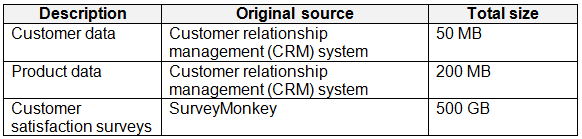
Litware has data that must be analyzed as shown in the following table.
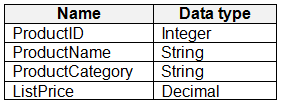
The Product data contains a single table and the following columns.
The customer satisfaction data contains the following tables:
• Survey
• Question
• Response
For each survey submitted, the following occurs:
• One row is added to the Survey table.
• One row is added to the Response table for each question in the survey.
The Question table contains the text of each survey question. The third question in each survey response is an overall satisfaction score. Customers can submit a survey after each purchase.
User Problems -
The analytics team has large volumes of data, some of which is semi-structured. The team wants to use Fabric to create a new data store.
Product data is often classified into three pricing groups: high, medium, and low. This logic is implemented in several databases and semantic models, but the logic does NOT always match across implementations.
Requirements -
Planned Changes -
Litware plans to enable Fabric features in the existing tenant. The analytics team will create a new data store as a proof of concept (PoC). The remaining Liware users will only get access to the Fabric features once the PoC is complete. The PoC will be completed by using a Fabric trial capacity
The following three workspaces will be created:
• AnalyticsPOC: Will contain the data store, semantic models, reports pipelines, dataflow, and notebooks used to populate the data store
• DataEngPOC: Will contain all the pipelines, dataflows, and notebooks used to populate OneLake
• DataSciPOC: Will contain all the notebooks and reports created by the data scientists
The following will be created in the AnalyticsPOC workspace:
• A data store (type to be decided)
• A custom semantic model
• A default semantic model
• Interactive reports
The data engineers will create data pipelines to load data to OneLake either hourly or daily depending on the data source. The analytics engineers will create processes to ingest, transform, and load the data to the data store in the AnalyticsPOC workspace daily. Whenever possible, the data engineers will use low-code tools for data ingestion. The choice of which data cleansing and transformation tools to use will be at the data engineers’ discretion.
All the semantic models and reports in the Analytics POC workspace will use the data store as the sole data source.
Technical Requirements -
The data store must support the following:
• Read access by using T-SQL or Python
• Semi-structured and unstructured data
• Row-level security (RLS) for users executing T-SQL queries
Files loaded by the data engineers to OneLake will be stored in the Parquet format and will meet Delta Lake specifications.
Data will be loaded without transformation in one area of the AnalyticsPOC data store. The data will then be cleansed, merged, and transformed into a dimensional model
The data load process must ensure that the raw and cleansed data is updated completely before populating the dimensional model
The dimensional model must contain a date dimension. There is no existing data source for the date dimension. The Litware fiscal year matches the calendar year. The date dimension must always contain dates from 2010 through the end of the current year.
The product pricing group logic must be maintained by the analytics engineers in a single location. The pricing group data must be made available in the data store for T-SOL. queries and in the default semantic model. The following logic must be used:
• List prices that are less than or equal to 50 are in the low pricing group.
• List prices that are greater than 50 and less than or equal to 1,000 are in the medium pricing group.
• List prices that are greater than 1,000 are in the high pricing group.
Security Requirements -
Only Fabric administrators and the analytics team must be able to see the Fabric items created as part of the PoC.
Litware identifies the following security requirements for the Fabric items in the AnalyticsPOC workspace:
• Fabric administrators will be the workspace administrators.
• The data engineers must be able to read from and write to the data store. No access must be granted to datasets or reports.
• The analytics engineers must be able to read from, write to, and create schemas in the data store. They also must be able to create and share semantic models with the data analysts and view and modify all reports in the workspace.
• The data scientists must be able to read from the data store, but not write to it. They will access the data by using a Spark notebook
• The data analysts must have read access to only the dimensional model objects in the data store. They also must have access to create Power BI reports by using the semantic models created by the analytics engineers.
• The date dimension must be available to all users of the data store.
• The principle of least privilege must be followed.
Both the default and custom semantic models must include only tables or views from the dimensional model in the data store. Litware already has the following Microsoft Entra security groups:
• FabricAdmins: Fabric administrators
• AnalyticsTeam: All the members of the analytics team
• DataAnalysts: The data analysts on the analytics team
• DataScientists: The data scientists on the analytics team
• DataEngineers: The data engineers on the analytics team
• AnalyticsEngineers: The analytics engineers on the analytics team
Report Requirements -
The data analysts must create a customer satisfaction report that meets the following requirements:
• Enables a user to select a product to filter customer survey responses to only those who have purchased that product.
• Displays the average overall satisfaction score of all the surveys submitted during the last 12 months up to a selected dat.
• Shows data as soon as the data is updated in the data store.
• Ensures that the report and the semantic model only contain data from the current and previous year.
• Ensures that the report respects any table-level security specified in the source data store.
• Minimizes the execution time of report queries.
You need to ensure the data loading activities in the AnalyticsPOC workspace are executed in the appropriate sequence. The solution must meet the technical requirements.
What should you do?
A. Create a dataflow that has multiple steps and schedule the dataflow.
B. Create and schedule a Spark notebook.
C. Create and schedule a Spark job definition.
D. Create a pipeline that has dependencies between activities and schedule the pipeline.
Show Answer
Correct Answer: D
Explanation: Create and schedule a pipeline with dependencies between its activities. The dependencies ensure the raw and cleansed data loads finish before the dimensional model is populated, satisfying the required execution sequence.
Question 10
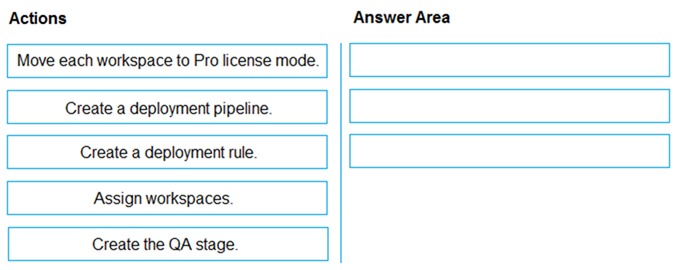
DRAG DROP
-
You have Fabric tenant that contains four workspaces named Development, Test, QA, and Production. All the workspaces are in Premium Per User (PPU) license mode.
You plan to use a release pipeline to support the development lifecycle from Development to Production.
Which three actions should you perform in sequence? To answer, move the appropriate actions from the list of actions to the answer area and arrange them in the correct order.
Show Answer
Correct Answer: Create a deployment pipeline.
Create the QA stage.
Assign workspaces.
Explanation: Deployment pipelines support PPU workspaces. A new pipeline starts with the default stages, and an additional QA stage can be added before assigning the corresponding workspaces to each stage. Moving to Pro is unnecessary, and deployment rules are optional, not required.
Question 11
Case study -
This is a case study. Case studies are not timed separately. You can use as much exam time as you would like to complete each case. However, there may be additional case studies and sections on this exam. You must manage your time to ensure that you are able to complete all questions included on this exam in the time provided.
To answer the questions included in a case study, you will need to reference information that is provided in the case study. Case studies might contain exhibits and other resources that provide more information about the scenario that is described in the case study. Each question is independent of the other questions in this case study.
At the end of this case study, a review screen will appear. This screen allows you to review your answers and to make changes before you move to the next section of the exam. After you begin a new section, you cannot return to this section.
To start the case study -
To display the first question in this case study, click the Next button. Use the buttons in the left pane to explore the content of the case study before you answer the questions. Clicking these buttons displays information such as business requirements, existing environment, and problem statements. If the case study has an All Information tab, note that the information displayed is identical to the information displayed on the subsequent tabs. When you are ready to answer a question, click the Question button to return to the question.
Overview -
Litware, Inc. is a manufacturing company that has offices throughout North America. The analytics team at Litware contains data engineers, analytics engineers, data analysts, and data scientists.
Existing Environment -
Fabric Environment -
Litware has been using a Microsoft Power BI tenant for three years. Litware has NOT enabled any Fabric capacities and features.
Available Data -
Litware has data that must be analyzed as shown in the following table.
The Product data contains a single table and the following columns.
The customer satisfaction data contains the following tables:
• Survey
• Question
• Response
For each survey submitted, the following occurs:
• One row is added to the Survey table.
• One row is added to the Response table for each question in the survey.
The Question table contains the text of each survey question. The third question in each survey response is an overall satisfaction score. Customers can submit a survey after each purchase.
User Problems -
The analytics team has large volumes of data, some of which is semi-structured. The team wants to use Fabric to create a new data store.
Product data is often classified into three pricing groups: high, medium, and low. This logic is implemented in several databases and semantic models, but the logic does NOT always match across implementations.
Requirements -
Planned Changes -
Litware plans to enable Fabric features in the existing tenant. The analytics team will create a new data store as a proof of concept (PoC). The remaining Liware users will only get access to the Fabric features once the PoC is complete. The PoC will be completed by using a Fabric trial capacity
The following three workspaces will be created:
• AnalyticsPOC: Will contain the data store, semantic models, reports pipelines, dataflow, and notebooks used to populate the data store
• DataEngPOC: Will contain all the pipelines, dataflows, and notebooks used to populate OneLake
• DataSciPOC: Will contain all the notebooks and reports created by the data scientists
The following will be created in the AnalyticsPOC workspace:
• A data store (type to be decided)
• A custom semantic model
• A default semantic model
• Interactive reports
The data engineers will create data pipelines to load data to OneLake either hourly or daily depending on the data source. The analytics engineers will create processes to ingest, transform, and load the data to the data store in the AnalyticsPOC workspace daily. Whenever possible, the data engineers will use low-code tools for data ingestion. The choice of which data cleansing and transformation tools to use will be at the data engineers’ discretion.
All the semantic models and reports in the Analytics POC workspace will use the data store as the sole data source.
Technical Requirements -
The data store must support the following:
• Read access by using T-SQL or Python
• Semi-structured and unstructured data
• Row-level security (RLS) for users executing T-SQL queries
Files loaded by the data engineers to OneLake will be stored in the Parquet format and will meet Delta Lake specifications.
Data will be loaded without transformation in one area of the AnalyticsPOC data store. The data will then be cleansed, merged, and transformed into a dimensional model
The data load process must ensure that the raw and cleansed data is updated completely before populating the dimensional model
The dimensional model must contain a date dimension. There is no existing data source for the date dimension. The Litware fiscal year matches the calendar year. The date dimension must always contain dates from 2010 through the end of the current year.
The product pricing group logic must be maintained by the analytics engineers in a single location. The pricing group data must be made available in the data store for T-SOL. queries and in the default semantic model. The following logic must be used:
• List prices that are less than or equal to 50 are in the low pricing group.
• List prices that are greater than 50 and less than or equal to 1,000 are in the medium pricing group.
• List prices that are greater than 1,000 are in the high pricing group.
Security Requirements -
Only Fabric administrators and the analytics team must be able to see the Fabric items created as part of the PoC.
Litware identifies the following security requirements for the Fabric items in the AnalyticsPOC workspace:
• Fabric administrators will be the workspace administrators.
• The data engineers must be able to read from and write to the data store. No access must be granted to datasets or reports.
• The analytics engineers must be able to read from, write to, and create schemas in the data store. They also must be able to create and share semantic models with the data analysts and view and modify all reports in the workspace.
• The data scientists must be able to read from the data store, but not write to it. They will access the data by using a Spark notebook
• The data analysts must have read access to only the dimensional model objects in the data store. They also must have access to create Power BI reports by using the semantic models created by the analytics engineers.
• The date dimension must be available to all users of the data store.
• The principle of least privilege must be followed.
Both the default and custom semantic models must include only tables or views from the dimensional model in the data store. Litware already has the following Microsoft Entra security groups:
• FabricAdmins: Fabric administrators
• AnalyticsTeam: All the members of the analytics team
• DataAnalysts: The data analysts on the analytics team
• DataScientists: The data scientists on the analytics team
• DataEngineers: The data engineers on the analytics team
• AnalyticsEngineers: The analytics engineers on the analytics team
Report Requirements -
The data analysts must create a customer satisfaction report that meets the following requirements:
• Enables a user to select a product to filter customer survey responses to only those who have purchased that product.
• Displays the average overall satisfaction score of all the surveys submitted during the last 12 months up to a selected dat.
• Shows data as soon as the data is updated in the data store.
• Ensures that the report and the semantic model only contain data from the current and previous year.
• Ensures that the report respects any table-level security specified in the source data store.
• Minimizes the execution time of report queries.
You need to recommend a solution to prepare the tenant for the PoC.
Which two actions should you recommend performing from the Fabric Admin portal? Each correct answer presents part of the solution.
NOTE: Each correct answer is worth one point.
A. Enable the Users can try Microsoft Fabric paid features option for the entire organization.
B. Enable the Users can try Microsoft Fabric paid features option for specific security groups.
C. Enable the Allow Azure Active Directory guest users to access Microsoft Fabric option for specific security groups.
D. Enable the Users can create Fabric items option and exclude specific security groups.
E. Enable the Users can create Fabric items option for specific security groups.
Show Answer
Correct Answer: B, E
Explanation: Enable the Fabric trial/paid-features option only for the PoC participants by targeting specific security groups, rather than the entire organization. Also enable the ability to create Fabric items only for specified groups, so item creation is limited to authorized PoC users.
Question 11
You have a Fabric workspace named Workspace1 that contains a lakehouse named Lakehouse1 and a user named User1.
You need to ensure that User1 can read all the data in Lakehouse1. The solution must follow the principle of least privilege.
Which two actions should you perform? Each correct answer presents part of the solution.
NOTE: Each correct selection is worth one point.
A. Assign the Contributor role to User1.
B. Select Read all Apache Spark.
C. Assign the Viewer role to User1.
D. Share Lakehouse1 by using item permissions.
E. Assign the Member role to User1.
Show Answer
Correct Answer: B, D
Explanation: To provide read access with least privilege, share the lakehouse using item permissions so the user can access the item, and enable the 'Read all Apache Spark' permission so the user can read all data in the lakehouse through Spark. Viewer alone does not grant Spark data read access, while Contributor and Member provide broader permissions than necessary.
Sources:
https://www.dumpspedia.com/implementing-analytics-solutions-using-microsoft-fabric-beta-dumps.html
https://www.secexams.com/exams/Microsoft/dp-700/view/6
$19
Get all 205 questions with detailed answers and explanations
Instant download HTML + PDF delivered the moment payment clears.
Secure Stripe checkout we never see or store your card details.
7-day refund if files are defective see our refund policy.