You have a Fabric tenant that contains two workspaces named Workspace1 and Workspace2.
Workspace1 is used as the development environment. Workspace2 is used as the production environment. Each environment uses a different storage account.
Workspace1 contains a Dataflow Gen2 named Dataflow1. The data source of Dataflow1 is a CSV file in blob storage.
You plan to implement a deployment pipeline to deploy items from Workspace1 to Workspace2.
You need to ensure that the data source references the correct location in the production environment.
What should you do?
A. Create a data source rule only.
B. Create a parameter rule only.
C. Create a data source rule and a parameter rule.
D. After implementing the deployment pipeline, manually change the data source
Show Answer
Correct Answer: B
Explanation: For a Dataflow Gen2 whose source location (such as the blob storage path or storage account reference) differs between development and production, deployment pipelines use parameter rules to substitute environment-specific values. A data source rule remaps connections/credentials, but the source location itself should be parameterized so the production deployment points to the correct storage account and path.
Question 18
HOTSPOT
-
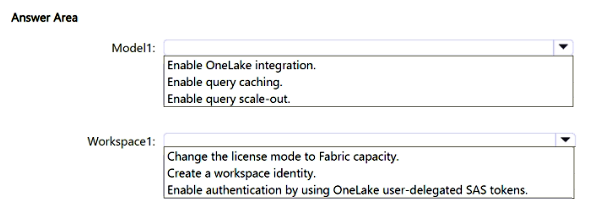
You have a Fabric workspace named Workspace1 that uses the Premium Per User (PPU) license mode and contains a semantic model named Model1.
Large semantic model storage format is selected for Model1.
You need to ensure that tables imported into Model1 are written automatically to Delta tables in OneLake.
What should you do for Model1 and Workspace1? To answer, select the appropriate options in the answer area.
NOTE: Each correct selection is worth one point.
Show Answer
Correct Answer: Model1: Enable OneLake integration.
Workspace1: Change the license mode to Fabric capacity.
Explanation: Automatic writing of imported semantic model tables to Delta tables in OneLake requires OneLake integration on the semantic model, and this feature requires a Fabric capacity rather than a PPU workspace.
Question 18
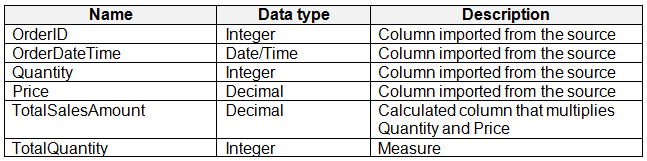
You have a Fabric tenant that contains a semantic model named Model1. Model1 uses Import mode. Model1 contains a table named Orders. Orders has 100 million rows and the following fields.
You need to reduce the memory used by Model1 and the time it takes to refresh the model.
Which two actions should you perform? Each correct answer presents part of the solution.
NOTE: Each correct answer is worth one point.
A. Split OrderDateTime into separate date and time columns.
B. Replace TotalQuantity with a calculated column.
C. Convert Quantity into the Text data type.
D. Replace TotalSalesAmount with a measure.
Show Answer
Correct Answer: A, D
Explanation: Split OrderDateTime into date and time columns to improve columnar compression, especially when the combined datetime has high cardinality. Replace the calculated TotalSalesAmount column with a measure: the measure is evaluated when queried rather than storing a value for each of the 100 million rows, reducing model memory and refresh work.
Question 19
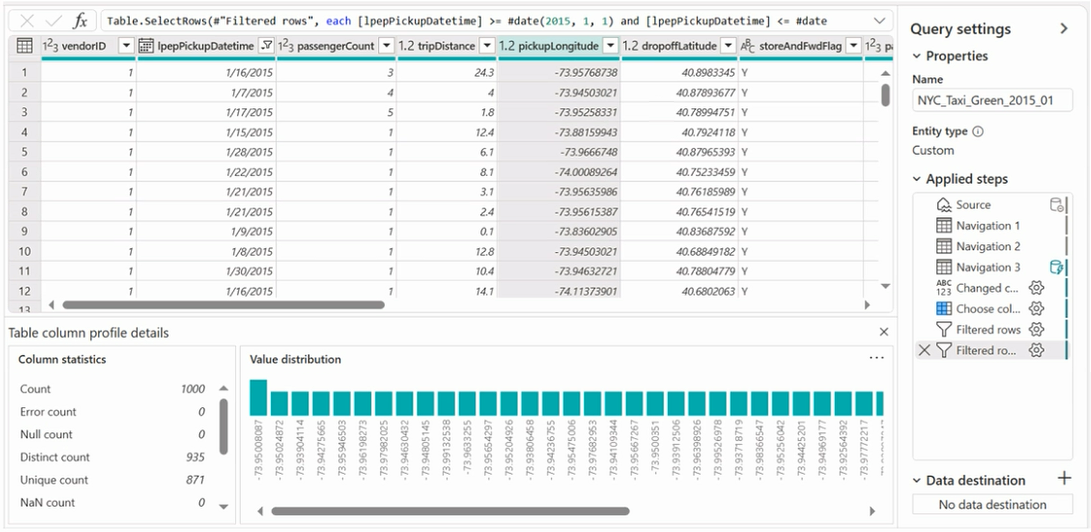
You have a Fabric workspace named Workspace1 that contains a dataflow named Dataflow1. Dataflow1 has a query that returns 2,000 rows.
You view the query in Power Query as shown in the following exhibit.
What can you identify about the pickupLongitude column?
A. The column has duplicate values.
B. All the table rows are profiled.
C. The column has missing values.
D. There are 935 values that occur only once.
Show Answer
Correct Answer: A
Explanation: The column profile shows 1,000 values but only 935 distinct values, so at least some values occur more than once. The profile is based on 1,000 rows, not all 2,000; the unique count is 871, not 935.
Question 19
You have a Microsoft Power BI semantic model.
You need to identify any surrogate key columns in the model that have the Summarize By property set to a value other than to None. The solution must minimize effort.
What should you use?
A. Performance Analyzer in Power BI Desktop
B. Model explorer in Microsoft Power BI Desktop
C. Model view in Microsoft Power BI Desktop
D. DAX Formatter in DAX Studio
Show Answer
Correct Answer: B
Explanation: Model explorer provides a hierarchical view of semantic model objects and exposes their properties, making it the lowest-effort way to inspect columns and identify surrogate key columns whose Summarize By (default summarization) property is not set to None. Performance Analyzer and DAX Formatter are unrelated, while Model view can inspect properties but Model explorer is designed for browsing and managing model object properties efficiently.
Sources:
https://learn.microsoft.com/en-us/power-bi/transform-model/model-explorer
Question 20
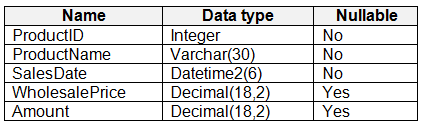
You have a Fabric warehouse that contains a table named Staging.Sales. Staging.Sales contains the following columns.
You need to write a T-SQL query that will return data for the year 2023 that displays ProductID and ProductName and has a summarized Amount that is higher than 10,000.
Which query should you use?
A.
B.
C.
D.
Show Answer
Correct Answer: A
Explanation: Filter rows to 2023 in the WHERE clause, group by ProductID and ProductName, and use HAVING SUM(Amount) > 10000 to keep only groups whose summed Amount exceeds 10,000. Option A follows this order.
Question 20
DRAG DROP
-
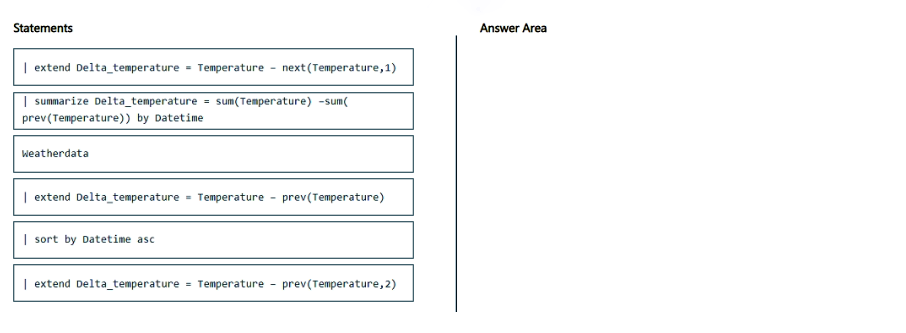
You have a Fabric eventhouse named Eventhouse1 that contains a table named Weatherdata. A sample of the data in Weatherdata is shown in the following table.
You plan to use a KQL queryset to manipulate the data in Eventhouse1. The result set must have the following columns.
You need to build the query.
Which four KQL statements should you use in sequence? To answer, move the appropriate statements from the list of statements to the answer area and arrange them in the correct order.
Show Answer
Correct Answer: Weatherdata
| sort by Datetime asc
| extend Delta_temperature = Temperature - prev(Temperature)
| project Datetime, Lat, Long, Temperature, Delta_temperature
Explanation: To compute the difference from the preceding row, first read the table, sort chronologically so prev() refers to the previous timestamp, then extend with the temperature difference, and finally project the required columns.
Question 21
Case study -
This is a case study. Case studies are not timed separately. You can use as much exam time as you would like to complete each case. However, there may be additional case studies and sections on this exam. You must manage your time to ensure that you are able to complete all questions included on this exam in the time provided.
To answer the questions included in a case study, you will need to reference information that is provided in the case study. Case studies might contain exhibits and other resources that provide more information about the scenario that is described in the case study. Each question is independent of the other questions in this case study.
At the end of this case study, a review screen will appear. This screen allows you to review your answers and to make changes before you move to the next section of the exam. After you begin a new section, you cannot return to this section.
To start the case study -
To display the first question in this case study, click the Next button. Use the buttons in the left pane to explore the content of the case study before you answer the questions. Clicking these buttons displays information such as business requirements, existing environment, and problem statements. If the case study has an All Information tab, note that the information displayed is identical to the information displayed on the subsequent tabs. When you are ready to answer a question, click the Question button to return to the question.
Overview -
Litware, Inc. is a manufacturing company that has offices throughout North America. The analytics team at Litware contains data engineers, analytics engineers, data analysts, and data scientists.
Existing Environment -
Fabric Environment -
Litware has been using a Microsoft Power BI tenant for three years. Litware has NOT enabled any Fabric capacities and features.
Available Data -
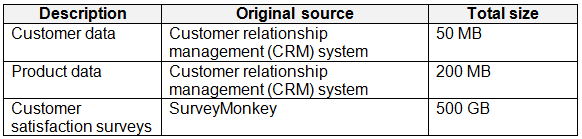
Litware has data that must be analyzed as shown in the following table.
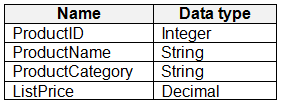
The Product data contains a single table and the following columns.
The customer satisfaction data contains the following tables:
Survey -
Question -
Response -
For each survey submitted, the following occurs:
One row is added to the Survey table.
One row is added to the Response table for each question in the survey.
The Question table contains the text of each survey question. The third question in each survey response is an overall satisfaction score. Customers can submit a survey after each purchase.
User Problems -
The analytics team has large volumes of data, some of which is semi-structured. The team wants to use Fabric to create a new data store.
Product data is often classified into three pricing groups: high, medium, and low. This logic is implemented in several databases and semantic models, but the logic does NOT always match across implementations.
Requirements -
Planned Changes -
Litware plans to enable Fabric features in the existing tenant. The analytics team will create a new data store as a proof of concept (PoC). The remaining Liware users will only get access to the Fabric features once the PoC is complete. The PoC will be completed by using a Fabric trial capacity
The following three workspaces will be created:
AnalyticsPOC: Will contain the data store, semantic models, reports pipelines, dataflow, and notebooks used to populate the data store
DataEngPOC: Will contain all the pipelines, dataflows, and notebooks used to populate OneLake
DataSciPOC: Will contain all the notebooks and reports created by the data scientists
The following will be created in the AnalyticsPOC workspace:
A data store (type to be decided)
A custom semantic model -
A default semantic model -
Interactive reports -
The data engineers will create data pipelines to load data to OneLake either hourly or daily depending on the data source. The analytics engineers will create processes to ingest, transform, and load the data to the data store in the AnalyticsPOC workspace daily. Whenever possible, the data engineers will use low-code tools for data ingestion. The choice of which data cleansing and transformation tools to use will be at the data engineers’ discretion.
All the semantic models and reports in the Analytics POC workspace will use the data store as the sole data source.
Technical Requirements -
The data store must support the following:
Read access by using T-SQL or Python
Semi-structured and unstructured data
Row-level security (RLS) for users executing T-SQL queries
Files loaded by the data engineers to OneLake will be stored in the Parquet format and will meet Delta Lake specifications.
Data will be loaded without transformation in one area of the AnalyticsPOC data store. The data will then be cleansed, merged, and transformed into a dimensional model
The data load process must ensure that the raw and cleansed data is updated completely before populating the dimensional model
The dimensional model must contain a date dimension. There is no existing data source for the date dimension. The Litware fiscal year matches the calendar year. The date dimension must always contain dates from 2010 through the end of the current year.
The product pricing group logic must be maintained by the analytics engineers in a single location. The pricing group data must be made available in the data store for T-SOL. queries and in the default semantic model. The following logic must be used:
List prices that are less than or equal to 50 are in the low pricing group.
List prices that are greater than 50 and less than or equal to 1,000 are in the medium pricing group.
List prices that are greater than 1,000 are in the high pricing group.
Security Requirements -
Only Fabric administrators and the analytics team must be able to see the Fabric items created as part of the PoC.
Litware identifies the following security requirements for the Fabric items in the AnalyticsPOC workspace:
Fabric administrators will be the workspace administrators.
The data engineers must be able to read from and write to the data store. No access must be granted to datasets or reports.
The analytics engineers must be able to read from, write to, and create schemas in the data store. They also must be able to create and share semantic models with the data analysts and view and modify all reports in the workspace.
The data scientists must be able to read from the data store, but not write to it. They will access the data by using a Spark notebook
The data analysts must have read access to only the dimensional model objects in the data store. They also must have access to create Power BI reports by using the semantic models created by the analytics engineers.
The date dimension must be available to all users of the data store.
The principle of least privilege must be followed.
Both the default and custom semantic models must include only tables or views from the dimensional model in the data store. Litware already has the following Microsoft Entra security groups:
FabricAdmins: Fabric administrators
AnalyticsTeam: All the members of the analytics team
DataAnalysts: The data analysts on the analytics team
DataScientists: The data scientists on the analytics team
DataEngineers: The data engineers on the analytics team
AnalyticsEngineers: The analytics engineers on the analytics team
Report Requirements -
The data analysts must create a customer satisfaction report that meets the following requirements:
Enables a user to select a product to filter customer survey responses to only those who have purchased that product.
Displays the average overall satisfaction score of all the surveys submitted during the last 12 months up to a selected dat.
Shows data as soon as the data is updated in the data store.
Ensures that the report and the semantic model only contain data from the current and previous year.
Ensures that the report respects any table-level security specified in the source data store.
Minimizes the execution time of report queries.
Which type of data store should you recommend in the AnalyticsPOC workspace?
A. a data lake
B. a warehouse
C. a lakehouse
D. an external Hive metastore
Show Answer
Correct Answer: C
Explanation: Recommend a lakehouse. It supports Delta/Parquet data and semi-structured or unstructured files, while providing access through Spark/Python and a T-SQL analytics endpoint. A warehouse is less suitable for the unstructured-data requirement.
Question 22
Case study -
This is a case study. Case studies are not timed separately. You can use as much exam time as you would like to complete each case. However, there may be additional case studies and sections on this exam. You must manage your time to ensure that you are able to complete all questions included on this exam in the time provided.
To answer the questions included in a case study, you will need to reference information that is provided in the case study. Case studies might contain exhibits and other resources that provide more information about the scenario that is described in the case study. Each question is independent of the other questions in this case study.
At the end of this case study, a review screen will appear. This screen allows you to review your answers and to make changes before you move to the next section of the exam. After you begin a new section, you cannot return to this section.
To start the case study -
To display the first question in this case study, click the Next button. Use the buttons in the left pane to explore the content of the case study before you answer the questions. Clicking these buttons displays information such as business requirements, existing environment, and problem statements. If the case study has an All Information tab, note that the information displayed is identical to the information displayed on the subsequent tabs. When you are ready to answer a question, click the Question button to return to the question.
Overview -
Litware, Inc. is a manufacturing company that has offices throughout North America. The analytics team at Litware contains data engineers, analytics engineers, data analysts, and data scientists.
Existing Environment -
Fabric Environment -
Litware has been using a Microsoft Power BI tenant for three years. Litware has NOT enabled any Fabric capacities and features.
Available Data -
Litware has data that must be analyzed as shown in the following table.
The Product data contains a single table and the following columns.
The customer satisfaction data contains the following tables:
Survey -
Question -
Response -
For each survey submitted, the following occurs:
One row is added to the Survey table.
One row is added to the Response table for each question in the survey.
The Question table contains the text of each survey question. The third question in each survey response is an overall satisfaction score. Customers can submit a survey after each purchase.
User Problems -
The analytics team has large volumes of data, some of which is semi-structured. The team wants to use Fabric to create a new data store.
Product data is often classified into three pricing groups: high, medium, and low. This logic is implemented in several databases and semantic models, but the logic does NOT always match across implementations.
Requirements -
Planned Changes -
Litware plans to enable Fabric features in the existing tenant. The analytics team will create a new data store as a proof of concept (PoC). The remaining Liware users will only get access to the Fabric features once the PoC is complete. The PoC will be completed by using a Fabric trial capacity
The following three workspaces will be created:
AnalyticsPOC: Will contain the data store, semantic models, reports pipelines, dataflow, and notebooks used to populate the data store
DataEngPOC: Will contain all the pipelines, dataflows, and notebooks used to populate OneLake
DataSciPOC: Will contain all the notebooks and reports created by the data scientists
The following will be created in the AnalyticsPOC workspace:
A data store (type to be decided)
A custom semantic model -
A default semantic model -
Interactive reports -
The data engineers will create data pipelines to load data to OneLake either hourly or daily depending on the data source. The analytics engineers will create processes to ingest, transform, and load the data to the data store in the AnalyticsPOC workspace daily. Whenever possible, the data engineers will use low-code tools for data ingestion. The choice of which data cleansing and transformation tools to use will be at the data engineers’ discretion.
All the semantic models and reports in the Analytics POC workspace will use the data store as the sole data source.
Technical Requirements -
The data store must support the following:
Read access by using T-SQL or Python
Semi-structured and unstructured data
Row-level security (RLS) for users executing T-SQL queries
Files loaded by the data engineers to OneLake will be stored in the Parquet format and will meet Delta Lake specifications.
Data will be loaded without transformation in one area of the AnalyticsPOC data store. The data will then be cleansed, merged, and transformed into a dimensional model
The data load process must ensure that the raw and cleansed data is updated completely before populating the dimensional model
The dimensional model must contain a date dimension. There is no existing data source for the date dimension. The Litware fiscal year matches the calendar year. The date dimension must always contain dates from 2010 through the end of the current year.
The product pricing group logic must be maintained by the analytics engineers in a single location. The pricing group data must be made available in the data store for T-SOL. queries and in the default semantic model. The following logic must be used:
List prices that are less than or equal to 50 are in the low pricing group.
List prices that are greater than 50 and less than or equal to 1,000 are in the medium pricing group.
List prices that are greater than 1,000 are in the high pricing group.
Security Requirements -
Only Fabric administrators and the analytics team must be able to see the Fabric items created as part of the PoC.
Litware identifies the following security requirements for the Fabric items in the AnalyticsPOC workspace:
Fabric administrators will be the workspace administrators.
The data engineers must be able to read from and write to the data store. No access must be granted to datasets or reports.
The analytics engineers must be able to read from, write to, and create schemas in the data store. They also must be able to create and share semantic models with the data analysts and view and modify all reports in the workspace.
The data scientists must be able to read from the data store, but not write to it. They will access the data by using a Spark notebook
The data analysts must have read access to only the dimensional model objects in the data store. They also must have access to create Power BI reports by using the semantic models created by the analytics engineers.
The date dimension must be available to all users of the data store.
The principle of least privilege must be followed.
Both the default and custom semantic models must include only tables or views from the dimensional model in the data store. Litware already has the following Microsoft Entra security groups:
FabricAdmins: Fabric administrators
AnalyticsTeam: All the members of the analytics team
DataAnalysts: The data analysts on the analytics team
DataScientists: The data scientists on the analytics team
DataEngineers: The data engineers on the analytics team
AnalyticsEngineers: The analytics engineers on the analytics team
Report Requirements -
The data analysts must create a customer satisfaction report that meets the following requirements:
Enables a user to select a product to filter customer survey responses to only those who have purchased that product.
Displays the average overall satisfaction score of all the surveys submitted during the last 12 months up to a selected dat.
Shows data as soon as the data is updated in the data store.
Ensures that the report and the semantic model only contain data from the current and previous year.
Ensures that the report respects any table-level security specified in the source data store.
Minimizes the execution time of report queries.
What should you recommend using to ingest the customer data into the data store in the AnalyticsPOC workspace?
A. a stored procedure
B. a pipeline that contains a KQL activity
C. a Spark notebook
D. a dataflow
Show Answer
Correct Answer: D
Explanation: Use a dataflow for low-code ingestion of the customer data. The data is loaded on an hourly or daily schedule, so real-time KQL processing is unnecessary; a stored procedure or Spark notebook would add complexity for this ingestion task.
Question 23
HOTSPOT
-
You have a Fabric eventhouse that contains a KQL database. The database contains a table named TaxiData that stores the following data.
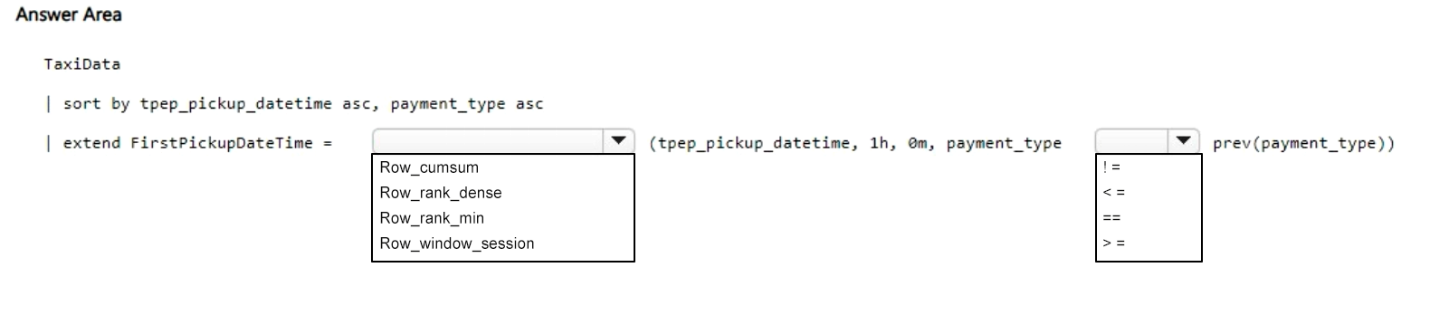
You need to create a column named FirstPickupDateTime that will contain the first value of each hour from tpep_pickup_datetime partitioned by payment_type.
How should you complete the query? To answer, select the appropriate options in the answer area.
NOTE: Each correct selection is worth one point.
Show Answer
Correct Answer: row_window_session
!=
Explanation: Use the session window function to return the first timestamp of each 1-hour window. Restart the window when the payment_type changes, so the partition boundary is detected with payment_type != prev(payment_type).
$19
Get all 205 questions with detailed answers and explanations
Instant download HTML + PDF delivered the moment payment clears.
Secure Stripe checkout we never see or store your card details.
7-day refund if files are defective see our refund policy.