This is the free Comptia N10-009 practice question bank —
330 of 652 total questions, each with a full explanation, free to
read with no signup required. Updated 2026-10-13.
Every answer is verified against official Comptia documentation —
see our methodology.
Question 1
A laptop is experiencing intermittent connectivity issues. Given the following wireless network configuration:
Which of the following should the technician do to resolve this issue?
A. Configure roaming between APs.
B. Modify saturation of the 10dBM transmit power on CompTIA_2.
C. Adjust the transmit power on CompTIA_3.
D. Move CompTIA_2 to channel 1.
Show Answer
Correct Answer: D
Explanation: CompTIA_2 is on channel 5 with a 40 MHz channel width, so it overlaps the nearby 2.4 GHz channel used by CompTIA_1 (channel 6), creating potential interference. Moving CompTIA_2 to channel 1 reduces that overlap. In practice, using 20 MHz channel widths on 2.4 GHz would also help avoid interference.
Question 1
Which of the following has the highest administrative distance?
A. Enhanced Interior Gateway Routing Protocol
B. Border Gateway Protocol
C. Static route
D. Open Shortest Path First
Show Answer
Correct Answer: D
Explanation: Using the commonly compared default values—static route 1, eBGP 20, internal EIGRP 90, and OSPF 110—OSPF has the highest administrative distance. Note that iBGP has an administrative distance of 200, so if “BGP” includes iBGP, the question is ambiguous; the expected answer assumes eBGP.
Question 2
After a hospital installs a new set of IoT devices that leverage the existing nurses' station's wireless network, nurses complain that the IoT devices are experiencing intermittent connectivity issues. A network engineer receives the following information:
Which of the following is most likely causing the performance issue?
A. Poor RSSI
B. Incorrect channel size
C. Frequency overlap
D. Roaming misconfiguration
Show Answer
Correct Answer: C
Explanation: The Nurses network is on channel 1 and the IoT network is on channel 5, both at 20 MHz in the 2.4 GHz band. These channels overlap, which can cause intermittent interference and connectivity issues. The IoT signal strength (−57 dBm) is adequate, making poor RSSI less likely.
Question 2
A network engineer troubleshoots an issue with an SMTP relay server. The engineer suspects the issue is related to a reverse DNS lookup failure. Which of the following should the engineer implement to resolve the issue?
A. DNSSEC
B. MX
C. DoT
D. PTR
Show Answer
Correct Answer: D
Explanation: Implement a PTR (pointer) record. PTR records map an IP address to a hostname and are used for reverse DNS lookups, which receiving mail servers may check for an SMTP relay.
Question 3
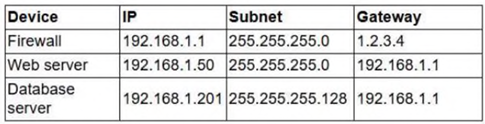
An administrator is troubleshooting a Layer 3 communication issue between the web server and the database server. The administrator finds the following information:
Which of the following corrects the communication issue?
A. Changing the subnet on the database server to 255.255.255.0
B. Changing the subnet on the firewall to 255.255.255.128
C. Changing the default gateway on the database server to 1.2.3.4
D. Changing the IP address on the database server to 192.168.1.150
E. Changing the gateway on the firewall to 192.168.1.1
Show Answer
Correct Answer: A
Explanation: The database server’s 192.168.1.201 address with a /25 mask is on the 192.168.1.128/25 subnet, while its gateway, 192.168.1.1, is outside that subnet. Changing its mask to 255.255.255.0 places the gateway on the same subnet, consistent with the web server and firewall.
Question 3
A network administrator receives a report that a user is unable to access several internal resources. The following information is provided during initial troubleshooting:
• Ping is successful to the resources.
• Access to the internet is working.
• Access to resources by IP is successful.
• Other users report no issues.
Which of the following commands would the administrator most likely use to continue troubleshooting?
A. netstat
B. nbtstat
C. nslookup
D. nnap
Show Answer
Correct Answer: C
Explanation: Since the user can reach resources by IP address but is having trouble accessing them by name, the administrator should investigate DNS name resolution. `nslookup` queries DNS records and helps troubleshoot DNS issues.
Question 4
A company wants to implement a strict network policy and disallow the following:
• New connections without clearance from the IT team
• Moving workstations
Which of the following should the company configure to meet these requirements?
A. Static routing
B. ACL
C. Content filtering
D. Port security
Show Answer
Correct Answer: D
Explanation: Port security can restrict which device MAC addresses are allowed on each switch port. This blocks unauthorized devices from connecting and can prevent a workstation from being moved to a different port without IT approval.
Question 4
A systems administrator is resolving connectivity issues to an organization's DNS server. While troubleshooting, the administrator performs remote scans and receives the following output:
Which of the following should the systems administrator investigate?
A. URL filters
B. Unused services
C. Firewall rules
D. 802.1X on the switch
Show Answer
Correct Answer: C
Explanation: The scan shows DNS on UDP port 53 is open, but TCP port 53 is closed. DNS also uses TCP, so the administrator should investigate whether firewall rules are preventing the required connection.
Question 5
A user reports network performance issues when accessing a specific server. Which of the following should be used to identify the cause of the issue in real time?
A. Port mirroring
B. Syslog reports
C. Baseline metrics
D. Packet capture
Show Answer
Correct Answer: D
Explanation: A packet capture lets an administrator inspect live network traffic and identify issues such as retransmissions, delays, or dropped packets affecting access to the server.
Question 5
A laptop user gets an error when trying to access the company's intranet site. A technician runs ipconfig /all with the following results:
Which of the following is most likely causing the issue?
A. Short DHCP lease duration
B. IIS server malfunction
C. Address pool exhaustion
D. IDS misconfiguration
Show Answer
Correct Answer: C
Explanation: The 169.254.0.5 address is an APIPA address, assigned when the laptop cannot obtain an address from DHCP. Address pool exhaustion can prevent the DHCP server from assigning a lease, making it the most likely option.
$19
Get all 652 questions with detailed answers and explanations
Instant download HTML + PDF delivered the moment payment clears.
Secure Stripe checkout we never see or store your card details.
7-day refund if files are defective see our refund policy.