Which of the following transceivers should a technician use for a multimode LC/LC cable?
A. LR SFP
B. SR SFP
C. LR QSFP
D. SR QSFP
Show Answer
Correct Answer: B
Explanation: An SR SFP is designed for short-reach multimode fiber and typically uses a duplex LC connector, matching an LC/LC cable. LR transceivers are intended for longer-reach single-mode fiber, while SR QSFP modules commonly use MPO/MTP connectors.
Question 25
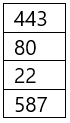
A company is hosting a secure server that requires all connections to the server to be encrypted. A junior administrator needs to harden the web server. The following ports on the web server are open:
Which of the following ports should be disabled?
A. 22
B. 80
C. 443
D. 587
Show Answer
Correct Answer: B
Explanation: Disable port 80, which serves unencrypted HTTP. Port 443 is used for HTTPS, and port 22 is used for encrypted SSH. Port 587 is commonly used for email submission with TLS.
Question 25
A network administrator needs to split the company network into two subnets. The company has a Class В address, and the current mask in use is 255.255.0.0. The administrator realizes that a mask of 255.255.128.0 will accomplish the division. Which of the following concepts describes this change?
A. APIРА
B. RFC1918
C. VLSM
D. Class С
Show Answer
Correct Answer: C
Explanation: Changing the Class B mask from /16 (255.255.0.0) to /17 (255.255.128.0) borrows one host bit, creating two subnets. Of the options, VLSM is the intended answer, though strictly speaking this change alone is subnetting; VLSM refers to using different subnet-mask lengths within an address space.
Question 26
Which of the following is used for network device management?
A. VPN
B. FTP
C. SSH
D. RDP
Show Answer
Correct Answer: C
Explanation: SSH provides secure, encrypted remote command-line access for configuring and managing network devices.
Question 27
Which of the following is the best example of implementing role-based access control?
A. Granting data center access only to server and network administrators
B. Providing the entire IT department access to an application development server
C. Requiring all employees use multifactor authentication when accessing the network
D. Allowing the human resources director to determine who can access human resources files
Show Answer
Correct Answer: A
Explanation: Role-based access control grants permissions according to defined job roles. Limiting data center access to server and network administrators is based on their roles; the other options describe broad department access, an authentication requirement, or an individual deciding access.
Question 28
Which of the following is considered the most secure method of controlling device authentication?
A. PKI
B. MFA
C. SAML
D. SSO
Show Answer
Correct Answer: A
Explanation: PKI is generally considered the strongest choice for device authentication because certificates and public-key cryptography can establish a device’s identity without relying on a user password. MFA typically authenticates users, while SAML and SSO provide federation and single sign-on.
Question 29
Which of the following is an efficient routing protocol that offers the best interoperability between different manufacturers?
A. RIP
B. EIGRP
C. RSTP
D. OSPF
Show Answer
Correct Answer: D
Explanation: OSPF is an open-standard routing protocol supported by equipment from many manufacturers, providing strong interoperability. RIP is less efficient, EIGRP has historically been associated with Cisco, and RSTP is a spanning-tree protocol rather than a routing protocol.
Question 30
A network administrator is setting up two new firewalls for redundancy and needs to implement a redundant internet connection. Which of the follow ng routing technologies will the administrator most likely use?
A. EIGRP
B. RIPv2
C. OSPF
D. BGP
Show Answer
Correct Answer: D
Explanation: BGP is used for routing between autonomous systems and is the standard choice for redundant or multihomed internet connections, allowing routes to adapt if an ISP connection fails.
Question 31
Which of the following should a network technician do to have remote, administrative redundancy if a switch becomes unresponsive through an SSH?
A. Deploy a jump host.
B. Use an out-of-band management solution.
C. Enable administrative GUI.
D. Connect a physical console cable.
Show Answer
Correct Answer: B
Explanation: An out-of-band management solution provides a separate remote access path that does not depend on the switch’s normal network or SSH connectivity. A physical console cable can provide local access, but not remote administrative redundancy.
Question 32
A network technician is adding a security camera with an enhancer to a network closet in an organization's office building that has six APs. When plugged in, the camera does not respond. Given the following information:
• Switch: 24 ports, 124W PoE capable, maximum 16W per port
• AP: 12W PoE
• Camera: 14W
• Enhancer: 4W
Which of the following is the most likely reason the camera is not working?
A. The cable is experiencing too much crosstalk.
B. The switch is beyond the PoE budget.
C. The cable is improperly terminated.
D. The single connection surpasses the power allowed.
Show Answer
Correct Answer: D
Explanation: The camera (14W) plus the enhancer (4W) require 18W on a single PoE connection. Although the switch has a total PoE budget of 124W and six APs consume only 72W total (6 × 12W), each port is limited to 16W. The required 18W exceeds the per-port maximum, so the device will not power on.
$19
Get all 652 questions with detailed answers and explanations
Instant download HTML + PDF delivered the moment payment clears.
Secure Stripe checkout we never see or store your card details.
7-day refund if files are defective see our refund policy.