A technician is troubleshooting an issue related to packets. Which of the following OSI model layers is the technician most likely to interact with devices on?
A. Transport
B. Network
C. Physical
D. Data link
Show Answer
Correct Answer: B
Explanation: Packets are the protocol data unit of the OSI Network layer (Layer 3). Devices such as routers process and route packets.
Question 16
A user in the finance department reports that they cannot access the internet. Other finance department users are not having issues.
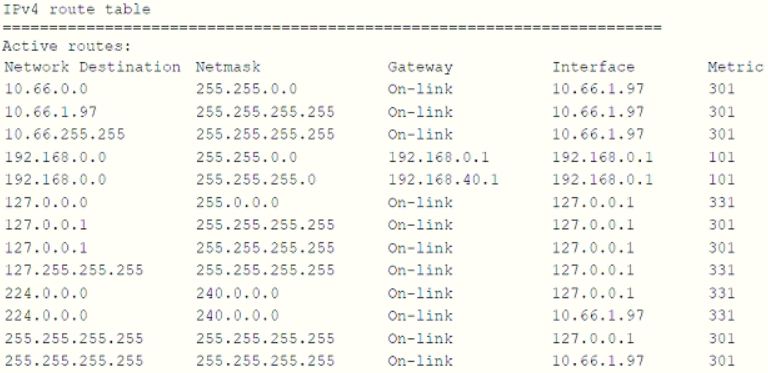
A network administrator runs a route print command on the user's machine:
Which of the following is most likely the root cause of the issue?
A. The default route is missing.
B. The route metric value is incorrect.
C. The interface is pointing to the localhost.
D. The default gateway is configured with an incorrect subnet mask.
Show Answer
Correct Answer: A
Explanation: The route table has no 0.0.0.0 destination with a 0.0.0.0 netmask, which would be the default route used to send traffic to destinations outside the listed networks. Without it, the user cannot reach the internet.
Question 16
Which of the following is used when implementing VoIP phones?
A. VPN
B. CDN
C. TTL
D. QoS
Show Answer
Correct Answer: D
Explanation: QoS (Quality of Service) prioritizes time-sensitive VoIP traffic, helping reduce latency, jitter, and packet loss for clearer calls.
Question 17
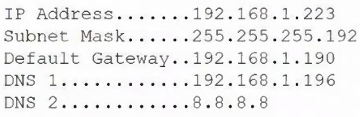
A customer calls the help desk to report issues connecting to the internet. The customer can reach a local database server. A technician goes to the site and examines the configuration:
Which of the following is causing the user's issue?
A. Incorrect DNS
B. Unreachable gateway
C. Failed root bridge
D. Poor upstream routing
Show Answer
Correct Answer: B
Explanation: The device’s address, 192.168.1.223/26, is in the 192.168.1.192/26 subnet. Its configured gateway, 192.168.1.190, is in a different subnet, so the device cannot reach that gateway to route traffic to the internet. It may still reach a local database server on its own subnet.
Question 17
A network administrator upgrades the network infrastructure from copper wiring to fiber connections to increase throughput between network closets. After the upgrade, most of the new connections come online, but one of the connections still remains offline. During troubleshooting with a visual fault locator, the administrator verifies that the final connection was terminated properly. Which of the following is the most likely issue with the fiber connection?
A. Transposed TX/RX
B. Incorrect SFP
C. Incompatible cable
D. CRC errors
Show Answer
Correct Answer: A
Explanation: The most likely issue is transposed TX/RX strands. A visual fault locator can confirm light continuity and proper termination, but reversed transmit and receive fibers prevent the link from coming online. Swap the fiber strands at one end.
Question 18
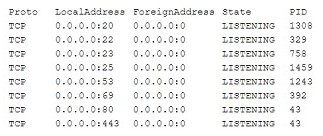
A network administrator is reviewing a production web server and observes the following output from the netstat command:
Which of the following actions should the network administrator take to harden the security of the web server?
A. Disable the unused ports.
B. Enforce access control lists.
C. Perform content filtering.
D. Set up a screened subnet.
Show Answer
Correct Answer: A
Explanation: The output shows several services listening that may not be needed on a production web server, including Telnet (23), SMTP (25), DNS (53), and TFTP (69). Disable unused services and their ports to reduce the server’s attack surface; keep only required services enabled.
Question 18
A network administrator receives a message that a duplicate IP address is on the network. Which of the following commands should the administrator use to locate the node?
A. ping
B. arp
C. ipconfig
D. nslookup
Show Answer
Correct Answer: B
Explanation: Use `arp` (for example, `arp -a`) to view the IP-to-MAC address mappings. The MAC address associated with the duplicate IP can then help identify the device or trace it to a switch port.
Question 19
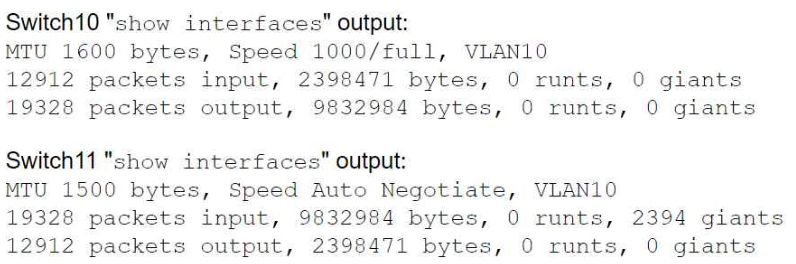
A network technician is troubleshooting network latency and has determined the issue to be occurring between two network switches (Switch10 and Switch11). Symptoms reported include poor video performance and slow file copying. Given the following information:
Which of the following should the technician most likely do to resolve the issue?
A. Disable automatic negotiation on Switch11.
B. Modify Switch10 MTU value to 1500.
C. Configure STP on both switches.
D. Change the native VLAN on the ports.
Show Answer
Correct Answer: B
Explanation: Switch10’s MTU is 1600 bytes, while Switch11’s is 1500 bytes. The MTU mismatch is consistent with the giant frames reported on Switch11 and can cause packet drops or performance problems. Set Switch10’s MTU to 1500 bytes so the switches match.
Question 19
Which of the following physical installation locations best represents the function of an MDF?
A. Between the service provider and the customer
B. Between two service providers
C. Between the top floor and the bottom floor
D. Between the Layer 2 switch and the patch panel
Show Answer
Correct Answer: A
Explanation: An MDF is the building’s main telecommunications distribution point, where incoming service-provider lines connect to the customer’s internal network.
Question 20
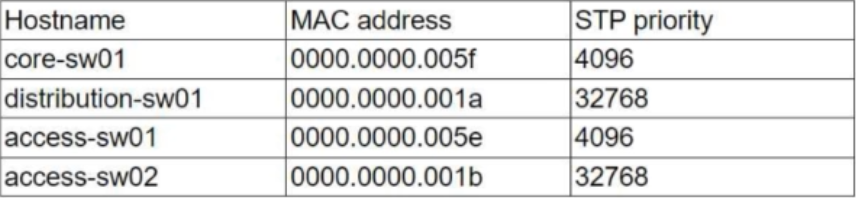
A network engineer is deploying switches at a new remote office. The switches have been preconfigured with hostnames and STP priority values.
Based on the following table:
Which of the following switches will become the root bridge?
A. core-sw01
B. access-sw01
C. distribution-sw01
D. access-sw02
Show Answer
Correct Answer: B
Explanation: The root bridge is chosen by the lowest bridge ID: first compare STP priority, then MAC address if priorities tie. core-sw01 and access-sw01 both have priority 4096, and access-sw01 has the lower MAC address (…005e versus …005f), so access-sw01 becomes the root bridge.
$19
Get all 652 questions with detailed answers and explanations
Instant download HTML + PDF delivered the moment payment clears.
Secure Stripe checkout we never see or store your card details.
7-day refund if files are defective see our refund policy.