You are developing custom pages for a model-driven app.
The app must display a timer control within a menu and include a mixture of buttons and icons. If a change is made to any of these elements, then the changes must cascade out automatically to all custom pages.
You need to implement a solution.
What should you implement?
A. PCF control
B. Canvas component
C. Timer control
D. Web resource
Show Answer
Correct Answer: B
Explanation: Custom pages in model-driven apps are built with canvas app technology. To create a reusable UI that combines a timer, buttons, and icons and automatically propagates changes to every custom page, use a Canvas component. A PCF control creates a reusable custom control but is intended as a single control rather than composing multiple canvas controls into a reusable page fragment. A standalone Timer control or web resource does not provide the required reusable composite behavior.
Question 68
DRAG DROP
-
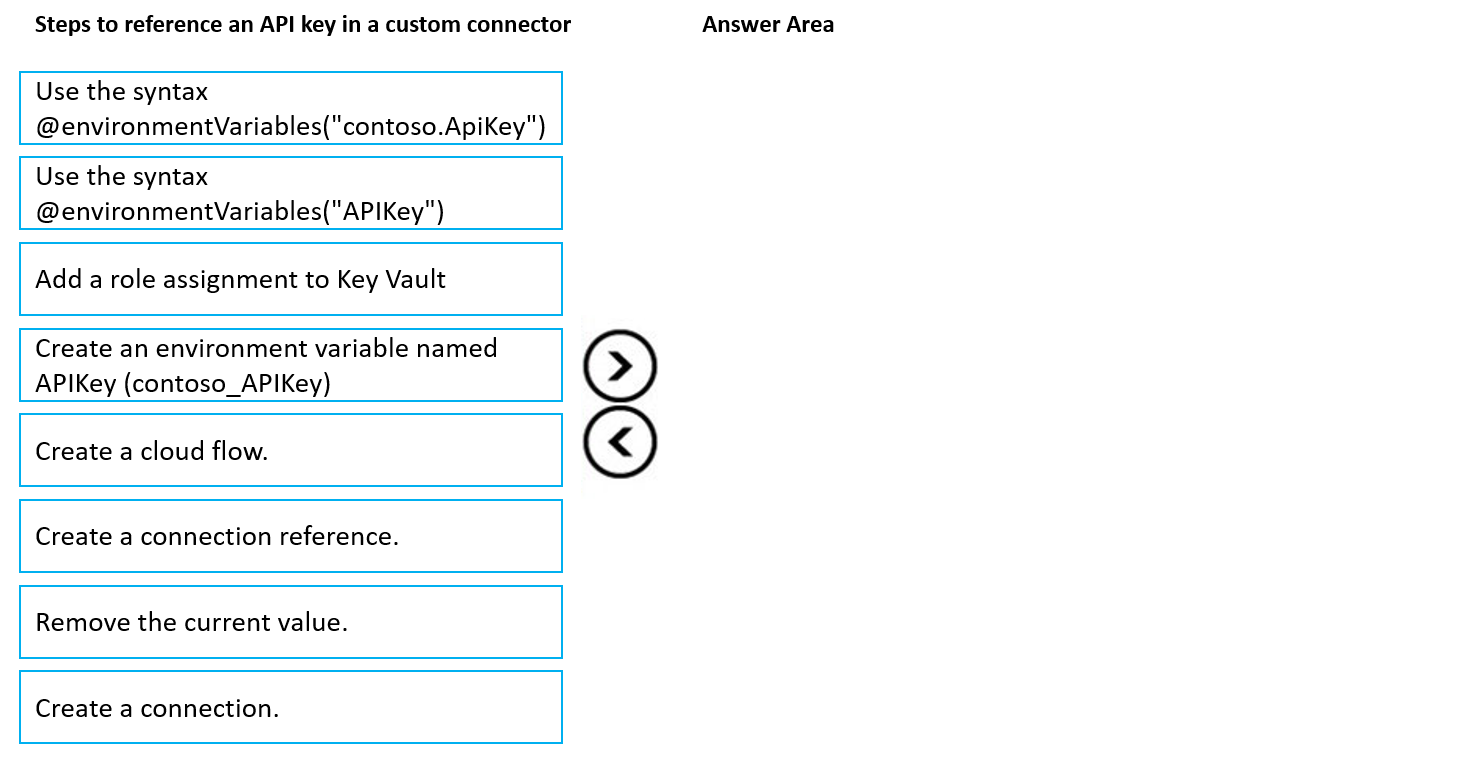
You are designing a custom connector for an internal API used by Contoso, LLC.
Authentication to the API is carried out by using an API key. The API key is stored within Azure Key Vault. Each environment has a separate instance of the API with a different API key.
You need to reference the API key from Key Vault in the custom connector.
Which four actions should you perform in sequence? To answer, move the appropriate actions from the list of actions to the answer area and arrange them in the correct order.
NOTE: More than one order of answer choices is correct. You will receive credit for any of the correct orders you select.
Show Answer
Correct Answer: Create an environment variable named APIKey (contoso_APIKey)
Add a role assignment to Key Vault
Use the syntax @environmentVariables("contoso_APIKey")
Create a connection
Explanation: Create a Key Vault-backed environment variable, grant access to the secret, reference it in the custom connector with the environment variable expression, then create the connector connection.
Question 69
You are creating an asynchronous automation that targets an external API.
The automation must retrieve a stored API key to connect with the API. The API key must be rotated regularly by business users, without the need for dedicated tooling. No connector is available for the external API.
You need to implement the automation.
What should you use?
A. Unsecure config
B. Secure config
C. Connection references
D. Environment variables
Show Answer
Correct Answer: D
Explanation: Environment variables are the appropriate choice for storing configuration such as an API key that business users need to update without developer tooling. They are designed to hold configurable values across environments and can be referenced by cloud flows/automations. Secure/unsecure configuration applies to plug-ins, and connection references are for supported connectors, which are not available here.
Question 70
You create a custom page that is used as a contextual dialog in a model-driven app.
The app must be able to receive two contextual parameters by passing a concatenated string. The string must use the pipe (|) symbol with the recordId parameter.
You need to compose the formulas to extract parameter information.
Which two formulas should you compose? Each correct answer presents part of the solution.
NOTE: Each correct selection is worth one point.
A. Left(Param("recordId"), Find("|", Param("recordId")) - 1)
B. Left(Param("recordId"), Len(Param("recordId")) - Find("|", Param(“recordId")))
C. Right(Param("recordId"), Len(Param("recordId")) - Find("|", Param(“recordId")))
D. Right(Param("recordId"), Find("|", Param("recordId")) - 1)
Show Answer
Correct Answer: A, C
Explanation: To split a concatenated string of the form 'first|second', use Left() with the position of the pipe minus one to extract the first value, and Right() with the total length minus the pipe position to extract the second value. Specifically, Left(Param("recordId"), Find("|", Param("recordId")) - 1) returns the text before '|', and Right(Param("recordId"), Len(Param("recordId")) - Find("|", Param("recordId"))) returns the text after '|'. Options B and D compute incorrect lengths for the intended substrings.
Question 71
Note: This question is part of a series of questions that present the same scenario. Each question in the series contains a unique solution that might meet the stated goals. Some question sets might have more than one correct solution, while others might not have a correct solution.
After you answer a question in this section, you will NOT be able to return to it. As a result, these questions will not appear in the review screen.
A company requires custom validation when users save form records that use a synchronous plug-in.
If validation fails, a message that explains how to resolve the issue must be displayed on the form to the user.
You need to implement the custom validation.
Solution: Use the tracing service to log the message.
Does the solution meet the goal?
A. Yes
B. No
Show Answer
Correct Answer: B
Explanation: Using the tracing service only writes diagnostic information to plug-in traces for administrators or developers. It does not display a validation message to the user on the form. To present a user-facing validation error from a synchronous plug-in, the plug-in should throw an InvalidPluginExecutionException with the appropriate message.
Question 72
An organization uses Dynamics 365 Sales. The organization has accounting and customer service departments.
You must restrict users in customer service from being able to change the value of the balance field on the Contact records. The accounting team must be the only team able to edit this field.
You need to create the appropriate solution without any customizations.
What should you do first?
A. Enable field security for the balance field and grant the customer service team read permissions.
B. Create a customer service form and role and make the balance field read-only.
C. Create a customer service form and role and a business rule that enables the balance field.
D. Create an accounting form and role and a business rule that enables the balance field.
Show Answer
Correct Answer: A
Explanation: Use Dataverse field-level security to restrict editing of a specific field without customizations. The first step is to enable field security on the balance field. Then assign field security profiles so accounting has update permission while customer service has read-only access. Form read-only settings and business rules are UI-level only and do not securely enforce field edit permissions.
Sources:
https://www.certshero.com/microsoft/pl-400/practice-test
https://www.pass4success.com/microsoft/discussions/exam-pl-400-topic-10-question-19-discussion
Question 73
You need to improve the efficiency of counting warehouse inventory.
What should you create?
A. a model-driven app that allows the user to key in inventory counts
B. a Power BI dashboard that shows the inventory counting variances
C. a flow that updates the warehouse counts as the worker performs the count
D. a canvas app that scans barcodes to allow a warehouse worker to select inventory counts
Show Answer
Correct Answer: D
Explanation: A canvas app with barcode scanning is the most appropriate solution to improve the efficiency of warehouse inventory counting. Barcode scanning minimizes manual entry, speeds up the counting process, and reduces errors. Model-driven apps are not optimized for this mobile scanning scenario, Power BI is for reporting rather than data capture, and a flow cannot directly provide the interactive scanning experience workers need.
Question 74
A company requires a plug-in that makes multiple requests to an external web service. The plug-in must not time out when the web service has issues or is slow to respond.
You need to create the plug-in.
What should you do?
A. Assign the IOrganizationService object to a member variable.
B. Register the plug-in to run synchronously.
C. Register the plug-in step once for each web service request.
D. Set the HTTP connection KeepAlive property to false.
Show Answer
Correct Answer: D
Explanation: For Dataverse/Power Apps plug-ins that call external web services, Microsoft recommends setting the HTTP KeepAlive property to false. Persistent connections can cause the plug-in to wait on stale or closed connections, increasing the risk of delays and timeouts when external services are slow or unavailable. The other options do not address this issue: storing IOrganizationService in a member variable is unrelated, synchronous execution is more susceptible to blocking, and registering multiple plug-in steps is not a timeout mitigation strategy.
Question 75
Case study -
This is a case study. Case studies are not timed separately. You can use as much exam time as you would like to complete each case. However, there may be additional case studies and sections on this exam. You must manage your time to ensure that you are able to complete all questions included on this exam in the time provided.
To answer the questions included in a case study, you will need to reference information that is provided in the case study. Case studies might contain exhibits and other resources that provide more information about the scenario that is described in the case study. Each question is independent of the other questions in this case study.
At the end of this case study, a review screen will appear. This screen allows you to review your answers and to make changes before you move to the next section of the exam. After you begin a new section, you cannot return to this section.
To start the case study -
To display the first question in this case study, click the Next button. Use the buttons in the left pane to explore the content of the case study before you answer the questions. Clicking these buttons displays information such as business requirements, existing environment, and problem statements. If the case study has an All Information tab, note that the information displayed is identical to the information displayed on the subsequent tabs. When you are ready to answer a question, click the Question button to return to the question.
Background -
Northwind Traders uses Microsoft Dynamics 365 Sales to manage its sales process. To better understand its customers, Northwind Traders invests in a team of researchers who gather data from multiple sources. The company stores the data it collects in a Microsoft Azure SQL Database. The company plans to use the data to enrich account records and make the sales team more effective.
Current environment -
Environment -
• The company has three Microsoft Power Platform environments with Dynamics 365 Sales installed. The environments are named development, test, and production.
• Each environment has an application user that can be used for integrations.
• The company must use solutions to perform all customization and configuration deployment.
Data -
• Researchers are responsible for creating account records.
• Researchers have permissions on the Account table to create records, read all records, and update records they own.
• A synchronous plug-in runs when an account record is created and could reassign the record to a different user.
• Users must access data as themselves to enforce security and audit changes.
• A column named new_dataid is added to the Account table. The column uniquely identifies which data it should receive.
• Researchers have researched only the top 20 percent of account records.
Web API -
• The company creates an Azure Function to run a RESTful .NET Web API.
• Data can be retrieved by placing a GET request to the URL https://dataservice-[ENVIRONMENTNAME].azurewebsites.net/enrich/[DATAID].
• [ENVIRONMENTNAME] is the name of the Microsoft Power Platform environment that requests the data.
• [DATAID] is the new_dataid column in the Account table.
• The Web API response will return a 200 response plus data if the DataId is found. Otherwise, a 404 response is returned.
• Developers plan to create a custom connector from the Web API to make it accessible from Microsoft Power Platform.
Requirements -
Custom connector -
• The Web API definition used to create the custom connector must be generated based on a low-code technology.
• The URL used by the custom connector must incorporate the current environment name without hardcoding values.
• Errors generated by the custom connector must not cause downstream processes to fail.
• Text descriptions and field placeholder text that describe the use of the custom connector must appear for non-developers.
Process -
• All account records must be updated with data from the Web API once automatically.
• Only account records that contain a DataId should be updated by the Web API.
• Researchers must create Power Automate flows to specify data analysis priority.
• The researchers require a process that repurposes a set of identical steps of parameterized Microsoft Dataverse queries from a Power Automate flow for use in other flows that have different parameters. The researchers want to avoid recreating the steps manually each time they create a flow to save time and avoid errors.
Issues -
• A tester attempts to connect to the production instance of the Web API with a DataId that should return data. The tester receives an error stating that the remote name could not be resolved.
• A missing component causes an error to occur when importing the solution that contains the Power Automate flow to update account records in a test environment.
You need to determine the cause of the 404 error when connecting to the production instance of the Web API.
What do you identify?
A. The web service lacks data for the record.
B. An authentication error occurred.
C. The request timed-out.
D. The host name in the URL is missing a valid value.
Show Answer
Correct Answer: D
Explanation: The reported issue is 'the remote name could not be resolved,' which indicates DNS/hostname resolution failed before the API could return its documented 200 or 404 response. In this case study, the hostname depends on substituting [ENVIRONMENTNAME] into the URL. If that value is missing or invalid, the hostname cannot be resolved. A true 404 from the API would indicate the DataId was not found after successfully reaching the service.
Sources:
https://quizlet.com/1161498570/md-101-flash-cards
Question 76
Case study -
This is a case study. Case studies are not timed separately. You can use as much exam time as you would like to complete each case. However, there may be additional case studies and sections on this exam. You must manage your time to ensure that you are able to complete all questions included on this exam in the time provided.
To answer the questions included in a case study, you will need to reference information that is provided in the case study. Case studies might contain exhibits and other resources that provide more information about the scenario that is described in the case study. Each question is independent of the other questions in this case study.
At the end of this case study, a review screen will appear. This screen allows you to review your answers and to make changes before you move to the next section of the exam. After you begin a new section, you cannot return to this section.
To start the case study -
To display the first question in this case study, click the Next button. Use the buttons in the left pane to explore the content of the case study before you answer the questions. Clicking these buttons displays information such as business requirements, existing environment, and problem statements. If the case study has an All Information tab, note that the information displayed is identical to the information displayed on the subsequent tabs. When you are ready to answer a question, click the Question button to return to the question.
Background -
Northwind Traders uses Microsoft Dynamics 365 Sales to manage its sales process. To better understand its customers, Northwind Traders invests in a team of researchers who gather data from multiple sources. The company stores the data it collects in a Microsoft Azure SQL Database. The company plans to use the data to enrich account records and make the sales team more effective.
Current environment -
Environment -
• The company has three Microsoft Power Platform environments with Dynamics 365 Sales installed. The environments are named development, test, and production.
• Each environment has an application user that can be used for integrations.
• The company must use solutions to perform all customization and configuration deployment.
Data -
• Researchers are responsible for creating account records.
• Researchers have permissions on the Account table to create records, read all records, and update records they own.
• A synchronous plug-in runs when an account record is created and could reassign the record to a different user.
• Users must access data as themselves to enforce security and audit changes.
• A column named new_dataid is added to the Account table. The column uniquely identifies which data it should receive.
• Researchers have researched only the top 20 percent of account records.
Web API -
• The company creates an Azure Function to run a RESTful .NET Web API.
• Data can be retrieved by placing a GET request to the URL https://dataservice-[ENVIRONMENTNAME].azurewebsites.net/enrich/[DATAID].
• [ENVIRONMENTNAME] is the name of the Microsoft Power Platform environment that requests the data.
• [DATAID] is the new_dataid column in the Account table.
• The Web API response will return a 200 response plus data if the DataId is found. Otherwise, a 404 response is returned.
• Developers plan to create a custom connector from the Web API to make it accessible from Microsoft Power Platform.
Requirements -
Custom connector -
• The Web API definition used to create the custom connector must be generated based on a low-code technology.
• The URL used by the custom connector must incorporate the current environment name without hardcoding values.
• Errors generated by the custom connector must not cause downstream processes to fail.
• Text descriptions and field placeholder text that describe the use of the custom connector must appear for non-developers.
Process -
• All account records must be updated with data from the Web API once automatically.
• Only account records that contain a DataId should be updated by the Web API.
• Researchers must create Power Automate flows to specify data analysis priority.
• The researchers require a process that repurposes a set of identical steps of parameterized Microsoft Dataverse queries from a Power Automate flow for use in other flows that have different parameters. The researchers want to avoid recreating the steps manually each time they create a flow to save time and avoid errors.
Issues -
• A tester attempts to connect to the production instance of the Web API with a DataId that should return data. The tester receives an error stating that the remote name could not be resolved.
• A missing component causes an error to occur when importing the solution that contains the Power Automate flow to update account records in a test environment.
You need to implement visual hints in the custom connector.
What should you do? Each correct answer presents a complete solution.
NOTE: Each correct selection is worth one point.
A. In the custom connector, update the name of the policy template.
B. Extend the Open API definition of the Web API for the EnvironmentName parameter.
C. Extend the Open API definition of the Web API for the DataId parameter.
D. In the custom connector, update the description for the DataId parameter.
Show Answer
Correct Answer: C, D
Explanation: Visual hints for non-developers are provided through the OpenAPI metadata and connector parameter descriptions. The DataId is the user-supplied parameter, so extending its OpenAPI definition (for example, with description, summary, examples, and placeholder metadata) and updating its description in the custom connector provide helpful text and placeholder guidance. The EnvironmentName is intended to be incorporated dynamically rather than entered by end users, and renaming a policy template does not provide user-facing hints.
Sources:
https://quizlet.com/1161498570/md-101-flash-cards
$19
Get all 410 questions with detailed answers and explanations
Instant download HTML + PDF delivered the moment payment clears.
Secure Stripe checkout we never see or store your card details.
7-day refund if files are defective see our refund policy.