A company requires a plug-in that makes multiple requests to an external web service. The plug-in must not time out when the web service has issues or is slow to respond.
You need to create the plug-in.
What should you do?
A. Send requests to use multiple threads.
B. Register the plug-in to run synchronously.
C. Register the plug-in step once for each web service request.
D. Set the HTTP connection timeout value explicitly to limit how long each connection can remain open.
Show Answer
Correct Answer: D
Explanation: Set an explicit HTTP timeout for outbound web service calls so the plug-in does not block indefinitely on a slow or unresponsive service. Multiple threads are not appropriate in Dataverse plug-ins, synchronous registration does not prevent timeouts, and registering separate steps per request does not address external service latency.
Question 47
Case Study -
This is a case study. Case studies are not timed separately. You can use as much exam time as you would like to complete each case. However, there may be additional case studies and sections on this exam. You must manage your time to ensure that you are able to complete all questions included on this exam in the time provided.
To answer the questions included in a case study, you will need to reference information that is provided in the case study. Case studies might contain exhibits and other resources that provide more information about the scenario that is described in the case study. Each question is independent of the other questions in this case study.
At the end of this case study, a review screen will appear. This screen allows you to review your answers and to make changes before you move to the next section of the exam. After you begin a new section, you cannot return to this section.
To start the case study -
To display the first question in this case study, click the Next button. Use the buttons in the left pane to explore the content of the case study before you answer the questions. Clicking these buttons displays information such as business requirements, existing environment, and problem statements. If the case study has an All Information tab, note that the information displayed is identical to the information displayed on the subsequent tabs. When you are ready to answer a question, click the Question button to return to the question.
Background -
City Power & Light is an energy and utilities company that has offices in Europe. The company subsidizes home improvements for domestic customers, to improve energy efficiency and to meet environmental commitments. The company also distributes and generates electricity for domestic and commercial customers. The company has 2,000 employees in multiple offices and in work-from-home locations.
City Power & Light uses a team of schedulers, assessors, field engineers, and customer support agents for home improvements in a program named Get Energy Fit.
Current Environment -
Get Energy Fit Program -
City Power & Light uses the following to manage the Get Energy Fit program:
• The company uses a Microsoft Excel spreadsheet named Planning Hub on Microsoft SharePoint Online to store information about customer appointments, customer details, and customer eligibility in the program.
• The company records sensitive customer information that includes the document identification numbers and the customer's financial information.
• The company uses an assessor to verify customer eligibility in the program and to perform a suitability assessment. The assessor completes the suitability assessment by using a paper and clipboard at the customer property and enters the data to the Planning Hub after the assessment is completed. The assessor also uploads photographs to an on-premises document library. The assessor completes the eligibility assessment by using an application written in React.
• Schedulers use Microsoft Outlook to schedule engineers and assessors for home improvement appointments. About 200 appointments are scheduled daily.
• Employees for the company submit funding claims on behalf of the customer by uploading evidence and compliance checks information to an application named the Claim Submission Portal.
Technical Environment -
• Schedulers use Windows 11 desktop and laptop computers with the latest version of Microsoft Edge.
• Assessors use iOS and Android tablet devices.
• The Claim Submission Portal uses REST-based APIs for all operations and a dedicated testing environment. Authentication to the API is provided by using the following example header key and value pair: o Authentication: 2C8D41431415E429C7FC7A74D8315
• The company uses Microsoft Azure for hosting multiple applications.
Requirements -
Overview -
City Power & Light plans to implement Microsoft Power Platform to improve the customer experience and increase delivery for the Get Energy Fit program.
Business Requirements -
• Only team leaders and senior managers should have access to read personally identifiable information (PII).
• All development changes must be tested in a separate environment.
• The company requires out-of-the-box solutions, when possible.
• Sensitive credentials, such as user passwords and API secrets, must be stored securely.
• The Claim Submission Portal must allow citizen developers to create automated solutions.
• Customer and appointment information must be accessible to all applications.
Planning Hub Application -
The company is planning to replace the Planning Hub spreadsheet with a new application. The new application has the following requirements:
• The application must support a component design that provides rapid changes requested by the schedulers.
• The data model for the application must capture the following information:
o Information about customers such as name, address, and other PII. o The data and time for an assessor's or engineer's appointment. Schedulers must be able to view all appointments without filters. o Records the details of the home improvements installed for the customer. o Contains all the information and evidence for submission to the Claim Submission Portal.
• After an assessor uploads the funding application and all evidence after a home improvement has been complete, the company requires that the status of the application is set to Submit and should run the following:
o Retrieve the details about the customer and the improvement installed. o Send an approval to a senior manager to review and approve in Microsoft Teams. o Upload the information to the API endpoint. o If the upload fails to complete, it should retry after a delay of 30 seconds up to three times. If an error occurs after three times, the application should send an email notification to the application support team. o Must record the status on the funding application.
Suitability Assessment Tool -
The company plans to implement a new application named the Suitability Assessment Tool for the assessors. The new application has the following requirements:
• Must integrate with Microsoft Power Platform.
• Assessors must be able to complete the eligibility assessment by using the Suitability Assessment Tool. The assessors must be able to upload photographs to the on-premises file share.
• Must be developed by using modular components that can be used by other applications.
• Must be optimized for use on tablet devices.
• All changes to the application must be completed in the Suitability Assessment Tool solution.
Reporting -
The company has the following requirements for a reporting solution:
• The data source for the reporting solution must support incremental refreshes.
• The solution must report accurate data if an error occurs.
Issues -
• A recent audit identified that all users can access the PII in the Planning Hub spreadsheet.
• After a developer deploys a change to the production environment, a user reports information is loaded incorrectly to the test system when processing a funding application.
• After deploying a change to the new eligibility assessment tool in the development environment, you observe that the changes do not appear in the development environment.
• After removing a column from the Planning Hub application and deploying the changes to the production environment, you observe that the column is still present.
• You deploy the customizations for the data model. Users report that the email address of the user who created the appointment is missing and that searches on the description information do not return any results.
You need to create the eligibility assessment app.
Which command should you run?
A. pac application install
B. pac pcf init
C. pac plugin init
D. pac solution init
Show Answer
Correct Answer: B
Explanation: The requirement is to build the eligibility assessment app using modular components that can be reused by other applications. In Power Platform, reusable modular UI components are created with the Power Apps Component Framework (PCF). The `pac pcf init` command initializes a new PCF project. The other commands are for installing the CLI application (`pac application install`), creating a plug-in project (`pac plugin init`), or initializing a solution structure (`pac solution init`), none of which create reusable PCF components.
Question 48
Case study -
This is a case study. Case studies are not timed separately. You can use as much exam time as you would like to complete each case. However, there may be additional case studies and sections on this exam. You must manage your time to ensure that you are able to complete all questions included on this exam in the time provided.
To answer the questions included in a case study, you will need to reference information that is provided in the case study. Case studies might contain exhibits and other resources that provide more information about the scenario that is described in the case study. Each question is independent of the other questions in this case study.
At the end of this case study, a review screen will appear. This screen allows you to review your answers and to make changes before you move to the next section of the exam. After you begin a new section, you cannot return to this section.
To start the case study -
To display the first question in this case study, click the Next button. Use the buttons in the left pane to explore the content of the case study before you answer the questions. Clicking these buttons displays information such as business requirements, existing environment, and problem statements. If the case study has an All Information tab, note that the information displayed is identical to the information displayed on the subsequent tabs. When you are ready to answer a question, click the Question button to return to the question.
Background -
City Power & Light is an energy and utilities company that has offices in Europe. The company subsidizes home improvements for domestic customers, to improve energy efficiency and to meet environmental commitments. The company also distributes and generates electricity for domestic and commercial customers. The company has 2,000 employees in multiple offices and in work-from-home locations.
City Power & Light uses a team of schedulers, assessors, field engineers, and customer support agents for home improvements in a program named Get Energy Fit.
Current Environment -
Get Energy Fit Program -
City Power & Light uses the following to manage the Get Energy Fit program:
• The company uses a Microsoft Excel spreadsheet named Planning Hub on Microsoft SharePoint Online to store information about customer appointments, customer details, and customer eligibility in the program.
• The company records sensitive customer information that includes the document identification numbers and the customer's financial information.
• The company uses an assessor to verify customer eligibility in the program and to perform a suitability assessment. The assessor completes the suitability assessment by using a paper and clipboard at the customer property and enters the data to the Planning Hub after the assessment is completed. The assessor also uploads photographs to an on-premises document library. The assessor completes the eligibility assessment by using an application written in React.
• Schedulers use Microsoft Outlook to schedule engineers and assessors for home improvement appointments. About 200 appointments are scheduled daily.
• Employees for the company submit funding claims on behalf of the customer by uploading evidence and compliance checks information to an application named the Claim Submission Portal.
Technical Environment -
• Schedulers use Windows 11 desktop and laptop computers with the latest version of Microsoft Edge.
• Assessors use iOS and Android tablet devices.
• The Claim Submission Portal uses REST-based APIs for all operations and a dedicated testing environment. Authentication to the API is provided by using the following example header key and value pair: o Authentication: 2C8D41431415E429C7FC7A74D8315
• The company uses Microsoft Azure for hosting multiple applications.
Requirements -
Overview -
City Power & Light plans to implement Microsoft Power Platform to improve the customer experience and increase delivery for the Get Energy Fit program.
Business Requirements -
• Only team leaders and senior managers should have access to read personally identifiable information (PII).
• All development changes must be tested in a separate environment.
• The company requires out-of-the-box solutions, when possible.
• Sensitive credentials, such as user passwords and API secrets, must be stored securely.
• The Claim Submission Portal must allow citizen developers to create automated solutions.
• Customer and appointment information must be accessible to all applications.
Planning Hub Application -
The company is planning to replace the Planning Hub spreadsheet with a new application. The new application has the following requirements:
• The application must support a component design that provides rapid changes requested by the schedulers.
• The data model for the application must capture the following information:
o Information about customers such as name, address, and other PII. o The data and time for an assessor's or engineer's appointment. Schedulers must be able to view all appointments without filters. o Records the details of the home improvements installed for the customer. o Contains all the information and evidence for submission to the Claim Submission Portal.
• After an assessor uploads the funding application and all evidence after a home improvement has been complete, the company requires that the status of the application is set to Submit and should run the following:
o Retrieve the details about the customer and the improvement installed. o Send an approval to a senior manager to review and approve in Microsoft Teams. o Upload the information to the API endpoint. o If the upload fails to complete, it should retry after a delay of 30 seconds up to three times. If an error occurs after three times, the application should send an email notification to the application support team. o Must record the status on the funding application.
Suitability Assessment Tool -
The company plans to implement a new application named the Suitability Assessment Tool for the assessors. The new application has the following requirements:
• Must integrate with Microsoft Power Platform.
• Assessors must be able to complete the eligibility assessment by using the Suitability Assessment Tool. The assessors must be able to upload photographs to the on-premises file share.
• Must be developed by using modular components that can be used by other applications.
• Must be optimized for use on tablet devices.
• All changes to the application must be completed in the Suitability Assessment Tool solution.
Reporting -
The company has the following requirements for a reporting solution:
• The data source for the reporting solution must support incremental refreshes.
• The solution must report accurate data if an error occurs.
Issues -
• A recent audit identified that all users can access the PII in the Planning Hub spreadsheet.
• After a developer deploys a change to the production environment, a user reports information is loaded incorrectly to the test system when processing a funding application.
• After deploying a change to the new eligibility assessment tool in the development environment, you observe that the changes do not appear in the development environment.
• After removing a column from the Planning Hub application and deploying the changes to the production environment, you observe that the column is still present.
• You deploy the customizations for the data model. Users report that the email address of the user who created the appointment is missing and that searches on the description information do not return any results.
You need to resolve the issue with the eligibility assessment tool.
Which two commands should you run? Each correct answer presents part of the solution.
NOTE: Each correct selection is worth one point.
A. pac solution version
B. pac solution import
C. pac pcf push
D. pac pcf version --strategy manifest
Show Answer
Correct Answer: B, C
Explanation: The issue states that after deploying a change to the eligibility assessment tool in the development environment, the changes do not appear. The Suitability Assessment Tool is built using modular Power Apps Component Framework (PCF) components and all changes are completed in its solution. 'pac pcf push' deploys the latest PCF component directly to a development environment for testing, making code changes visible. 'pac solution import' imports the updated solution into the target environment. The version commands only update version metadata and do not deploy changes.
Question 49
Case study -
This is a case study. Case studies are not timed separately. You can use as much exam time as you would like to complete each case. However, there may be additional case studies and sections on this exam. You must manage your time to ensure that you are able to complete all questions included on this exam in the time provided.
To answer the questions included in a case study, you will need to reference information that is provided in the case study. Case studies might contain exhibits and other resources that provide more information about the scenario that is described in the case study. Each question is independent of the other questions in this case study.
At the end of this case study, a review screen will appear. This screen allows you to review your answers and to make changes before you move to the next section of the exam. After you begin a new section, you cannot return to this section.
To start the case study -
To display the first question in this case study, click the Next button. Use the buttons in the left pane to explore the content of the case study before you answer the questions. Clicking these buttons displays information such as business requirements, existing environment, and problem statements. If the case study has an All Information tab, note that the information displayed is identical to the information displayed on the subsequent tabs. When you are ready to answer a question, click the Question button to return to the question.
Background -
City Power & Light is an energy and utilities company that has offices in Europe. The company subsidizes home improvements for domestic customers, to improve energy efficiency and to meet environmental commitments. The company also distributes and generates electricity for domestic and commercial customers. The company has 2,000 employees in multiple offices and in work-from-home locations.
City Power & Light uses a team of schedulers, assessors, field engineers, and customer support agents for home improvements in a program named Get Energy Fit.
Current Environment -
Get Energy Fit Program -
City Power & Light uses the following to manage the Get Energy Fit program:
• The company uses a Microsoft Excel spreadsheet named Planning Hub on Microsoft SharePoint Online to store information about customer appointments, customer details, and customer eligibility in the program.
• The company records sensitive customer information that includes the document identification numbers and the customer's financial information.
• The company uses an assessor to verify customer eligibility in the program and to perform a suitability assessment. The assessor completes the suitability assessment by using a paper and clipboard at the customer property and enters the data to the Planning Hub after the assessment is completed. The assessor also uploads photographs to an on-premises document library. The assessor completes the eligibility assessment by using an application written in React.
• Schedulers use Microsoft Outlook to schedule engineers and assessors for home improvement appointments. About 200 appointments are scheduled daily.
• Employees for the company submit funding claims on behalf of the customer by uploading evidence and compliance checks information to an application named the Claim Submission Portal.
Technical Environment -
• Schedulers use Windows 11 desktop and laptop computers with the latest version of Microsoft Edge.
• Assessors use iOS and Android tablet devices.
• The Claim Submission Portal uses REST-based APIs for all operations and a dedicated testing environment. Authentication to the API is provided by using the following example header key and value pair: o Authentication: 2C8D41431415E429C7FC7A74D8315
• The company uses Microsoft Azure for hosting multiple applications.
Requirements -
Overview -
City Power & Light plans to implement Microsoft Power Platform to improve the customer experience and increase delivery for the Get Energy Fit program.
Business Requirements -
• Only team leaders and senior managers should have access to read personally identifiable information (PII).
• All development changes must be tested in a separate environment.
• The company requires out-of-the-box solutions, when possible.
• Sensitive credentials, such as user passwords and API secrets, must be stored securely.
• The Claim Submission Portal must allow citizen developers to create automated solutions.
• Customer and appointment information must be accessible to all applications.
Planning Hub Application -
The company is planning to replace the Planning Hub spreadsheet with a new application. The new application has the following requirements:
• The application must support a component design that provides rapid changes requested by the schedulers.
• The data model for the application must capture the following information:
o Information about customers such as name, address, and other PII. o The data and time for an assessor's or engineer's appointment. Schedulers must be able to view all appointments without filters. o Records the details of the home improvements installed for the customer. o Contains all the information and evidence for submission to the Claim Submission Portal.
• After an assessor uploads the funding application and all evidence after a home improvement has been complete, the company requires that the status of the application is set to Submit and should run the following:
o Retrieve the details about the customer and the improvement installed. o Send an approval to a senior manager to review and approve in Microsoft Teams. o Upload the information to the API endpoint. o If the upload fails to complete, it should retry after a delay of 30 seconds up to three times. If an error occurs after three times, the application should send an email notification to the application support team. o Must record the status on the funding application.
Suitability Assessment Tool -
The company plans to implement a new application named the Suitability Assessment Tool for the assessors. The new application has the following requirements:
• Must integrate with Microsoft Power Platform.
• Assessors must be able to complete the eligibility assessment by using the Suitability Assessment Tool. The assessors must be able to upload photographs to the on-premises file share.
• Must be developed by using modular components that can be used by other applications.
• Must be optimized for use on tablet devices.
• All changes to the application must be completed in the Suitability Assessment Tool solution.
Reporting -
The company has the following requirements for a reporting solution:
• The data source for the reporting solution must support incremental refreshes.
• The solution must report accurate data if an error occurs.
Issues -
• A recent audit identified that all users can access the PII in the Planning Hub spreadsheet.
• After a developer deploys a change to the production environment, a user reports information is loaded incorrectly to the test system when processing a funding application.
• After deploying a change to the new eligibility assessment tool in the development environment, you observe that the changes do not appear in the development environment.
• After removing a column from the Planning Hub application and deploying the changes to the production environment, you observe that the column is still present.
• You deploy the customizations for the data model. Users report that the email address of the user who created the appointment is missing and that searches on the description information do not return any results.
You need to implement the Suitability Assessment Tool.
What should you use?
A. Power App Component Framework (PCF) control
B. view
C. component library
D. form
Show Answer
Correct Answer: C
Explanation: A component library is designed to build reusable, modular UI components for canvas apps, matching the requirement for modular components that can be reused by other applications. PCF controls are appropriate when custom controls beyond out-of-the-box capabilities are needed, but the case explicitly prefers out-of-the-box solutions where possible and does not state a need for custom controls.
Sources:
https://quizlet.com/1161498570/md-101-flash-cards
Question 50
DRAG DROP
-
Case study
-
This is a case study. Case studies are not timed separately. You can use as much exam time as you would like to complete each case. However, there may be additional case studies and sections on this exam. You must manage your time to ensure that you are able to complete all questions included on this exam in the time provided.
To answer the questions included in a case study, you will need to reference information that is provided in the case study. Case studies might contain exhibits and other resources that provide more information about the scenario that is described in the case study. Each question is independent of the other questions in this case study.
At the end of this case study, a review screen will appear. This screen allows you to review your answers and to make changes before you move to the next section of the exam. After you begin a new section, you cannot return to this section.
To start the case study
-
To display the first question in this case study, click the Next button. Use the buttons in the left pane to explore the content of the case study before you answer the questions. Clicking these buttons displays information such as business requirements, existing environment, and problem statements. If the case study has an All Information tab, note that the information displayed is identical to the information displayed on the subsequent tabs. When you are ready to answer a question, click the Question button to return to the question.
Background
-
City Power & Light is an energy and utilities company that has offices in Europe. The company subsidizes home improvements for domestic customers, to improve energy efficiency and to meet environmental commitments. The company also distributes and generates electricity for domestic and commercial customers. The company has 2,000 employees in multiple offices and in work-from-home locations.
City Power & Light uses a team of schedulers, assessors, field engineers, and customer support agents for home improvements in a program named Get Energy Fit.
Current Environment
-
Get Energy Fit Program
-
City Power & Light uses the following to manage the Get Energy Fit program:
• The company uses a Microsoft Excel spreadsheet named Planning Hub on Microsoft SharePoint Online to store information about customer appointments, customer details, and customer eligibility in the program.
• The company records sensitive customer information that includes the document identification numbers and the customer's financial information.
• The company uses an assessor to verify customer eligibility in the program and to perform a suitability assessment. The assessor completes the suitability assessment by using a paper and clipboard at the customer property and enters the data to the Planning Hub after the assessment is completed. The assessor also uploads photographs to an on-premises document library. The assessor completes the eligibility assessment by using an application written in React.
• Schedulers use Microsoft Outlook to schedule engineers and assessors for home improvement appointments. About 200 appointments are scheduled daily.
• Employees for the company submit funding claims on behalf of the customer by uploading evidence and compliance checks information to an application named the Claim Submission Portal.
Technical Environment
-
• Schedulers use Windows 11 desktop and laptop computers with the latest version of Microsoft Edge.
• Assessors use iOS and Android tablet devices.
• The Claim Submission Portal uses REST-based APIs for all operations and a dedicated testing environment. Authentication to the API is provided by using the following example header key and value pair:
o Authentication: 2C8D41431415E429C7FC7A74D8315
• The company uses Microsoft Azure for hosting multiple applications.
Requirements
-
Overview
-
City Power & Light plans to implement Microsoft Power Platform to improve the customer experience and increase delivery for the Get Energy Fit program.
Business Requirements
-
• Only team leaders and senior managers should have access to read personally identifiable information (PII).
• All development changes must be tested in a separate environment.
• The company requires out-of-the-box solutions, when possible.
• Sensitive credentials, such as user passwords and API secrets, must be stored securely.
• The Claim Submission Portal must allow citizen developers to create automated solutions.
• Customer and appointment information must be accessible to all applications.
Planning Hub Application
-
The company is planning to replace the Planning Hub spreadsheet with a new application. The new application has the following requirements:
• The application must support a component design that provides rapid changes requested by the schedulers.
• The data model for the application must capture the following information:
o Information about customers such as name, address, and other PII.
o The data and time for an assessor's or engineer's appointment. Schedulers must be able to view all appointments without filters.
o Records the details of the home improvements installed for the customer.
o Contains all the information and evidence for submission to the Claim Submission Portal.
• After an assessor uploads the funding application and all evidence after a home improvement has been complete, the company requires that the status of the application is set to Submit and should run the following:
o Retrieve the details about the customer and the improvement installed.
o Send an approval to a senior manager to review and approve in Microsoft Teams.
o Upload the information to the API endpoint.
o If the upload fails to complete, it should retry after a delay of 30 seconds up to three times. If an error occurs after three times, the application should send an email notification to the application support team.
o Must record the status on the funding application.
Suitability Assessment Tool
-
The company plans to implement a new application named the Suitability Assessment Tool for the assessors. The new application has the following requirements:
• Must integrate with Microsoft Power Platform.
• Assessors must be able to complete the eligibility assessment by using the Suitability Assessment Tool. The assessors must be able to upload photographs to the on-premises file share.
• Must be developed by using modular components that can be used by other applications.
• Must be optimized for use on tablet devices.
• All changes to the application must be completed in the Suitability Assessment Tool solution.
Reporting
-
The company has the following requirements for a reporting solution:
• The data source for the reporting solution must support incremental refreshes.
• The solution must report accurate data if an error occurs.
Issues
-
• A recent audit identified that all users can access the PII in the Planning Hub spreadsheet.
• After a developer deploys a change to the production environment, a user reports information is loaded incorrectly to the test system when processing a funding application.
• After deploying a change to the new eligibility assessment tool in the development environment, you observe that the changes do not appear in the development environment.
• After removing a column from the Planning Hub application and deploying the changes to the production environment, you observe that the column is still present.
• You deploy the customizations for the data model. Users report that the email address of the user who created the appointment is missing and that searches on the description information do not return any results.
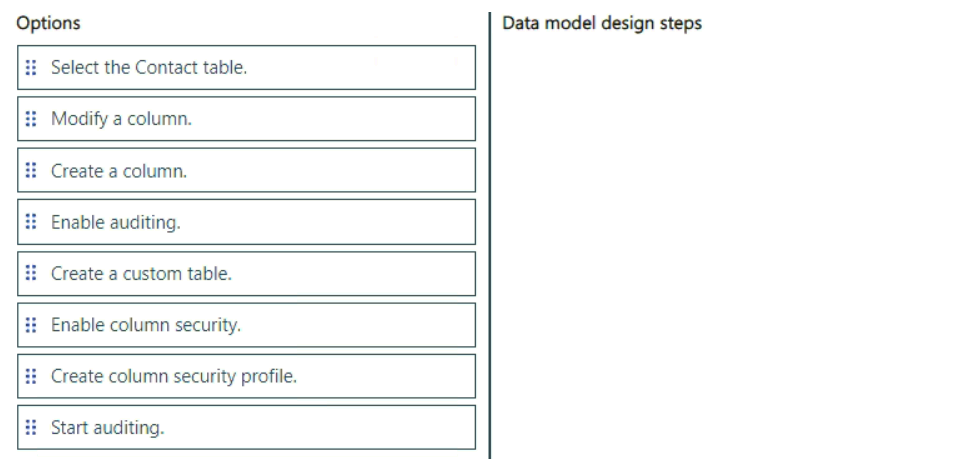
You need to design the Planning Hub data model.
Which four actions should you perform in sequence? To answer, move the appropriate actions from the list of actions to the answer area and arrange them in the correct order.
Show Answer
Correct Answer: Select the Contact table.
Create a column.
Enable column security.
Create column security profile.
Explanation: Use the out-of-the-box Contact table for customer data, add the required PII columns, secure those columns with column security, then assign access through a column security profile so only authorized roles can read PII.
Question 51
You are creating a FetchXML query.
The query must return data from a table and return filtered data from a related table.
You need to configure the FetchXML query.
Which two elements should you use? Each correct answer presents part of the solution.
NOTE: Each correct selection is worth one point.
A. attribute
B. link-entity
C. alias
D. condition
Show Answer
Correct Answer: B, D
Explanation: To return data from a related table in FetchXML, use a link-entity element to join the related table. To filter data from that related table, apply a condition element (typically within a filter inside the link-entity). The attribute element selects columns, and alias only provides an alternate name for a linked entity or attribute; neither is required to satisfy the stated requirement.
Question 52
A company deploys managed customizations by using two solutions, SolutionA and SolutionB. The solutions share components with one another.
A developer for SolutionA requires a new development environment. Customizations made in SolutionA must not interfere with customizations made in SolutionB.
You need to import solutions to prepare the environment.
What should you do?
A. Import SolutionA as managed and SolutionB as unmanaged.
B. Import SolutionA and SolutionB as unmanaged.
C. Import SolutionA as unmanaged and SolutionB as managed.
D. Import SolutionA and SolutionB as managed.
Show Answer
Correct Answer: C
Explanation: In a development environment, the solution being actively developed should be imported as unmanaged so its components can be edited. The other solution should be imported as managed to prevent accidental modifications. Although the solutions share components, unmanaged customizations from SolutionA can layer over the managed SolutionB without changing SolutionB itself, helping ensure development in SolutionA does not directly interfere with SolutionB.
Question 53
DRAG DROP -
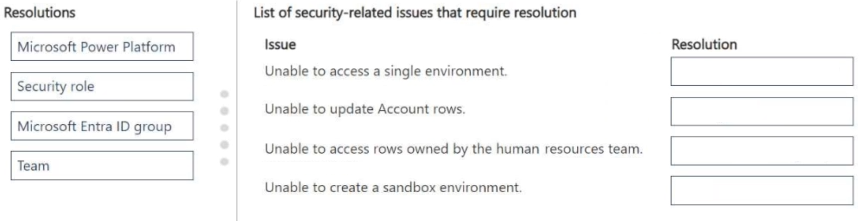
You are testing the deployment of a model-driven app. Microsoft Entra ID groups are used exclusively to manage environment- and team-level permissions.
Users encounter several access-related issues that prevent them from testing the app.
You need to select the component to use to resolve each issue by using the principle of least privilege.
What should you assign to resolve each issue? To answer, move the appropriate resolutions to the correct issues. You may use each resolution once, more than once, or not at all. You may need to move the split bar between panes or scroll to view content.
NOTE: Each correct selection is worth one point.
Show Answer
Correct Answer: Unable to access a single environment. → Microsoft Entra ID group
Unable to update Account rows. → Security role
Unable to access rows owned by the human resources team. → Team
Unable to create a sandbox environment. → Microsoft Power Platform
Explanation: Environment access is controlled by the environment's Entra ID group. Table permissions such as updating Account rows are granted through security roles. Access to records owned by a team is provided through team membership. Sandbox environment creation is governed by the Power Platform governance setting controlling who can create environments.
Question 54
DRAG DROP
-
You are designing an implementation that has complex data requirements.
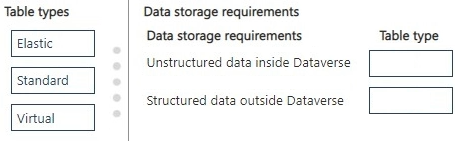
The data storage requirements are as follows:
• Query large amounts of unstructured data in Dataverse.
• Read and update structured data stored outside of Dataverse.
You need to implement data storage to meet the requirements.
Which table types should you use? To answer, move the appropriate table types to the correct data storage requirements. You may use each table type once, more than once, or not at all. You may need to move the split bar between panes or scroll to view content.
NOTE: Each correct selection is worth one point.
Show Answer
Correct Answer: Unstructured data inside Dataverse → Elastic
Structured data outside Dataverse → Virtual
Explanation: Elastic tables are designed for high-scale storage and querying of large volumes of data in Dataverse. Virtual tables expose and allow interaction with structured data that remains in external systems.
Question 56
DRAG DROP
-
A company develops a model-driven app. The company sets up a custom form for the Contact table. The app contains multiple custom app pages.
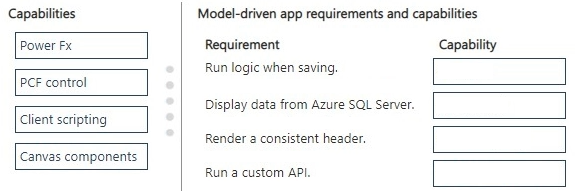
You must extend the app as follows:
• Run logic when a contact is saved.
• Display data from an Azure SQL Server database.
• Apply a consistent header across multiple app pages.
• Run a Dataverse custom API when the Contact row is saved.
You need to implement the app extension by using minimal development effort.
What should you implement for each requirement? To answer, move the appropriate capabilities to the correct requirements. You may use each capability once, more than once, or not at all. You may need to move the split bar between panes or scroll to view content.
Show Answer
Correct Answer: Run logic when saving → Client scripting
Display data from Azure SQL Server → PCF control
Render a consistent header → Canvas components
Run a Dataverse custom API → Power Fx
Explanation: Client scripting handles form OnSave events. PCF controls are appropriate for rendering external data in model-driven apps. Canvas components provide reusable UI such as headers across app pages. Power Fx can invoke Dataverse custom APIs with minimal development effort in supported app-page scenarios.
$19
Get all 410 questions with detailed answers and explanations
Instant download HTML + PDF delivered the moment payment clears.
Secure Stripe checkout we never see or store your card details.
7-day refund if files are defective see our refund policy.