DRAG DROP
-
Case study
-
This is a case study. Case studies are not timed separately. You can use as much exam time as you would like to complete each case. However, there may be additional case studies and sections on this exam. You must manage your time to ensure that you are able to complete all questions included on this exam in the time provided.
To answer the questions included in a case study, you will need to reference information that is provided in the case study. Case studies might contain exhibits and other resources that provide more information about the scenario that is described in the case study. Each question is independent of the other questions in this case study.
At the end of this case study, a review screen will appear. This screen allows you to review your answers and to make changes before you move to the next section of the exam. After you begin a new section, you cannot return to this section.
To start the case study
-
To display the first question in this case study, click the Next button. Use the buttons in the left pane to explore the content of the case study before you answer the questions. Clicking these buttons displays information such as business requirements, existing environment, and problem statements. If the case study has an All Information tab, note that the information displayed is identical to the information displayed on the subsequent tabs. When you are ready to answer a question, click the Question button to return to the question.
Background
-
City Power & Light is an energy and utilities company that has offices in Europe. The company subsidizes home improvements for domestic customers, to improve energy efficiency and to meet environmental commitments. The company also distributes and generates electricity for domestic and commercial customers. The company has 2,000 employees in multiple offices and in work-from-home locations.
City Power & Light uses a team of schedulers, assessors, field engineers, and customer support agents for home improvements in a program named Get Energy Fit.
Current Environment
-
Get Energy Fit Program
-
City Power & Light uses the following to manage the Get Energy Fit program:
• The company uses a Microsoft Excel spreadsheet named Planning Hub on Microsoft SharePoint Online to store information about customer appointments, customer details, and customer eligibility in the program.
• The company records sensitive customer information that includes the document identification numbers and the customer's financial information.
• The company uses an assessor to verify customer eligibility in the program and to perform a suitability assessment. The assessor completes the suitability assessment by using a paper and clipboard at the customer property and enters the data to the Planning Hub after the assessment is completed. The assessor also uploads photographs to an on-premises document library. The assessor completes the eligibility assessment by using an application written in React.
• Schedulers use Microsoft Outlook to schedule engineers and assessors for home improvement appointments. About 200 appointments are scheduled daily.
• Employees for the company submit funding claims on behalf of the customer by uploading evidence and compliance checks information to an application named the Claim Submission Portal.
Technical Environment
-
• Schedulers use Windows 11 desktop and laptop computers with the latest version of Microsoft Edge.
• Assessors use iOS and Android tablet devices.
• The Claim Submission Portal uses REST-based APIs for all operations and a dedicated testing environment. Authentication to the API is provided by using the following example header key and value pair:
o Authentication: 2C8D41431415E429C7FC7A74D8315
• The company uses Microsoft Azure for hosting multiple applications.
Requirements
-
Overview
-
City Power & Light plans to implement Microsoft Power Platform to improve the customer experience and increase delivery for the Get Energy Fit program.
Business Requirements
-
• Only team leaders and senior managers should have access to read personally identifiable information (PII).
• All development changes must be tested in a separate environment.
• The company requires out-of-the-box solutions, when possible.
• Sensitive credentials, such as user passwords and API secrets, must be stored securely.
• The Claim Submission Portal must allow citizen developers to create automated solutions.
• Customer and appointment information must be accessible to all applications.
Planning Hub Application
-
The company is planning to replace the Planning Hub spreadsheet with a new application. The new application has the following requirements:
• The application must support a component design that provides rapid changes requested by the schedulers.
• The data model for the application must capture the following information:
o Information about customers such as name, address, and other PII.
o The data and time for an assessor's or engineer's appointment. Schedulers must be able to view all appointments without filters.
o Records the details of the home improvements installed for the customer.
o Contains all the information and evidence for submission to the Claim Submission Portal.
• After an assessor uploads the funding application and all evidence after a home improvement has been complete, the company requires that the status of the application is set to Submit and should run the following:
o Retrieve the details about the customer and the improvement installed.
o Send an approval to a senior manager to review and approve in Microsoft Teams.
o Upload the information to the API endpoint.
o If the upload fails to complete, it should retry after a delay of 30 seconds up to three times. If an error occurs after three times, the application should send an email notification to the application support team.
o Must record the status on the funding application.
Suitability Assessment Tool
-
The company plans to implement a new application named the Suitability Assessment Tool for the assessors. The new application has the following requirements:
• Must integrate with Microsoft Power Platform.
• Assessors must be able to complete the eligibility assessment by using the Suitability Assessment Tool. The assessors must be able to upload photographs to the on-premises file share.
• Must be developed by using modular components that can be used by other applications.
• Must be optimized for use on tablet devices.
• All changes to the application must be completed in the Suitability Assessment Tool solution.
Reporting
-
The company has the following requirements for a reporting solution:
• The data source for the reporting solution must support incremental refreshes.
• The solution must report accurate data if an error occurs.
Issues
-
• A recent audit identified that all users can access the PII in the Planning Hub spreadsheet.
• After a developer deploys a change to the production environment, a user reports information is loaded incorrectly to the test system when processing a funding application.
• After deploying a change to the new eligibility assessment tool in the development environment, you observe that the changes do not appear in the development environment.
• After removing a column from the Planning Hub application and deploying the changes to the production environment, you observe that the column is still present.
• You deploy the customizations for the data model. Users report that the email address of the user who created the appointment is missing and that searches on the description information do not return any results.
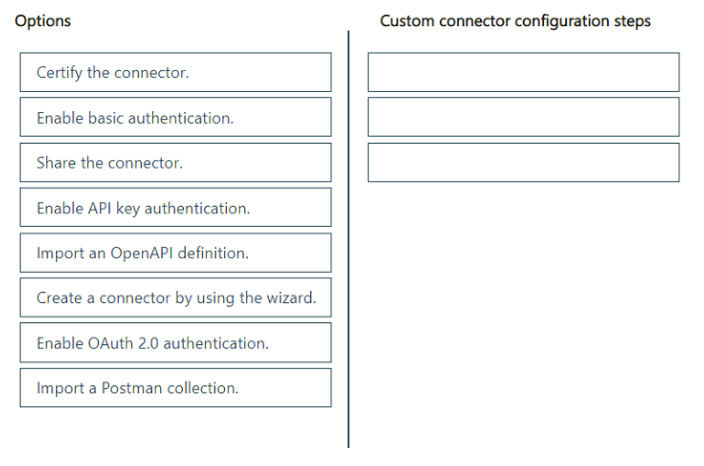
You need to configure a custom connector for the claim submission portal API.
Which three actions should you perform in sequence? To answer, move the appropriate actions from the list of actions to the answer area and arrange them in the correct order.
Show Answer
Correct Answer: Create a connector by using the wizard.
Enable API key authentication.
Import an OpenAPI definition.
Explanation: The API authenticates with a static header key, so API key authentication is appropriate. Build the custom connector, configure its authentication, and use an OpenAPI definition to define the API operations.
Question 58
You need to create the model driven app for accounts designated as referrals.
What should you add to the app?
A. Workflow
B. Subgrid
C. Business rule
D. Flow
E. Chart
Show Answer
Correct Answer: C
Explanation: A business rule is added to a model-driven app/table to apply client-side and server-side logic such as setting field values, showing/hiding fields, making fields required, or validating data without code. Workflows and flows automate processes rather than define app behavior, while subgrids and charts are UI components and do not implement business logic.
Question 59
Note: This question is part of a series of questions that present the same scenario. Each question in the series contains a unique solution that might meet the stated goals. Some question sets might have more than one correct solution, while others might not have a correct solution.
After you answer a question in this section, you will NOT be able to return to it. As a result these questions will not appear on the review screen.
You are designing an integration that sends created records from a custom Dataverse table to an exposed REST API.
When the REST API is unavailable, you must be able to retry if the response status code is 500.
You need to select a solution that meets the requirement.
Solution: Register a service endpoint for an Azure Service Bus queue. Use an Azure Function to process messages from the queue and forward them to the REST API. Redirect failed messages to the dead-letter queue.
Does the solution meet the goal?
A. Yes
B. No
Show Answer
Correct Answer: A
Explanation: The solution meets the stated goal. Registering a Dataverse service endpoint to Azure Service Bus decouples message delivery from the REST API. An Azure Function consuming the queue can implement retry behavior for HTTP 500 responses before abandoning processing. If retries are exhausted, moving the message to the dead-letter queue preserves it for later inspection or reprocessing rather than losing it. This architecture supports reliable retry when the REST API is temporarily unavailable.
Question 60
Note: This question is part of a series of questions that present the same scenario. Each question in the series contains a unique solution that might meet the stated goals. Some question sets might have more than one correct solution, while others might not have a correct solution.
After you answer a question in this section, you will NOT be able to return to it. As a result these questions will not appear on the review screen.
You are designing an integration that sends created records from a custom Dataverse table to an exposed REST API.
When the REST API is unavailable, you must be able to retry if the response status code is 500.
You need to select a solution that meets the requirement.
Solution: Register an asynchronous plug-in that makes an HTTP request to the REST API. Raise an InvalidPluginExecutionException that is configured to retry when the request fails.
Does the solution meet the goal?
A. Yes
B. No
Show Answer
Correct Answer: B
Explanation: An asynchronous Dataverse plug-in does not automatically retry simply because it throws an InvalidPluginExecutionException. Throwing the exception marks the async operation as failed; it does not provide a configurable retry mechanism for transient HTTP 500 responses. Meeting the requirement requires implementing retry logic or using a more appropriate asynchronous messaging/integration pattern.
Question 61
Note: This question is part of a series of questions that present the same scenario. Each question in the series contains a unique solution that might meet the stated goals. Some question sets might have more than one correct solution, while others might not have a correct solution.
After you answer a question in this section, you will NOT be able to return to it. As a result these questions will not appear on the review screen.
You are designing an integration that sends created records from a custom Dataverse table to an exposed REST API.
When the REST API is unavailable, you must be able to retry if the response status code is 500.
You need to select a solution that meets the requirement.
Solution: Register a synchronous plug-in that makes an HTTP request to the REST API. Raise an InvalidPluginExecutionException when the request fails.
Does the solution meet the goal?
A. Yes
B. No
Show Answer
Correct Answer: B
Explanation: A synchronous plug-in that performs an HTTP call and throws InvalidPluginExecutionException will fail the transaction and return an error to the caller, but it does not provide automatic retry behavior for transient HTTP 500 errors. Automatic retry support is associated with asynchronous processing or resilient messaging patterns, not synchronous plug-in exceptions.
Sources:
https://www.certlibrary.com/exam/PL-300
Question 62
You are creating a plug in that connects to a third-party REST API.
The API credentials must be secured so they are visible only to system administrators. The API credentials must not interfere with other system functionality.
You need to store the credentials.
Which method should you use?
A. Plug-in secure configuration
B. Text environment variable
C. Connection reference
D. Plug-in unsecure configuration
Show Answer
Correct Answer: A
Explanation: Use the plug-in secure configuration. Secure configuration is intended for sensitive data such as passwords or API credentials and is only accessible to system administrators. It is stored separately from the plug-in assembly and does not affect other system functionality. Unsecure configuration is visible to users who can view the plug-in step, text environment variables are not appropriate for secrets because their values can be exposed, and connection references are used for Power Platform connectors rather than arbitrary plug-in REST API credentials.
Question 63
HOTSPOT
-
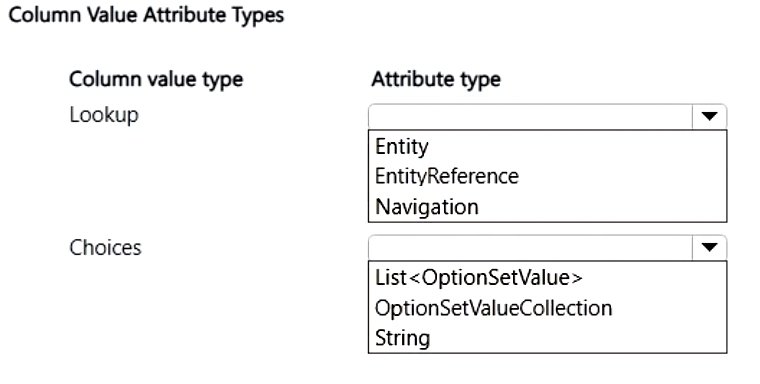
You are creating an application using the Microsoft Dataverse SDK for .NET.
A record must be created by using the column types of lookup and choices.
You need to set the record's column values.
Which attribute type should you use? To answer, select the appropriate options in the answer area.
NOTE: Each correct selection is worth one point.
Explanation: In the Dataverse .NET SDK, lookup columns are set with EntityReference. A multi-select Choices column uses OptionSetValueCollection (not List<OptionSetValue> or String).
Question 64
HOTSPOT
-
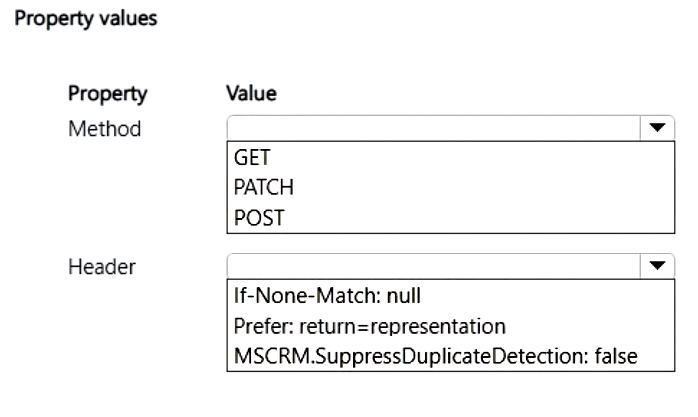
You are composing a request to the Microsoft Dataverse Web API that updates existing account records in Dataverse and returns resulting records in the response.
You need to complete the request.
Which value should you use for each property? To answer, select the appropriate options in the Value for Property area.
NOTE: Each correct selection is worth one point.
Explanation: Updating existing Dataverse records uses the PATCH method. To return the updated entity in the response, include the header 'Prefer: return=representation'.
Question 65
DRAG DROP
-
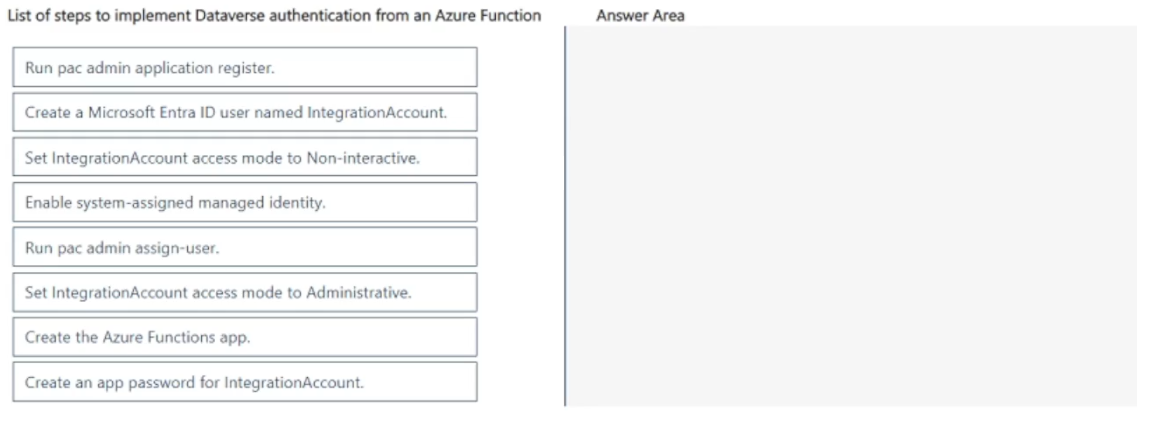
A company plans to deploy an Azure Function that connects to Dataverse on a defined schedule to bulk-update Account data.
Corporate policy discourages password-based authentication if other viable options exist.
You need to implement the function app.
Which three actions should you perform in sequence? To answer, move the appropriate actions from the list of actions to the answer area and arrange them in the correct order.
Show Answer
Correct Answer: Create the Azure Functions app.
Enable system-assigned managed identity.
Run pac admin assign-user.
Explanation: Create the Function App first, then enable its system-assigned managed identity so it can authenticate without passwords. Finally, assign the managed identity as a Dataverse application user with appropriate security roles using pac admin assign-user.
Question 66
You must move an API key between environments by using a solution. You must use an environment variable with a data type of Secret.
You need to create the environment variable.
What must you create first?
A. Application user
B. Certificate
C. Azure Key Vault
D. Client secret
Show Answer
Correct Answer: C
Explanation: A Secret-type environment variable in Microsoft Power Platform stores a reference to a secret in Azure Key Vault rather than the secret value itself. Therefore, you must first create an Azure Key Vault and store the API key there before configuring the environment variable to reference it.
$19
Get all 410 questions with detailed answers and explanations
Instant download HTML + PDF delivered the moment payment clears.
Secure Stripe checkout we never see or store your card details.
7-day refund if files are defective see our refund policy.