This is the free Microsoft DP-700 practice question bank —
70 of 140 total questions, each with a full explanation, free to
read with no signup required. Updated 2026-10-13.
Every answer is verified against official Microsoft documentation —
see our methodology.
Question 1
You have a Fabric workspace named Workspace1.
You need to implement workspace monitoring for Workspace1. The solution must meet the following requirements:
• Ensure that the logs and metrics of the items in Workspace1 are collected automatically.
• Minimize administrative effort.
What should you do?
A. In Workspace1, create a lakehouse and an eventstream.
B. From Workspace settings, add an eventhouse.
C. From Workspace settings, connect a Log Analytics workspace.
D. From Workspace settings, connect an Azure Data Lake Storage Gen2 account.
Show Answer
Correct Answer: C
Explanation: Connect a Log Analytics workspace from Workspace settings. Fabric workspace monitoring automatically collects and exports the workspace’s item logs and metrics there, minimizing administrative effort.
Question 1
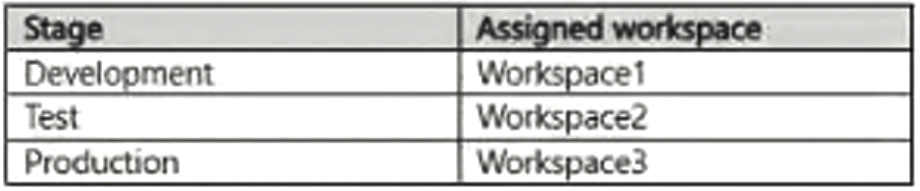
You have a Fabric deployment pipeline that contains the stages shown in the following table.
Workspace1 contains a semantic model named Model1 and a report named Report1. Report1 is bound to Model1.
You modify Report1 and Model1.
You need to deploy the updated Report1 to Test. The solution must meet the following requirements:
• Ensure that Report1 remains bound to Model1 in Test.
• Minimize the number of items deployed
What should you do?
A. Switch to flat list view, select Report1 only, and deploy the selected item.
B. Stay in folder view, select Report1 and Model1, and deploy the selected items.
C. From Development, select Deploy, and then select Test as the target.
D. Switch to flat list view, select Report1, use Select related, and deploy the selected items.
Show Answer
Correct Answer: D
Explanation: Switch to flat list view, select Report1, and use **Select related** before deploying. This includes the semantic model required to preserve Report1’s binding in Test while limiting deployment to the related items. Deploying the entire stage could deploy more items than necessary.
Question 2
You have a Fabric workspace that contains a lakehouse named Lakehouse1. Lakehouse1 contains a table named Table1.
You need to ensure that a user named User1 can view only specific rows in Table1.
What should you do first?
A. Create a security predicate.
B. Create a function.
C. Create a security policy.
D. Grant User1 the SELECT permission for Table1.
Show Answer
Correct Answer: B
Explanation: Row-level security in Fabric SQL endpoints/lakehouses is implemented by first creating an inline table-valued function that defines the filtering logic. That function is then referenced by a security policy to create the security predicate, after which appropriate SELECT permissions are granted. Therefore, the first step is to create the function.
Question 2
You have an Azure subscription that contains a blob storage account named sa1. sa1 contains two files named File1.csv and File2.csv.
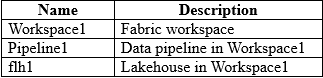
You have a Fabric tenant that contains the items shown in the following table.
You need to configure Pipeline1 to perform the following actions:
• At 2 PM each day, process File1.csv and load the file into flh1.
• At 5 PM each day, process File2.csv and load the file into flh1.
The solution must minimize development effort.
What should you use?
A. a data pipeline trigger
B. a data pipeline schedule
C. a job definition
D. an activator
Show Answer
Correct Answer: A
Explanation: Use two scheduled data pipeline triggers: one at 2 PM passing File1.csv to Pipeline1, and another at 5 PM passing File2.csv. Parameterizing the file name lets the same pipeline load both files into flh1 with minimal development effort.
Question 2
You are developing a data engineering solution in Fabric by using Apache Spark.
You need to monitor the performance of Spark workloads. The solution must meet the following requirements:
• Provide comprehensive information about the performance of the data engineering workloads.
• Identify stages and tasks that run slowly.
• Minimize administrative effort.
What should you use?
A. Spark application logs
B. workspace metrics in Fabric
C. the Spark UI
D. Spark job event logs
Show Answer
Correct Answer: C
Explanation: Use the Spark UI. It provides workload performance details and lets you drill into jobs, stages, and tasks to identify slow-running work. It is integrated into Fabric, so it requires less setup and administration than analyzing Spark logs or event logs.
Question 3
You have a Fabric lakehouse that contains the resources shown in the following table.
You need to use a notebook to query for customers in the United States and load the filtered data into USCustomers. The solution must minimize the number of scripts used.
Which statement should you use?
A. customers.write.format("parquet").mode("append").saveAsTable("USCustomers")
B. customers.write.format("delta").mode("overwrite").save("Tables/USCustomers")
C. customers.write.format("delta").mode("overwrite").saveAsTable("USCustomers")
D. customers.write. format("parquet").mode("append").save("Tables/USCustomers")
Show Answer
Correct Answer: C
Explanation: Use `saveAsTable` to write the filtered DataFrame as a managed lakehouse table without specifying a path. Delta is the appropriate table format, and `overwrite` replaces existing contents so reruns do not duplicate rows.
Question 3
You have two Fabric workspaces named Workspace1 and Workspace2. Workspace1 is assigned to a Fabric capacity that contains a KQL database named DB1. Workspace2 contains a lakehouse named Lakehouse1. Lakehouse1 contains a Delta table named Table1 that is updated every few minutes.
You need to ensure that you can query Table1 from DB1. The solution must ensure that the queries have access to near-real-time (NRT) data.
What should you create?
A. in Workspace2, an eventstream to stream Table1 changes into DB1
B. a data pipeline to copy Table1 into a lakehouse in Workspace1
C. in the Files folder of Lakehouse1, a OneLake shortcut to Table1
D. in DB1, a OneLake shortcut to Table1
Show Answer
Correct Answer: D
Explanation: Create a OneLake shortcut in DB1 to Table1. This lets the KQL database access the lakehouse’s Delta table directly, so queries can use the frequently updated data without copying it or setting up a streaming pipeline.
Question 4
HOTSPOT
-
You have a Fabric workspace named Workspace1 that contains an Azure Data Factory pipeline named Pipeline1.
You need to monitor the execution and activity status of Pipeline1 and automatically email an alert if the pipeline fails. The solution must minimize development and administrative effort.
What should you use to monitor Pipeline1, and what should you use to email the alert? To answer, select the appropriate options in the answer area.
NOTE: Each correct selection is worth one point.
Show Answer
Correct Answer: Monitor Pipeline1: Monitor hub
Email alert: A Microsoft Power Automate flow
Explanation: Fabric Monitor hub is the built-in place to monitor Data Factory pipeline runs and activity status. To minimize development and administration for email notifications, use a Power Automate flow triggered from monitoring/alerts to send email.
Question 4
You have a Fabric workspace named Workspace1 that is connected to a GitHub repository named repo1. Workspace1 contains the items shown in the following table.
You modify Semanticmodel1, Semanticmodel2, and Report2.
You need to commit the changes to repo1.
What is the minimum number of commits you should perform?
A. 1
B. 2
C. 3
D. 4
Show Answer
Correct Answer: B
Explanation: The modified items total 52 MB (26 + 14 + 12 MB), exceeding the 50 MB commit limit for GitHub integration. They must therefore be committed in at least two commits.
Question 5
You have a Fabric workspace named Workspace1 that contains three notebooks named notebook_01, notebook_02, and notebook_03.
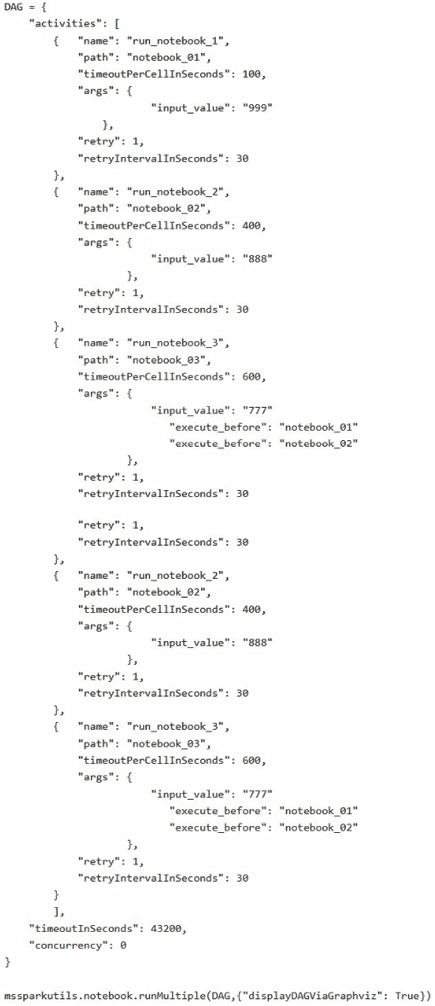
You are building a new notebook in Workspace1 that will contain the following Directed Acyclic Graph (DAG) definition.
You need to modify the DAG definition to meet the following requirements:
• Ensure that notebook_01 and notebook_02 run in parallel.
• Ensure that notebook_02 only runs after the execution of notebook_03 is complete.
How should you modify the DAG definition?
A. Create a second DAG definition. Move notebook_03 and notebook_02 to the new DAG definition.
B. Move the notebook_03 declaration to the top of the DAG definition. Add a concurrency to notebook_02 and notebook_01.
C. Create two stages in the DAG definition. Add notebook_03 to the first stage. Add notebook_01 and notebook_02 to the second stage.
D. Move the declaration of notebook_03 to the top of the DAG definition. Add a new stage that contains notebook_01 and notebook_02.
Show Answer
Correct Answer: C
Explanation: Put notebook_03 in the first stage, then put notebook_01 and notebook_02 together in the second stage. The second stage starts only after the first completes, so notebook_02 waits for notebook_03; the two notebooks in the second stage run in parallel.
$19
Get all 140 questions with detailed answers and explanations
Instant download HTML + PDF delivered the moment payment clears.
Secure Stripe checkout we never see or store your card details.
7-day refund if files are defective see our refund policy.