This is the free Microsoft AI-103 practice question bank —
80 of 147 total questions, each with a full explanation, free to
read with no signup required. Updated 2026-10-13.
Every answer is verified against official Microsoft documentation —
see our methodology.
Question 1
You have an Azure subscription that contains an Azure Language in Foundry Tools service resource named ta1 and a virtual network named vnet1.
You need to ensure that only resources in vnet1 can access ta1.
What should you configure?
A. a network security group (NSG) for vnet1
B. an Azure Language in Foundry Tools service container for ta1
C. Azure Firewall for vnet1
D. the virtual network settings for ta1
Show Answer
Correct Answer: D
Explanation: Configure the virtual network settings on ta1 to restrict access to the specified virtual network, vnet1. An NSG or firewall alone does not set the Language resource’s allowed network access.
Question 1
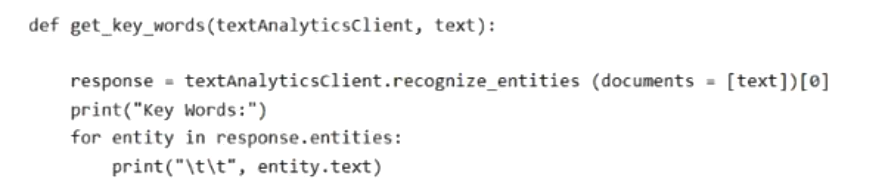
You are developing a text processing solution.
You have the following function.
You call the function and use the following string as the second argument.
Our tour of London included a visit to Buckingham Palace
What will be the output of the function?
A. London and Buckingham Palace only
B. Tour and visit only
C. Our tour of London included a visit to Buckingham Palace
D. London and Tour only
Show Answer
Correct Answer: A
Explanation: The function calls `recognize_entities` and prints each recognized entity. In this sentence, those entities are “London” and “Buckingham Palace.”
Question 2
Case Study -
This is a case study. Case studies are not timed separately from other exam sections. You can use as much exam time as you would like to complete each case study. However, there might be additional case studies or other exam sections. Manage your time to ensure that you can complete all the exam sections in the time provided. Pay attention to the Exam Progress at the top of the screen so you have sufficient time to complete any exam sections that follow this case study.
To answer the case study questions, you will bed to reference information that is provided in the case. Case studies and associated questions might contain exhibits or other resources that provide more information about the scenario described in the case. Information provided in an individual question does not apply to the other questions in the case study.
A Review Screen will appear at the end of this case study. From the Review Screen, you can review and change your answers before you move to the next exam section. After you leave this case study, you will NOT be able to return to it.
To start the case study -
To display the first question in this case study, select the “Next” button. To the left of the question, a menu provides links to information such as business requirements, the existing environment, and problem statements. Please read through all this information before answering any questions. When you are ready to answer a question, select the “Question” button to return to the question.
Overview -
Company Information -
Contoso, Ltd is a multinational retail company that builds, deploys, and manages generative AI and agent-based solutions by using Microsoft Foundry.
Existing Environment -
Identity Environment -
Contoso uses Microsoft Entra ID for identity management, authentication, and authorization capabilities that enable agents to access organizational resources and services.
Contoso recently formed a new AI engineering team named Agent1Dev Team to optimize and maintain existing AI solutions.
The team collaborates with solution architects, DevOps engineers, and security engineers to design, implement. monitor, and secure AI applications.
Contoso also has a team named Agent1Test Team that is responsible for validating AI solutions before the solution deployments.
Generative Environment -
Contoso has a Microsoft Foundry deployment that contains two projects named Project1 and Project2.
Project1 -
Project1 contains a customer support agent named Agent1 that assists customers with product inquiries and troubleshooting requests.
Agent1 has the following configurations:
Agent1 uses a base model deployment.
A safety evaluation pipeline is NOT enabled.
Tool invocation approval workflows are NOT enabled.
Conversation memory constraints are NOT configured.
Agent1 interacts with customers by using digital support channels and answers general questions about Contoso products.
Project1 is deployed to an Azure region located in the European Union (EU).
Agent1Dev Team will use Project1 to optimize and maintain Agent1.
Project2 -
Project2 contains a deployed video generation model. The marketing department at Contoso has access to Project2 and plans to use the model to develop a video creation solution.
Development of the solution is incomplete.
Data Environment -
Contoso stores product-related information in Azure resources that support AI applications.
The Azure environment contains an Azure Blob Storage account named storage1 that stores product detail sheets for all the Contoso products.
The product sheets include specifications, feature descriptions, and product support information that Agent1 can use to answer customer questions. The product sheets are stored in the PDF format.
Problem Statements -
Contoso identifies the following issues:
Agent1 has only general knowledge of the Contoso products.
A recent chat interaction with Agent1 was analyzed for sentiment. The results of the analysis have NOT been processed yet.
Agent1 does NOT use the detailed product information in the product sheets stored in storage1 when responding to customer questions.
The finance department at Contoso reports that vendor invoices must be reviewed manually to ensure that the invoices match the terms defined in the vendor contracts. The invoices contain tables, logos, and varied layouts that make the documents difficult to process consistently.
Requirements -
Planned Changes -
Contoso plans to implement the following changes:
Implement a solution for Project1 that analyzes the vendor invoices by evaluating both the visual layout and the textual content of the invoices, so that the invoice details can be verified against the vendor contract terms.
Update the base model deployment used by Agent1 and standardize the model version to ensure continuity and consistent responses.
Enable Agent1 to retrieve and use the detailed product information from the product sheets stored in storage1.
Implement an indexing solution for the product sheets that Agent1 can use to answer customer questions.
Complete the development of the video creation solution.
Technical Requirements -
Contoso identifies the following technical requirements:
The model deployment used by Agent1 must support scalable, high-throughput generative AI workloads and dynamically scale to handle variable customer support traffic, without requiring reserved throughput capacity.
The product sheets must be processed by using an indexing pipeline that enables semantic and vector search, so that Agent1 can retrieve the relevant product information.
Responses generated by using the product sheet information must be relevant, complete, and accurate.
Agent1 must be able to use the product sheets to answer natural language questions about product details.
The model version used by Agent1 must remain consistent to ensure stable responses.
The data processed by the model must remain within the EU.
Security and Compliance Requirements
Contoso identifies the following security and compliance requirements:
API keys must NOT be used to access Foundry-deployed models.
Access to the Azure resources must follow the principle of least privilege.
The developers at Contoso must authenticate to Microsoft Foundry resources by using Microsoft Entra authentication.
Access to Project1 must be assigned to the members of Agent1Dev Team by using a security group named SC_Agent1_Dev.
Access to Project1 must be assigned to the members of Agent1Test Team by using a security group named SC_Agent1_Test.
Agent1 must never reveal customer information, even if a document that contains customer data is added erroneously to the product sheet repository in storage1.
The product sheets might contain images that include embedded text. Agent1 must be protected from malicious instructions potentially hidden within the images.
Business Requirements -
Contoso identifies the following business requirements:
Users that interact with Agent1 must have a personalized experience in future interactions, including the ability for Agent1 to retain conversation context and recall relevant information from previous interactions.
Agent1 must answer questions only about the products sold by Contoso.
You need to recommend a solution to support the planned changes and technical requirements for Agent1 to use the product information stored in storage1.
What should you include in the recommendation?
A. Azure Translator in Foundry Tools
B. Grounding with Bing Search
C. Azure AI Search
D. Azure Document intelligence in Foundry Tools
Show Answer
Correct Answer: C
Explanation: The requirement is to process PDFs into an indexing pipeline that supports semantic and vector search so the agent can retrieve relevant product information for natural language questions. Azure AI Search provides indexing, vector and semantic search, and is the standard retrieval layer for RAG with Azure AI Foundry. Azure Document Intelligence extracts document content but is not the retrieval/indexing solution. Bing Search grounds on web content, not private Blob Storage, and Translator is unrelated.
Question 2
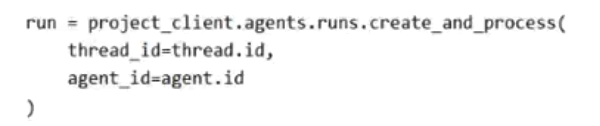
You have a Microsoft Foundry project that contains an agent. The agent has a Model Context Protocol (MCP) tool named kbsearch that queries a knowledge base stored in Azure AI Search.
Some agent runs return answers from the base model without invoking the knowledge base, which results in responses without grounded citations.
You are provided with the following code snippet that runs the agent.
You need to deterministically force the agent to invoke kbsearch on each run.
What should you do?
A. Add the response_format parameter to the create_and_process() method call.
B. Replace create_and_process() method with the create_thread_and_process_run() method.
C. Add the toolset parameter to the create_and_process() method call.
D. Add the tool_choice parameter to the create_and_process() method call.
Show Answer
Correct Answer: D
Explanation: Add the `tool_choice` parameter to the run call and set it to `kbsearch`. This explicitly requires the agent to use that tool; adding a toolset only makes the tool available, while response format and the processing method do not force its invocation.
Question 2
Note: This question is part of a series of questions that present the same scenario. Each question in the series contains a unique solution that might meet the stated goals. Some question sets might have more than one correct solution, while others might not have a correct solution.
After you answer a question in this section, you will NOT be able to return to it. As a result, these questions will not appear in the review screen.
You have an Azure subscription that contains a Microsoft Foundry resource named AI1 and a Content Safety in Foundry Control Plane resource named CS1.
You build an agent that uses AI1 to provide generative answers to specific questions and CS1 to check input and output for objectionable content.
You need to optimize the content filter configurations by running tests on sample questions.
Solution: From Content Safety Studio, you use the Protected material detection feature to run the tests.
Does this meet the requirement?
A. Yes
B. No
Show Answer
Correct Answer: B
Explanation: No. Protected material detection checks text for protected content, such as copyrighted material. It is not the feature for testing sample questions to optimize content filter configurations; use the content moderation testing features instead.
Question 3
You have a Microsoft Foundry project that contains an agent. The agent has a Model Context Protocol (MCP) tool that queries a knowledge base stored in Azure AI Search.
Some agent runs return answers from the base model without invoking the knowledge base, which results in responses without grounded citations.
You are provided with the following code snippet that runs the agent.
You need to add the correct tool _choice parameter to the code to deterministically force the agent to invoke the MCP tool on each run.
What should you add?
A. tool_choice={“required”}
B. tool_choice={“auto”}
C. tool_choice={“type”:“knowledge_base”}
D. tool_choice ={“type”:“mcp”}
Show Answer
Correct Answer: A
Explanation: `required` forces a tool call instead of allowing the agent to answer directly. If the MCP tool is the agent’s only available tool, it will be invoked on each run. The option appears to have a syntax error: in Python, use `tool_choice="required"`, not `tool_choice={"required"}`.
Question 3
Case Study -
This is a case study. Case studies are not timed separately from other exam sections. You can use as much exam time as you would like to complete each case study. However, there might be additional case studies or other exam sections. Manage your time to ensure that you can complete all the exam sections in the time provided. Pay attention to the Exam Progress at the top of the screen so you have sufficient time to complete any exam sections that follow this case study.
To answer the case study questions, you will bed to reference information that is provided in the case. Case studies and associated questions might contain exhibits or other resources that provide more information about the scenario described in the case. Information provided in an individual question does not apply to the other questions in the case study.
A Review Screen will appear at the end of this case study. From the Review Screen, you can review and change your answers before you move to the next exam section. After you leave this case study, you will NOT be able to return to it.
To start the case study -
To display the first question in this case study, select the “Next” button. To the left of the question, a menu provides links to information such as business requirements, the existing environment, and problem statements. Please read through all this information before answering any questions. When you are ready to answer a question, select the “Question” button to return to the question.
Overview -
Company Information -
Contoso, Ltd is a multinational retail company that builds, deploys, and manages generative AI and agent-based solutions by using Microsoft Foundry.
Existing Environment -
Identity Environment -
Contoso uses Microsoft Entra ID for identity management, authentication, and authorization capabilities that enable agents to access organizational resources and services.
Contoso recently formed a new AI engineering team named Agent1Dev Team to optimize and maintain existing AI solutions.
The team collaborates with solution architects, DevOps engineers, and security engineers to design, implement. monitor, and secure AI applications.
Contoso also has a team named Agent1Test Team that is responsible for validating AI solutions before the solution deployments.
Generative Environment -
Contoso has a Microsoft Foundry deployment that contains two projects named Project1 and Project2.
Project1 -
Project1 contains a customer support agent named Agent1 that assists customers with product inquiries and troubleshooting requests.
Agent1 has the following configurations:
Agent1 uses a base model deployment.
A safety evaluation pipeline is NOT enabled.
Tool invocation approval workflows are NOT enabled.
Conversation memory constraints are NOT configured.
Agent1 interacts with customers by using digital support channels and answers general questions about Contoso products.
Project1 is deployed to an Azure region located in the European Union (EU).
Agent1Dev Team will use Project1 to optimize and maintain Agent1.
Project2 -
Project2 contains a deployed video generation model. The marketing department at Contoso has access to Project2 and plans to use the model to develop a video creation solution.
Development of the solution is incomplete.
Data Environment -
Contoso stores product-related information in Azure resources that support AI applications.
The Azure environment contains an Azure Blob Storage account named storage1 that stores product detail sheets for all the Contoso products.
The product sheets include specifications, feature descriptions, and product support information that Agent1 can use to answer customer questions. The product sheets are stored in the PDF format.
Problem Statements -
Contoso identifies the following issues:
Agent1 has only general knowledge of the Contoso products.
A recent chat interaction with Agent1 was analyzed for sentiment. The results of the analysis have NOT been processed yet.
Agent1 does NOT use the detailed product information in the product sheets stored in storage1 when responding to customer questions.
The finance department at Contoso reports that vendor invoices must be reviewed manually to ensure that the invoices match the terms defined in the vendor contracts. The invoices contain tables, logos, and varied layouts that make the documents difficult to process consistently.
Requirements -
Planned Changes -
Contoso plans to implement the following changes:
Implement a solution for Project1 that analyzes the vendor invoices by evaluating both the visual layout and the textual content of the invoices, so that the invoice details can be verified against the vendor contract terms.
Update the base model deployment used by Agent1 and standardize the model version to ensure continuity and consistent responses.
Enable Agent1 to retrieve and use the detailed product information from the product sheets stored in storage1.
Implement an indexing solution for the product sheets that Agent1 can use to answer customer questions.
Complete the development of the video creation solution.
Technical Requirements -
Contoso identifies the following technical requirements:
The model deployment used by Agent1 must support scalable, high-throughput generative AI workloads and dynamically scale to handle variable customer support traffic, without requiring reserved throughput capacity.
The product sheets must be processed by using an indexing pipeline that enables semantic and vector search, so that Agent1 can retrieve the relevant product information.
Responses generated by using the product sheet information must be relevant, complete, and accurate.
Agent1 must be able to use the product sheets to answer natural language questions about product details.
The model version used by Agent1 must remain consistent to ensure stable responses.
The data processed by the model must remain within the EU.
Security and Compliance Requirements
Contoso identifies the following security and compliance requirements:
API keys must NOT be used to access Foundry-deployed models.
Access to the Azure resources must follow the principle of least privilege.
The developers at Contoso must authenticate to Microsoft Foundry resources by using Microsoft Entra authentication.
Access to Project1 must be assigned to the members of Agent1Dev Team by using a security group named SC_Agent1_Dev.
Access to Project1 must be assigned to the members of Agent1Test Team by using a security group named SC_Agent1_Test.
Agent1 must never reveal customer information, even if a document that contains customer data is added erroneously to the product sheet repository in storage1.
The product sheets might contain images that include embedded text. Agent1 must be protected from malicious instructions potentially hidden within the images.
Business Requirements -
Contoso identifies the following business requirements:
Users that interact with Agent1 must have a personalized experience in future interactions, including the ability for Agent1 to retain conversation context and recall relevant information from previous interactions.
Agent1 must answer questions only about the products sold by Contoso.
You need to configure an indexing pipeline for Agent1 to retrieve the relevant product information in storage1. The solution must meet the technical requirement.
Which two built-in skills should you use? Each correct answer presents part of the solution.
NOTE: Each correct selection is worth one point.
A. Azure OpenAI Embedding
B. Entity Recognition
C. Text Split
D. Merge
E. Language Detection
F. key phrase extraction
Show Answer
Correct Answer: A, C
Explanation: To support semantic and vector search, the indexing pipeline should first split PDF content into manageable chunks using the Text Split skill, then generate vector embeddings for those chunks using the Azure OpenAI Embedding skill. This enables retrieval-augmented generation with relevant product information. The other listed skills enrich content but are not required to build a vector index for semantic retrieval.
Question 3
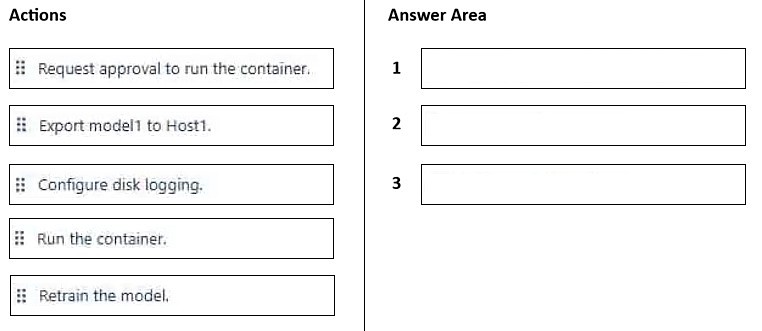
DRAG DROP
You have a Docker host named Host1 that contains a container base image.
You have an Azure subscription that contains a custom speech-to-text model named model1.
You need to run model1 on Host1.
Which three actions should you perform in sequence? To answer, move the appropriate actions from the list of actions to the answer area and arrange them in the correct order.
Show Answer
Correct Answer: 1. Request approval to run the container.
2. Export model1 to Host1.
3. Run the container.
Explanation: Custom Speech containers require approval. After approval, export the model to the Docker host, then start the container with access to the exported model.
Question 4
You have an application named App1 that uses Azure Speech in Foundry Tools to transcribe live calls.
Transcript segments often contain both English and Spanish. App1 sends each segment to Azure Translator in Foundry Tools to translate to another language.
Sometimes, mixed-language segments result in incomplete or incorrect translations.
You need to reduce translation errors. The solution must ensure that the entire transcript is translated successfully.
What should you do before sending the segments to Translator?
A. Use document translation to translate the entire transcript as a single document.
B. Split the mixed-language segments into single-language segments and translate each segment separately.
C. Enable automatic language detection for the translation request.
D. Specify English as the source language in the translation request for all the segments.
Show Answer
Correct Answer: B
Explanation: Azure Translator expects a single source language per translation request. Mixed-language text in one segment can lead to poor or incomplete translations because automatic detection identifies only one source language for the request. Splitting transcript segments into single-language portions before translation allows each portion to be translated accurately and completely. Document translation does not resolve mixed-language content within a segment, and forcing English as the source causes Spanish text to be mistranslated.
Question 4
You have a Microsoft Foundry project that contains three agents as shown in the following table.
You need to orchestrate the agents to ensure that the customer requests meet the following requirements:
Support a deterministic, step-based process that uses conditional branching and shared state across the agents.
Optionally trigger a ticket action based on the triage result.
The solution must minimize development effort.
What should you include in the solution?
A. a workflow
B. threads and runs without a workflow
C. a multi-agent group chat session
D. separate agent runs coordinated in the application code
Show Answer
Correct Answer: A
Explanation: Include a workflow. It provides deterministic, step-based orchestration with conditional branching and shared state, so the triage result can determine whether to invoke the ActionAgent. This also avoids implementing orchestration logic yourself.
$19
Get all 147 questions with detailed answers and explanations
Instant download HTML + PDF delivered the moment payment clears.
Secure Stripe checkout we never see or store your card details.
7-day refund if files are defective see our refund policy.