You are developing an app that will use the Speech and Language APIs.
You need to provision resources for the app. The solution must ensure that each service is accessed by using a single endpoint and credential.
Which type of resource should you create?
A. Azure Language in Foundry Tools
B. Microsoft Foundry service
C. Azure Speech in Foundry Tools
D. Content Safety in Foundry Control Plane
Show Answer
Correct Answer: B
Explanation: Create a Microsoft Foundry service resource. It provides access to multiple AI capabilities, including Speech and Language, through a single endpoint and credential.
Question 33
You are building a web app named App1 that generates responses by using a model deployed to a Microsoft Foundry project named Project1.
Before sending the prompts to the model, App1 must retrieve documents by using Azure AI Search.
You need to integrate Project1 and App1. The solution must meet the following requirements:
Multiple client applications must use the same search configuration.
A security policy must prevent key-based authentication.
Administrative effort must be minimized.
What should you do?
A. Create a custom HTTP connection in Foundry and manually configure Azure AI Search endpoints per application.
B. Configure an Azure AI Search connection in Project1 and reference the connection in each application.
C. Call Azure AI Search directly from each application by using Microsoft Entra authentication.
D. Enable a managed identity for each application and call Azure AI Search directly.
Show Answer
Correct Answer: B
Explanation: Configuring an Azure AI Search connection in the Foundry project centralizes the search configuration so multiple client applications can reuse it. Project connections support Microsoft Entra-based authentication, avoiding key-based authentication, and managing a single shared connection minimizes administrative overhead.
Question 33
You use the Azure Custom Vision service to build a classifier.
After training is complete, you need to evaluate the classifier.
Which two metrics are available for review? Each correct answer presents a complete solution.
NOTE: Each correct selection is worth one point.
A. F-score
B. area under the curve (AUC)
C. precision
D. weighted accuracy
E. recall
Show Answer
Correct Answer: C, E
Explanation: Azure Custom Vision lets you review a classifier’s precision and recall. Precision measures how many of the positive predictions are correct; recall measures how many actual positive examples the classifier finds.
Question 34
DRAG DROP -
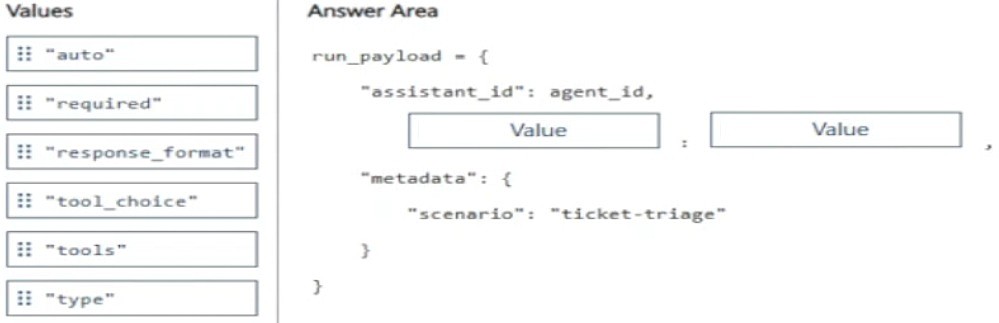
You have a Microsoft Foundry project that contains a deployed ticket-triage agent.
You discover that sometimes the agent responds without calling any tools, even when a tool is required.
You need to ensure that the agent calls a tool during execution.
How should you complete the Python code? To answer, drag the appropriate values to the correct targets. Each value may be used once, more than once, or not at all. You may need to drag the split bar between panes or scroll to view content.
NOTE: Each correct selection is worth one point.
Show Answer
Correct Answer: tool_choice
required
Explanation: Use the `tool_choice` parameter with the value `required` to force the agent to invoke a tool during execution rather than allowing the model to decide automatically.
Question 34
You have an Azure subscription.
You need to build an app that will compare documents for semantic similarity. The solution must meet the following requirements:
• Return numeric vectors that represent the tokens of each document.
• Minimize development effort.
Which Azure OpenAI model should you use?
A. GPT-3.5
B. embeddings
C. GPT-4
D. DALL-E
Show Answer
Correct Answer: B
Explanation: Azure OpenAI embedding models convert text into numeric vectors that capture semantic meaning, enabling documents to be compared for semantic similarity with minimal development effort.
Question 35
You have an Azure AI Search indexer that ingest PDF policy manuals.
Client applications must display page-level citations that have bounding polygons for both text and images.
You need to add a single built-in multimodal content extraction skill to the Azure AI Search skillset. The solution must meet the following requirements:
• Provide text and image location metadata.
• Extract tables that span multiple pages.
What should you add?
A. Document Layout
B. Document Extraction
C. Azure Content Understanding
D. GenAI Prompt
Show Answer
Correct Answer: C
Explanation: Add Azure Content Understanding. It is the built-in multimodal extraction skill suited to extracting text and images with page-level location metadata, including bounding polygons, and handling tables that span multiple pages.
Question 36
You are developing an application that will use Azure AI Search for internal documents.
You need to implement document-level filtering for Azure AI Search.
Which three actions should you include in the solution? Each correct answer presents part of the solution.
NOTE: Each correct selection is worth one point.
A. Add allowed groups to each index entry
B. Create one index per group.
C. Send access tokens from Microsoft Entra ID, with the search request.
D. Retrieve all the groups.
E. Retrieve the group memberships of the user
F. Supply the groups as a filter for the search requests
Show Answer
Correct Answer: A, E, F
Explanation: Add an allowed-groups field to each indexed document, retrieve the searching user’s group memberships, and apply those groups as a filter in the search request. This trims results to documents the user’s groups are authorized to access.
Question 37
HOTSPOT
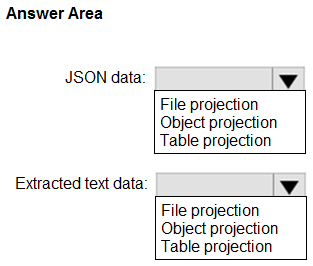
You are creating an enrichment pipeline that will use Azure AI Search. The knowledge store contains unstructured JSON data and the text from scanned PDF documents.
Which projection type should you use for each data type? To answer, select the appropriate options in the answer area.
NOTE: Each correct selection is worth one point.
Explanation: Object projections preserve unstructured content as JSON. Table projections are for structured, tabular data; file projections are for binary files such as images.
Question 38
Note: This section contains one or more sets of questions with the same scenario and problem. Each question presents a unique solution to the problem. You must determine whether the solution meets the stated goals. More than one solution in the set might solve the problem. It is also possible that none of the solutions in the set solve the problem.
After you answer a question in this section, you will NOT be able to return. As a result, these questions do not appear on the Review Screen.
You have a multimodal AI generative model that accepts image uploads and uses extracted image text to generate responses.
You discover that users can upload unsafe images and embed hidden instructions into images to manipulate the model.
You need to implement controls to mitigate the risk.
Solution: You configure image moderation to block unsafe content before processing the images.
Does this meet the goal?
A. Yes
B. No
Show Answer
Correct Answer: B
Explanation: Image moderation can block unsafe visual content, but it does not by itself prevent or neutralize prompt injection via hidden text or embedded instructions extracted from images. Mitigating both unsafe images and embedded instruction attacks requires additional prompt injection protections, so this solution alone does not meet the stated goal.
Question 38
You have a Microsoft Foundry project that contains an agent.
The agent uses Azure Content Understanding in Foundry Too to process vendor onboarding packets. The packs include digital PDFs that contain tables and hyperlinks.
The extracted content is indexed for search and provided to a downstream agent in the Markdown format.
You need to generate a Markdown output that has a layout and a semantic structure optimized for Retrieval Augmented Generation (RAG) workflows.
Which built-in analyzer should you use?
A. prebuilt-documentFieldSchema
B. prebuilt-documentSearch
C. prebuilt-read
D. prebuilt-layout
Show Answer
Correct Answer: B
Explanation: Use **prebuilt-documentSearch**. It is designed for RAG-oriented document processing and produces structured Markdown suitable for indexing and downstream agent retrieval. The other analyzers focus on field extraction, basic reading, or general layout analysis.
$19
Get all 147 questions with detailed answers and explanations
Instant download HTML + PDF delivered the moment payment clears.
Secure Stripe checkout we never see or store your card details.
7-day refund if files are defective see our refund policy.