HOTSPOT
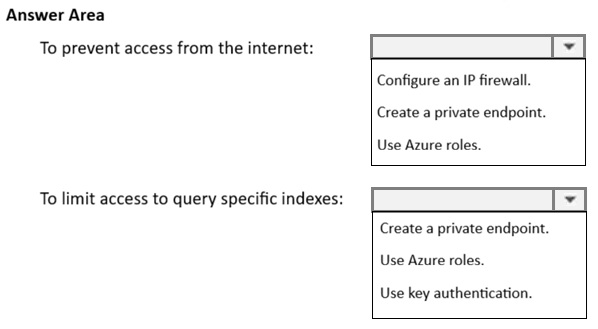
You have an Azure AI Search resource named Search1 that is used by multiple apps hosted in Azure.
You need to secure Search1. The solution must meet the following requirements:
• Prevent access to Search1 from the internet.
• Limit the access of each app to query specific indexes.
What should you do? To answer, select the appropriate options in the answer area.
NOTE: Each correct answer is worth one point.
Show Answer
Correct Answer: To prevent access from the internet: Create a private endpoint.
To limit access to query specific indexes: Use Azure roles.
Explanation: Use a private endpoint and disable public network access for Search1. Assign each app an Azure role scoped to the indexes it is allowed to query.
Question 17
HOTSPOT -
You have a Microsoft Foundry project that contains an agent.
You use a GitHub Actions workflow for CI/CD.
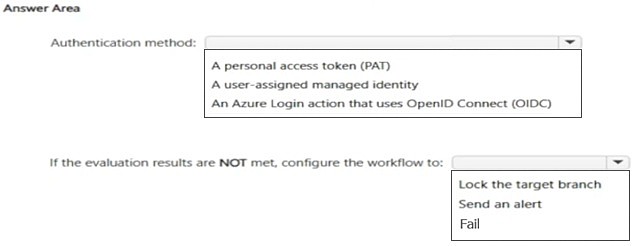
You need to configure the workflow to automatically evaluate the agent when a pull request (PR) is created and prevent branches from merging if the evaluation results do NOT meet the defined thresholds.
How should you configure the workflow? To answer, select the appropriate options in the answer area.
NOTE: Each correct selection is worth one point.
Show Answer
Correct Answer: Authentication method: An Azure Login action that uses OpenID Connect (OIDC)
If the evaluation results are NOT met, configure the workflow to: Fail
Explanation: GitHub Actions should authenticate to Azure using Azure Login with OIDC federation rather than PATs. To prevent PR merges based on evaluation thresholds, the workflow must fail so the required status check blocks the merge.
Question 17
You are building a solution in Azure that will use Azure Language in Foundry Tools service to process sensitive customer data.
You need to ensure that only specific Azure processes can access the Language service. The solution must minimize administrative effort.
What should you include in the solution?
A. Azure Application Gateway
B. a virtual network gateway
C. IPsec rules
D. virtual network rules
Show Answer
Correct Answer: D
Explanation: Use virtual network rules to limit access to the Azure Language service to approved virtual networks and subnets. This provides network-level access control without requiring extra gateway infrastructure.
Question 18
You have a customer support agent built by using the Microsoft Foundry Agent Service. The agent calls an Azure OpenAI model deployment.
During load testing, calls intermittently fail and return an HTTP 429 rate limit exceeded error.
You need to handle throttling to reduce call failures and improve reliability under load. The solution must remain within the service and model limits.
What should you do?
A. Create a new thread and retry the calls immediately.
B. Reduce the number of registered tools.
C. Implement a retry policy that uses exponential backoff and jitter.
D. Spit uploaded content into smaller files.
Show Answer
Correct Answer: C
Explanation: HTTP 429 indicates throttling due to rate limits. The recommended approach is to implement retries with exponential backoff and jitter so retry attempts are spread out, reducing contention while staying within service limits. Creating new threads and retrying immediately can worsen throttling, and reducing registered tools or splitting uploaded files does not address request rate limiting.
Question 18
HOTSPOT
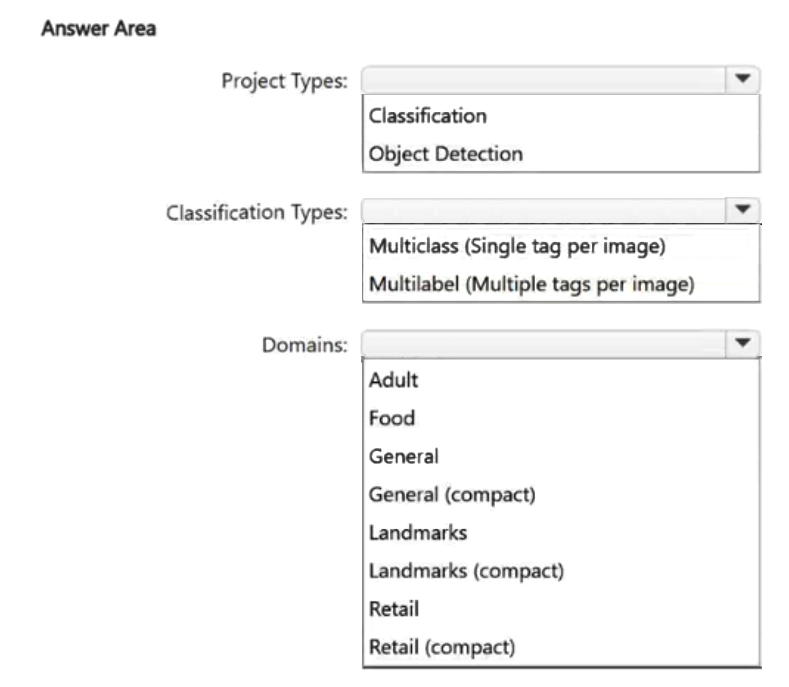
You are building a custom vision model that will be deployed as part of an iOS app.
You have images of cats and dogs. Each image contains either a cat or a dog.
You need to use the Azure Custom Vision service to detect whether the image is of a cat or a dog.
How should you configure the project in the Azure Custom Vision portal? To answer, select the appropriate options in the answer area.
NOTE: Each correct selection is worth one point.
Show Answer
Correct Answer: Project type: Classification
Classification type: Multiclass (single tag per image)
Domain: General (compact)
Explanation: Each image needs one label—cat or dog—not object locations. The compact domain supports exporting the model for use in an iOS app.
Question 19
You have a Microsoft Foundry project that contains an agent. The agent generates summaries from retrieved policy documents.
You need to improve response completeness. The solution must be implemented in the logic of the application code before responses are returned.
What should you do?
A. Add a retry evaluation before the responses are returned.
B. Decrease the value of the max_tokens parameter.
C. Switch to Retrieval Augmented Generation (RAG).
D. Replace the model with a smaller deployment.
Show Answer
Correct Answer: A
Explanation: A retry evaluation implemented in the application logic can assess whether the generated summary is complete and, if necessary, regenerate the response before returning it. Decreasing max_tokens is likely to truncate outputs, switching to RAG addresses retrieval rather than post-generation completeness in application logic, and using a smaller model generally does not improve completeness.
Question 19
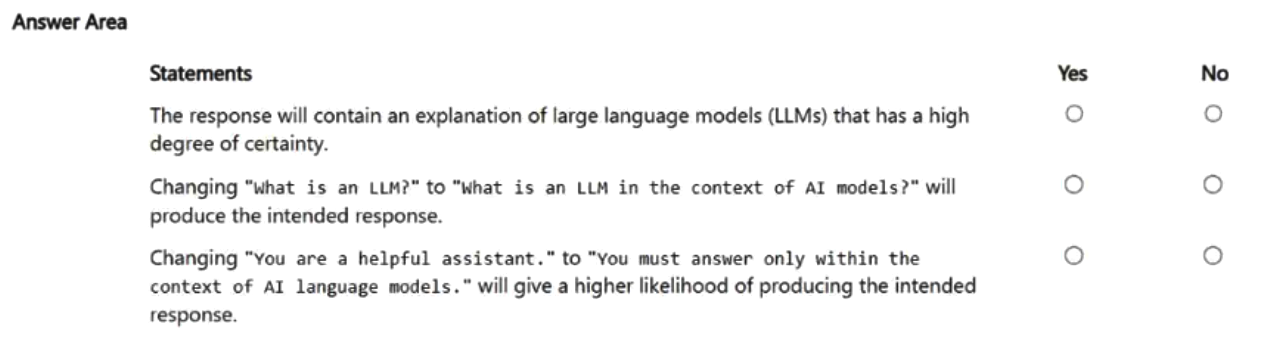
HOTSPOT
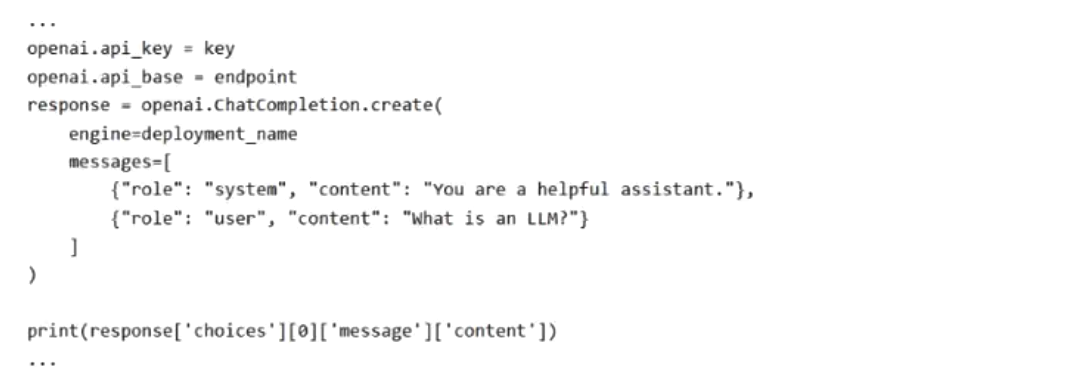
You are building an app that will provide users with definitions of common AI terms.
You create the following Python code.
For each of the following statements, select Yes if the statement is true. Otherwise, select No.
NOTE: Each correct selection is worth point.
Show Answer
Correct Answer: 1. No
2. Yes
3. Yes
Explanation: “LLM” is ambiguous without context, so the first prompt does not reliably produce the intended AI definition. Clarifying the user question or narrowing the system instruction makes that response more likely.
Question 20
Note: This section contains one or more sets of questions with the same scenario and problem. Each question presents a unique solution to the problem. You must determine whether the solution meets the stated goals. More than one solution in the set might solve the problem. It is also possible that none of the solutions in the set solve the problem.
After you answer a question in this section, you will NOT be able to return. As a result, these questions do not appear on the Review Screen.
You have a Microsoft Foundry project that contains an agent. The agent generates summaries from retrieved policy documents.
Users report that some responses omit required regulatory clauses, even when the clauses are present in the retrieved content.
You need to improve response completeness.
Solution: You add a reflection pass that regenerates the response if the required clauses are missing.
Does this meet the goal?
A. Yes
B. No
Show Answer
Correct Answer: A
Explanation: Yes. A reflection pass that checks whether required regulatory clauses are present in the generated summary and regenerates the response if they are missing is a standard technique to improve completeness and reduce omissions, assuming the clauses exist in the retrieved content.
Question 20
You are developing a text processing solution.
You have the following function.
You call the function and use the following string as the second argument.
Our tour of London included a visit to Buckingham Palace
What will be the output of the function?
A. London and Buckingham Palace only
B. Tour and visit only
C. Our tour of London included a visit to Buckingham Palace
D. London and Tour only
Show Answer
Correct Answer: A
Explanation: The function extracts named entities from the text. “London” and “Buckingham Palace” are named entities; the other words are not.
Question 21
You have a Microsoft Foundry project that ingests scanned PDF invoices stored in Azure Blob Storage. Each invoice contains printed fine items and has a table-based layout.
Extracted results are stored as structured JSON and used as grounding data for an agent in a Retrieval Augmented Generation (RAG) solution.
You need to create a single analyzer that meets the following requirements:
Extracts the invoice number, invoice date, vendor name, and total amount across varying templates
Returns confidence scores so that results with confidence below 0.80 can be routed for supervisor review
What should you use?
A. a Foundry agent that has groundedness guardrails enabled to extract invoice fields and confidence scores
B. a custom Azure Content Understanding in Foundry Tools analyzer that defines the required fields as the extracted fields and the returned confidence scores for routing
C. the Azure Content Understanding in Foundry Tools prebuilt-layout analyzer
D. the Azure Content Understanding in Foundry Tools prebuilt-documentSearch analyzer and search.score from the Azure AI Search results for routing
Show Answer
Correct Answer: B
Explanation: A custom Azure Content Understanding analyzer can define the specific invoice fields to extract across varying document templates and returns per-field confidence scores that can be used to route low-confidence extractions for review. A grounded agent is not the correct extraction mechanism, the prebuilt layout analyzer focuses on document structure rather than custom semantic fields, and Azure AI Search relevance scores are not extraction confidence scores.
$19
Get all 147 questions with detailed answers and explanations
Instant download HTML + PDF delivered the moment payment clears.
Secure Stripe checkout we never see or store your card details.
7-day refund if files are defective see our refund policy.