HOTSPOT
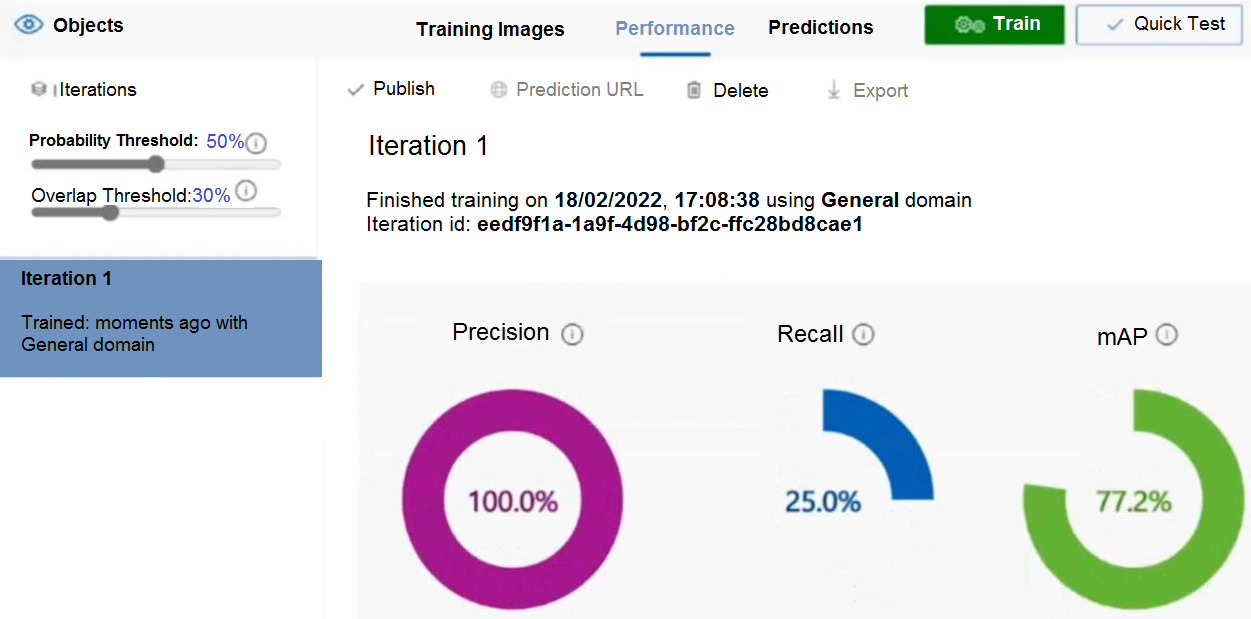
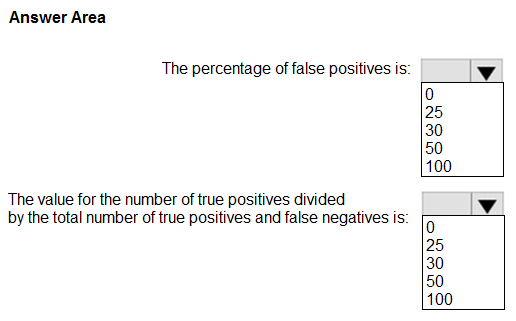
You are building a model to detect objects in images.
The performance of the model based on training data is shown in the following exhibit.
Use the drop-down menus to select the answer choice that completes each statement based on the information presented in the graphic.
NOTE: Each correct selection is worth one point.
Explanation: Precision is 100%, so there are no false positives. The second expression defines recall, shown as 25%.
Question 40
You have a Microsoft Foundry project that contains a customer support agent. The agent calls an internal knowledge API tool before generating responses.
Users report the following issues:
Some requests take more than 15 seconds to complete.
Some responses are incorrect, even when the knowledge API returns the expected data.
You need to inspect individual agent runs to view the ordered sequence of large language model (LLM) calls, tool invocations, and timing information.
Which observability capability should you use?
A. token usage
B. monitoring
C. safety metrics
D. tracing
Show Answer
Correct Answer: D
Explanation: Tracing provides per-run observability with the ordered sequence of LLM calls, tool invocations, and timing information, making it the appropriate capability for diagnosing latency and response issues within individual agent executions. Token usage, monitoring, and safety metrics provide aggregate or specialized telemetry rather than detailed execution traces.
Question 40
HOTSPOT
You have an Azure subscription.
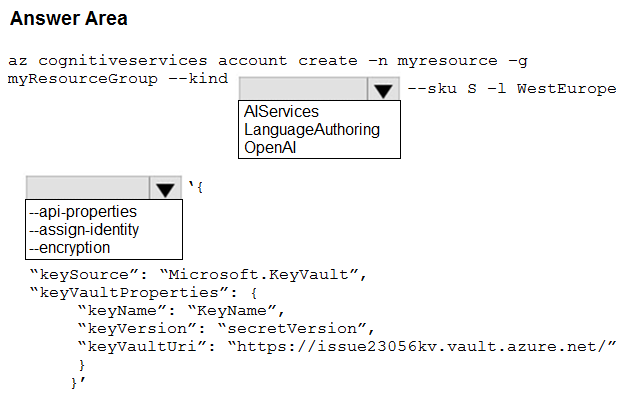
You need to create a new resource that will generate fictional stores in response to user prompts. The solution must ensure that the resource uses a customer-managed key to protect data.
How should you complete the script? To answer, select the appropriate options in the answer area.
NOTE: Each correct selection is worth one point.
Show Answer
Correct Answer: --kind OpenAI
--encryption
Explanation: Azure OpenAI generates text from user prompts. The --encryption parameter accepts the Key Vault key settings for customer-managed encryption.
Question 41
You have a Microsoft Foundry project named Project1 that contains the following:
An OpenAPI tool that calls an external API
A project connection named Connection1 that stores the API key of the external API
When an agent calls the OpenAPI tool, the API returns a 401 unauthorized error, and traces show that the API key header is NOT being sent.
You need to ensure that the OpenAPI tool automatically includes the API key from Connection1 on all requests.
What should you do?
A. Enable identity passthrough so that the tool uses the Microsoft Entra token of the caller.
B. Add the API key header manually to the OpenAPI specification.
C. Configure the tool to use the default connection of Project1.
D. Connect the tool to Connection1.
Show Answer
Correct Answer: D
Explanation: The OpenAPI tool must be associated with the project connection that stores the external API credentials. When the tool is connected to Connection1, Microsoft Foundry injects the stored API key into outgoing requests automatically. Identity passthrough uses Microsoft Entra tokens rather than the external API key, manually adding the API key header is not the correct secret management approach, and using the project's default connection does not ensure the tool uses Connection1.
Question 41
HOTSPOT
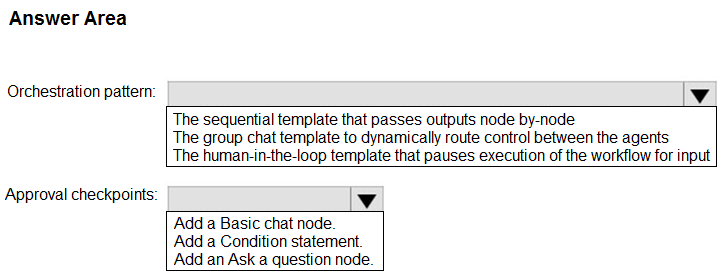
You have a Microsoft Foundry project that contains two agents named PolicyWriter and RskReviewer.
PolicyWriter generates daft updates for customer polices, and RiskReviewer reviews the drafts.
In the visual builder, you need to create a workflow that meets the following requirements:
• Finalizes low-risk updates without manual intervention
• Ensures predictable execution across the agents
• Requires user approval for highs updates
What should you configure? To answer, select the appropriate options in the answer area.
NOTE: Each comet selection is worth one point.
Show Answer
Correct Answer: Orchestration pattern: The sequential template that passes outputs node-by-node
Approval checkpoints: Add a Condition statement.
Explanation: Sequential execution keeps PolicyWriter and RiskReviewer in a predictable order. A condition branches on the review outcome: low-risk updates proceed automatically, while high-risk updates are routed for user approval.
Question 42
HOTSPOT -
You have a Microsoft Foundry project that contains an agent.
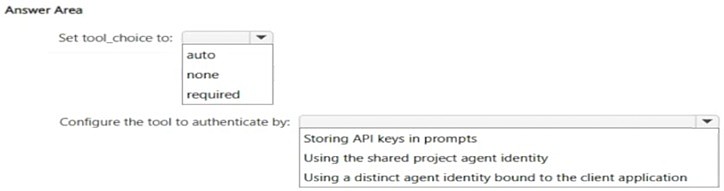
The agent uses tools to retrieve internal content and call external APIs. The agent is configured to let the model decide when to call the tools.
You need to publish the agent for a compliance workflow. The solution must meet the following requirements:
Each workflow run must include a retrieval step before generating a response.
Tool calls must authenticate by using the published agent’s own identity.
Tool access must use an identity isolated from other project resources.
Tool access must use support audit tracing.
What should you do? To answer, select the appropriate options in the answer area.
NOTE: Each correct selection is worth one point.
Show Answer
Correct Answer: Set tool_choice to: required
Configure the tool to authenticate by: Using a distinct agent identity bound to the client application
Explanation: Requiring tool use ensures a retrieval step occurs before response generation. A distinct agent identity provides isolated authentication for tool access and supports auditing, unlike shared identities or embedded API keys.
Question 42
You have an Azure AI Search indexer that ingests PDF policy manuals.
Client applications must display page-level citations that have bounding polygons for both text and images.
You need to add a single built-in multimodal content extraction skill to the Azure AI Search skillset. The solution must meet the following requirements:
• Provide text and image location metadata.
• Extract tables that span multiple pages.
What should you add?
A. Document Extraction
B. Azure Content Understanding in Foundry Tools
C. GenAI Prompt
D. Document Layout
Show Answer
Correct Answer: B
Explanation: Azure Content Understanding in Foundry Tools supports multimodal extraction with text and image location metadata, including bounding polygons, and can treat tables spanning multiple pages as a single extracted structure.
Question 43
You have a Microsoft Foundry project that contains a high-traffic agent.
After a recent update, operational costs increase significantly.
Monitoring confirms that the volume of user traffic to the agent remains unchanged.
You suspect that changes to the request or response characteristics are causing the increase. You need to identify whether the additional costs are driven by the model input size, the model output size, or expanded tool usage.
Which observability capability should you use?
A. latency
B. evaluation metrics
C. run success rate
D. token usage
Show Answer
Correct Answer: D
Explanation: Token usage observability breaks down model input tokens, output tokens, and tool-related token consumption, which directly correlates with model inference costs. It allows you to determine whether increased costs are caused by larger prompts, larger responses, or expanded tool usage. Latency, evaluation metrics, and run success rate do not identify the source of token-driven cost increases.
Question 43
HOTSPOT
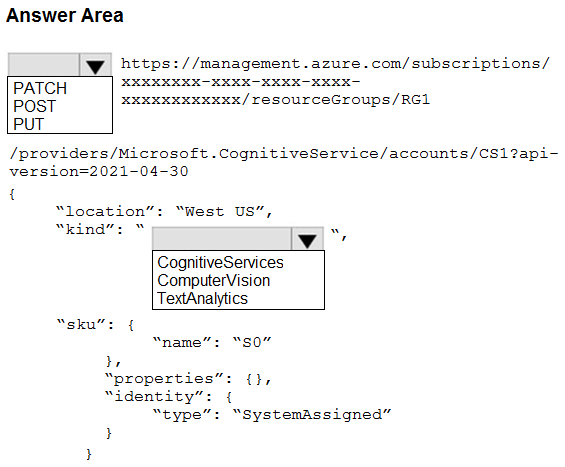
You need to create a new resource that will be used to perform sentiment analysis and optical character recognition (OCR). The solution must meet the following requirements:
• Use a single key and endpoint to access multiple services.
• Consolidate billing for future services that you might use.
• Support the use of Azure Vision in Foundry Tools in the future.
How should you complete the HTTP request to create the new resource? To answer, select the appropriate options in the answer area.
NOTE: Each correct selection is worth one point.
Show Answer
Correct Answer: HTTP method: PUT
kind: CognitiveServices
Explanation: PUT creates the resource at the specified Azure Resource Manager URL. CognitiveServices provides a multi-service resource with one key and endpoint and consolidated billing, including support for Vision.
Question 44
You have a Microsoft Foundry project that serves a high-volume chat app.
Most requests are simple FAQs, but some require advanced reasoning.
You need to reduce costs and latency for common queries, without degrading the quality of the responses to complex questions.
What should you do?
A. Route all the requests to a smaller model.
B. Use a model cascade that routes the requests to different models.
C. Increase the value of the max_tokens parameter for all the requests.
D. Route all the requests to the most capable model.
Show Answer
Correct Answer: B
Explanation: A model cascade routes straightforward FAQ requests to a smaller, faster, lower-cost model and sends only more complex requests to a more capable model. This reduces latency and cost for common queries while preserving response quality for advanced reasoning tasks. Using only a small model can reduce quality on difficult questions, using only the largest model increases cost and latency, and increasing max_tokens does not achieve the stated goal.
$19
Get all 147 questions with detailed answers and explanations
Instant download HTML + PDF delivered the moment payment clears.
Secure Stripe checkout we never see or store your card details.
7-day refund if files are defective see our refund policy.