A financial company is training a generative AI model to predict outcomes of loan applications. The training dataset is small. The dataset categorizes loan applicants as “younger-aged,” “middle-aged,” or “older-aged.” Most individuals in the dataset are characterized as "middle-aged."
The company removes the age range feature from the training dataset.
Which model behavior will likely happen as a result of this change to the dataset?
A. The model will inaccurately predict outcomes for younger and older age groups.
B. The model will require less training data.
C. The model will predict accurate outcomes for only younger age groups.
D. The model will accurately predict outcomes for all ages.
Show Answer
Correct Answer: A
Explanation: Removing the age feature does not solve the underlying issue of a small, imbalanced dataset. Age may contain predictive information, and without it the model is less able to distinguish patterns affecting different age groups. Because the dataset is dominated by middle-aged applicants, the model is likely to generalize poorly for the underrepresented younger and older groups, leading to less accurate predictions for those populations.
Question 42
HOTSPOT
-
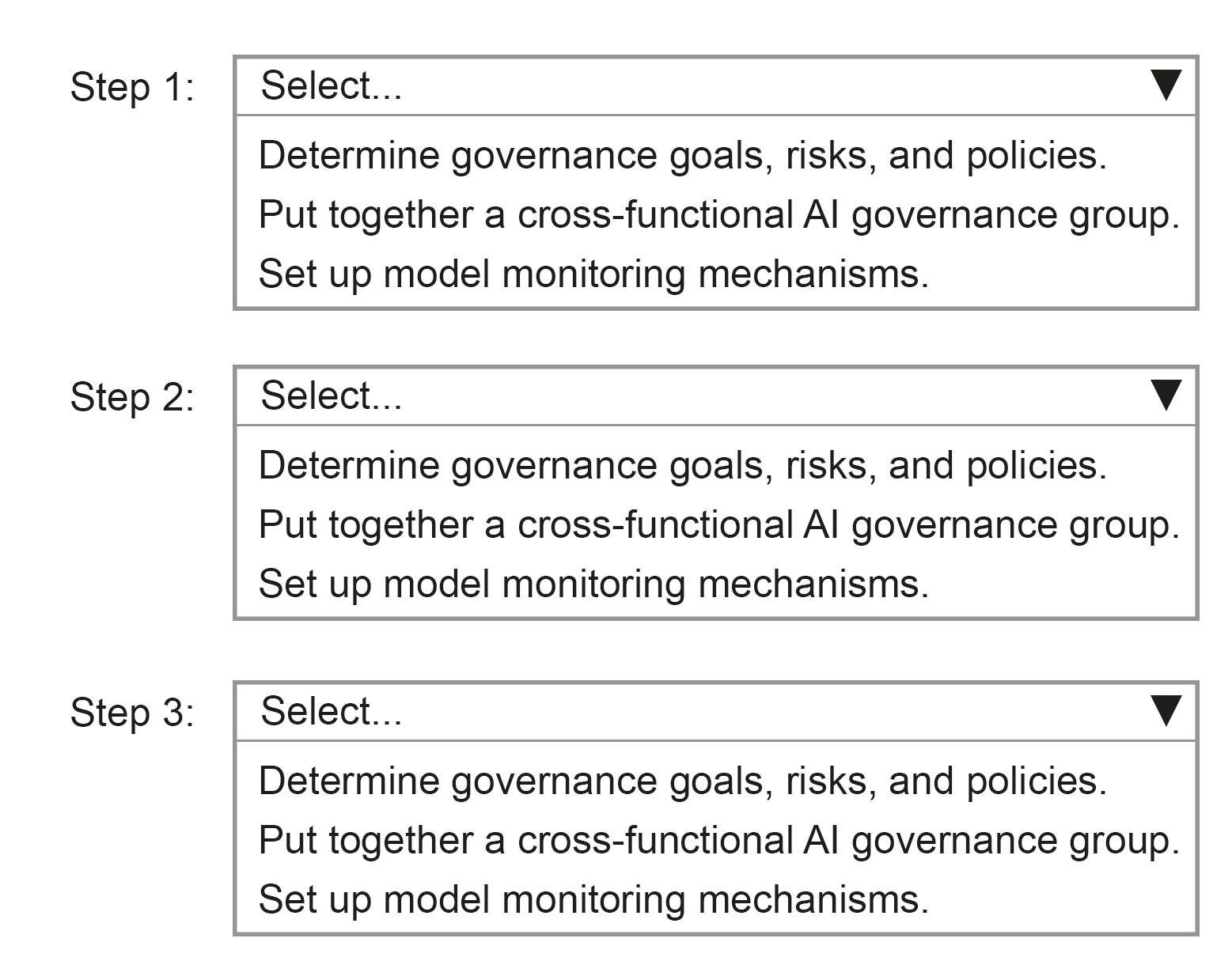
A company is building an AI assistant application. The company must implement a core governance process for the application development project. The company must ensure that the application aligns with responsible AI practices.
Select and order the steps from the following list to correctly describe the implementation of a core governance process for this use case. Select each step one time.
Show Answer
Correct Answer: Step 1: Put together a cross-functional AI governance group.
Step 2: Determine governance goals, risks, and policies.
Step 3: Set up model monitoring mechanisms.
Explanation: Establish the governance body first, then define governance objectives, risks, and policies, and finally implement ongoing monitoring to ensure compliance and responsible AI over time.
Question 43
A company is using a large collection of web data to produce a large language model (LLM). The company completes a random initialization of the model’s weights. Next, the company fits the model to the data through a language objective modelling function.
Which stage of the model training process does this scenario describe?
A. Fine-tuning
B. Pre-training
C. Model selection
D. Deployment
Show Answer
Correct Answer: B
Explanation: The scenario describes training a language model from scratch: the model is randomly initialized and then trained on a large corpus using a language modeling objective. This is the pre-training stage. Fine-tuning occurs afterward on a smaller, task-specific dataset; model selection is choosing an architecture or configuration; deployment is making the trained model available for use.
Question 44
A company uses an Amazon Bedrock large language model (LLM) in an application. During testing, the company observes different outputs from the same input.
What is the MOST likely cause of this issue?
A. The LLM is acting in a nondeterministic way.
B. The guardrails of the LLM are not configured properly.
C. The LLM has security vulnerabilities.
D. The LLM is acting in a deterministic way.
Show Answer
Correct Answer: A
Explanation: Large language models typically use probabilistic token sampling during generation, so the same prompt can produce different outputs across multiple invocations unless configured for deterministic decoding (for example, with temperature set to 0 and controlled settings). This behavior is due to nondeterminism, not guardrails or security vulnerabilities.
Question 45
A company wants to improve a large language model (LLM) for content moderation within 3 months. The company wants the model to moderate content according to the company's values and ethics. The LLM must also be able to handle emerging trends and new types of problematic content.
Which solution will meet these requirements?
A. Conduct continuous pre-training on a large amount of text-based internet content.
B. Create a high quality dataset of historical moderation decisions.
C. Fine-tune the LLM on a diverse set of general ethical guidelines from various sources.
D. Conduct reinforcement learning from human feedback (RLHF) by using real-time input from skilled moderators.
Show Answer
Correct Answer: D
Explanation: RLHF using skilled moderators directly aligns the model with the company's values and moderation policies while allowing ongoing incorporation of feedback about emerging trends and new forms of problematic content. Continuous pretraining on internet text does not align behavior to company-specific values, historical decisions alone are static, and general ethical fine-tuning is less tailored and less adaptable.
Question 46
Which outcome is a result of increasing model transparency?
A. Reduced need for model validation steps
B. Elimination of regulatory compliance monitoring requirements
C. Automatic removal of all bias from model predictions
D. Enhanced ability to identify bias and improve model governance
Show Answer
Correct Answer: D
Explanation: Increasing model transparency improves understanding of how a model makes decisions, making it easier to detect bias, assess fairness, audit behavior, and strengthen governance. Transparency does not eliminate bias, remove the need for validation, or eliminate regulatory compliance obligations.
Question 47
A company is using a foundation model (FM) to generate creative marketing slogans for various products. The company wants to reuse a standard template with common instructions when generating slogans for different products. However, the company needs to add short descriptions for each product.
Which Amazon Bedrock solution will meet these requirements?
A. Prompt management
B. Knowledge Bases
C. Model evaluation
D. Cross-region inference
Show Answer
Correct Answer: A
Explanation: Amazon Bedrock Prompt management is designed to create reusable prompt templates with variables that can be filled at runtime, allowing a standard instruction template to be reused while inserting different product descriptions for each request.
Question 48
A company has developed a neural network model to replace an existing decision tree model. The neural network model has a higher prediction accuracy compared to the decision tree model. However, the neural network model’s decision process is not as explainable as the decision tree model’s decision process.
Which tradeoff is the company making by adopting the neural network model?
A. Higher compliance for lower interpretability
B. Higher performance for lower portability
C. Higher performance for lower interpretability
D. Higher portability for lower interpretability
Show Answer
Correct Answer: C
Explanation: The neural network provides higher prediction accuracy (better performance) but is less explainable than the decision tree, meaning the company is trading interpretability for performance.
Question 49
Which AWS service creates business intelligence reports and automatically generates executive summaries based on data that users provide?
A. Amazon Q in QuickSight
B. Amazon Rekognition
C. Amazon Textract
D. Amazon Polly
Show Answer
Correct Answer: A
Explanation: Amazon Q in QuickSight provides generative business intelligence capabilities, including creating BI reports, answering questions about data, and automatically generating executive summaries and narrative insights from user-provided data. Rekognition analyzes images and video, Textract extracts text from documents, and Polly converts text to speech.
Question 50
A company wants to use its documents as a knowledge base for a large language model (LLM) in a Retrieval Augmented Generation (RAG) solution.
Which solution will meet these requirements?
A. Encrypt each document with encryption keys.
B. Create embeddings from document chunks.
C. Label the document data with metadata.
D. Generate one-hot encoding for each document
Show Answer
Correct Answer: B
Explanation: Retrieval-Augmented Generation (RAG) relies on converting document chunks into vector embeddings so that semantically relevant content can be retrieved for the LLM at query time. Encryption, metadata labeling, and one-hot encoding do not provide the semantic vector representations needed for similarity search.
$19
Get all 446 questions with detailed answers and explanations
Instant download HTML + PDF delivered the moment payment clears.
Secure Stripe checkout we never see or store your card details.
7-day refund if files are defective see our refund policy.