A company wants to use an ML model to analyze customer reviews on social media. The model must determine if each review has a neutral, positive, or negative sentiment.
Which model evaluation strategy will meet these requirements?
A. Open-ended generation
B. Text summarization
C. Machine translation
D. Classification
Show Answer
Correct Answer: D
Explanation: The task is sentiment analysis with predefined labels (positive, negative, neutral). This is a multiclass text classification problem, where the model assigns each review to one of the specified sentiment categories.
Question 136
Sentiment analysis is a subset of which broader field of AI?
A. Computer vision
B. Robotics
C. Natural language processing (NLP)
D. Time series forecasting
Show Answer
Correct Answer: C
Explanation: Sentiment analysis focuses on identifying opinions or emotions expressed in text, such as positive, negative, or neutral sentiment. This is a core task within natural language processing (NLP), which deals with understanding and processing human language.
Question 137
HOTSPOT
-
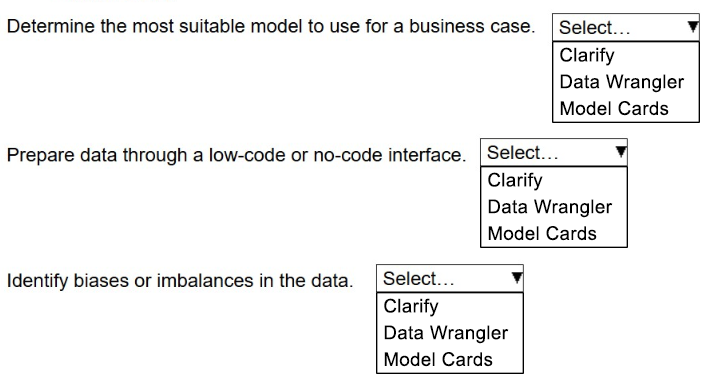
A company is building an AI solution by using Amazon SageMaker AI. The company wants to use SageMaker AI features to facilitate application development.
Select the correct SageMaker AI feature from the following list for each use case. Select each feature one time.
Show Answer
Correct Answer: Determine the most suitable model to use for a business case — Model Cards
Prepare data through a low-code or no-code interface — Data Wrangler
Identify biases or imbalances in the data — Clarify
Explanation: Model Cards document model characteristics and intended use to help assess suitability. Data Wrangler provides low-code/no-code data preparation. SageMaker Clarify detects bias and data imbalance and explains model predictions.
Question 138
An AI practitioner is writing software code. The AI practitioner wants to quickly develop a test case and create documentation for the code.
Which solution will meet these requirements with the LEAST effort?
A. Upload the code to an online coding assistant.
B. Develop an application to use foundation models (FMs).
C. Use Amazon Q Developer in an integrated development environment (IDE).
D. Research and write test cases. Then, create test cases and add documentation.
Show Answer
Correct Answer: C
Explanation: Amazon Q Developer integrates directly with supported IDEs and can generate unit tests, explain code, and create documentation with minimal setup and effort. Building an application with foundation models requires substantially more work, uploading code to a generic online assistant is less integrated and may not provide the same workflow, and manually writing tests and documentation requires the most effort.
Question 139
A company wants to build an ML model to detect abnormal patterns in sensor data. The company does not have labeled data for training.
Which ML method will meet these requirements?
A. Linear regression
B. Classification
C. Decision tree
D. Autoencoders
Show Answer
Correct Answer: D
Explanation: The requirement is anomaly detection without labeled training data, which is an unsupervised learning problem. Autoencoders learn the normal structure of the sensor data by reconstructing inputs; anomalous patterns typically produce higher reconstruction error and can be flagged. Linear regression predicts continuous values, while classification and standard decision trees are supervised methods that require labeled data.
Question 140
A company is training ML models on datasets. The datasets contain some classes that have more examples than other classes. The company wants to measure how well the model balances detecting and labeling the classes.
Which metric should the company use?
A. Accuracy
B. Recall
C. Precision
D. F1 score
Show Answer
Correct Answer: D
Explanation: F1 score is the harmonic mean of precision and recall, making it a better metric than accuracy for imbalanced class distributions when you want to balance detecting instances (recall) and correctly labeling them (precision). It is commonly used to evaluate classification performance on imbalanced datasets.
Question 141
A financial company uses a generative AI model to assign credit limits to new customers. The company wants to make the decision-making process of the model more transparent to its customers.
Which solution meets these requirements?
A. Use a rule-based system instead of an ML model.
B. Apply explainable AI techniques to show customers which factors influenced the model’s decision.
C. Develop an interactive UI for customers and provide clear technical explanations about the system.
D. Increase the accuracy of the model to reduce the need for transparency.
Show Answer
Correct Answer: B
Explanation: Explainable AI (XAI) techniques are specifically designed to improve transparency by providing understandable explanations of which input features and factors influenced a model's decision. This addresses the requirement to make credit limit decisions more transparent to customers. Replacing the model with a rule-based system is unnecessary, a UI alone does not explain model reasoning, and improving accuracy does not provide transparency.
Question 142
A company is using an Amazon Nova Canvas model to generate images. The model generates images successfully.
The company needs to prevent the model from including specific items in the generated images.
Which solution will meet this requirement?
A. Use a higher temperature value.
B. Use a more detailed prompt.
C. Use a negative prompt.
D. Use another foundation model (FM).
Show Answer
Correct Answer: C
Explanation: Amazon Nova Canvas supports negative prompts to specify elements that should be excluded from generated images. Increasing temperature changes randomness, a more detailed prompt does not explicitly forbid unwanted content, and switching foundation models is unnecessary because this capability is already supported.
Question 143
HOTSPOT
-
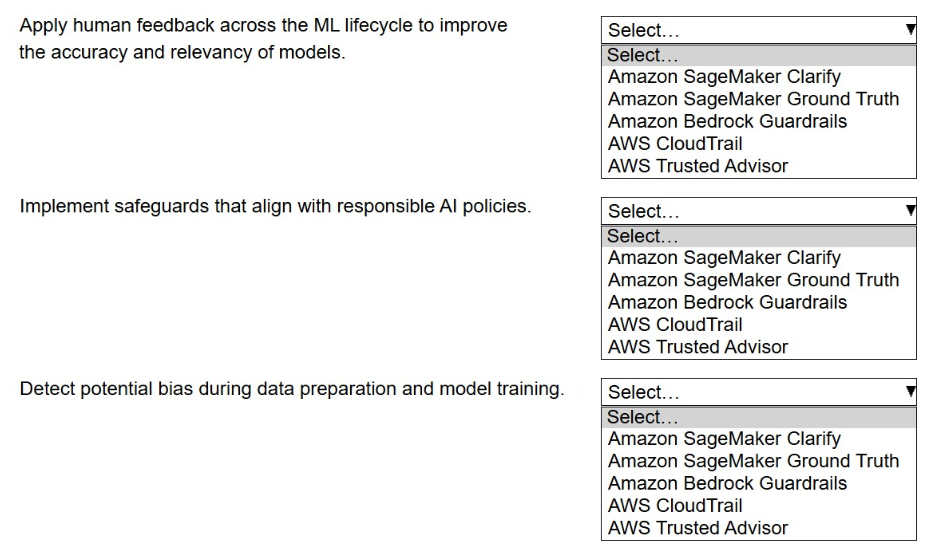
Select the correct AWS service or tool from the following list for each use case. Select each AWS service or tool one time or not at all.
Show Answer
Correct Answer: Apply human feedback: Amazon SageMaker Ground Truth
Implement safeguards: Amazon Bedrock Guardrails
Detect bias: Amazon SageMaker Clarify
Explanation: Ground Truth supports human-in-the-loop labeling and feedback. Bedrock Guardrails enforces responsible AI safety policies. SageMaker Clarify detects bias and provides explainability during data preparation and model evaluation.
Question 144
A financial company is developing a generative AI application for loan approval decisions. The company needs the application output to be responsible and fair.
Which solution meets these requirements?
A. Review the training data to check for biases. Include data from all demographics in the training data.
B. Use a deep learning model with many hidden layers.
C. Keep the model’s decision-making process a secret to protect proprietary algorithms.
D. Continuously monitor the model’s performance on a static test dataset
Show Answer
Correct Answer: A
Explanation: Responsible and fair AI for loan approval requires identifying and mitigating bias in the training data. Reviewing the dataset for bias and ensuring appropriate representation across demographics helps reduce unfair outcomes. Using a deeper model does not improve fairness, hiding decision-making reduces transparency, and monitoring only on a static test set is insufficient for ensuring ongoing fairness.
$19
Get all 446 questions with detailed answers and explanations
Instant download HTML + PDF delivered the moment payment clears.
Secure Stripe checkout we never see or store your card details.
7-day refund if files are defective see our refund policy.