HOTSPOT
-
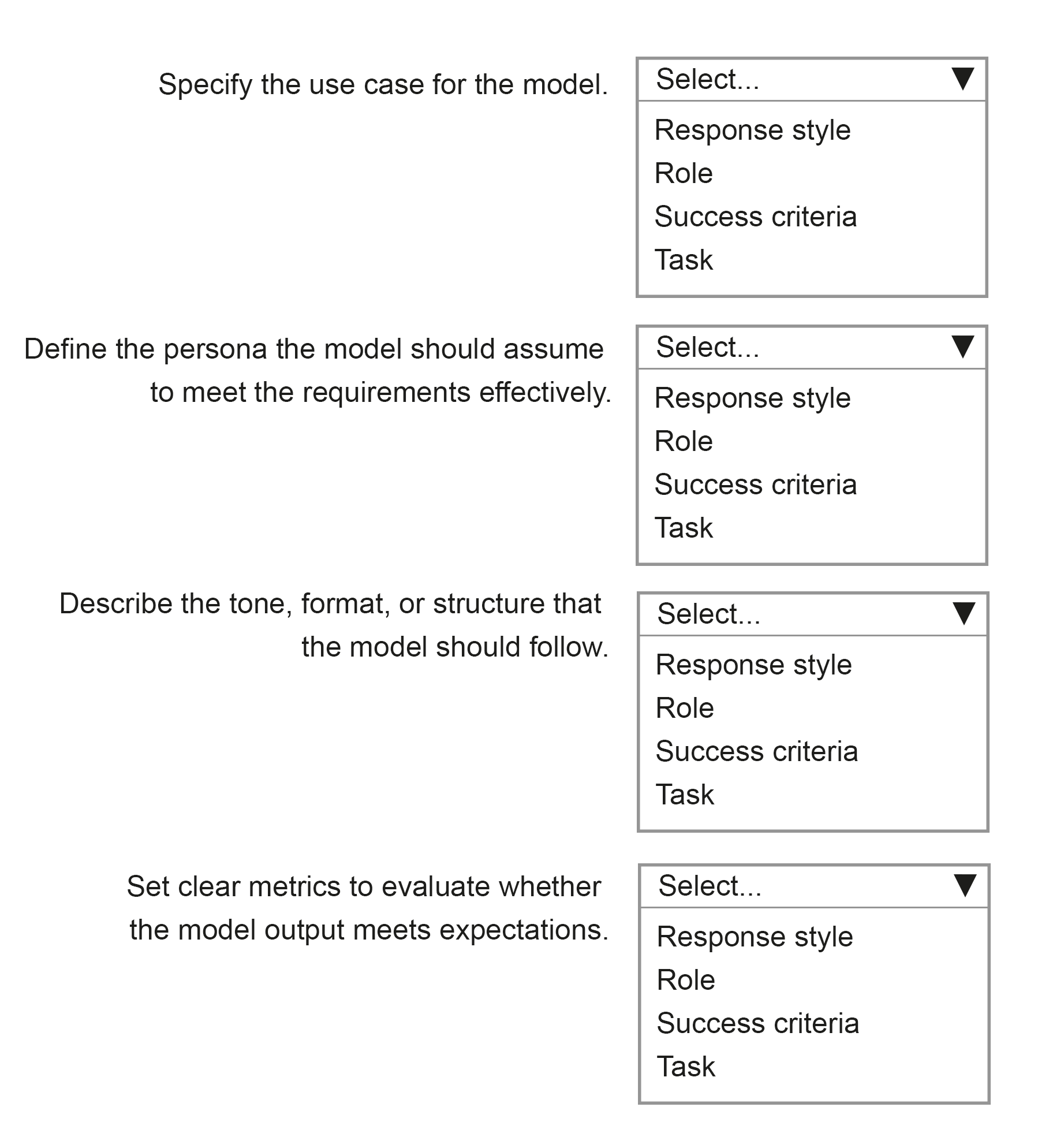
An AI practitioner is using an Amazon Nova text model. The AI practitioner wants to apply prompt engineering techniques to ensure that prompts support an iterative refinement process.
Select the correct prompt design component from the following list for each definition. Select each prompt design component one time.
Show Answer
Correct Answer: Task
Role
Response style
Success criteria
Explanation: The use case maps to the task, the persona maps to the role, the desired tone/format maps to response style, and evaluation metrics map to success criteria.
Question 32
Which strategy will evaluate the performance of a foundation model (FM) in real-world applications?
A. Conducting A/B testing with users in a controlled environment
B. Human evaluation by subject matter experts
C. Measuring the model’s accuracy on a training dataset
D. Analysis of the model’s internal representations and attention patterns
Show Answer
Correct Answer: A
Explanation: A/B testing with users evaluates a foundation model in an application under realistic usage by comparing variants on user-facing outcomes and business or task metrics. Human expert evaluation is valuable but does not by itself measure production performance in real-world deployment. Accuracy on the training set is not a meaningful evaluation of generalization, and inspecting internal representations is an analysis technique rather than an application-level performance evaluation.
Question 33
A financial company uses an ML model to detect potentially fraudulent transactions. The company needs to ensure that some types of predictions receive review by human analysts before the company acts upon the predictions.
Which AWS solution will meet this requirement?
A. Amazon SageMaker Clarify
B. Amazon SageMaker Ground Truth
C. Amazon Augmented AI (Amazon A2I)
D. Amazon SageMaker Model Monitor
Show Answer
Correct Answer: C
Explanation: Amazon Augmented AI (Amazon A2I) provides human-in-the-loop review workflows for machine learning predictions. You can configure conditions such as low-confidence or specific prediction categories to route results to human reviewers before any action is taken. SageMaker Clarify explains and detects bias, Ground Truth is for data labeling, and Model Monitor detects data/model quality drift in production.
Question 34
A company runs an application on servers in an Amazon VPC. The company’s application uses Amazon Bedrock APIs for AI features. The company does not want API calls to travel across the public internet.
Which solution will meet this requirement?
A. Use AWS PrivateLink to establish a private connection between the Amazon VPC and Amazon Bedrock.
B. Sign API requests by using an access key ID and a secret access key that is associated with an IAM principal.
C. Move the application to an on-premises server. Make API calls to the public endpoint of Amazon Bedrock.
D. Encrypt the data in transit from clients to the APIs that have been implemented in the Amazon VPC. Encrypt the data in transit for API calls from the Amazon VPC to Amazon Bedrock.
Show Answer
Correct Answer: A
Explanation: AWS PrivateLink provides private connectivity from resources in an Amazon VPC to supported AWS services, including Amazon Bedrock via interface VPC endpoints, so API traffic stays on the AWS network and does not traverse the public internet. Signing requests with IAM credentials does not change the network path, moving on premises still uses public endpoints, and encryption protects data but does not prevent internet traversal.
Question 35
A company is deploying a new AI application to generate content for internal users.
Which strategy will make the application output more deterministic?
A. Decreasing the temperature
B. Increasing the learning rate
C. Setting stop sequences
D. Setting the token count
Show Answer
Correct Answer: A
Explanation: Decreasing the temperature reduces randomness during token sampling, making the model's outputs more consistent and deterministic. Increasing the learning rate is a training parameter, not an inference setting. Stop sequences only define where generation ends, and token count limits output length rather than determinism.
Question 36
A company is building a large language model (LLM)-based AI assistant to support service agents by automatically managing customer inquiries. The company wants to reduce the effort that customer service agents require during support calls.
The company needs to select a metric to evaluate the AI assistant against one of the company’s business objectives.
Which metric will meet these requirements?
A. Website engagement rate
B. Average call duration
C. Agent attrition rate
D. First contact resolution rate
Show Answer
Correct Answer: B
Explanation: The stated business objective is to reduce the effort customer service agents require during support calls. Average call duration (or average handle time) is the metric most directly tied to agent effort during each interaction. An effective AI assistant that helps agents find information and respond faster should reduce call duration. Website engagement is unrelated, agent attrition is influenced by many long-term factors, and first contact resolution measures customer issue resolution rather than agent effort.
Question 37
A company wants to implement a single environment for both data and AI development. Developers across different teams must be able to access the environment and work together. The developers must be able to build and share models and generative AI applications securely in the environment.
Which AWS solution will meet these requirements?
A. Amazon Lex
B. Amazon SageMaker Unified Studio
C. Amazon Bedrock PartyRock
D. Amazon Q Developer
Show Answer
Correct Answer: B
Explanation: Amazon SageMaker Unified Studio provides a unified, governed environment for data, analytics, AI, and machine learning development. It enables multiple teams to securely collaborate, build and share ML models, and develop generative AI applications within a single workspace. Amazon Lex is for conversational interfaces, PartyRock is a no-code GenAI app playground rather than a collaborative enterprise development environment, and Amazon Q Developer is an AI coding assistant, not a unified development studio.
Question 38
A company plans to build an AI model for the company’s global customer base. The company wants to train the model on a dataset that reflects user diversity.
Which action will meet this requirement?
A. Balance class representation in the dataset.
B. Use a regional dataset with complete data.
C. Oversample majority class data.
D. Drop minority class data records.
Show Answer
Correct Answer: A
Explanation: Balancing class representation helps ensure the training dataset better reflects the diversity of the user population and reduces bias toward overrepresented groups. Using only a regional dataset limits diversity, while oversampling the majority class or dropping minority records increases imbalance.
Question 39
A company wants to deploy a secure AI system with controlled access. The system must allow only authorized personnel to access model training data.
Which AWS service will meet these requirements?
A. AWS Key Management System (AWS KMS)
B. Amazon EMR
C. AWS Identity and Access Management (IAM)
D. Amazon Redshift
Show Answer
Correct Answer: C
Explanation: AWS Identity and Access Management (IAM) controls authentication and authorization for AWS resources, allowing only authorized users, groups, or roles to access model training data. AWS KMS manages encryption keys rather than user access, Amazon EMR is a big data processing service, and Amazon Redshift is a data warehouse.
Question 40
Sometimes generative AI models generate data unrelated to the input or the task.
Which term is used for this disadvantage of using generative AI for business problems?
A. Interpretability
B. Hallucinations
C. Data bias
D. Nondeterminism
Show Answer
Correct Answer: B
Explanation: Hallucinations are outputs where a generative AI model produces fabricated, irrelevant, or unsupported content unrelated to the input or task. Nondeterminism refers to the model producing different valid outputs for the same prompt across runs, not necessarily unrelated or false content. Interpretability concerns understanding how a model reaches its outputs, and data bias refers to systematic skew introduced by training data.
$19
Get all 446 questions with detailed answers and explanations
Instant download HTML + PDF delivered the moment payment clears.
Secure Stripe checkout we never see or store your card details.
7-day refund if files are defective see our refund policy.