A company is evaluating several large language models (LLMs) for a text summarization task. The company needs to select a metric to evaluate the quality of the summaries that the LLMs generate.
Which metric will meet this requirement?
A. Recall
B. Area under the ROC curve (AUC)
C. Recall-Oriented Understudy for Gisting Evaluation (ROUGE)
D. Mean squared error (MSE)
Show Answer
Correct Answer: C
Explanation: ROUGE (Recall-Oriented Understudy for Gisting Evaluation) is the standard metric for evaluating text summarization by comparing overlap between generated summaries and reference summaries (e.g., n-grams and longest common subsequence). Recall alone is a generic classification metric, AUC evaluates classifier discrimination, and MSE measures regression error.
Question 156
An AI practitioner is building an ML model. The AI practitioner wants to provide model transparency and explainability to stakeholders.
Which solution will meet these requirements?
A. Present the model Shapley values.
B. Provide the model accuracy measure.
C. Provide the model confusion matrix.
D. Provide a secure model inference endpoint.
Show Answer
Correct Answer: A
Explanation: Shapley values (SHAP) explain the contribution of each feature to individual predictions and overall model behavior, making them a standard approach for model transparency and explainability. Accuracy and confusion matrices evaluate performance, while a secure inference endpoint addresses deployment security rather than explainability.
Question 157
HOTSPOT
-
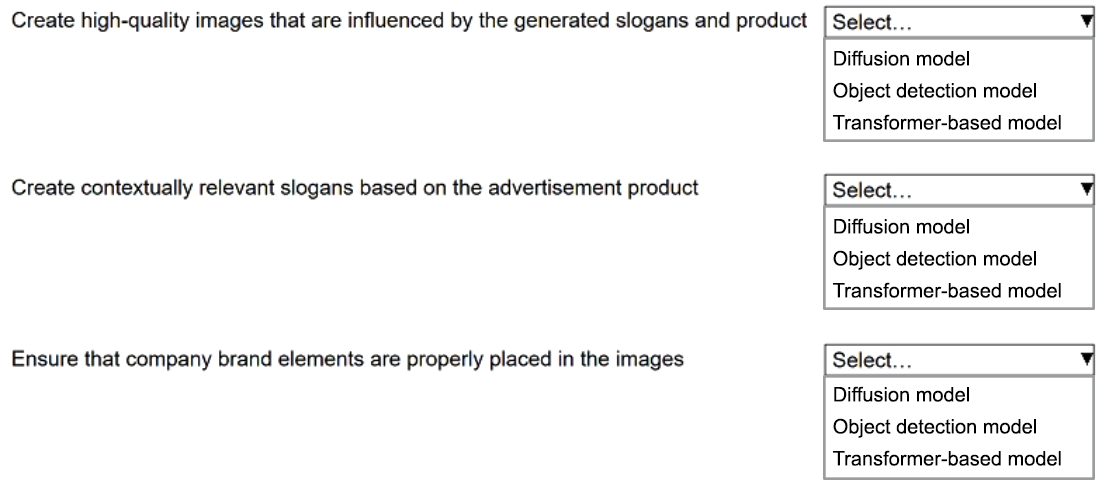
A company wants to develop a solution that uses generative AI to create content for product advertisements, including sample images and slogans.
Select the correct model type from the following list for each action. Each model type should be selected one time.
Show Answer
Correct Answer: Create high-quality images that are influenced by the generated slogans and product → Diffusion model
Create contextually relevant slogans based on the advertisement product → Transformer-based model
Ensure that company brand elements are properly placed in the images → Object detection model
Explanation: Diffusion models generate images, transformer-based models generate coherent text such as slogans, and object detection models identify and verify the placement of visual brand elements.
Question 158
A research group wants to test different generative AI models to create research papers. The research group has defined a prompt and needs a method to assess the models’ output. The research group wants to use a team of scientists to perform the output assessments.
Which solution will meet these requirements?
A. Use automatic evaluation on Amazon Personalize.
B. Use content moderation on Amazon Rekognition.
C. Use model evaluation on Amazon Bedrock.
D. Use sentiment analysis on Amazon Comprehend.
Show Answer
Correct Answer: C
Explanation: Amazon Bedrock model evaluation supports evaluating foundation model outputs using either automatic metrics or human evaluation workflows. A team of scientists can act as human evaluators to assess generated research papers against defined criteria. The other services are unrelated: Amazon Personalize is for recommendations, Amazon Rekognition is for image/video analysis and moderation, and Amazon Comprehend provides NLP features such as sentiment analysis rather than generative model evaluation.
Question 159
A financial company wants to build workflows for human review of ML predictions. The company wants to define confidence thresholds for its use case and adjust the thresholds over time.
Which AWS service meets these requirements?
A. Amazon Personalize
B. Amazon Augmented AI (Amazon A2I)
C. Amazon Inspector
D. AWS Audit Manager
Show Answer
Correct Answer: B
Explanation: Amazon Augmented AI (Amazon A2I) provides human-in-the-loop workflows for machine learning predictions. It supports routing inferences for human review based on configurable confidence thresholds and allows those thresholds and review workflows to be adjusted over time. The other services serve different purposes: Amazon Personalize is for recommendations, Amazon Inspector is for security vulnerability assessment, and AWS Audit Manager is for compliance auditing.
Question 160
HOTSPOT
-
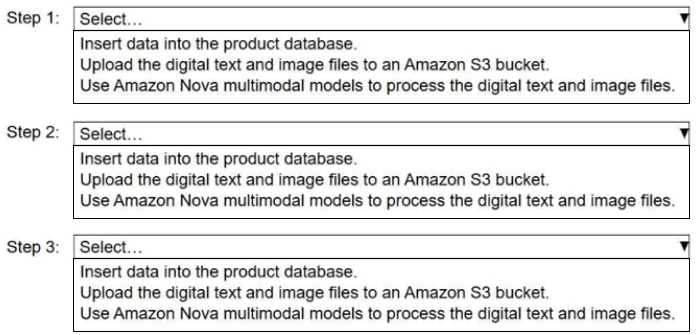
A company periodically updates its product database by manually uploading digital product guides. The product guides contain text and images. The company wants to automate this task by using generative AI.
Select and order the steps from the following list to automate the database update task by using generative AI. Select each step one time.
Show Answer
Correct Answer: Step 1: Upload the digital text and image files to an Amazon S3 bucket.
Step 2: Use Amazon Nova multimodal models to process the digital text and image files.
Step 3: Insert data into the product database.
Explanation: Store the source files in Amazon S3 first, then use a multimodal model to extract/process information from the text and images, and finally write the structured results into the product database.
Question 161
A company is building a new generative AI chatbot. The chatbot uses an Amazon Bedrock foundation model (FM) to generate responses. During testing, the company notices that the chatbot is prone to prompt injection attacks.
What can the company do to secure the chatbot with the LEAST implementation effort?
A. Fine-tune the FM to avoid harmful responses.
B. Use Amazon Bedrock Guardrails content filters and denied topics.
C. Change the FM to a more secure FM.
D. Use chain-of-thought prompting to produce secure responses.
Show Answer
Correct Answer: B
Explanation: Amazon Bedrock Guardrails provide built-in protections such as content filters, denied topics, and prompt attack mitigation with minimal application changes. Fine-tuning requires significantly more effort and does not specifically address prompt injection as directly. Switching foundation models does not guarantee resistance to prompt injection, and chain-of-thought prompting is not a security control and is not a recommended mitigation for prompt injection.
Question 162
A company is exploring Amazon Nova models in Amazon Bedrock. The company needs a multimodal model that supports multiple languages.
Which Nova model will meet these requirements MOST cost-effectively?
A. Nova Lite
B. Nova Pro
C. Nova Canvas
D. Nova Reel
Show Answer
Correct Answer: A
Explanation: Amazon Nova Lite is the most cost-effective multimodal Nova model. It supports multimodal inputs (such as text and images) and multiple languages while being optimized for low cost and low latency. Nova Pro also supports multimodal and multilingual use cases but is intended for more complex workloads at higher cost. Nova Canvas is an image generation model, and Nova Reel is a video generation model.
Question 163
A company is using Amazon Bedrock for a generative AI solution. The solution must integrate a service with vector database storage and vector search capabilities.
Which AWS service will meet these requirements?
A. Amazon DynamoDB
B. Amazon OpenSearch Service
C. Amazon ElastiCache
D. Amazon Redshift
Show Answer
Correct Answer: B
Explanation: Amazon OpenSearch Service provides managed vector database capabilities, including vector storage and k-nearest neighbor (k-NN)/approximate nearest neighbor (ANN) vector search, making it a common choice for retrieval-augmented generation (RAG) with Amazon Bedrock. DynamoDB, ElastiCache, and Redshift are not the primary AWS managed services for vector search in this context.
Question 164
A company is using Amazon SageMaker to deploy a model that identifies if social media posts contain certain topics. The company needs to show how different input features influence model behavior.
Which SageMaker feature meets these requirements?
A. SageMaker Canvas
B. SageMaker Clarify
C. SageMaker Feature Store
D. SageMaker Ground Truth
Show Answer
Correct Answer: B
Explanation: Amazon SageMaker Clarify is designed for model explainability and bias detection. It provides feature attribution (such as SHAP-based explanations) to show how input features influence individual predictions and overall model behavior. Canvas is a no-code ML tool, Feature Store manages ML features, and Ground Truth is for data labeling.
$19
Get all 446 questions with detailed answers and explanations
Instant download HTML + PDF delivered the moment payment clears.
Secure Stripe checkout we never see or store your card details.
7-day refund if files are defective see our refund policy.