HOTSPOT
-
You have a Microsoft Entra tenant named contoso.com that is linked to an Azure subscription named Sub1 and a Microsoft 365 subscription. Sub1 contains a publicly accessible Azure App Service web app named App1.
You have an external partner that has a Microsoft Entra tenant named fabrikam.com.
You need to recommend a solution that meets the following requirements:
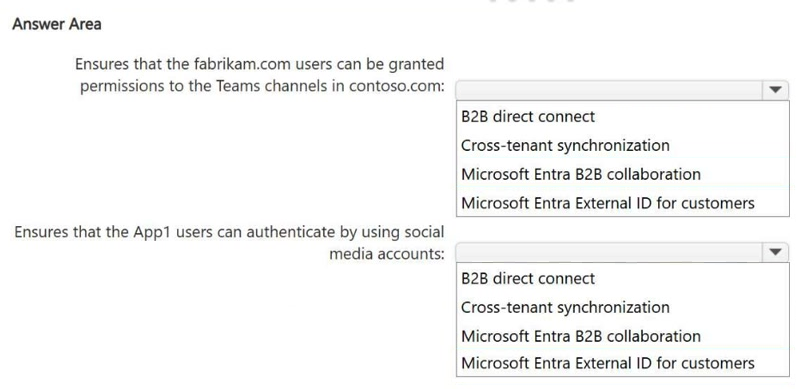
• Ensures that the users in fabrikam.com can be granted permissions to specific Microsoft Teams channels in contoso.com
• Ensures that the users of App1 can authenticate by using social media accounts
• Minimizes administrative effort
Which authentication method should you recommend for each requirement? To answer, select the appropriate options in the answer area.
NOTE: Each correct selection is worth one point.
Show Answer
Correct Answer: B2B direct connect
Microsoft Entra External ID for customers
Explanation: B2B direct connect is designed for cross-tenant access to Microsoft Teams shared channels. Microsoft Entra External ID for customers supports customer sign-in with social identity providers for web applications.
Question 5
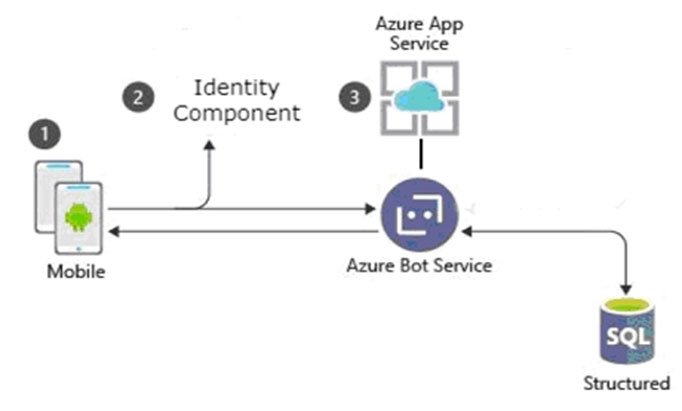
A customer uses Azure to develop a mobile app that will be consumed by external users as shown in the following exhibit.
You need to design an identity strategy for the app. The solution must meet the following requirements:
✑ Enable the usage of external IDs such as Google, Facebook, and Microsoft accounts.
✑ Use a customer identity store.
✑ Support fully customizable branding for the app.
Which service should you recommend to complete the design?
A. Azure Active Directory (Azure AD) B2B
B. Azure Active Directory Domain Services (Azure AD DS)
C. Azure Active Directory (Azure AD) B2C
D. Azure AD Connect
Show Answer
Correct Answer: C
Explanation: Azure AD B2C is designed for customer-facing applications. It supports social identity providers such as Google and Facebook, provides a customer identity store, and allows customizable branding of sign-up and sign-in experiences.
Question 5
You are designing a ransomware mitigation strategy.
You perform a ransomware risk assessment and identify business-critical assets.
You need to recommend a solution to mitigate ransomware threats. The solution must follow Microsoft security best practices.
Which two actions should you include in the recommendation? Each correct answer presents a complete solution.
NOTE: Each correct answer is worth one point.
A. Enable firewall logging for auditing, without restricting inbound or outbound traffic.
B. Use extended patching cycles to reduce the risk of update-related service disruptions.
C. Implement immutable, offline backups that have restricted access and test restore procedures regularly.
D. Deploy Privileged Identity Management (PIM) that uses just-in-time (JIT) access and approval workflows.
Show Answer
Correct Answer: C, D
Explanation: Microsoft ransomware guidance emphasizes resilient backup strategies with immutable/offline backups, restricted access, and regular restore testing. It also recommends least-privilege administration using Privileged Identity Management with just-in-time access and approval workflows to reduce the impact of compromised privileged accounts. Firewall logging alone does not mitigate ransomware, and extended patching cycles increase exposure rather than following security best practices.
Question 6
Note: This question is part of a series of questions that present the same scenario. Each question in the series contains a unique solution that might meet the stated goals. Some question sets might have more than one correct solution, while others might not have a correct solution.
After you answer a question in this section, you will NOT be able to return to it. As a result, these questions will not appear in the review screen.
Your on-premises network contains an e-commerce web app that was developed in Angular and Node,js. The web app uses a MongoDB database.
You plan to migrate the web app to Azure. The solution architecture team proposes the following architecture as an Azure landing zone.
You need to provide recommendations to secure the connection between the web app and the database. The solution must follow the Zero Trust model.
Solution: You recommend implementing Azure Front Door with Azure Web Application Firewall (WAF).
Does this meet the goal?
A. Yes
B. No
Show Answer
Correct Answer: B
Explanation: No. Azure Front Door with WAF protects the web application from inbound web threats; it does not secure the connection between the web app and the database. Use controls such as private connectivity and appropriate identity and access restrictions for that connection.
Question 6
You have an Azure subscription.
You have a subscription to a third-party cloud provider. The subscription contains 100 virtual machines.
You manage cloud security for both subscriptions from the Azure subscription.
You need to recommend a solution to validate the security posture of the virtual machines.
Which two services should you include in the recommendation? Each correct answer presents part of the solution.
NOTE: Each correct answer is worth one point.
A. Microsoft Sentinel
B. Azure Arc
C. Microsoft Defender for Cloud
D. Azure Lighthouse
E. Microsoft Defender for Endpoint
Show Answer
Correct Answer: B, C
Explanation: Use Azure Arc to onboard and manage servers/virtual machines from third-party clouds in Azure. Then use Microsoft Defender for Cloud to assess and continuously validate their security posture across hybrid and multicloud environments. Microsoft Sentinel is a SIEM/SOAR rather than a posture assessment service, Azure Lighthouse is for cross-tenant management, and Defender for Endpoint focuses on endpoint protection rather than overall cloud security posture.
Question 7
Note: This question is part of a series of questions that present the same scenario. Each question in the series contains a unique solution that might meet the stated goals. Some question sets might have more than one correct solution, while others might not have a correct solution.
After you answer a question in this section, you will NOT be able to return to it. As a result, these questions will not appear in the review screen.
Your on-premises network contains an e-commerce web app that was developed in Angular and Node,js. The web app uses a MongoDB database.
You plan to migrate the web app to Azure. The solution architecture team proposes the following architecture as an Azure landing zone.
You need to provide recommendations to secure the connection between the web app and the database. The solution must follow the Zero Trust model.
Solution: You recommend implementing Azure Application Gateway with Azure Web Application Firewall (WAF).
Does this meet the goal?
A. Yes
B. No
Show Answer
Correct Answer: B
Explanation: No. Azure Application Gateway with WAF protects incoming web traffic to the application; it does not secure the connection between the web app and the database. A private network connection, such as a private endpoint where supported, is needed for that connection to align with Zero Trust principles.
Question 7
You have an Azure subscription. The subscription contains multiple Azure App Service web apps that are distributed across multiple Azure regions and are accessed via the internet.
You need to ensure that all incoming requests to the apps are inspected for threats based on the Core Rule Set (CRS) from the Open Web Application Security Project (OWASP). The solution must meet the following requirements:
• Support the use of Microsoft-managed X.509 certificates.
• Route users to the geographically closest app.
• Minimize administrative effort.
What should you use?
A. Azure Firewall Premium
B. Azure Front Door with a web application firewall (WAF)
C. Azure Firewall Standard
D. Azure Application Gateway with a web application firewall (WAF)
Show Answer
Correct Answer: B
Explanation: Azure Front Door with WAF provides OWASP Core Rule Set (CRS) inspection, supports Microsoft-managed certificates, performs global anycast-based routing to the closest healthy regional backend, and is a fully managed service that minimizes administrative effort. Azure Application Gateway with WAF is regional and does not provide global nearest-region routing. Azure Firewall Standard/Premium are network firewalls and do not satisfy the web application routing and managed certificate requirements.
Question 8
Note: This question is part of a series of questions that present the same scenario. Each question in the series contains a unique solution that might meet the stated goals. Some question sets might have more than one correct solution, while others might not have a correct solution.
After you answer a question in this section, you will NOT be able to return to it. As a result, these questions will not appear in the review screen.
Your on-premises network contains an e-commerce web app that was developed in Angular and Node,js. The web app uses a MongoDB database.
You plan to migrate the web app to Azure. The solution architecture team proposes the following architecture as an Azure landing zone.
You need to provide recommendations to secure the connection between the web app and the database. The solution must follow the Zero Trust model.
Solution: You recommend creating private endpoints for the web app and the database layer.
Does this meet the goal?
A. Yes
B. No
Show Answer
Correct Answer: B
Explanation: An Azure App Service private endpoint handles incoming traffic to the web app; it does not provide the app with outbound connectivity to the database’s private endpoint. To secure that connection, the web app also needs VNet integration so it can reach the database privately. Creating private endpoints for both layers alone does not meet the goal.
Question 9
Note: This question is part of a series of questions that present the same scenario. Each question in the series contains a unique solution that might meet the stated goals. Some question sets might have more than one correct solution, while others might not have a correct solution.
After you answer a question in this section, you will NOT be able to return to it. As a result, these questions will not appear in the review screen.
Your on-premises network contains an e-commerce web app that was developed in Angular and Node,js. The web app uses a MongoDB database.
You plan to migrate the web app to Azure. The solution architecture team proposes the following architecture as an Azure landing zone.
You need to provide recommendations to secure the connection between the web app and the database. The solution must follow the Zero Trust model.
Solution: You recommend implementing Azure Key Vault to store credentials.
Does this meet the goal?
A. Yes
B. No
Show Answer
Correct Answer: B
Explanation: Key Vault protects stored credentials, but it does not by itself secure the network connection between the web app and the database. Use measures such as a private endpoint and encrypted transport; managed identity can also avoid stored credentials where supported.
Question 9
HOTSPOT
-
You have a Microsoft 365 subscription.
You configure Microsoft Purview Information Protection to apply sensitivity labels automatically.
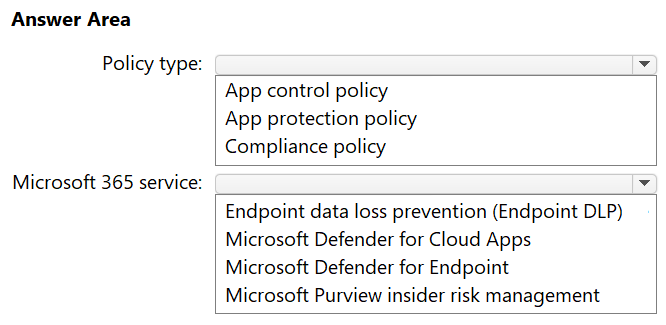
You need to recommend a solution that will prevent users from uploading unlabeled files to Microsoft SharePoint Online if the files contain content defined by Microsoft Purview classifiers as sensitive.
What should you include in the recommendation? To answer, select the appropriate options in the answer area.
NOTE: Each correct selection is worth one point.
Show Answer
Correct Answer: Policy type: App control policy
Microsoft 365 service: Microsoft Defender for Cloud Apps
Explanation: Defender for Cloud Apps app control policies can enforce real-time controls on SharePoint Online uploads, including blocking uploads of files that are unlabeled while containing sensitive information detected through Microsoft Purview classification.
$19
Get all 314 questions with detailed answers and explanations
Instant download HTML + PDF delivered the moment payment clears.
Secure Stripe checkout we never see or store your card details.
7-day refund if files are defective see our refund policy.