Note: This question is part of a series of questions that present the same scenario. Each question in the series contains a unique solution that might meet the stated goals. Some question sets might have more than one correct solution, while others might not have a correct solution.
After you answer a question in this section, you will NOT be able to return to it. As a result, these questions will not appear in the review screen.
Your Azure environment contains multiple Azure virtual machines.
You need to ensure that a virtual machine named VM1 is accessible from the Internet over HTTP.
Solution: You modify an Azure firewall.
Does this meet the goal?
A. Yes
B. No
Show Answer
Correct Answer: B
Explanation: No. Azure Firewall can use a DNAT rule to forward inbound HTTP traffic, but modifying it alone does not ensure VM1 is reachable. The VM also needs a valid path from the Internet (such as an appropriate public IP/DNAT configuration) and network security rules that allow inbound TCP port 80.
Question 11
HOTSPOT -
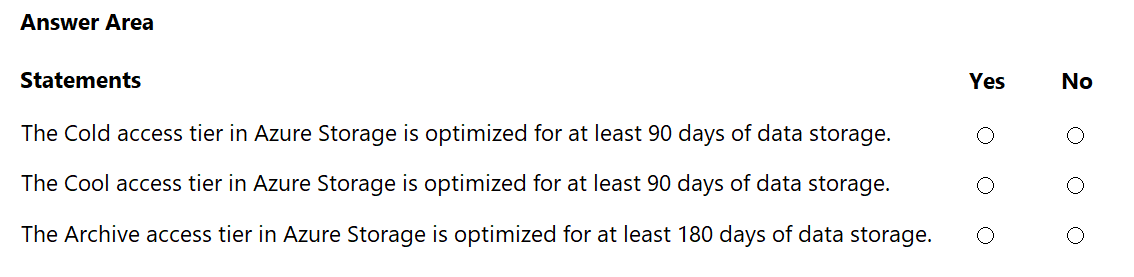
For each of the following statements, select Yes if the statement is true. Otherwise, select No.
NOTE: Each correct selection is worth one point.
Show Answer
Correct Answer: Yes
No
Yes
Explanation: Cold tier is optimized for a minimum of 90 days, Cool tier for 30 days (not 90), and Archive tier for 180 days.
Question 12
HOTSPOT
-
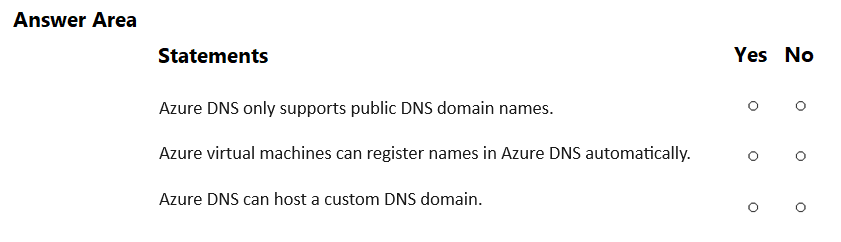
For each of the following statements, select Yes if the statement is true. Otherwise, select No.
NOTE: Each correct selection is worth one point.
Show Answer
Correct Answer: No
No
Yes
Explanation: Azure DNS supports both public and private DNS zones. Automatic VM name registration is a feature of Azure Private DNS with auto-registration enabled, not Azure DNS generally/public DNS. Azure DNS can host custom DNS domains.
Question 13
HOTSPOT
-
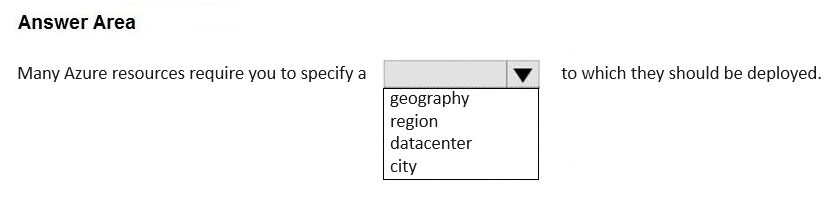
Select the answer that correctly completes the sentence.
Show Answer
Correct Answer: region
Explanation: Many Azure resources are deployed to a specific Azure region, which represents a geographic area containing one or more datacenters.
Question 14
HOTSPOT
-
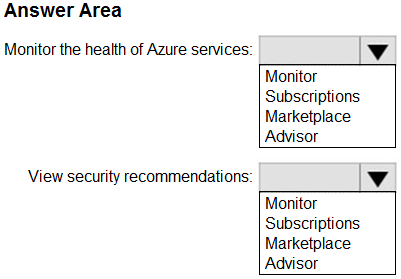
You need to identify which blades in the Azure portal must be used to perform the following tasks:
• View security recommendations.
• Monitor the health of Azure services.
Which blade should you identify for each task? To answer, select the appropriate options in the answer area.
NOTE: Each correct selection is worth one point.
Show Answer
Correct Answer: Monitor the health of Azure services: Monitor
View security recommendations: Advisor
Explanation: Azure Monitor provides service health monitoring (including Azure Service Health). Azure Advisor displays security recommendations alongside other best-practice recommendations.
Question 15
HOTSPOT
-
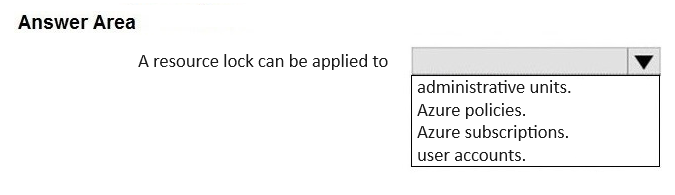
Select the answer that correctly completes the sentence.
Show Answer
Correct Answer: Azure subscriptions.
Explanation: Resource locks can be applied at the subscription, resource group, or individual resource scope. They cannot be applied to administrative units, Azure Policy objects, or user accounts.
Question 16
You have an Azure environment.
You need to create a new Azure virtual machine from a tablet that runs the Android operating system.
What are three possible solutions? Each correct answer presents a complete solution.
NOTE: Each correct selection is worth one point.
A. Use the Settings app.
B. Use the Azure portal.
C. Use Bash in Azure Cloud Shell.
D. Use the PowerApps portal.
E. Use PowerShell in Azure Cloud Shell.
Show Answer
Correct Answer: B, C, E
Explanation: The Azure portal can be accessed from an Android tablet via a web browser to create a virtual machine. Azure Cloud Shell supports both Bash (Azure CLI) and PowerShell, either of which can be used to create and manage Azure VMs. The Settings app is not used to provision Azure resources, and the PowerApps portal is for building and managing Power Apps rather than creating Azure virtual machines.
Question 17
HOTSPOT -
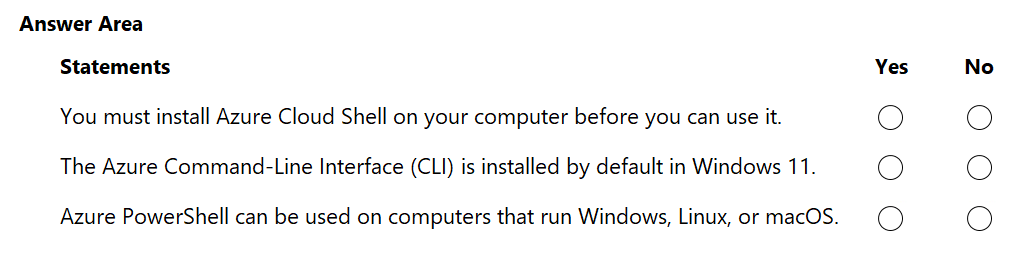
For each of the following statements, select Yes if the statement is true. Otherwise, select No.
NOTE: Each correct selection is worth one point.
Show Answer
Correct Answer: No
No
Yes
Explanation: Azure Cloud Shell is browser-based and requires no local installation. Azure CLI is not installed by default on Windows 11. Azure PowerShell is cross-platform and supports Windows, Linux, and macOS.
Question 19
Microsoft 365 is an example of which cloud service model?
A. infrastructure as a service (IaaS)
B. platform as a service (PaaS)
C. software as a service (SaaS)
Show Answer
Correct Answer: C
Explanation: Microsoft 365 is a Software as a Service (SaaS) offering. Microsoft hosts and manages the applications and underlying infrastructure, and users access productivity software such as Outlook, Word, Excel, Teams, and OneDrive over the internet via subscription. It is not IaaS, which provides virtualized infrastructure, nor PaaS, which provides application development platforms.
Question 20
HOTSPOT -
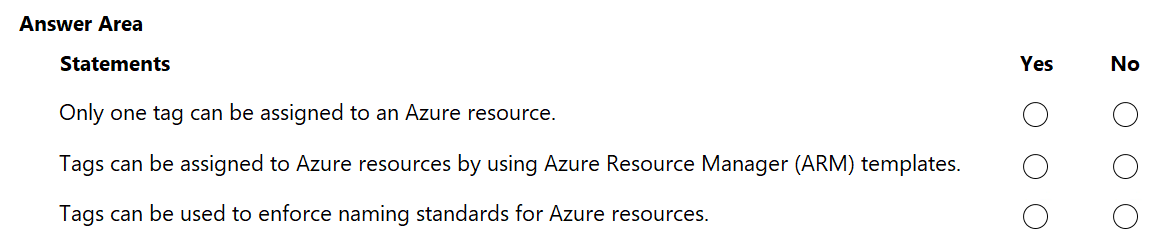
For each of the following statements, select Yes if the statement is true. Otherwise, select No.
NOTE: Each correct selection is worth one point.
Show Answer
Correct Answer: No
Yes
No
Explanation: Azure resources can have multiple tags (up to the platform limit), ARM templates can assign tags during deployment, and tags are metadata for organization rather than enforcing naming standards.
$19
Get all 428 questions with detailed answers and explanations
Instant download HTML + PDF delivered the moment payment clears.
Secure Stripe checkout we never see or store your card details.
7-day refund if files are defective see our refund policy.