HOTSPOT -
Select the answer that correctly completes the sentence.
Hot Area:
Show Answer
Correct Answer: the Microsoft Service Trust Portal.
Explanation: The Microsoft Service Trust Portal provides audit reports, certifications, and compliance documentation for Microsoft cloud services, including Azure services. Defender for Cloud focuses on the compliance posture of your own Azure resources, not Microsoft's service audit reports.
Question 133
You need to manage containers.
Which two services can you use? Each correct answer presents a complete solution.
NOTE: Each correct selection is worth one point.
A. Azure Virtual Desktop
B. Azure virtual machines
C. Azure Functions
D. Azure Container Instances
E. Azure Kubernetes Service (AKS)
Show Answer
Correct Answer: D, E
Explanation: Azure Container Instances (ACI) is a managed service for running containers without managing VMs. Azure Kubernetes Service (AKS) is Azure's managed Kubernetes service for deploying, orchestrating, and managing containerized applications. Azure Virtual Desktop is for desktop virtualization, Azure VMs are general compute rather than a container management service, and Azure Functions is a serverless compute service, not a container management platform.
Question 134
DRAG DROP -
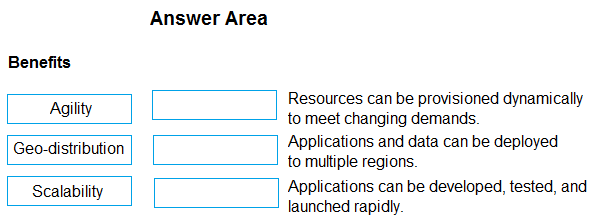
Match the cloud computing benefits to the correct descriptions.
To answer, drag the appropriate benefit from the column on the left to its description on the right. Each benefit may be used once, more than once, or not at all.
NOTE: Each correct match is worth one point.
Select and Place:
Show Answer
Correct Answer: Scalability → Resources can be provisioned dynamically to meet changing demands.
Geo-distribution → Applications and data can be deployed to multiple regions.
Agility → Applications can be developed, tested, and launched rapidly.
Explanation: Scalability is the ability to adjust resources as demand changes. Geo-distribution places apps/data across regions. Agility enables rapid development and deployment.
Question 135
HOTSPOT -
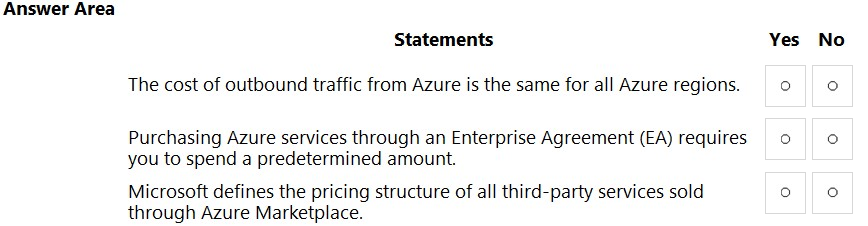
For each of the following statements, select Yes if the statement is true. Otherwise, select No.
NOTE: Each correct selection is worth one point.
Hot Area:
Show Answer
Correct Answer: No
Yes
No
Explanation: Outbound data transfer pricing varies by Azure region. Enterprise Agreements involve a monetary commitment. Marketplace publishers (vendors), not Microsoft, set pricing for third-party offers.
Question 136
Which Service Level Agreement (SLA) is provided for Azure services in public preview?
A. Each service defines its own SLA
B. The SLA will be 99%
C. The SLA will be 1% less than the general availability (GA) SLA
D. The SLA will be 99.95%
Show Answer
Correct Answer: A
Explanation: Azure services in public preview generally do not have a standard SLA; preview features are excluded from normal SLAs unless explicitly stated. Since the provided options do not include 'no SLA', the closest/expected exam answer is that each service defines its own SLA, though in practice preview services typically have no SLA.
Question 137
HOTSPOT -
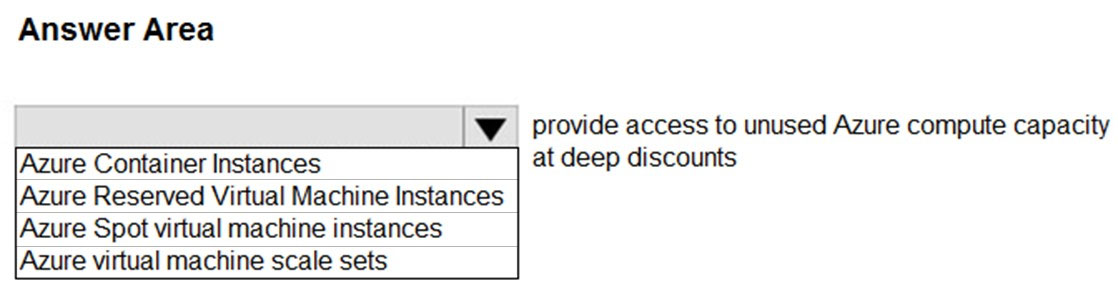
Select the answer that correctly completes the sentence.
Hot Area:
Explanation: Azure Spot VMs provide access to unused Azure compute capacity at significant discounts, with the tradeoff that they can be evicted when Azure needs the capacity.
Question 138
HOTSPOT -
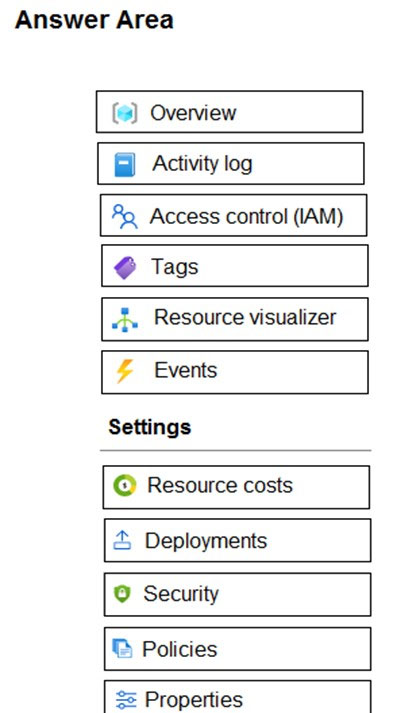
Which node in the Azure portal should you use to assign a user the Reader role for a resource group? To answer, select the node in the answer area.
NOTE: Each correct selection is worth one point.
Hot Area:
Show Answer
Correct Answer: Access control (IAM)
Explanation: Azure role assignments, including assigning the Reader role at the resource group scope, are managed from the resource group's Access control (IAM) blade.
Question 139
DRAG DROP -
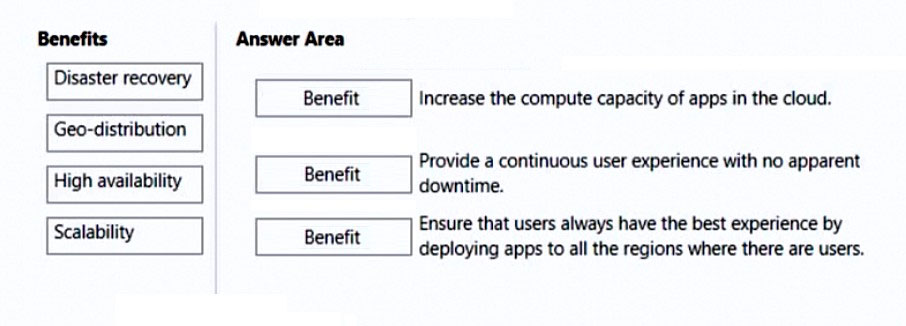
Match the cloud computing benefits to the appropriate descriptions.
To answer, drag the appropriate benefit from the column on the left to its description on the right. Each benefit may be used once, more than once, or not at all.
NOTE: Each correct match is worth one point.
Select and Place:
Show Answer
Correct Answer: Scalability → Increase the compute capacity of apps in the cloud.
High availability → Provide a continuous user experience with no apparent downtime.
Geo-distribution → Ensure that users always have the best experience by deploying apps to all the regions where there are users.
Explanation: Scalability increases resources as demand grows. High availability minimizes perceived downtime through redundancy and failover. Geo-distribution places applications closer to users across regions for better performance and experience.
Question 140
DRAG DROP -
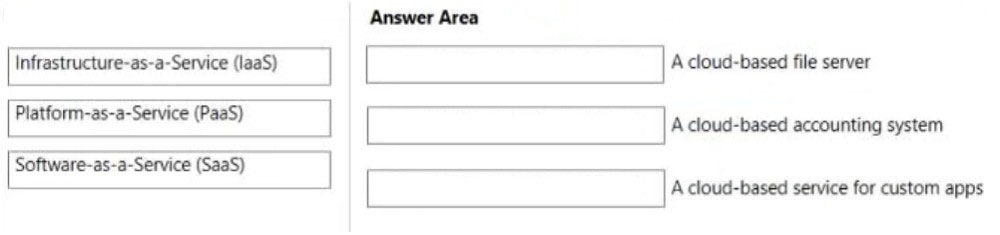
Match the cloud service models to the appropriate solutions.
To answer, drag the appropriate cloud service model from the column on the left to its solution on the right Each cloud service model may be used once, more than once, or not at all.
NOTE: Each correct match is worth one point.
Select and Place:
Show Answer
Correct Answer: A cloud-based file server → Infrastructure-as-a-Service (IaaS)
A cloud-based accounting system → Software-as-a-Service (SaaS)
A cloud-based service for custom apps → Platform-as-a-Service (PaaS)
Explanation: IaaS provides virtualized infrastructure such as servers. SaaS delivers complete applications like accounting software. PaaS provides a managed platform for developing and hosting custom applications.
Question 141
HOTSPOT -
Select the answer that correctly completes the sentence.
Hot Area:
Show Answer
Correct Answer: Microsoft Trust Center
Explanation: The Microsoft Trust Center provides in-depth information about security, privacy, compliance offerings, policies, and features across Microsoft cloud products, unlike the admin portals which are used to manage an organization's services.
$19
Get all 428 questions with detailed answers and explanations
Instant download HTML + PDF delivered the moment payment clears.
Secure Stripe checkout we never see or store your card details.
7-day refund if files are defective see our refund policy.