DRAG DROP -
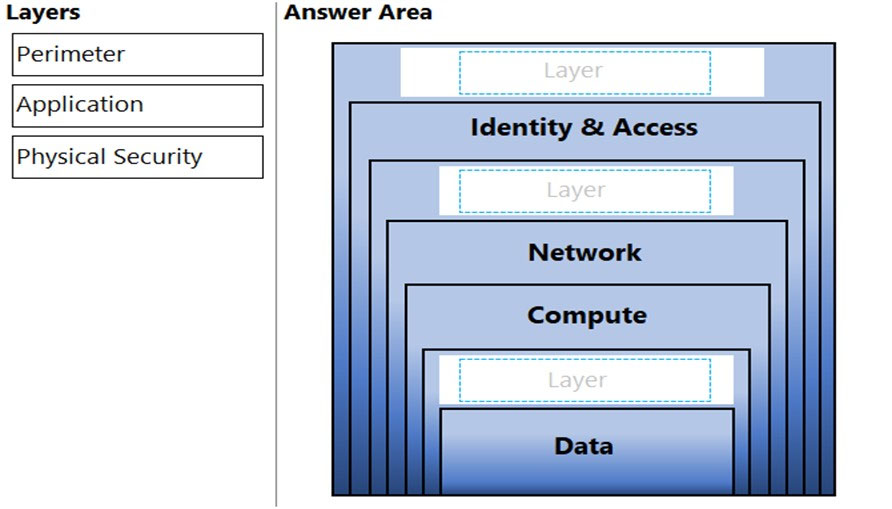
You need to complete the defense-in-depth strategy used in a datacenter.
What should you do? To answer, drag the appropriate layers to the correct positions in the model. Each layer may be used once, more than once, or not at all.
You may need to drag the split bar between panes or scroll to view content.
NOTE: Each correct selection is worth one point.
Select and Place:
Explanation: The standard defense-in-depth order is: Physical Security → Identity & Access → Perimeter → Network → Compute → Application → Data.
Question 199
Your company plans to start using Azure and will migrate all its network resources to Azure.
You need to start the planning process by exploring Azure.
What should you create first?
A. a subscription
B. a resource group
C. a virtual network
D. a management group
Show Answer
Correct Answer: A
Explanation: The first Azure construct you need is a subscription. A subscription provides the billing, access, and resource boundary required before you can create resource groups, virtual networks, or other Azure resources. Management groups are used to organize multiple subscriptions, not to begin using Azure.
Question 201
Your company has an on-premises network that contains multiple servers.
The company plans to reduce the following administrative responsibilities:
✑ Backing up application data
✑ Replacing failed server hardware
✑ Managing physical server security
✑ Updating server operating systems
✑ Managing permissions to shared documents
The company plans to migrate servers to Azure virtual machines.
You need to identify which administrative responsibilities will be eliminated after the planned migration.
Which two responsibilities should you identify? Each correct answer presents a complete solution.
NOTE: Each correct selection is worth one point.
A. Replacing failed server hardware
B. Backing up application data
C. Managing physical server security
D. Updating server operating systems
E. Managing permissions to shared documents
Show Answer
Correct Answer: A, C
Explanation: Azure Virtual Machines are an IaaS offering. Microsoft is responsible for the underlying physical infrastructure, including replacing failed server hardware and physical datacenter/server security. The customer remains responsible for the guest operating system, application data backups (unless using additional backup services), and managing access permissions to shared documents.
Question 202
DRAG DROP -
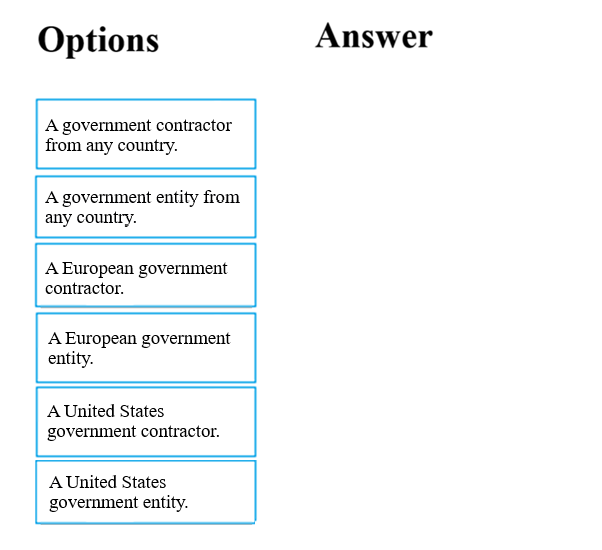
The company would like to develop a cloud solution by making use of Azure Government. Azure Government can only be used by certain types of clients to develop cloud solutions.
Which of the following are the types of customers that can make use of Azure Government in this situation? Answer by dragging the correct option from the list to the answer area.
Select and Place:
Show Answer
Correct Answer: A United States government contractor.
A United States government entity.
Explanation: Azure Government is a dedicated cloud available to verified U.S. government entities and their approved partners/contractors, not governments or contractors from other countries.
Question 203
Note: The question is included in a number of questions that depicts the identical set-up. However, every question has a distinctive result. Establish if the solution satisfies the requirements.
You have been informed by your superiors of the company's intentions to automate server deployment to Azure. There is, however, some concern that administrative credentials could be uncovered during this process.
You are required to make sure that during the deployment, the administrative credentials are encrypted using a suitable Azure solution.
Solution: You recommend the use of Azure Multi-Factor Authentication (MFA).
Does the solution meet the goal?
A. Yes
B. No
Show Answer
Correct Answer: B
Explanation: Azure Multi-Factor Authentication (MFA) strengthens the authentication process by requiring additional verification during sign-in, but it does not encrypt or securely store administrative credentials used in automated deployments. Azure Key Vault is the appropriate Azure service for protecting secrets, passwords, keys, and certificates during deployment workflows.
Question 204
HOTSPOT -
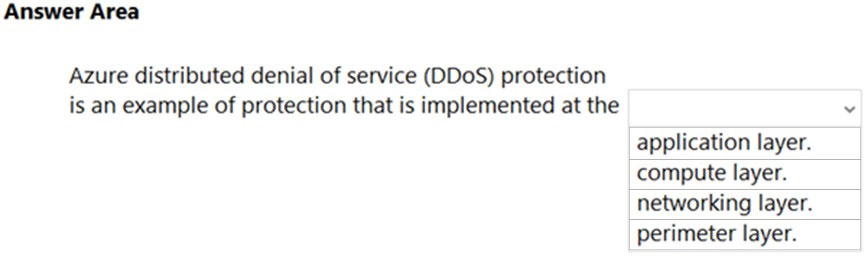
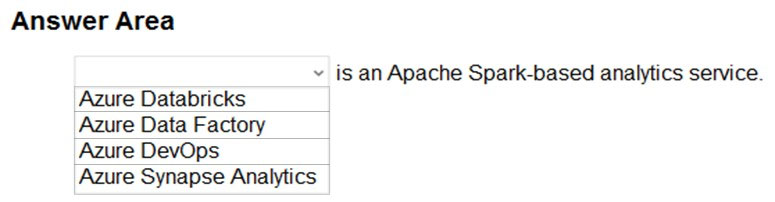
To complete the sentence, select the appropriate option in the answer area.
Hot Area:
Show Answer
Correct Answer: Perimeter layer
Explanation: The question refers to Azure's defense-in-depth model, where Azure DDoS Protection is implemented at the perimeter layer to stop large-scale attacks before they reach internal resources. Although Azure DDoS Protection operates at OSI Layers 3 and 4, this exam item is asking about the defense-in-depth layer.
Question 205
HOTSPOT -
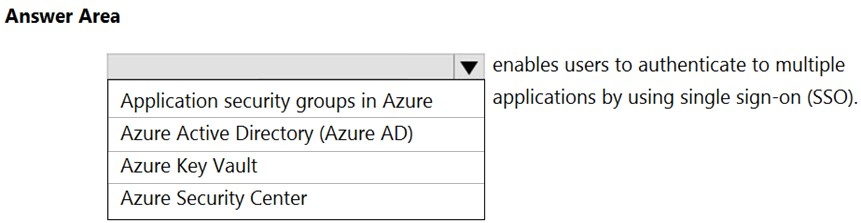
To complete the sentence, select the appropriate option in the answer area.
Hot Area:
Show Answer
Correct Answer: Azure Active Directory (Azure AD)
Explanation: Azure Active Directory (now Microsoft Entra ID) provides identity management and single sign-on (SSO) for multiple applications.
Question 206
HOTSPOT -
To complete the sentence, select the appropriate option in the answer area.
Hot Area:
Show Answer
Correct Answer: Azure Databricks
Explanation: Azure Databricks is Microsoft's Apache Spark-based analytics platform. Azure Data Factory is for data integration, Azure DevOps is for development workflows, and Azure Synapse Analytics is a broader analytics service rather than the Spark-based service specifically referenced.
Question 207
HOTSPOT -
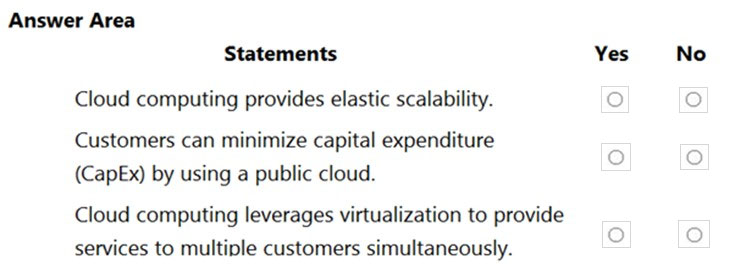
For each of the following statements, select Yes if the statement is true. Otherwise, select No.
NOTE: Each correct selection is worth one point.
Hot Area:
Show Answer
Correct Answer: Yes
Yes
Yes
Explanation: Cloud computing provides elasticity/scalability, public cloud reduces upfront capital expenditure by shifting costs toward operational expenses, and cloud platforms commonly use virtualization and multi-tenancy to serve multiple customers.
Question 208
You have an Azure subscription and 100 Windows 10 devices.
You need to ensure that only users whose devices have the latest security patches installed can access Azure Active Directory (Azure AD)-integrated applications.
What should you implement?
A. a conditional access policy
B. Azure Bastion
C. Azure Firewall
D. Azure Policy
Show Answer
Correct Answer: A
Explanation: Use an Azure AD (Microsoft Entra ID) Conditional Access policy that requires the device to be marked as compliant. Device compliance, typically evaluated by Microsoft Intune, can enforce that Windows 10 devices have the latest required security updates before users are granted access to Azure AD-integrated applications. Azure Bastion provides secure VM access, Azure Firewall filters network traffic, and Azure Policy governs Azure resource configuration rather than user sign-in conditions.
Sources:
https://learn.microsoft.com/en-sg/answers/questions/412521/need-to-migrate-applications-to-azure-ad
$19
Get all 428 questions with detailed answers and explanations
Instant download HTML + PDF delivered the moment payment clears.
Secure Stripe checkout we never see or store your card details.
7-day refund if files are defective see our refund policy.