Your company plans to automate the deployment of servers to Azure.
Your manager is concerned that you may expose administrative credentials during the deployment.
You need to recommend an Azure solution that encrypts the administrative credentials during the deployment.
What should you include in the recommendation?
A. Azure Key Vault
B. Azure Information Protection
C. Microsoft Defender for Cloud
D. Azure Multi-Factor Authentication (MFA)
Show Answer
Correct Answer: A
Explanation: Azure Key Vault is designed to securely store and manage secrets, keys, and certificates. During automated Azure deployments (such as ARM/Bicep deployments), administrative credentials can be stored as secrets in Key Vault and referenced securely, avoiding exposure in templates or scripts. Azure Information Protection classifies and protects documents, Microsoft Defender for Cloud provides security posture and threat protection, and Azure MFA strengthens authentication but does not encrypt deployment credentials.
Question 103
HOTSPOT -
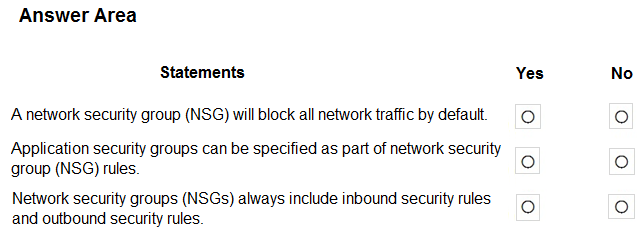
For each of the following statements, select Yes if the statement is true. Otherwise, select No.
NOTE: Each correct selection is worth one point.
Hot Area:
Show Answer
Correct Answer: No
Yes
Yes
Explanation: NSGs have default rules that do not block all traffic (they allow some inbound VNet/Azure load balancer traffic and allow outbound Internet traffic), so statement 1 is false. NSG rules can reference Application Security Groups. Every NSG includes both inbound and outbound security rules, including default rules.
Question 104
HOTSPOT -
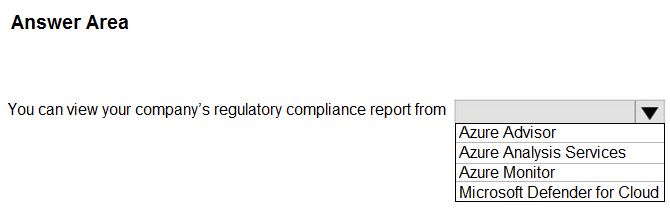
Select the answer that correctly completes the sentence.
Hot Area:
Show Answer
Correct Answer: Azure Active Directory (Azure AD)
Explanation: Azure Active Directory (now Microsoft Entra ID) provides identity management and single sign-on (SSO), allowing users to authenticate once and access multiple applications.
Question 105
HOTSPOT -
Select the answer that correctly completes the sentence.
Hot Area:
Show Answer
Correct Answer: Microsoft Defender for Cloud
Explanation: The Regulatory compliance dashboard is part of Microsoft Defender for Cloud (formerly Azure Security Center), where you can view compliance against standards and regulations.
Question 106
HOTSPOT -
Select the answer that correctly completes the sentence.
Hot Area:
Show Answer
Correct Answer: collection of policy definitions.
Explanation: An Azure Policy initiative definition groups multiple policy definitions into a single assignable object to manage related compliance goals together.
Question 107
Which Azure service can you use as a security information and event management (SIEM) solution?
A. Azure Analysis Services
B. Microsoft Sentinel
C. Azure Information Protection
D. Azure Cognitive Services
Show Answer
Correct Answer: B
Explanation: Microsoft Sentinel is Microsoft's cloud-native security information and event management (SIEM) and security orchestration, automation, and response (SOAR) service for Azure and hybrid/multi-cloud environments. The other options are analytics, information protection, and AI services, not SIEM solutions.
Question 108
HOTSPOT -
For each of the following statements, select Yes if the statement is true. Otherwise, select No.
NOTE: Each correct selection is worth one point.
Hot Area:
Show Answer
Correct Answer: No
Yes
Yes
Explanation: Cloud services can be managed from multiple operating systems, via command-line tools (such as cloud CLIs/PowerShell), and through web portals in a browser.
Question 109
What is the longest term you can purchase for Azure Reserved VM instances?
A. one year
B. five years
C. four years
D. three years
Show Answer
Correct Answer: D
Explanation: Azure Reserved VM Instances are generally available with 1-year and 3-year reservation terms. While certain specialized VM families have had exceptions, the standard maximum reservation term for Azure Reserved VM instances is 3 years, which is the expected exam answer.
Question 110
HOTSPOT -
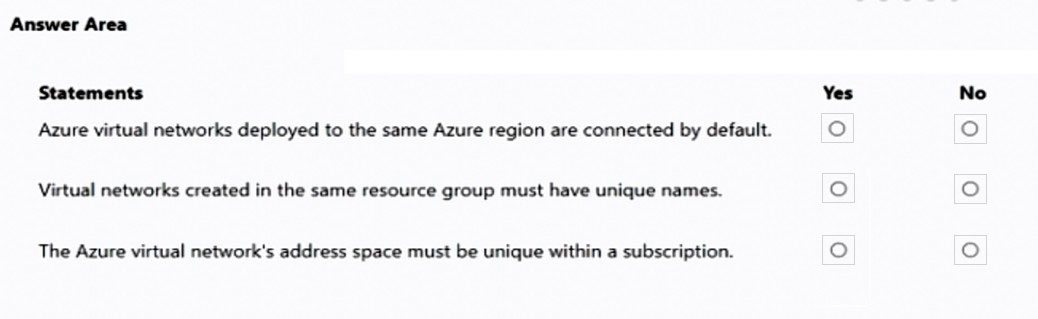
For each of the following statements, select Yes if the statement is true. Otherwise, select No.
NOTE: Each correct selection is worth one point.
Hot Area:
Show Answer
Correct Answer: No
Yes
No
Explanation: VNets in the same region are not connected by default. VNet names must be unique within a resource group. Address spaces do not have to be unique within a subscription; overlapping spaces are allowed but limit connectivity such as peering.
Question 111
HOTSPOT -
Select the answer that correctly completes the sentence.
Hot Area:
Show Answer
Correct Answer: Microsoft Online Services Privacy Statement
Explanation: The privacy statement describes what data Microsoft processes, how it processes that data, and the purposes for processing it.
$19
Get all 428 questions with detailed answers and explanations
Instant download HTML + PDF delivered the moment payment clears.
Secure Stripe checkout we never see or store your card details.
7-day refund if files are defective see our refund policy.