This is the free Microsoft AB-731 practice question bank —
50 of 99 total questions, each with a full explanation, free to
read with no signup required. Updated 2026-10-03.
Every answer is verified against official Microsoft documentation —
see our methodology.
Question 1
What is a key feature of Microsoft 365 Copilot that aligns with the Microsoft responsible AI principles of transparency, reliability, and safety?
A. Automatically approves AI-generated content for company-wide publishing.
B. Removes the need for a human to review AI-generated outputs.
C. Provides grounded, verifiable responses based on organizational data.
D. Enables users to select from an authorized catalog of AI models.
Show Answer
Correct Answer: C
Explanation: Microsoft 365 Copilot grounds responses in organizational data and provides citations/references where applicable, supporting transparency, reliability, and safety by enabling users to verify AI-generated content. The other options incorrectly imply autonomous approval, removal of human oversight, or describe a different capability rather than a core responsible AI feature.
Question 1
Your company has a Microsoft 365 subscription and uses Microsoft 365 Copilot Chat.
Some users need to build and use declarative agents that can access work data.
Which type of license should you recommend for the users?
A. a Microsoft 365 Copilot add-on license
B. Microsoft Copilot Studio user license
C. a Copilot Chat pay-as-you-go plan
Show Answer
Correct Answer: A
Explanation: Recommend a Microsoft 365 Copilot add-on license. It gives users the Microsoft 365 Copilot capabilities needed to build and use declarative agents grounded in work data. A Copilot Chat pay-as-you-go plan can meter agent usage, but it is not the recommended user license for these capabilities.
Question 2
HOTSPOT -
Select the answer that correctly completes the sentence.
Show Answer
Correct Answer: create a Microsoft Word document.
Explanation: Microsoft 365 Copilot can draft and edit documents in Word.
Question 2
Your company uses Microsoft 365 Copilot.
You identify several business processes that require custom workflows and specialized automation.
You need to recommend a solution that extends Copilot capabilities while minimizing development effort and costs.
What should you recommend?
A. Create an agent by using Microsoft Foundry.
B. Deploy a Copilot connector.
C. Build a custom agent by using the full experience of Microsoft Copilot Studio.
D. Build a declarative agent by using the lite experience of Microsoft Copilot Studio.
Show Answer
Correct Answer: D
Explanation: Declarative agents built with the lite experience of Microsoft Copilot Studio are intended to extend Microsoft 365 Copilot with custom business workflows while requiring minimal development effort and lower cost. The full experience is better suited for more complex, highly customized agents, Copilot connectors expose external data rather than implementing workflow automation, and Microsoft Foundry is not the recommended low-effort option for extending Microsoft 365 Copilot in this scenario.
Question 3
DRAG DROP
-
Match the Microsoft responsible AI principles to the appropriate descriptions.
To answer, drag the principle from the column on the left to its description on the right. Each principle may be used once, more than once, or not at all.
NOTE: Each correct match is worth one point.
Show Answer
Correct Answer: Privacy and security
Transparency
Inclusiveness
Accountability
Explanation: These map directly to Microsoft's Responsible AI principles: protecting data is Privacy and security; explaining decisions is Transparency; accessibility is Inclusiveness; and human oversight is Accountability.
Question 3
Your company plans to build a generative AI solution based on internal data.
You recommend using Microsoft Foundry as a starting point to develop and manage the solution.
What is a key benefit of using Microsoft Foundry for this project?
A. Provides a scalable platform for developing and deploying generative AI solutions.
B. Removes the need to select or configure the underlying AI model.
C. Enables business users to build generative AI solutions.
D. Offers a low-code platform for developing generative AI solutions.
Show Answer
Correct Answer: A
Explanation: Microsoft Foundry provides an integrated, scalable platform to develop, deploy, and manage generative AI solutions. It does not remove the need to choose an underlying model, and it is not primarily a business-user or low-code platform.
Question 4
HOTSPOT
-
For each of the following statements, select Yes if the statement is true. Otherwise, select No.
NOTE: Each correct selection is worth one point.
Show Answer
Correct Answer: Yes
No
Yes
Explanation: Copilot drafts professional emails and summarizes conversations. It assists with Excel but does not autonomously update spreadsheets without user action. It can summarize recent updates across Microsoft 365 documents, spreadsheets, and presentations using Microsoft Graph context.
Question 6
HOTSPOT
-
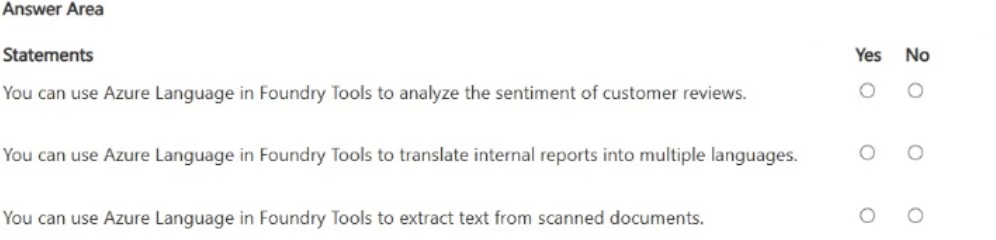
For each of the following statements, select Yes if the statement is true. Otherwise, select No.
NOTE: Each correct selection is worth one point.
Show Answer
Correct Answer: Yes
No
No
Explanation: Azure AI Language provides sentiment analysis. Text translation is handled by Azure AI Translator, and OCR/text extraction from scanned documents is provided by Azure AI Vision or Azure AI Document Intelligence, not Azure AI Language.
Question 7
HOTSPOT
-
Select the answer that correctly completes the sentence.
Show Answer
Correct Answer: data security
Explanation: The principle of least privilege enforces access control so Copilot can only access data the user is authorized to view, which is a data security control.
Question 8
Your company plans to use generative AI to help summarize and analyze internal business documents.
You need to recommend a solution to prevent generative AI from accessing confidential or classified information.
What should you include in the recommendation?
A. an information barrier (IB) policy
B. communication monitoring
C. a data retention policy
D. data governance
Show Answer
Correct Answer: D
Explanation: Data governance is the broad set of policies and controls used to classify, label, protect, and control access to organizational data. For generative AI, strong data governance ensures confidential or classified information is appropriately restricted and not available for AI grounding or retrieval by unauthorized users. The other options address specific compliance or communication scenarios but do not comprehensively prevent AI from accessing sensitive information.
$19
Get all 99 questions with detailed answers and explanations
Instant download HTML + PDF delivered the moment payment clears.
Secure Stripe checkout we never see or store your card details.
7-day refund if files are defective see our refund policy.