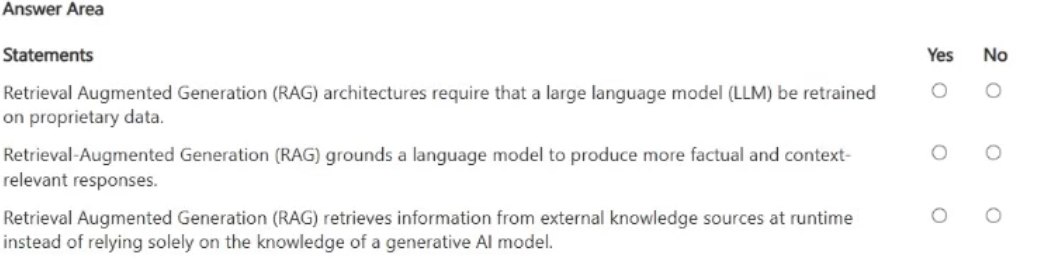
HOTSPOT
-
For each of the following statements, select Yes if the statement is true. Otherwise, select No.
NOTE: Each correct selection is worth one point.
Show Answer
Correct Answer: 1. No
2. Yes
3. Yes
Explanation: RAG does not require retraining the base LLM; it augments prompts with retrieved external knowledge at runtime, improving factuality and context relevance.
Question 40
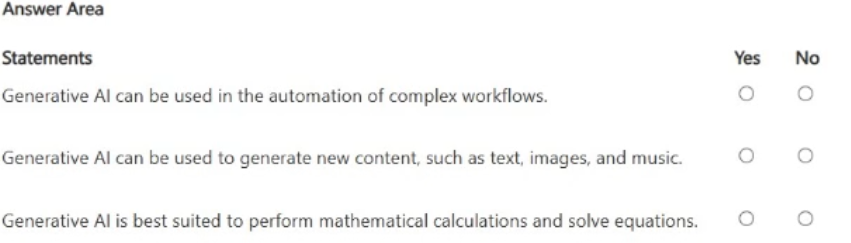
HOTSPOT
-
For each of the following statements, select Yes if the statement is true. Otherwise, select No.
NOTE: Each correct selection is worth one point.
Show Answer
Correct Answer: Yes
Yes
No
Explanation: Generative AI can help automate complex workflows and generate new content, but it is not the best tool for precise mathematical calculations or solving equations.
Question 41
Your company creates a custom Azure Machine Learning model that uses a generative AI assistant.
The model initially delivers strong results. However, six months later, the model predictions become noticeably less accurate.
What is a possible cause of the issue?
A. The model requires additional compute resources.
B. The input data changed over time.
C. The model was trained incorrectly.
Show Answer
Correct Answer: B
Explanation: A model that performs well initially but degrades over time commonly experiences data drift or concept drift, where the distribution or nature of input data changes from what the model was trained on. This reduces prediction accuracy even if the original training was correct. Additional compute resources do not inherently improve model accuracy, and incorrect training would typically affect performance from the outset rather than only after six months.
Question 42
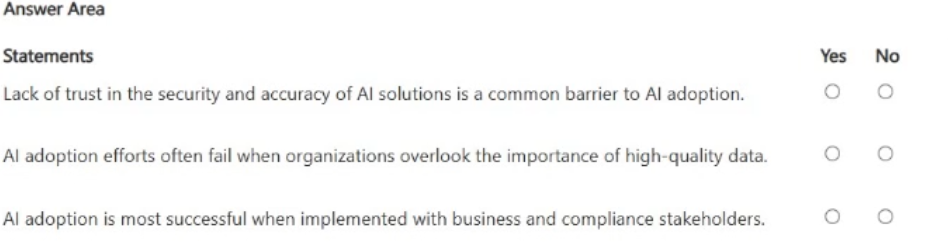
HOTSPOT
-
For each of the following statements, select Yes if the statement is true. Otherwise, select No.
NOTE: Each correct selection is worth one point.
Show Answer
Correct Answer: Yes
Yes
Yes
Explanation: All three statements reflect common AI adoption principles: trust in security/accuracy affects adoption, high-quality data is essential, and cross-functional involvement including business and compliance stakeholders improves success.
Question 43
Your company uses a fine-tuned generative AI solution trained on data that is representative of the general population.
You discover that some of the generated responses include inappropriate or exclusionary language based on ableist assumptions.
You need to prevent the inappropriate responses. Your solution must minimize costs.
What should you do?
A. Apply a newer version of the generative AI model.
B. Apply a content-moderation filter.
C. Create a new version of the solution that is trained on only inclusive and representative content.
D. Create a new version of the solution that is trained on only exclusionary content.
Show Answer
Correct Answer: B
Explanation: A content-moderation filter is the lowest-cost mitigation to prevent harmful, exclusionary, or ableist outputs from reaching users. Retraining or creating a new model is more expensive, and simply upgrading the model does not guarantee elimination of the issue.
Question 44
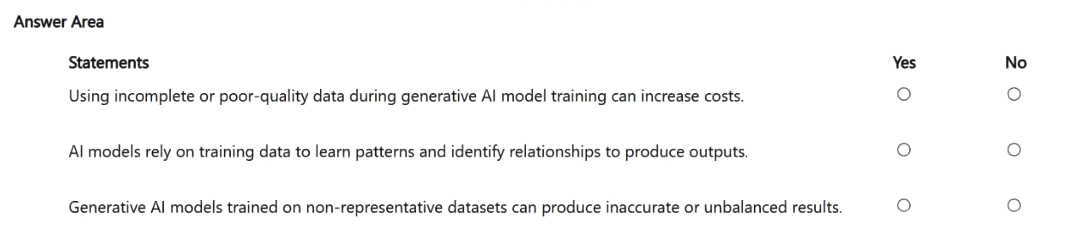
HOTSPOT -
For each of the following statements, select Yes if the statement is true. Otherwise, select No.
NOTE: Each correct selection is worth one point.
Show Answer
Correct Answer: Yes
Yes
Yes
Explanation: Poor-quality training data can increase development and retraining costs. AI models learn patterns and relationships from training data. Non-representative datasets can lead to biased, inaccurate, or unbalanced outputs.
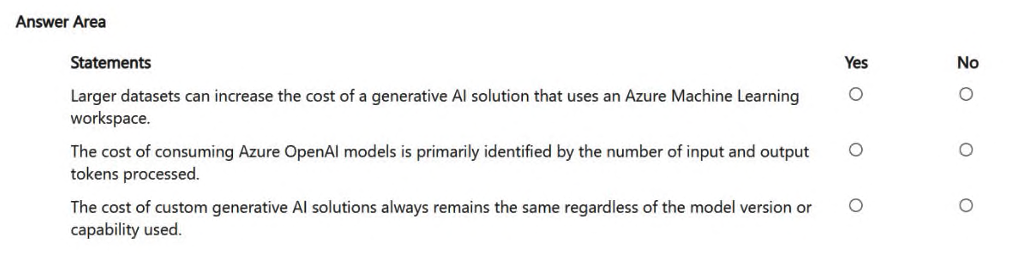
Question 45
HOTSPOT -
For each of the following statements, select Yes if the statement is true. Otherwise, select No.
NOTE: Each correct selection is worth one point.
Show Answer
Correct Answer: Yes
Yes
No
Explanation: Larger datasets generally increase storage and compute costs in Azure Machine Learning. Azure OpenAI usage is primarily billed by input/output tokens. Custom generative AI solution costs vary by model, version, deployment, and capability.
Question 46
Your company is developing an AI-powered customer support agent.
You need to ensure that the solution follows Microsoft responsible AI principles.
Which two actions should you perform? Select the two BEST answers. Each correct answer presents part of the solution.
NOTE: Each correct selection is worth one point.
A. Retain all customer conversations.
B. Test the agent to ensure that responses are inclusive and culturally sensitive.
C. Enable the agent to operate independently.
D. Ensure that the agent can be used for multiple purposes.
E. Provide a clear disclaimer that users are interacting with an AI solution.
Show Answer
Correct Answer: B, E
Explanation: Microsoft Responsible AI principles include fairness/inclusiveness and transparency. Testing the agent for inclusive and culturally sensitive responses supports fairness and inclusiveness. Clearly informing users that they are interacting with an AI system supports transparency. Retaining all conversations is not required and may conflict with privacy principles, independent operation reduces appropriate human oversight, and multipurpose use is unrelated to responsible AI principles.
Question 47
What is considered a best practice when forming an AI adoption team in an enterprise environment?
A. Include primarily IT and project management staff initially to streamline deployment, adding governance and compliance roles later.
B. Include procurement and vendor management specialists early to evaluate AI tools, involving business teams once a platform is selected.
C. Include representatives from legal, leadership, and business units to align AI initiatives with organizational priorities.
D. Include only data scientists and engineers at first to validate technical feasibility, then add other stakeholders later.
Show Answer
Correct Answer: C
Explanation: Enterprise AI adoption is most effective with a cross-functional team from the outset. Including legal, executive leadership, and business unit representatives helps align AI initiatives with organizational strategy, governance, compliance, risk management, and business value, rather than focusing only on technical deployment.
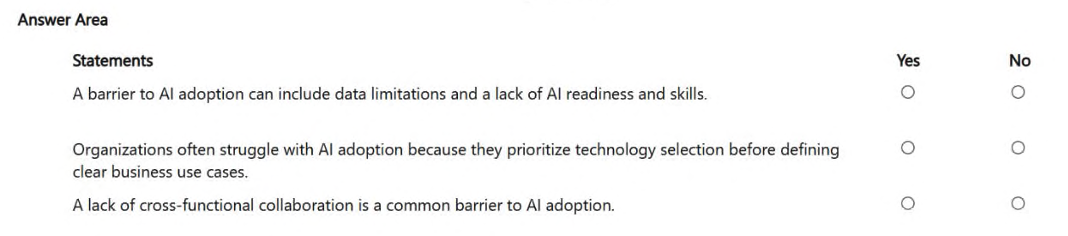
Question 48
HOTSPOT -
For each of the following statements, select Yes if the statement is true. Otherwise, select No.
NOTE: Each correct selection is worth one point.
Show Answer
Correct Answer: Yes
Yes
Yes
Explanation: All three statements describe widely recognized barriers to successful AI adoption: data and skills gaps, selecting technology before defining business use cases, and insufficient cross-functional collaboration.
$19
Get all 99 questions with detailed answers and explanations
Instant download HTML + PDF delivered the moment payment clears.
Secure Stripe checkout we never see or store your card details.
7-day refund if files are defective see our refund policy.